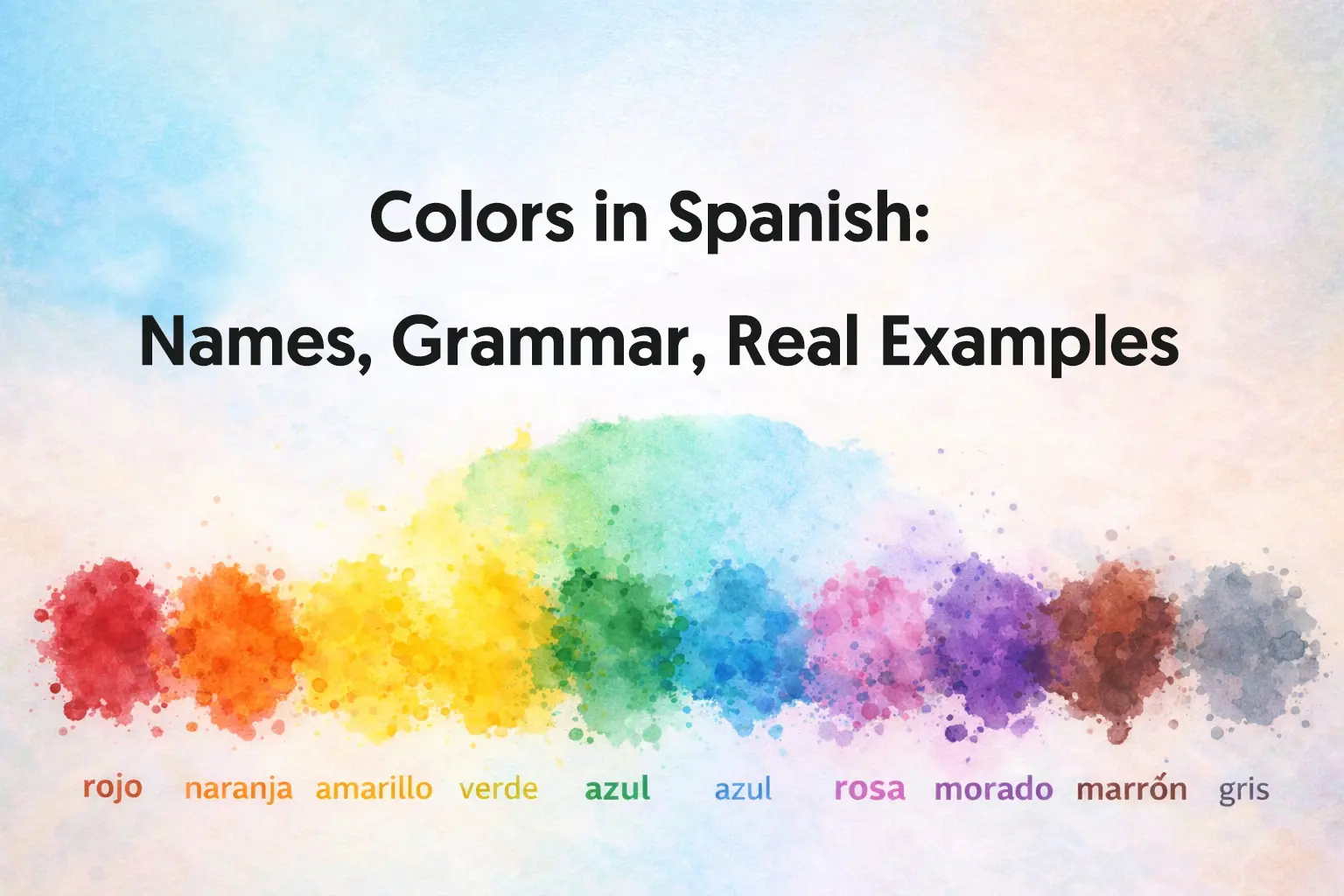
Colors are one of the quickest “real life” wins in Spanish. You use them when you shop, describe clothes, talk about your car, or explain what you see (“the red one,” “a black bag,” “green shoes”).
The main trick isn’t memorizing the list. It’s learning how colors behave as adjectives (agreement) and practicing them in short phrases you can actually say.
TL;DR
- Most colors work like adjectives: they change for gender + number (rojo/roja/rojos/rojas).
- Some color words that come from things (like naranja, rosa) may stay unchanged in plural (camisas naranja), but plural forms (camisas naranjas) are also common.
- Colors usually go after the noun: una camisa roja.
- Learn colors inside phrases: Quiero el azul, La camisa roja, ¿Tienes uno negro?
- Practice with 10 items around you daily (phone, bag, shoes, room objects).
Spanish colors list (the core set)
These cover most daily situations.
| English | Spanish |
|---|---|
| red | rojo / roja |
| blue | azul |
| green | verde |
| yellow | amarillo |
| black | negro / negra |
| white | blanco / blanca |
| orange | naranja |
| pink | rosa |
| purple | morado / morada / violeta |
| brown | marrón |
| gray | gris |
| gold | dorado / dorada |
| silver | plateado / plateada |
The most important rule: color agreement
Most colors act like normal adjectives in Spanish, so they match the noun.
Gender
- el coche rojo (the red car)
- la casa roja (the red house)
Plural
- los coches rojos
- las casas rojas
Position (easy rule)
Colors usually come after the noun:
- una camiseta blanca (a white T-shirt)
The “special case” colors: naranja, rosa (and sometimes violeta)
Some color words originally come from things (fruit, flowers, substances). In real Spanish, you’ll often see two common patterns:
- Used as a color label (often unchanged):
- camisas naranja
- ojos violeta
- Used as a normal adjective (agrees like others):
- camisas naranjas
- ojos violetas
Learner tip: pick one style and stay consistent. If you want the simplest beginner habit, use the “normal adjective” pattern (naranjas, rosas, violetas) unless you’re copying a phrase you’ve heard often.
Super useful phrases you’ll actually say
Shopping
- ¿De qué color? = What color?
- ¿Lo tienes en azul? = Do you have it in blue?
- Quiero el rojo. = I want the red one.
- ¿Tienes uno negro? = Do you have a black one?
Describing clothes
- Una camiseta blanca. = A white T-shirt.
- Pantalones negros. = Black pants.
- Zapatos marrones. = Brown shoes.
Describing people/things (simple)
- El coche es gris. = The car is gray.
- La mochila es verde. = The backpack is green.
Light, dark, and “kind of” (how Spanish really sounds)
This is where you start sounding natural fast.
| Spanish | Meaning | Example |
|---|---|---|
| claro / clara | light | azul claro |
| oscuro / oscura | dark | verde oscuro |
| muy | very | muy oscuro |
| un poco | a little | un poco claro |
| tirando a… | leaning toward… | tirando a rojo |
Examples:
- Una falda azul claro. = A light-blue skirt.
- Una chaqueta verde oscuro. = A dark-green jacket.
FAQ — Spanish colors
Do colors always change in Spanish?
Most do (rojo/roja/rojos/rojas). Some color words are commonly used either unchanged or with normal plural endings (like naranja/rosa). Both patterns appear in real usage.
Is marrón always the word for brown?
marrón is very common. In some regions you’ll also hear café for “brown.”
What’s the fastest way to memorize colors?
Don’t memorize a list. Use a “daily objects” routine: pick 10 objects you see every day and describe them with full phrases.
References
- For official meanings and standard usage of common color words (like rojo, azul, verde), you can check the Real Academia Española dictionary (DLE), for example: RAE DLE entry for “rojo”
- For a learner-friendly explanation of how some Spanish color adjectives can be used as invariable labels or as agreeing adjectives, see: UDEP Castellano Actual: “Adjetivos de color”