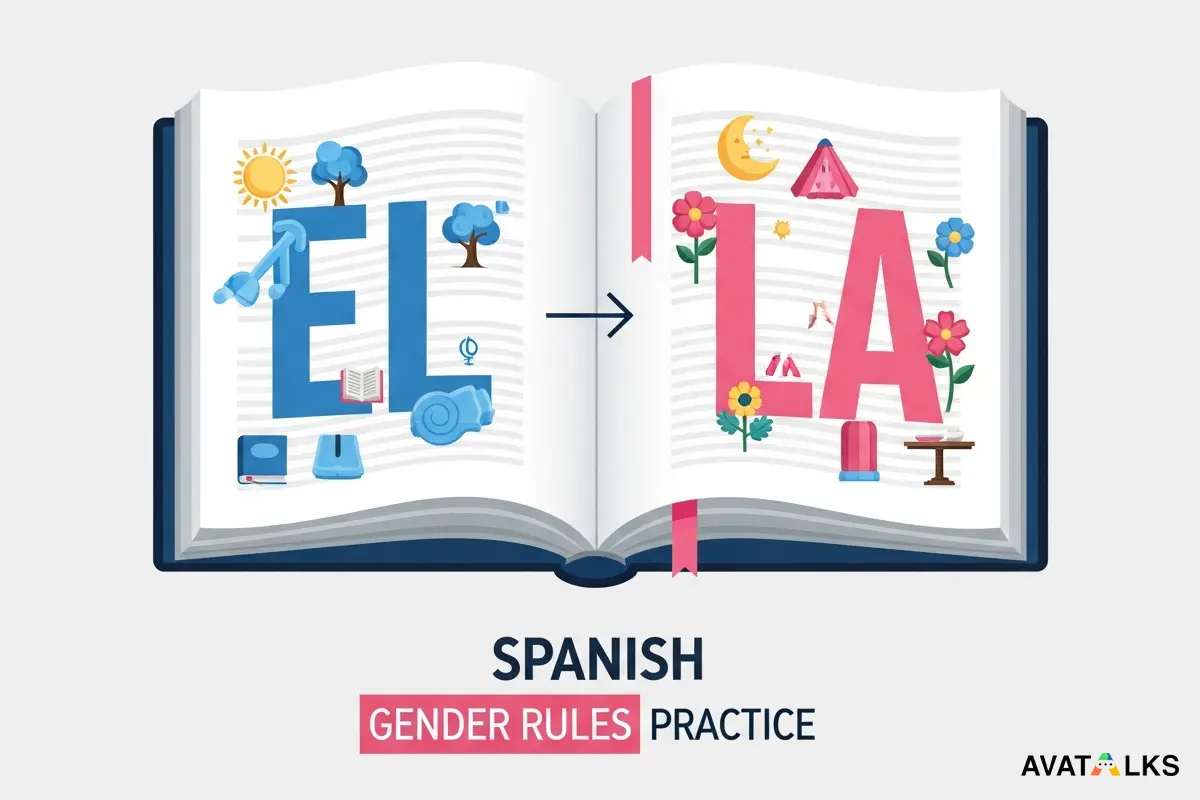
TL;DR — Spanish Gender Rules Practice
- Every Spanish noun is masculine or feminine
- Endings help, but they are not perfect rules
- Articles and adjectives must agree with noun gender
- Some nouns break the patterns and must be memorized
- The fastest improvement comes from targeted practice with context
- Learning the gender of nouns is the key to correct el/la and adjective agreement
Spanish Gender Rules Practice — Quick Answer
This Spanish gender rules practice trains you to recognize the gender of nouns (masculine vs feminine) so your articles and adjectives agree correctly.
Most nouns follow predictable patterns like -o (masculine) and -a (feminine), but common exceptions mean learners must practice recognition, not memorization alone.
This skill improves accuracy, clarity, and natural-sounding Spanish.
What Does “Gender” Mean in Spanish Grammar?
In Spanish, grammatical gender is a classification system, not a statement about biology.
In other words, Spanish is always tracking the gender of nouns, even when the noun is an object or an idea.

What is the gender of nouns in Spanish?
The gender of nouns in Spanish is grammatical (masculine or feminine), and it controls agreement with articles and adjectives.
Every noun — people, objects, ideas — is either:
- Masculine
- Feminine
This gender affects:
- Articles (el / la, un / una)
- Adjectives (alto / alta)
- Some pronouns
Example:
- El libro rojo (the red book)
- La mesa roja (the red table)
Even inanimate objects follow gender rules.
Spanish Gender Rules Practice Exercises
Choose the correct article based on gender and context.
👇 Do more Spanish Gender Rules Practices on Avatalks:
Understand noun genders (masculine, feminine) and their endings.
What Are the Core Spanish Gender Rules?
The most reliable Spanish gender rules are based on noun endings — but only as tendencies, not guarantees.
Most Common Patterns
| Ending | Typical Gender | Examples |
|---|---|---|
| -o | Masculine | el libro, el perro |
| -a | Feminine | la casa, la mesa |
| -ción / -sión | Feminine | la nación, la decisión |
| -dad / -tad | Feminine | la ciudad, la libertad |
| -ma (Greek origin) | Masculine | el problema, el sistema |
These patterns explain most nouns, but not all.
Why Do Learners Struggle With Spanish Gender Rules?
Because learners are taught rules before they see real usage.
Common problems include:
- Over-trusting -o / -a
- Forgetting article agreement
- Guessing instead of checking patterns
- Translating directly from English
This is why spanish gender rules practice must involve articles and adjectives, not isolated nouns.
How Do Articles Reveal Noun Gender?
Articles are the clearest signal of gender in real Spanish.
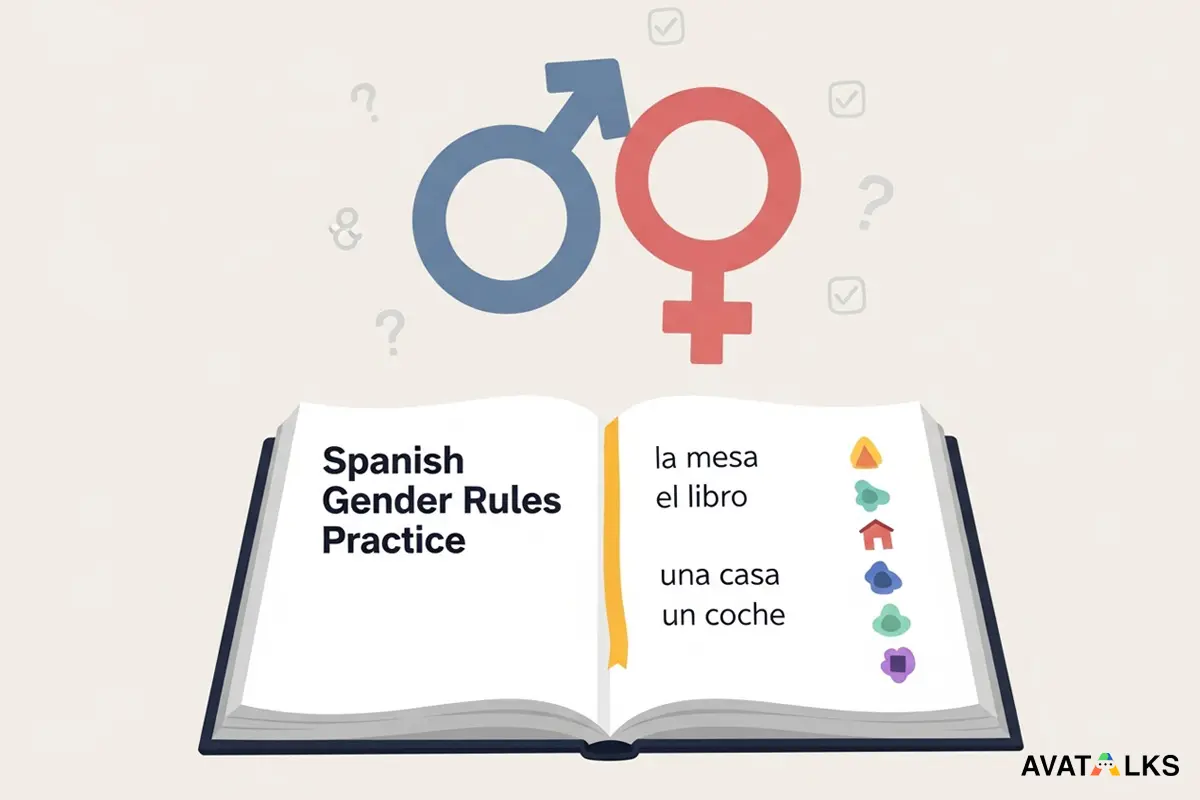
Definite Articles
| Gender | Singular | Plural |
|---|---|---|
| Masculine | el | los |
| Feminine | la | las |
Examples:
- el coche / los coches
- la puerta / las puertas
Indefinite Articles
| Gender | Singular | Plural |
|---|---|---|
| Masculine | un | unos |
| Feminine | una | unas |
When unsure, check the article first — native speakers rely on it instinctively.
What Are Common Exceptions You Must Learn?
Some of the most frequent Spanish nouns do not follow the standard endings.
Feminine Nouns Ending in -o
- la mano
- la foto (short for fotografía)
- la radio
Masculine Nouns Ending in -a
- el día
- el mapa
- el planeta
Nouns That Change Meaning by Gender
| Masculine | Feminine |
|---|---|
| el capital (money) | la capital (city) |
| el papa (pope) | la papa (potato) |
These must be learned through exposure and practice, not rules alone.
How Does Gender Affect Adjectives?
Adjectives must match the gender and number of the noun they describe.
Examples:
- el coche nuevo
- la casa nueva
- los libros nuevos
- las mesas nuevas
If the noun gender is wrong, everything else collapses grammatically.
How Should You Practice Spanish Gender Long-Term?
Effective strategies:
- Always learn nouns with their article
- Group exceptions by pattern (-ma, -ción, etc.)
- Read aloud to reinforce agreement
- Practice correcting full sentences, not single words
This builds intuition faster than memorization.
FAQ
How do I know if a Spanish noun is masculine or feminine?
Most Spanish nouns follow predictable endings, such as -o for masculine and -a for feminine, but common exceptions exist. The most reliable method is to learn each noun together with its article (el or la).
Are Spanish gender rules consistent?
Spanish gender rules are mostly consistent but not absolute. While many nouns follow common patterns, high-frequency exceptions like el problema or la mano must be learned through repeated exposure and practice.
Why does Spanish have grammatical gender?
Spanish inherited grammatical gender from Latin. Gender helps structure agreement between nouns, articles, and adjectives, making sentence relationships clearer even when word order changes.
Do adjectives change based on gender in Spanish?
Yes. Spanish adjectives must agree with the gender and number of the noun they describe. Incorrect gender causes agreement errors throughout the sentence.
Is there a neutral gender in Spanish?
Spanish has no true neutral noun gender. However, “lo” is used to refer to abstract ideas or qualities, not physical nouns (e.g., lo importante).
What is the fastest way to improve Spanish gender accuracy?
The fastest improvement comes from spanish gender rules practice using full sentences, not isolated words. Always practice nouns together with articles and adjectives in real contexts.
Final Takeaway
Spanish gender rules practice is not about memorizing lists — it is about mastering the gender of nouns, recognizing patterns, and practicing agreement in context.