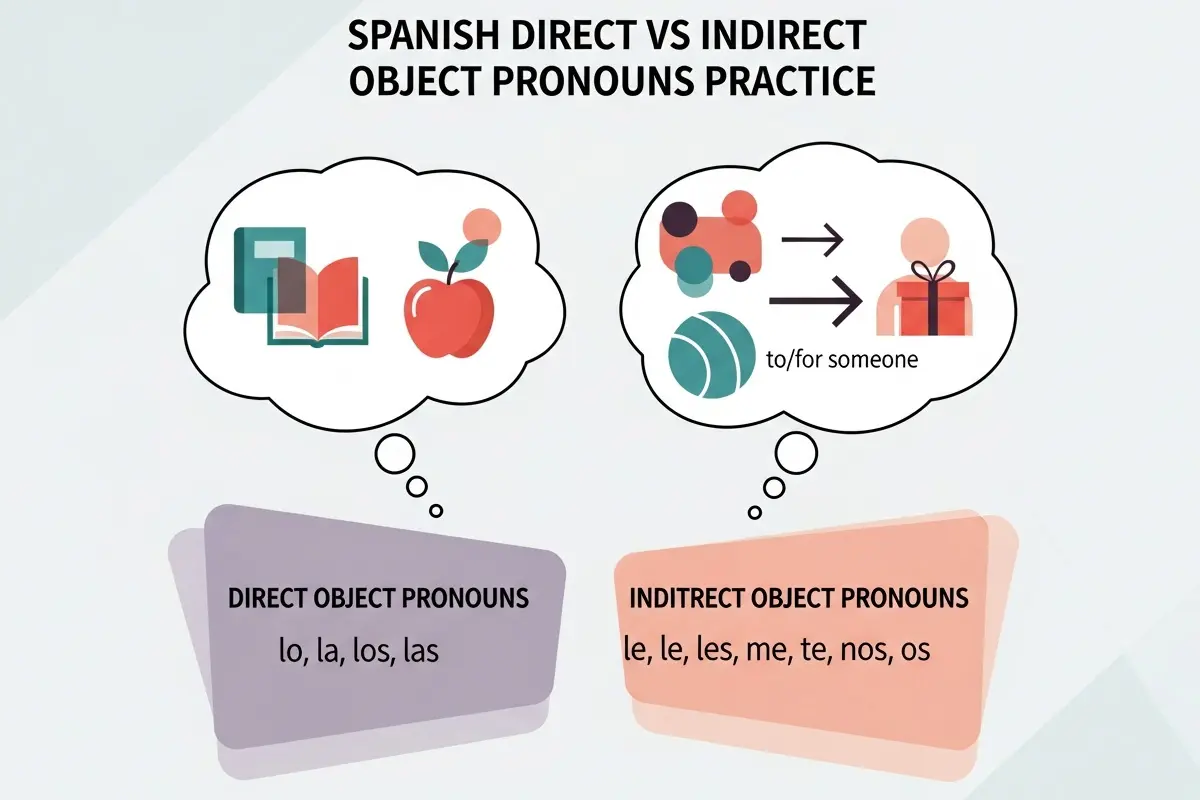
A lot of learners feel fine with Spanish until they hit sentences like:
- Se lo doy
- Te la explico
- Nos los mandan
Then everything suddenly feels less clear.
The problem is usually not the pronouns themselves.
It is that learners try to translate them word for word instead of asking two simple questions:
- who receives the action?
- what receives the action?
That is why this topic gets easier with practice much faster than with theory alone.
If you can learn to identify who and what, Spanish direct and indirect object pronouns stop feeling random and start feeling mechanical.
TL;DR
Here is the core idea:
- direct object pronouns replace what or whom directly receives the action
- indirect object pronouns replace to whom or for whom the action is done
- when both appear together, indirect comes first
- le and les change to se before lo, la, los, las
- the fastest way to improve is with sentence-based practice
If you want the shortest rule:
- who? = indirect
- what? = direct
Spanish Direct vs Indirect Object Pronouns Practice: Quick Answer
The difference is simple once you stop looking at the sentence as one big block.
Direct object pronouns
These replace the thing directly affected by the verb.
Examples:
- lo
- la
- los
- las
Indirect object pronouns
These show who receives, benefits from, or is affected by the action.
Examples:
- me
- te
- le
- nos
- les
When both appear together
The order is:
indirect + direct
So:
- Se lo doy not
- Lo se doy
If you want the bigger picture first, keep this nearby too: Spanish pronoun chart.
Spanish Direct vs Indirect Object Pronouns Practice: Try It Yourself
Choose the correct pronoun combination based on meaning.
👇 Do more Spanish object pronoun practice on Avatalks:
Practice direct and indirect object pronouns such as lo, la, le, and se.
What are direct object pronouns in Spanish?
Direct object pronouns replace the thing that directly receives the action of the verb.
Direct object pronouns
| Pronoun | Meaning |
|---|---|
| lo | him / it (masculine) |
| la | her / it (feminine) |
| los | them (masculine or mixed) |
| las | them (feminine) |
Example
- Compro el libro.
- Lo compro.
Here, el libro is what receives the action.
That makes it the direct object.
A useful beginner question is:
What am I buying?
Answer: the book
So:
- el libro → lo
Another example
- Veo la película.
- La veo.
Again, ask:
What do I see?
Answer: the movie
That is why la is the direct object pronoun here.
What are indirect object pronouns in Spanish?
Indirect object pronouns show who receives or benefits from the action.
Indirect object pronouns
| Pronoun | Meaning |
|---|---|
| me | to/for me |
| te | to/for you |
| le | to/for him, her, usted |
| nos | to/for us |
| les | to/for them, ustedes |
Example
- Doy el libro a Ana.
- Le doy el libro.
Ask:
To whom do I give the book?
Answer: to Ana
That is why Ana becomes le.
Another example
- Escribo una carta a mis padres.
- Les escribo una carta.
Ask:
To whom do I write the letter?
Answer: to my parents
That gives you les.
The key difference: direct vs indirect
This is the part learners need to slow down and get right.
Direct object
The thing directly affected by the action.
Indirect object
The person who receives, benefits from, or is affected by that thing.
Example
- Doy el regalo a mi madre.
Ask:
- What do I give? → el regalo = direct object
- To whom do I give it? → a mi madre = indirect object
With pronouns:
- Se lo doy.
That one sentence contains both ideas:
- se = to her
- lo = it
If Spanish word order still feels confusing, Spanish sentence structure: a clear beginner guide helps a lot.
When both pronouns appear together
This is where many learners panic, but the rule itself is simple.
When both object pronouns appear in one sentence:
- indirect comes first
- direct comes second
So the order is:
indirect + direct
Examples
- Me lo das.
- Te la explico.
- Nos los mandan.
Never reverse them.
Wrong:
- Lo me das
Correct:
- Me lo das
This order stays the same whether the pronouns go before the verb or attach to the end.
Why does le change to se?
This is one of the most famous rules in Spanish pronouns.
When le or les appears before:
- lo
- la
- los
- las
it changes to se.
So:
- le lo → se lo
- les la → se la
- les los → se los
Example
- Doy el libro a Juan.
- Le doy el libro.
- Lo doy a Juan.
- Se lo doy.
Spanish does this because forms like le lo sound awkward.
Important:
In this pattern, se is not reflexive.
It is still standing in for le or les.
Where do object pronouns go?
Spanish object pronouns have a few common positions, but the order rule stays the same.
1. Before a conjugated verb
This is the most common pattern.
Examples
- Se lo doy.
- Te la mando.
- Nos los explican.
2. Attached to an infinitive
Examples
- Voy a dártelo.
- Quiero explicártela.
- Necesito mandárselos.
3. Attached to a gerund
Examples
- Estoy explicándotelo.
- Sigue dándomela.
4. Attached to an affirmative command
Examples
- Dímelo.
- Mándaselo.
- Explícamela.
So the position can change, but the internal order does not:
indirect + direct
If you are also practicing pronoun placement more generally, Spanish pronoun placement practice pairs well with this topic.
A simple method to choose the right pronouns
When a sentence feels confusing, do not guess.
Use this 3-step method.
Step 1: Find the verb
What action is happening?
Example:
- Ella da el libro a Pedro.
Verb:
- da
Step 2: Ask “what?”
What is being given?
Answer:
- el libro
That is the direct object.
Step 3: Ask “to whom?”
To whom is the book given?
Answer:
- a Pedro
That is the indirect object.
Now replace both:
- a Pedro → le
- el libro → lo
- le lo becomes se lo
Final answer:
- Ella se lo da.
This is the fastest way to stop mixing them up.
Common mistakes learners make
1. Translating from English word by word
English and Spanish do not organize object pronouns the same way.
That is why direct translation often causes mistakes.
2. Forgetting that indirect comes first
This is probably the most common word-order mistake.
Wrong:
- lo me
- la te
Correct:
- me lo
- te la
3. Forgetting the le → se rule
Wrong:
- le lo doy
Correct:
- se lo doy
4. Choosing lo/la based on the person
Direct object pronouns agree with the noun you replace, not with the person doing the action.
- el libro → lo
- la carta → la
5. Trying to memorize everything without sentence practice
This topic usually improves through repeated sentence work, not by staring at a pronoun chart alone.
More examples with direct and indirect object pronouns
Direct only
- Compro la camisa. → La compro.
- Vemos a Juan. → Lo vemos.
Indirect only
- Escribo a mi amiga. → Le escribo.
- Te doy un consejo. → Te doy un consejo.
Both together
- Doy la carta a Ana. → Se la doy.
- Mando los documentos a ellos. → Se los mando.
- Explico la lección a ti. → Te la explico.
These are the types of sentences you want to get comfortable with, because this is how object pronouns actually appear in real Spanish.
FAQ
What is the difference between direct and indirect object pronouns in Spanish?
Direct object pronouns replace what directly receives the action, while indirect object pronouns show who receives or benefits from that action.
Why does le change to se?
Le and les change to se before lo, la, los, las to avoid awkward combinations like le lo.
Which pronoun comes first in Spanish?
The indirect object pronoun comes first, followed by the direct object pronoun.
Can both object pronouns appear in one sentence?
Yes. This is very common in natural Spanish.
What is the best way to practice Spanish object pronouns?
The best way is sentence-based practice where you identify:
- who receives the action
- what receives the action
- and then replace them step by step
Final Thoughts
Spanish direct and indirect object pronouns look harder than they really are.
What makes them feel confusing is that learners often try to memorize forms before understanding function.
But once you learn to ask:
- what?
- to whom?
the whole system gets much more manageable.
Then it becomes a pattern problem, not a mystery problem.
And that is why Spanish direct vs indirect object pronouns practice works best with lots of short real sentences.
That is what turns the rule into instinct.