If Spanish gender still trips you up, you are not alone.
A lot of learners understand the basic idea:
- el vs la
- un vs una
- masculine vs feminine nouns
But then real Spanish gets messier:
- el problema
- la mano
- el mapa
- la foto
That is why this page focuses on Spanish gender rules practice, not just theory.
You will get:
- the core patterns
- the exceptions that matter most
- article and adjective agreement
- and a short exercise section to test what you know
TL;DR
- Every Spanish noun is masculine or feminine.
- Common endings help, but they are patterns, not guarantees.
- Articles and adjectives must agree with the noun:
- el libro rojo
- la mesa roja
- Some high-frequency nouns break the expected ending pattern:
- el problema
- la mano
- The fastest way to improve is to practice nouns with their article and an example phrase, not as isolated words.
What grammatical gender means in Spanish
In Spanish, grammatical gender is a property of nouns. The RAE explains that Spanish nouns are masculine or feminine, and that this gender affects agreement with determiners and adjectives. Spanish does not have a true neutral noun gender.
See: RAE – Definición de género
That means gender is not just about people.
It also applies to:
- objects
- places
- abstract ideas
Examples
- el libro rojo
- la mesa roja
- la ciudad antigua
- el sistema moderno

The most useful Spanish gender patterns
There are useful patterns, and beginners should learn them. But they should learn them as tendencies, not as perfect rules.
The Cervantes curriculum for A1–A2 learners lists patterns such as masculine nouns in -o, feminine nouns in -a, feminine nouns in -ción / -sión / -dad, and masculine nouns in -ma of Greek origin.
See: Centro Virtual Cervantes – A1–A2 grammar inventory
Common endings and what they usually mean
| Ending | Usual gender | Examples |
|---|---|---|
| -o | masculine | el libro, el perro |
| -a | feminine | la casa, la mesa |
| -ción / -sión | feminine | la nación, la decisión |
| -dad / -tad | feminine | la ciudad, la libertad |
| -ma (Greek origin) | masculine | el problema, el sistema |
A useful beginner rule is:
- -o often points to masculine
- -a often points to feminine
- -ción, -sión, -dad, -tad are very often feminine
- -ma can be masculine in many common academic or abstract nouns
Spanish gender rules practice exercises
Choose the correct article based on the noun and the sentence.
👇 Do more Spanish gender practice on Avatalks:
Understand noun genders, common endings, and agreement patterns.
Why learners still get gender wrong
A lot of mistakes happen because learners apply one rule too strongly.
Common problem 1: trusting endings too much
Yes, endings help. But they are not perfect.
Examples:
- el día
- el mapa
- el problema
- la mano
Common problem 2: learning nouns without articles
If you memorize only:
- mesa
- libro
- ciudad
you lose a big part of the information.
It is better to learn:
- la mesa
- el libro
- la ciudad
Common problem 3: forgetting adjective agreement
Many learners choose the right article, then forget the adjective has to match too.
Examples:
- la casa blanca
- el coche blanco
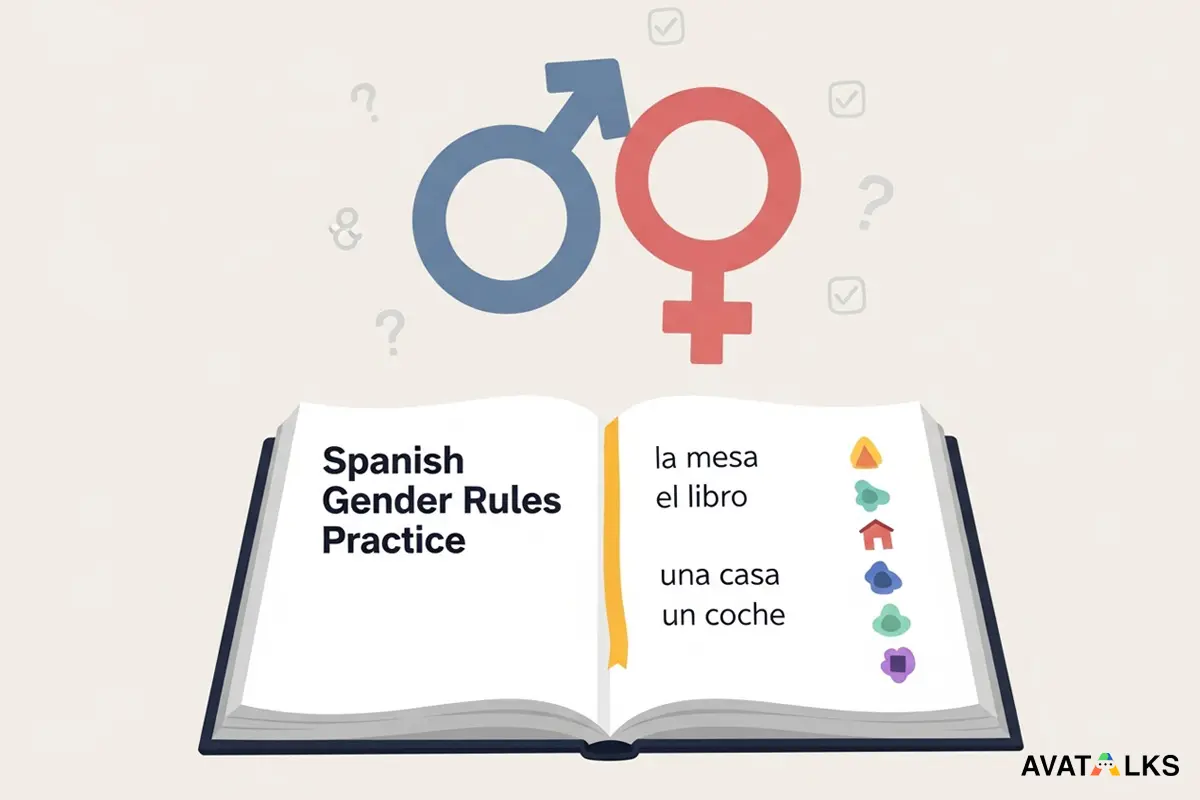
Articles are your best clue
In real Spanish, articles are often the clearest signal of noun gender.
Definite articles
| Gender | Singular | Plural |
|---|---|---|
| masculine | el | los |
| feminine | la | las |
Examples:
- el coche / los coches
- la puerta / las puertas
Indefinite articles
| Gender | Singular | Plural |
|---|---|---|
| masculine | un | unos |
| feminine | una | unas |
Examples:
- un libro
- una mesa
- unos amigos
- unas casas
When you are unsure, look at or learn the article first.
The exceptions worth memorizing early
Not all exceptions matter equally. Some are worth learning early because they appear often.
Feminine nouns that may look masculine
- la mano
- la foto
- la radio
- la moto
These are common and easy to meet in daily Spanish.
Masculine nouns that may look feminine
- el día
- el mapa
- el planeta
- el problema
- el sistema
These are also high-frequency words, so they are worth memorizing early.
How gender affects adjectives
Spanish adjectives usually agree with the noun in both gender and number.
Examples
- el coche rojo
- la casa roja
- los libros rojos
- las mesas rojas
If the noun gender is wrong, the whole phrase often becomes wrong too.
That is why Spanish gender is not just about choosing el or la. It affects the whole sentence.
A better way to practice Spanish gender
The fastest way to improve is not to memorize long noun lists.
A better method is:
Step 1
Learn the noun with the article:
- el libro
- la mesa
Step 2
Add one adjective:
- el libro interesante
- la mesa grande
Step 3
Read it aloud This helps you hear the agreement pattern.
Step 4
Review exceptions in small groups For example:
- el problema
- el sistema
- el mapa
- el planeta
This kind of grouped practice is usually easier than random memorization.
FAQ
How do I know if a Spanish noun is masculine or feminine?
Many Spanish nouns follow common endings, such as -o for masculine and -a for feminine, but there are important exceptions. The safest method is to learn each noun together with its article, such as el libro or la mesa.
Are Spanish gender rules consistent?
They are mostly consistent, but not absolute. Common endings help a lot, but frequent exceptions such as el problema and la mano still need practice and exposure.
Do adjectives change based on gender in Spanish?
Yes. Spanish adjectives usually agree with the gender and number of the noun they describe, such as el coche rojo and la casa roja.
Is there a neutral gender in Spanish?
Spanish does not have a true neutral noun gender. However, lo can be used with abstract ideas or qualities, as in lo importante.
What is the fastest way to improve Spanish gender accuracy?
Practice nouns with articles and adjectives in context, not as isolated words.
Final thoughts
Spanish gender gets easier when you stop treating it like a guessing game.
Start with the common patterns. Learn the important exceptions. Most importantly, practice nouns with their articles and agreement, not by themselves.
That is how gender starts to feel less like a rule you memorize and more like something you recognize automatically.