TL;DR
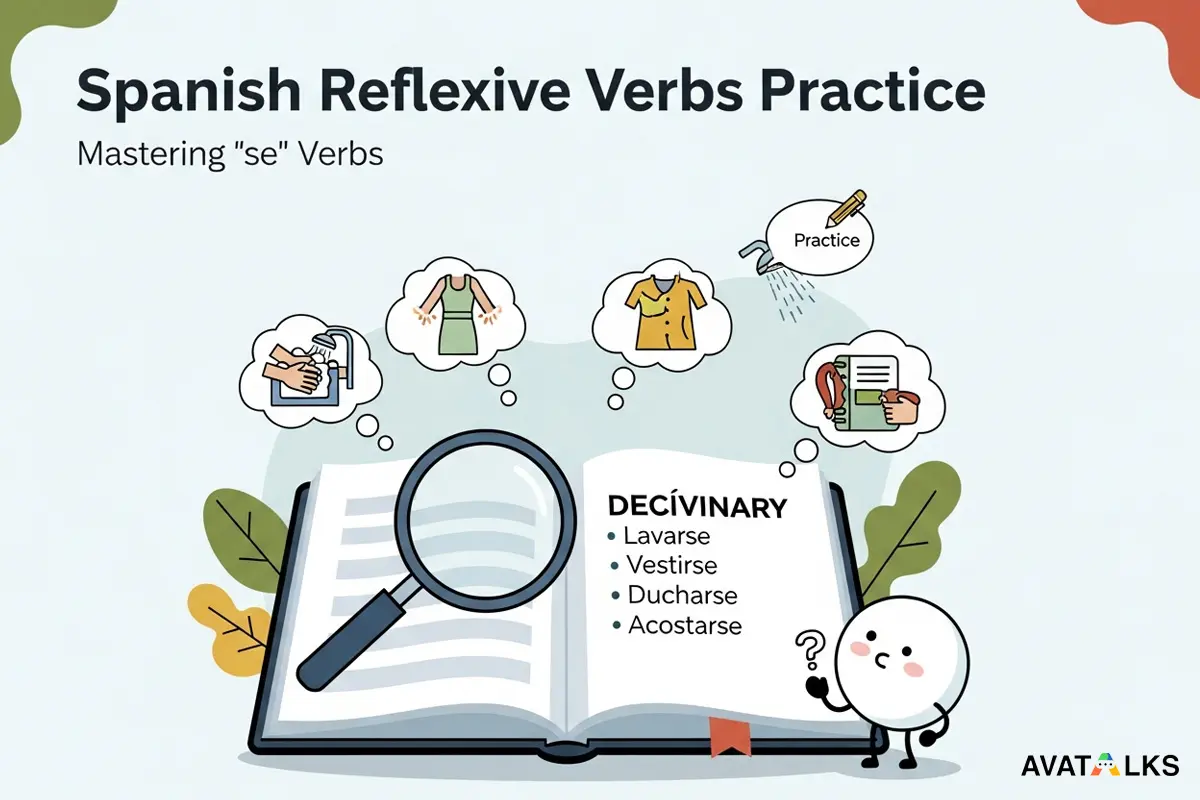
- Spanish reflexive verbs practice helps you express actions that affect the subject directly, using a reflexive pronoun (me, te, se, nos, os, se).
- Verbs like irse, ponerse, and sentirse often change meaning when used reflexively.
- The biggest challenge is not conjugation—it’s knowing when reflexive verbs are required.
- Practicing with full sentences and context builds accuracy faster than isolated drills.
- Mastery comes from repeated exposure + targeted exercises, not memorization alone.
Spanish Grammar Practice Hub
If you’re working through multiple grammar topics, our main Spanish grammar practice hub organizes exercises by topic so you can practice efficiently and build accuracy step by step.
Explore the practice hub →What is a reflexive verb in Spanish?
A reflexive verb is a verb that includes a reflexive pronoun showing that the subject and the object are the same person.
Quick definition:
A reflexive verb answers the question “Who is affected by the action?” → the subject.

| Subject | Reflexive Pronoun |
|---|---|
| yo | me |
| tú | te |
| él / ella / usted | se |
| nosotros | nos |
| vosotros | os |
| ellos / ustedes | se |
Key takeaway:
If removing the pronoun changes the meaning, the verb is functioning reflexively.
Why are reflexive verbs so common in Spanish?
Spanish uses reflexive verbs far more often than English, especially for:
- Daily routines
- Emotional states
- Physical changes
- Transitions (leaving, becoming, feeling)
English often avoids reflexives:
- “I feel tired”
- “I’m leaving”
Spanish requires them:
- Me siento cansado
- Me voy
This is why spanish reflexive verbs practice is essential for fluency.
What does irse mean in Spanish?
Short answer:
Irse means to leave, emphasizing departure from a place.
- Voy = I go
- Me voy = I’m leaving
Common examples
- Me voy de casa a las ocho.
- ¿Te vas ya?
- Se fueron sin decir nada.
Why it matters:
Without the reflexive pronoun, ir simply means “to go somewhere,” not “to leave.”
What does ponerse mean in Spanish?
Short answer:
Ponerse describes a change of state, not physical placement.

Common meanings
- Emotional: ponerse nervioso
- Physical: ponerse enfermo
- Situational: ponerse de moda
Examples:
- Me pongo nervioso antes de hablar.
- Se puso triste.
- Nos pusimos de acuerdo.
Key insight:
Poner = to place
Ponerse = to become
What does sentirse mean in Spanish?
Short answer:
Sentirse means to feel (emotionally or physically).
Examples:
- Me siento bien.
- ¿Cómo te sientes hoy?
- Se sienten preparados.
Why reflexive?
The feeling affects the subject directly, so Spanish requires a reflexive pronoun.
Reflexive verbs vs non-reflexive verbs
Many verbs exist in both forms, with different meanings.
| Verb | Non-reflexive | Reflexive |
|---|---|---|
| ir | to go | irse = to leave |
| poner | to place | ponerse = to become |
| sentir | to feel (emotion) | sentirse = to feel (state) |
| levantar | to lift | levantarse = to get up |
Takeaway:
Meaning changes → reflexive usage is not optional.
Where does the reflexive pronoun go?
Rule 1: Before a conjugated verb
- Me voy ahora.
- Se siente cansado.
Rule 2: Attached to infinitives or gerunds
- Voy a irme.
- Estoy sintiéndome mejor.
Rule 3: Attached to affirmative commands
- ¡Vete!
- ¡Siéntate!
Rule 4: Before negative commands
- No te vayas.
- No se sienta mal.
Spanish reflexive verbs practice: exercises
👇 Do more Spanish Reflexive Verbs Practices on Avatalks:
Use reflexive pronouns (me, te, se) for actions affecting the subject.
Common mistakes learners make
- Forgetting the reflexive pronoun
- Translating directly from English
- Mixing ir and irse
- Using poner instead of ponerse
Fix:
Always ask: Does this action affect the subject?
Conclusion
Spanish reflexive verbs practice is essential because reflexive verbs express how actions, emotions, and changes affect the subject directly.
Verbs like irse, ponerse, and sentirse appear constantly in real Spanish, and mastering them unlocks more natural sentence structure, clearer meaning, and better speaking confidence.
Consistent, contextual practice—not memorization—is what turns reflexive verbs into instinct.