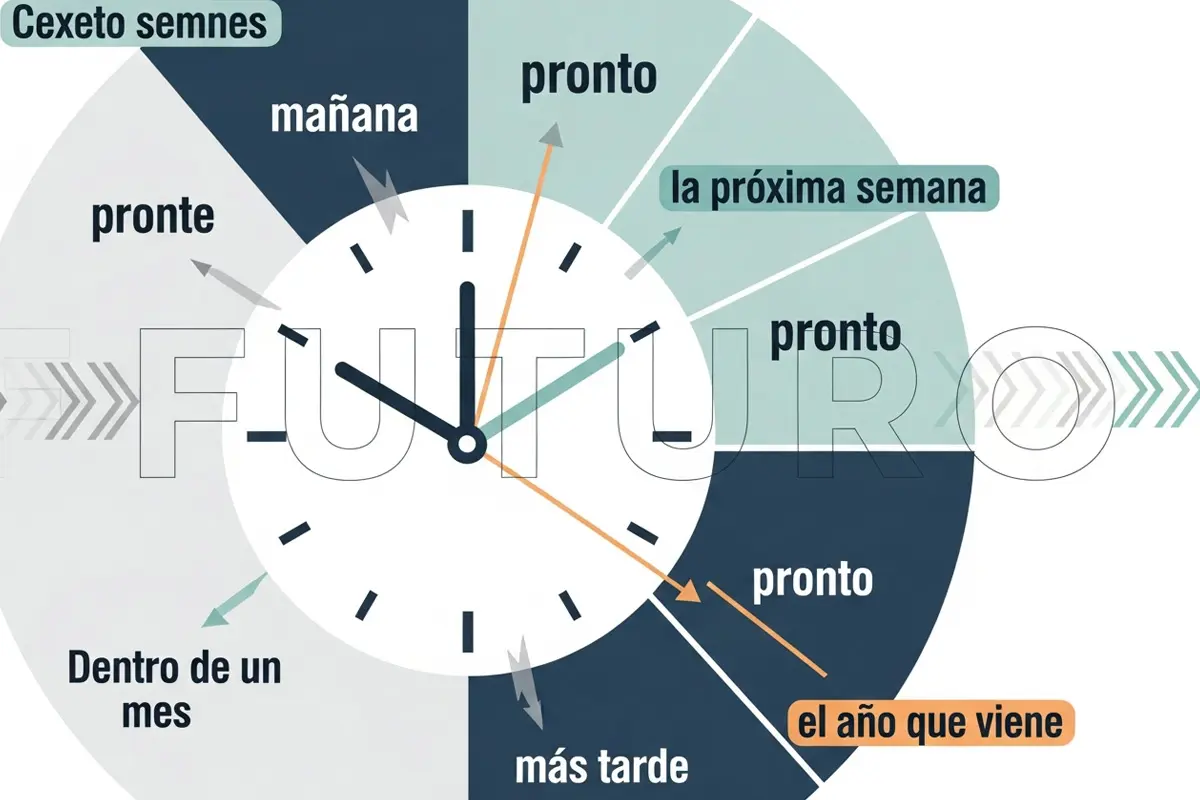
TL;DR
- Time expressions used with the Spanish future tense clarify when something will happen and often determine which tense Spanish prefers.
- Spanish frequently uses present tense + time expression instead of the future tense.
- The simple future tense is common with vague or uncertain time expressions.
- Choosing the right time expression improves clarity, tone, and naturalness, not just grammar.
Time Expressions Used With the Spanish Future Tense — Quick Answer
Time expressions used with the Spanish future tense help anchor future meaning and often decide whether Spanish uses the present tense, ir + a + infinitive, or the simple future tense.
Clear time markers like mañana, la semana que viene, or en unos años allow Spanish speakers to talk about the future naturally—sometimes without using the future tense at all.
Why Time Expressions Matter in Spanish Future Meaning
Spanish does not rely on verb tense alone to express time.
Instead, Spanish combines:
- verb tense, and
- time expressions
to communicate intention, certainty, and timing.
👉 Key takeaway: In Spanish, time expressions often carry more weight than the tense itself.
This is why learners who focus only on conjugation often sound unnatural.
What Are Time Expressions in Spanish?
❓ What counts as a time expression?
A time expression is any word or phrase that indicates when something happens.
Common examples include:
- mañana (tomorrow)
- esta noche (tonight)
- la semana que viene (next week)
- en dos horas (in two hours)
- algún día (someday)
These expressions shape how Spanish verbs behave.
Time Expressions That Commonly Trigger the Present Tense
❓ Why does Spanish use the present tense for future events?
Because a clear time expression already signals the future.
Spanish often prefers the present tense when the future event is:
- scheduled,
- planned,
- certain.
Examples:
- Mañana salgo temprano.
- El tren llega a las ocho.
- La reunión es esta tarde.
Even though these actions are future, the present tense sounds natural and confident.
👉 Takeaway: When timing is clear, Spanish avoids extra tense marking.
For comparison, see Future tense vs present tense in Spanish.
Common Near-Future Time Expressions
These expressions often pair with present tense or ir + a + infinitive.
| Time Expression | Meaning |
|---|---|
| mañana | tomorrow |
| esta noche | tonight |
| más tarde | later |
| ahora mismo | right now |
| dentro de poco | soon |
Examples:
- Mañana trabajo desde casa.
- Voy a salir más tarde.
- Dentro de poco empezamos.
👉 Key insight: Near-future expressions reduce the need for the future tense.
When Time Expressions Favor Ir + A + Infinitive
❓ When is ir + a most natural?
With near-future plans and intentions.
Typical combinations:
- mañana
- esta tarde
- en un momento
- ahora
Examples:
- Voy a llamar mañana.
- Vamos a comer en un momento.
- Voy a reservar el hotel ahora.
This structure feels:
- conversational,
- immediate,
- intentional.
👉 Takeaway: Ir + a signals action already decided.
Time Expressions That Pair Well With the Simple Future Tense
❓ When does the simple future sound best?
When the time expression is vague, distant, or uncertain.
Common examples:
- algún día (someday)
- en el futuro
- dentro de unos años
- pronto (soon, vague)
- más adelante
Examples:
- Algún día viajaré por América Latina.
- En el futuro cambiarán las cosas.
- Dentro de unos años viviré en España.
👉 Key takeaway: The future tense works best when timing is not fixed.
Using En vs Dentro De With Future Time
❓ What’s the difference between en and dentro de?
Both mean “in”, but usage differs slightly.
| Expression | Example | Meaning |
|---|---|---|
| en dos horas | Llego en dos horas. | arrival time |
| dentro de dos horas | Salgo dentro de dos horas. | time remaining |
Both work with:
- present tense,
- ir + a,
- future tense.
👉 Takeaway: These expressions anchor future meaning clearly.
Time Expressions With Days, Weeks, and Months
Spanish often adds que viene or próximo/a.
| Expression | Meaning |
|---|---|
| mañana | tomorrow |
| pasado mañana | day after tomorrow |
| la semana que viene | next week |
| el mes que viene | next month |
| el próximo año | next year |
Examples:
- La semana que viene empiezo el curso.
- El próximo año viajaremos más.
These frequently appear with:
- present tense,
- simple future.
Time Expressions and Irregular Verbs in the Future
❓ Do time expressions affect irregular verbs?
No — conjugation rules stay the same.
But time expressions influence tense choice, not verb form.
Examples:
- Mañana tendré tiempo.
- En unos años podré viajar más.
- Algún día haré ese viaje.
For conjugation rules, see Irregular future tense verbs in Spanish.
Time Expressions With the Verb Haber
The verb haber often appears with time expressions to express:
- predictions,
- assumptions,
- future completion.
Examples:
- Habrá mucha gente esta noche.
- Dentro de una hora habrá terminado.
- Para mañana, habremos salido.
👉 Key insight: Haber is common when time expressions involve results or completion.
Time Expressions and the Future Perfect Tense
❓ When do we use time expressions with the future perfect?
When an action will be completed before a future point.
Structure:
haber (future) + past participle
Examples:
- Para mañana, habré terminado.
- Cuando llegues, ya habremos comido.
- A esa hora, el vuelo habrá salido.
These expressions often include:
- para + time
- cuando
- antes de
Time Expressions That Do NOT Require the Future Tense
A common learner mistake is forcing the future tense.
❌ Unnatural:
- Mañana estudiaré a las ocho. (overly formal)
✅ Natural:
- Mañana estudio a las ocho.
👉 Takeaway: Spanish prefers economy, not extra marking.
Comparing Time Expression + Tense Choices
| Time Expression | Natural Tense |
|---|---|
| mañana | present / ir + a |
| esta noche | present |
| dentro de poco | ir + a |
| algún día | future |
| en el futuro | future |
| para mañana | future perfect |
Common Learner Mistakes With Time Expressions
❌ Translating directly from English
Spanish does not need “will” every time.
❌ Ignoring time markers
Without them, sentences feel vague.
❌ Overusing the future tense
This can sound stiff or distant.
👉 Fix: Let time expressions do the work.
FAQ
❓ Do time expressions replace the future tense?
Sometimes.
If the future meaning is clear, Spanish often uses the present tense instead.
❓ Are time expressions required with the future tense?
Not required, but highly common.
They make meaning clearer and more natural.
❓ Can one time expression work with multiple tenses?
Yes.
Spanish chooses tense based on certainty and intention, not the expression alone.
❓ Are time expressions tested on exams?
Yes.
DELE and AP Spanish test tense choice with time expressions, not just conjugation.
❓ Do native speakers think about these rules?
No.
They rely on context and habit, not grammar labels.
Final Takeaway
Time expressions used with the Spanish future tense often matter more than the tense itself.
Spanish speakers rely on time markers to communicate plans, certainty, and assumptions naturally—switching between the present tense, ir + a + infinitive, and the simple future with ease.
Once you stop translating directly from English and start letting time expressions guide tense choice, your Spanish becomes clearer, more natural, and far more confident.