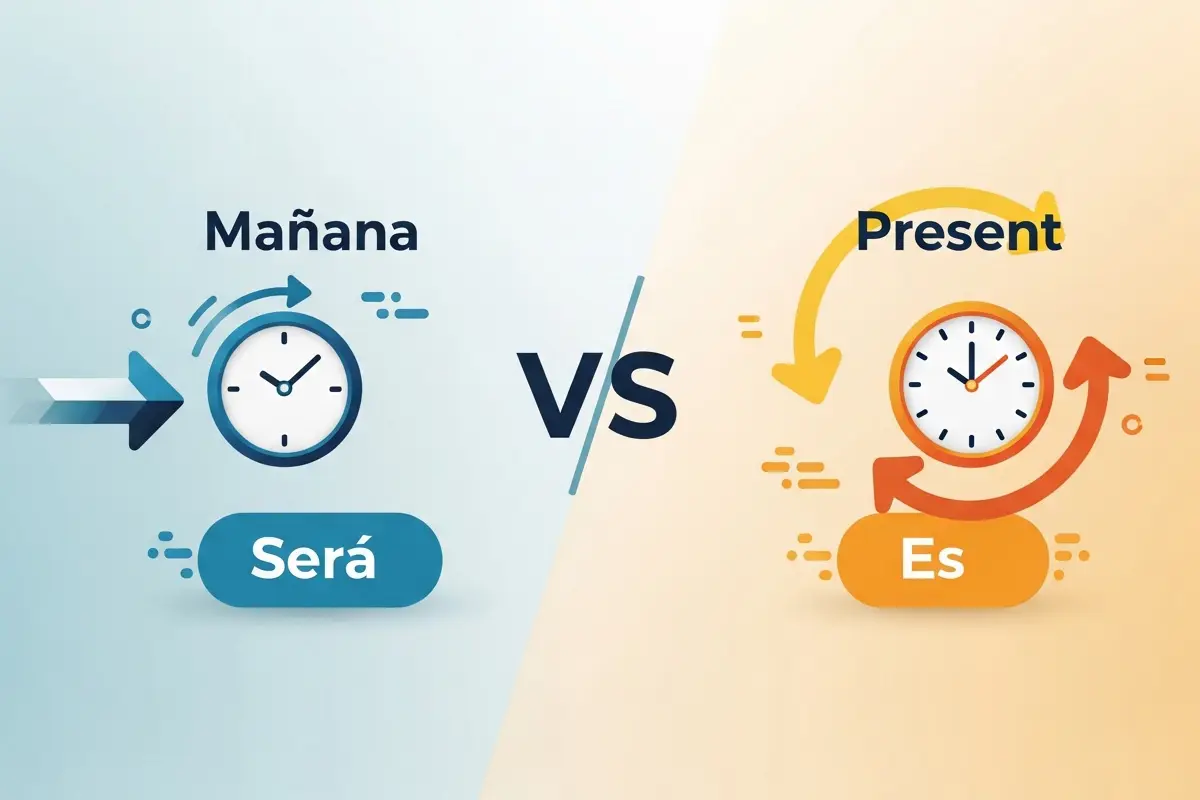
If you are confused about the future tense vs present tense in Spanish, you are not alone.
This is one of those topics that looks simple at first and then becomes strange very quickly.
In English, learners often expect a clean division:
- present tense for now
- future tense for later
But Spanish does not always work like that.
Spanish speakers often talk about the future using:
- the present tense
- ir + a + infinitive
- or the simple future
That is why beginners sometimes feel lost.
They learn:
- Mañana viajo
- Voy a viajar mañana
- Viajaré mañana
and then wonder:
Which one is actually correct?
The answer is: all three can be correct, but they do not feel exactly the same.
This guide explains the real difference in a practical way.
TL;DR
Spanish can use both the present tense and the future tense to talk about future time.
Use the present tense when:
- the future time is already clear
- the event feels scheduled, fixed, or close
- the tone is natural and conversational
Use the simple future when:
- you want to sound more definite
- you are making a promise or prediction
- you are speaking more formally
- or you are expressing probability or uncertainty
Also remember:
- ir + a + infinitive is extremely common in real spoken Spanish
- the difference is often about tone and intention, not just time
The short answer: what is the difference?
The basic difference is this:
- Present tense often sounds more immediate, natural, and scheduled
- Future tense often sounds more intentional, predictive, formal, or emotionally marked
So compare:
- Mañana viajo a México.
- Mañana viajaré a México.
Both mean:
- I’m traveling to Mexico tomorrow
But they do not feel identical.
The present tense version often sounds like:
- the plan is already set
- the schedule is real
- the speaker sees it as already arranged
The future tense version often sounds like:
- a more formal statement
- a clearer declaration
- a stronger intention or promise
That is the heart of the distinction.
When Spanish uses the present tense for the future
This is very common, and learners should get used to it early.
Spanish often uses the present tense for future meaning when the context already makes the time clear.
Common cases
- scheduled events
- appointments
- transport
- plans that feel fixed
- casual conversation about near-future events
Examples
-
Mañana viajo a México.
I’m traveling to Mexico tomorrow. -
La clase empieza a las ocho.
The class starts at eight. -
Esta noche cenamos con Ana.
Tonight we’re having dinner with Ana. -
¿Vienes más tarde?
Are you coming later?
In all of these, the future time is easy to understand because it is already signaled by:
- mañana
- esta noche
- a las ocho
- más tarde
That is why Spanish does not need the future tense every time.
Why the present tense feels so natural in Spanish
One reason learners overuse the future tense is because they expect Spanish to behave like textbook English.
But real Spanish often prefers what feels:
- immediate
- efficient
- conversational
So instead of always saying:
- iré
- haré
- estudiaré
Spanish speakers often say:
- voy
- hago
- estudio
when the time is already obvious.
That is not lazy grammar. That is normal Spanish.
When to use the simple future tense
The simple future still matters a lot.
It is not rare or outdated. But it usually carries a slightly different feeling.
The simple future is common for:
- predictions
- promises
- strong decisions
- formal statements
- written Spanish
- probability and guesswork
Examples
-
Lloverá mañana.
It will rain tomorrow. -
Te llamaré esta noche.
I’ll call you tonight. -
Lo haré mañana.
I’ll do it tomorrow. -
Habrá problemas.
There will be problems. -
Estará en casa.
He’s probably at home.
That last one is especially important: the future tense in Spanish is not only about future time.
It can also express:
- deduction
- assumption
- uncertainty
If you want to go deeper into that use, When to Use the Future Tense in Spanish for Probability connects directly to this topic.
The very common middle option: ir + a + infinitive
There is one more form learners need to keep in mind:
ir + a + infinitive
This is one of the most common ways to talk about the future in spoken Spanish.
Examples
- Voy a viajar mañana.
- Vamos a estudiar esta noche.
- Ella va a llamar luego.
This form often feels:
- very natural
- very spoken
- very personal
- and especially common for plans and intentions
So in real life, learners are often choosing between three forms:
| Form | Example | Usual feeling |
|---|---|---|
| present tense | Mañana viajo | scheduled, close, natural |
| ir + a + infinitive | Voy a viajar mañana | plan, intention, everyday speech |
| simple future | Viajaré mañana | formal, definite, predictive |
That is a much more realistic Spanish system than pretending only one future form exists.
Present tense vs future tense: side-by-side comparison
Here are some of the most useful contrasts.
| Spanish | Meaning | Feeling |
|---|---|---|
| Mañana voy al médico. | I’m going to the doctor tomorrow. | scheduled, natural |
| Mañana iré al médico. | I will go to the doctor tomorrow. | more formal or definite |
| Esta noche estudiamos. | We’re studying tonight. | already arranged |
| Esta noche estudiaremos. | We will study tonight. | more deliberate |
| ¿Vienes mañana? | Are you coming tomorrow? | casual |
| ¿Vendrás mañana? | Will you come tomorrow? | more formal or slightly softer/polite |
This is why grammar alone does not explain everything. Tone matters.
How tone changes the choice
This is where many grammar explanations stop too early.
The difference between present and future in Spanish is not only about correctness. It is also about how the sentence feels.
Present tense often feels:
- closer
- more immediate
- more conversational
- less dramatic
- more “already in motion”
Future tense often feels:
- more formal
- more deliberate
- more predictive
- more emphatic
- or more emotionally marked
That is why these can both work:
- Mañana te llamo.
- Mañana te llamaré.
Both mean:
- I’ll call you tomorrow
But the second one often sounds a bit more like:
- a promise
- a stronger commitment
- or a more formal statement
Present tense with future time markers
One of the easiest ways to recognize future meaning in the present tense is to look for time markers.
Common future time markers
- mañana
- esta noche
- la próxima semana
- el lunes
- más tarde
- dentro de una hora
Examples
- Mañana salgo temprano.
- La próxima semana empezamos.
- Dentro de una hora llego.
Without those markers, the sentence may simply sound present.
That is why context matters so much.
When the simple future sounds better
Even if Spanish often prefers present or ir + a, there are situations where the simple future sounds especially natural.
1. Predictions
- Será un buen año.
- Habrá mucha gente.
- Lloverá esta tarde.
2. Promises
- Te ayudaré.
- No te olvidaré.
3. Formal announcements
- El evento comenzará a las ocho.
- El documento se publicará mañana.
4. Strong decisions
- Lo haré.
- Iremos.
5. Probability or deduction
- Estará ocupado.
- Serán las diez.
That last category is especially important because it does not really compete with the present tense in the same way. It expresses a different meaning: not future time, but present uncertainty.
How to form each tense
Present tense example: hablar
| Subject | Form |
|---|---|
| yo | hablo |
| tú | hablas |
| él / ella / usted | habla |
| nosotros | hablamos |
| vosotros | habláis |
| ellos / ustedes | hablan |
Future tense example: hablar
| Subject | Form |
|---|---|
| yo | hablaré |
| tú | hablarás |
| él / ella / usted | hablará |
| nosotros | hablaremos |
| vosotros | hablaréis |
| ellos / ustedes | hablarán |
The future tense is built with:
- infinitive
- plus future endings
That is why it feels fairly clean once you know the pattern.
If you want the bigger picture, Future Tense Spanish and Conjugation for Future Tense in Spanish are natural next steps.
Same idea, different feeling
These pairs show the emotional difference more clearly.
Example 1
- Mañana estudio.
- Mañana estudiaré.
The first sounds more like:
- tomorrow I’m studying
- it is on the plan
The second sounds more like:
- tomorrow I will study
- more formal, more stated
Example 2
- ¿Vienes?
- ¿Vendrás?
Both can mean:
- are you coming / will you come
But vendrás can sound:
- a bit softer
- a bit more formal
- slightly more distant
Example 3
- Esta noche cenamos fuera.
- Esta noche cenaremos fuera.
Again, both are possible. The first feels very everyday. The second feels more deliberate.
Common learner mistakes
1. Overusing the future tense
Many learners think future time always requires future conjugation.
Not true.
Spanish very often uses the present tense or ir + a.
2. Avoiding the future tense completely
The opposite mistake also happens.
Some learners rely only on present tense and never build comfort with:
- prediction
- promise
- formal tone
- probability
That makes their Spanish narrower than it should be.
3. Ignoring tone differences
Two forms may both be grammatical, but one may sound much more natural in context.
4. Translating directly from English
English often pushes learners toward a one-form-fits-all future idea. Spanish is more flexible.
A practical rule that actually helps
If you want a simple working rule, use this:
Use the present tense when:
- the future time is clear
- the event feels arranged
- the tone is casual and natural
Use ir + a + infinitive when:
- you want a clear near-future plan
- the sentence feels spoken and personal
Use the simple future when:
- you are predicting
- promising
- sounding more formal
- or expressing probability
That rule will not cover every nuance in Spanish, but it will help you make much better choices quickly.
Quick practice
Choose the form that sounds most natural.
1. Casual plan with a friend
Tomorrow I’m going to your house.
Most natural:
- Mañana voy a tu casa.
Also possible:
- Mañana iré a tu casa.
But the present-tense version often sounds more natural in casual speech.
2. Formal announcement
The event will begin at 8:00.
Most natural:
- El evento comenzará a las ocho.
3. Prediction
There will be traffic tomorrow.
Most natural:
- Habrá tráfico mañana.
4. Clear scheduled class
Class starts at 9:00 tomorrow.
Very natural:
- La clase empieza a las nueve mañana.
FAQ
Can the present tense replace the future tense in Spanish?
Yes, very often, especially when the future time is already clear from context.
Is the future tense more formal?
Often yes. It can sound more formal, more deliberate, or more emotionally marked than the present tense.
Do Spanish speakers use the present tense for future plans?
Yes. This is extremely common in everyday speech.
What is more common in conversation: present tense or future tense?
For near-future plans, the present tense and ir + a + infinitive are often very common. The simple future still appears, but not for every future idea.
Can the future tense mean probability instead of future time?
Yes. For example, Estará en casa often means He’s probably at home.
Final takeaway
The difference between the future tense vs present tense in Spanish is not just about time.
It is about:
- context
- tone
- intention
- certainty
- and what kind of statement you want to make
That is why these can all be correct:
- Mañana viajo
- Voy a viajar mañana
- Viajaré mañana
But they do not sound exactly the same.
Once you stop asking only:
“Which tense is allowed?”
and start asking:
“What feeling does this tense create?”
your Spanish starts sounding much more natural.