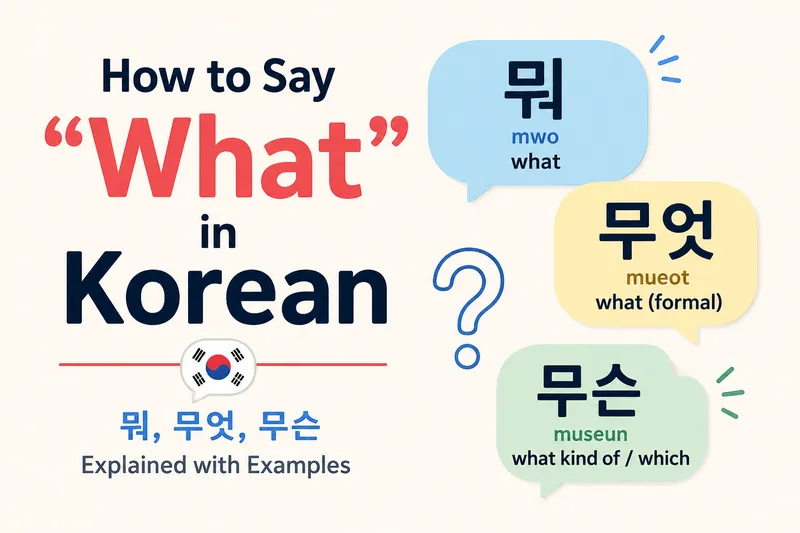
The most common way to say “what” in Korean is 뭐 (mwo).
But Korean also uses 무엇 and 무슨, depending on the sentence.
The easiest way to remember them is:
- 뭐 — everyday “what”
- 무엇 — the fuller, more formal form
- 무슨 — used before a noun, often meaning “what kind of”
For example:
이게 뭐예요?
Ige mwoyeyo?
What is this?
TL;DR
| Korean | Romanization | Use |
|---|---|---|
| 뭐 | mwo | Everyday “what” |
| 무엇 | mueot | Full or more formal “what” |
| 무슨 | museun | ”What / what kind of” before a noun |
Useful examples:
- 뭐예요? — What is it?
- 뭐 해요? — What are you doing?
- 이게 뭐예요? — What is this?
- 무슨 뜻이에요? — What does it mean?
- 무슨 음식 좋아해요? — What kind of food do you like?
For normal conversation, 뭐 is the form you will use most often.
How to Pronounce 뭐
뭐 is commonly romanized as mwo.
It is one syllable, not “moo-wo.”
It combines:
- ㅁ → m
- ㅝ → wo
So pronounce 뭐 as one smooth sound.
뭐 vs 무엇
무엇 (mueot) is the full form meaning “what.”
In everyday speech, it is commonly shortened to 뭐.
Compare:
| Korean | Meaning | Style |
|---|---|---|
| 뭐야? | What is it? | Casual |
| 뭐예요? | What is it? | Polite everyday speech |
| 무엇입니까? | What is it? | Formal |
For most beginners, 뭐예요? is the most practical form to learn first.
Casual
뭐야?
Mwoya?
What is it?
Use this with people you normally speak casually with.
Polite
뭐예요?
Mwoyeyo?
What is it?
This is useful in everyday polite conversation.
Formal
무엇입니까?
Mueosimnikka?
What is it?
You are more likely to encounter this in formal speech, announcements, presentations, or textbooks.
뭐 vs 무슨
This is the other important distinction.
The simple rule is:
- 뭐 can stand on its own
- 무슨 normally comes before a noun
Compare:
뭐 먹어요?
Mwo meogeoyo?
What are you eating?
But:
무슨 음식 좋아해요?
Museun eumsik joahaeyo?
What kind of food do you like?
Common 무슨 + noun combinations include:
| Korean | Meaning |
|---|---|
| 무슨 음식 | what kind of food |
| 무슨 영화 | what movie / what kind of movie |
| 무슨 음악 | what music |
| 무슨 책 | what book |
| 무슨 색 | what color |
| 무슨 뜻 | what meaning |
| 무슨 일 | what happened / what matter |
A useful memory rule:
뭐 = what?
무엇 = full/formal what
무슨 + noun = what kind of ___?
Useful Ways to Ask “What”
These are the expressions worth remembering first.
What is this?
이게 뭐예요?
Ige mwoyeyo?
What is this?
This is useful when shopping, ordering food, or asking about an unfamiliar object.
What are you doing?
뭐 해요?
Mwo haeyo?
What are you doing?
With a close friend:
뭐 해?
What do you want to eat?
뭐 먹고 싶어요?
Mwo meokgo sipeoyo?
What do you want to eat?
What does this mean?
이게 무슨 뜻이에요?
Ige museun tteusieyo?
What does this mean?
You can shorten it to:
무슨 뜻이에요?
What does it mean?
This is especially useful when studying Korean.
What happened?
무슨 일이에요?
Museun irieyo?
Depending on the situation, it can mean:
- What’s going on?
- What happened?
- What’s the matter?
This is a good example of why Korean phrases should not always be translated word for word.
Saying “What?” When You Didn’t Hear Someone
With a close friend, you may hear:
뭐?
What?
But 뭐? can sound blunt when politeness is expected.
If you simply did not hear someone, a safer polite response is:
네?
Ne?
Pardon? / Sorry?
So do not use 뭐? with everyone just because the dictionary says it means “what.”
Common Beginner Mistakes
Using 무엇 everywhere
무엇 is correct, but normal conversation often uses 뭐 instead.
For everyday Korean:
뭐 해요?
sounds more natural than always relying on the fuller form.
Using 뭐 before every noun
When “what” directly modifies a noun, 무슨 is often what you need.
For example:
무슨 영화예요?
What movie is it?
무슨 색이에요?
What color is it?
Pronouncing 뭐 as two syllables
Remember that 뭐 is one syllable.
Listen and repeat it as a single unit rather than saying something like “moo-wo.”
Translating word by word
Expressions such as:
무슨 일이에요?
make more sense when learned as a complete phrase rather than translating each Korean word individually.
Quick Practice
Choose 뭐, 무엇, or 무슨.
1. ___ 해요?
What are you doing?
Answer: 뭐
2. ___ 영화 좋아해요?
What kind of movies do you like?
Answer: 무슨
3. 이것은 ___입니까?
What is this? (formal)
Answer: 무엇
4. ___ 뜻이에요?
What does it mean?
Answer: 무슨
5. ___ 먹고 싶어요?
What do you want to eat?
Answer: 뭐
If you understand these five, you already understand the main difference.
Other Useful Korean Question Words
Once you know 뭐, these are useful next:
| Korean | Meaning |
|---|---|
| 누구 | who |
| 어디 | where |
| 언제 | when |
| 왜 | why |
| 어떻게 | how |
| 어느 | which |
For example:
누구예요? — Who is it?
어디 가요? — Where are you going?
왜요? — Why?
You do not need to learn them all at once. Start with the questions you actually expect to use.
무슨 vs 어느
Both can sometimes resemble English “what” or “which.”
For beginners, remember:
- 무슨 → what kind of / what type of
- 어느 → which one from a set of choices
Compare:
무슨 음식 좋아해요?
What kind of food do you like?
어느 식당에 갈까요?
Which restaurant shall we go to?
The distinction becomes easier with exposure, so you do not need to master every nuance immediately.
Frequently Asked Questions
What is the most common way to say “what” in Korean?
In everyday conversation, 뭐 (mwo) is the most common form.
Is 뭐 short for 무엇?
Yes. 뭐 is a common contracted form of 무엇 and is much more frequent in normal conversation.
What is the difference between 뭐 and 무슨?
뭐 can stand alone as “what,” while 무슨 normally comes before a noun.
For example:
- 뭐 해요? — What are you doing?
- 무슨 영화예요? — What movie is it?
How do you say “What is this?” in Korean?
Say:
이게 뭐예요?
How do you say “What does this mean?” in Korean?
Say:
이게 무슨 뜻이에요?
Final Thoughts
You do not need a complicated grammar lesson to start using “what” in Korean.
Remember these three forms:
- 뭐 — everyday “what”
- 무엇 — full or formal “what”
- 무슨 — used before a noun
If you are a beginner, start with these three phrases:
이게 뭐예요? — What is this?
뭐 해요? — What are you doing?
무슨 뜻이에요? — What does it mean?
Listen to them, repeat them, and use them as complete patterns.
That is much more useful than trying to memorize every possible translation of “what.”