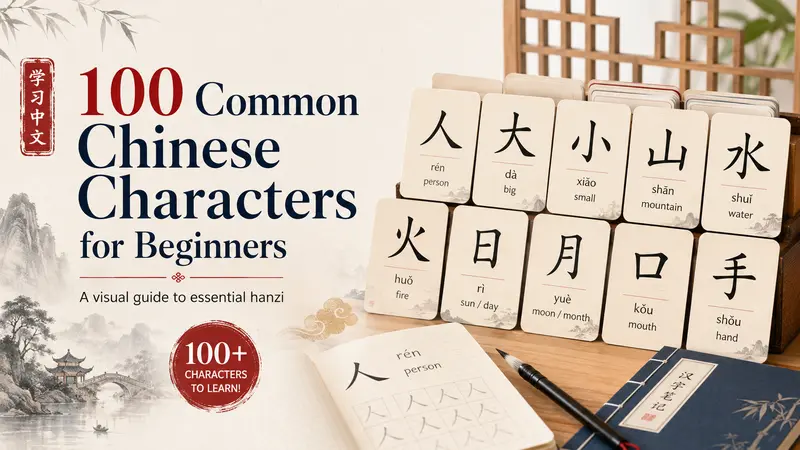
If you want a practical starting point for reading Chinese, this is it.
This page gives you 100 common Chinese characters for beginners in a clean table with:
- traditional character
- simplified character
- pinyin
- English meaning
- audio
If you are still getting comfortable with pronunciation, our guide to Chinese Pinyin is the best companion to this list.
TL;DR
This page gives you 100 high-use Chinese characters that beginners are most likely to meet early in real Mandarin.
Instead of learning random Hanzi, you can start with a practical core set that shows up in beginner lessons, simple sentences, and everyday reading. Use the table as a quick reference, then review the characters in small groups until they start to feel familiar.
100 common Chinese characters for beginners
| Traditional Character | Simplified Character | Pinyin | English Translation | Pronunciation |
|---|---|---|---|---|
| 的 | 的 | de | of / possessive particle | |
| 一 | 一 | yī | one | |
| 是 | 是 | shì | to be | |
| 不 | 不 | bù | not / no | |
| 了 | 了 | le / liǎo | completed action / finish | |
| 人 | 人 | rén | person | |
| 我 | 我 | wǒ | I / me | |
| 在 | 在 | zài | at / in / to be located | |
| 有 | 有 | yǒu | to have | |
| 他 | 他 | tā | he / him | |
| 這 | 这 | zhè | this | |
| 個 | 个 | gè | general measure word | |
| 們 | 们 | men | plural marker | |
| 中 | 中 | zhōng | middle / China | |
| 來 | 来 | lái | come | |
| 上 | 上 | shàng | up / on / above | |
| 大 | 大 | dà | big | |
| 為 | 为 | wèi / wéi | for / to do / to be | |
| 和 | 和 | hé | and | |
| 國 | 国 | guó | country | |
| 地 | 地 | dì | ground / land / -ly particle | |
| 到 | 到 | dào | arrive / to | |
| 以 | 以 | yǐ | by / with / in order to | |
| 說 | 说 | shuō | say / speak | |
| 時 | 时 | shí | time / hour | |
| 要 | 要 | yào | want / need / important | |
| 就 | 就 | jiù | then / just / right away | |
| 出 | 出 | chū | go out / come out | |
| 會 | 会 | huì | can / will / meeting | |
| 可 | 可 | kě | can / may / possible | |
| 也 | 也 | yě | also | |
| 你 | 你 | nǐ | you | |
| 對 | 对 | duì | correct / toward / to | |
| 生 | 生 | shēng | life / birth / raw | |
| 能 | 能 | néng | can / be able to | |
| 而 | 而 | ér | and yet / while / but | |
| 子 | 子 | zi / zǐ | child / suffix | |
| 那 | 那 | nà | that | |
| 得 | 得 | de / dé / děi | obtain / must / particle | |
| 於 | 于 | yú | in / at / from | |
| 著 | 着 | zhe / zháo / zhuó | continuous action / touch / wear | |
| 下 | 下 | xià | down / below / next | |
| 自 | 自 | zì | self / from | |
| 之 | 之 | zhī | of / it / literary connector | |
| 年 | 年 | nián | year | |
| 過 | 过 | guò | pass / cross / experienced | |
| 發 | 发 | fā / fà | send / issue / hair | |
| 後 | 后 | hòu | after / back / queen | |
| 作 | 作 | zuò | do / make / work | |
| 裡 | 里 | lǐ | inside / in | |
| 用 | 用 | yòng | use | |
| 道 | 道 | dào | way / path / say | |
| 行 | 行 | xíng / háng | go / okay / line / profession | |
| 所 | 所 | suǒ | place / classifier for buildings / institution | |
| 然 | 然 | rán | so / correct / natural | |
| 家 | 家 | jiā | home / family | |
| 種 | 种 | zhǒng / zhòng | type / kind / plant | |
| 事 | 事 | shì | matter / thing / affair | |
| 成 | 成 | chéng | become / complete / succeed | |
| 方 | 方 | fāng | square / direction / method | |
| 多 | 多 | duō | many / much | |
| 經 | 经 | jīng | pass through / scripture / classic | |
| 麼 | 么 | me / mó / yāo | question suffix / tiny | |
| 去 | 去 | qù | go | |
| 法 | 法 | fǎ | method / law | |
| 學 | 学 | xué | study / learn | |
| 如 | 如 | rú | like / as / if | |
| 都 | 都 | dōu | all / both | |
| 同 | 同 | tóng | same / together | |
| 現 | 现 | xiàn | appear / current | |
| 當 | 当 | dāng / dàng | should / be / work as | |
| 沒 | 没 | méi / mò | not have / not | |
| 動 | 动 | dòng | move / action | |
| 面 | 面 | miàn | face / side / noodles | |
| 起 | 起 | qǐ | rise / start | |
| 看 | 看 | kàn | look / watch / read | |
| 定 | 定 | dìng | decide / fixed / set | |
| 天 | 天 | tiān | sky / day | |
| 分 | 分 | fēn / fèn | divide / minute / part | |
| 還 | 还 | hái / huán | still / also / return | |
| 進 | 进 | jìn | enter / advance | |
| 好 | 好 | hǎo | good | |
| 小 | 小 | xiǎo | small | |
| 部 | 部 | bù | part / section / department | |
| 其 | 其 | qí | its / his / her / that | |
| 些 | 些 | xiē | some | |
| 主 | 主 | zhǔ | main / master / owner | |
| 樣 | 样 | yàng | appearance / kind / way | |
| 理 | 理 | lǐ | reason / logic / manage | |
| 心 | 心 | xīn | heart | |
| 她 | 她 | tā | she / her | |
| 本 | 本 | běn | root / origin / classifier for books | |
| 前 | 前 | qián | front / before | |
| 開 | 开 | kāi | open / start | |
| 但 | 但 | dàn | but | |
| 因 | 因 | yīn | because / cause | |
| 只 | 只 | zhǐ / zhī | only / classifier for animals | |
| 從 | 从 | cóng | from / follow | |
| 想 | 想 | xiǎng | think / want | |
| 實 | 实 | shí | real / true | |
| 日 | 日 | rì | sun / day | |
| 軍 | 军 | jūn | army / military | |
| 者 | 者 | zhě | person who / -er | |
| 意 | 意 | yì | meaning / idea / intention | |
| 無 | 无 | wú | without / no | |
| 力 | 力 | lì | power / strength | |
| 它 | 它 | tā | it | |
| 與 | 与 | yǔ | and / with / give | |
| 長 | 长 | cháng / zhǎng | long / grow / chief | |
| 把 | 把 | bǎ | hold / ba-construction / handle | |
| 機 | 机 | jī | machine / opportunity | |
| 十 | 十 | shí | ten | |
| 民 | 民 | mín | people / citizen |
How to use this list well
Do not try to memorize all 100 characters in one sitting.
A better way is:
Step 1
Start with the first 10 to 20 characters.
Step 2
Read them out loud every day.
Step 3
Look for them inside simple words and sentences.
Examples:
- 我的
- 不是
- 有人
- 这个
- 中国
- 好人
Step 4
Add new characters in small groups.
If you want a stronger review method, see our guide on how to memorize Chinese characters.
Simplified and traditional: what beginners need to know
This table includes both forms because learners often meet both online.
Simplified Chinese
Used mainly in:
- Mainland China
- Singapore
Traditional Chinese
Used mainly in:
- Taiwan
- Hong Kong
- many heritage and overseas communities
If you are learning Mandarin for Mainland China, focus on the simplified column first.
If your goal is Taiwan or traditional texts, pay more attention to the traditional column.
If you want a fuller breakdown, read our guide to the difference between traditional and simplified Chinese characters.
A useful beginner rule
Not every common character is easy to write.
And not every easy-looking character is common in real reading.
So your best study mix is:
- common reading characters first
- simple writing characters alongside them
That is how you build both reading ability and confidence.
FAQ
What are the most common Chinese characters for beginners?
They usually include very high-frequency characters like 的, 一, 是, 不, 了, 人, 我, 在, 有, 你 and other characters that show up constantly in beginner Mandarin.
Should I learn simplified or traditional characters first?
Learn the system that matches your main goal. Simplified is usually the best first choice for Mainland China. Traditional is better for Taiwan and Hong Kong contexts.
Are Chinese characters the same as words?
Not always. Many Chinese words use two or more characters, so one character is often only part of a full word.
How many Chinese characters should a beginner learn first?
A good first target is around 50 to 100 useful characters for recognition, then build upward from there.
Final thoughts
A good list of 100 common Chinese characters for beginners should help you do one thing well:
start recognizing real Chinese faster.
That is why this page focuses on high-use characters you will actually see again and again.
You do not need to master all of them at once.
Start small, review often, and use them in words and short sentences.
That is when Chinese characters stop looking random and start feeling familiar.