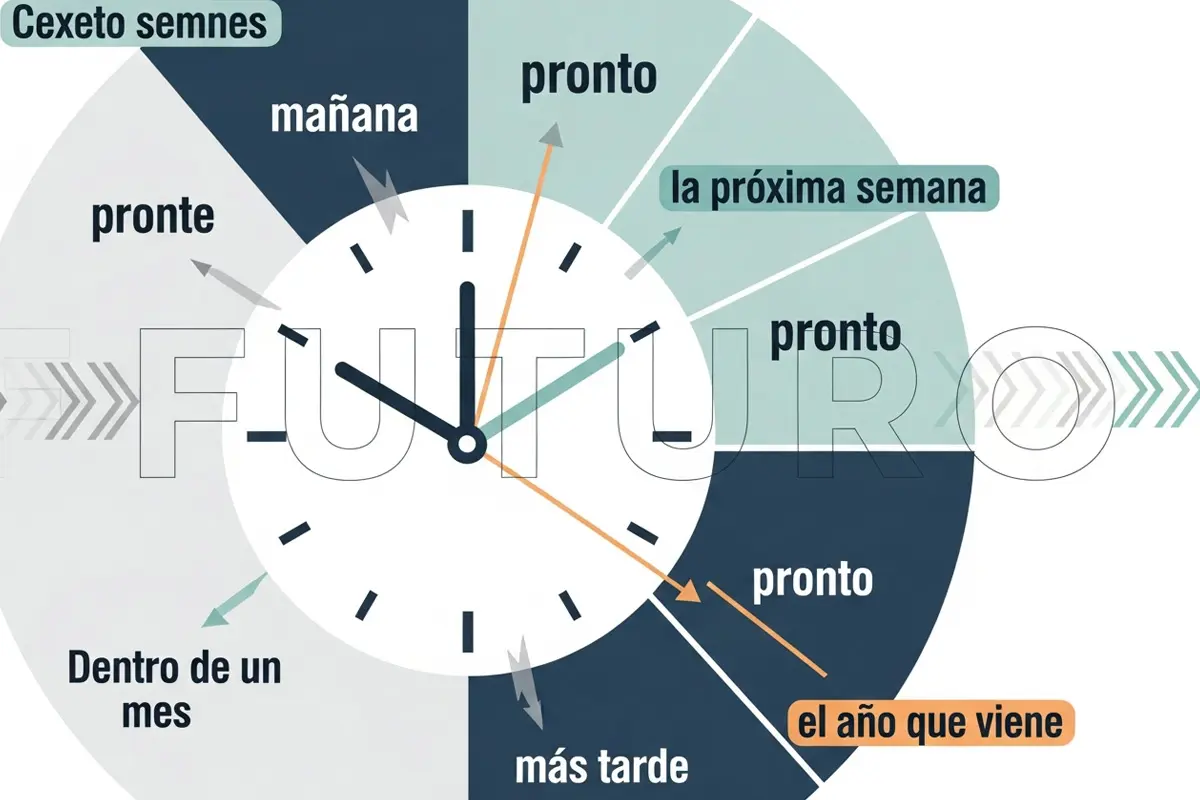
If you are studying time expressions used with the Spanish future tense, the first thing to understand is this:
Spanish does not use the future tense the same way English uses will.
Very often, Spanish lets the time expression carry the future meaning. That is why native speakers can say:
- Mañana salgo temprano.
- Esta noche vamos a cenar fuera.
- Algún día viajaré por América Latina.
All three talk about the future, but they do not use the same tense.
That is exactly where learners get stuck. They memorize future-tense endings, but they do not always learn which time expressions sound more natural with the present tense, which fit ir a + infinitive, and which really do pair well with the simple future or future perfect.
This guide focuses on that practical choice.
TL;DR
Time expressions like mañana, esta noche, la semana que viene, en unos años, and para mañana help Spanish speakers place future actions in time, but they do not all point to the same tense.
In everyday Spanish:
- clear, scheduled future often uses the present tense
- planned or immediate future often uses ir a + infinitive
- less fixed, more distant, or more rhetorical future often uses the simple future
- completed-before-a-future-point meaning often uses the future perfect
So the real question is not just, “What time expression goes with the future tense?” It is, “What time expression makes this tense sound natural?”
Quick answer: what time expressions are used with the Spanish future tense?
Many time expressions can appear with future meaning in Spanish, including:
- mañana
- esta noche
- más tarde
- la semana que viene
- el próximo año
- en dos horas
- dentro de poco
- algún día
- en el futuro
- para mañana
- a esa hora
But the important point is that these expressions do not all behave the same way.
Some strongly favor:
- the present tense
- or ir a + infinitive
Others sound more natural with:
- the simple future
- or the future perfect
That is why time expressions are so important in Spanish grammar. They help determine not only when something happens, but also which tense sounds most natural.
Why time expressions matter so much in Spanish
Spanish grammar allows the present tense to refer to future events when the context makes the time clear. The RAE describes this as presente prospectivo, with examples like Llegan mañana.
That is why Spanish learners need to think in this order:
- What kind of future meaning do I want?
- How clear is the time expression?
- Which tense matches that level of certainty or distance?
If you skip step 2, your Spanish may be grammatical but still sound stiff.
If you need a broader tense overview first, our guide to future tense Spanish gives the full picture before you zoom in on time expressions.
The 4 main patterns you need to know
1. Present tense + future time expression
Very common for:
- schedules
- plans
- fixed arrangements
- things the speaker sees as settled
2. Ir a + infinitive + future time expression
Very common for:
- near-future plans
- intentions
- actions already decided
- conversational future
3. Simple future + future time expression
Common for:
- distant future
- predictions
- promises
- less fixed timing
- formal or written tone
4. Future perfect + future time expression
Used for:
- actions that will be completed before another future point
Time expressions that often go with the present tense
This is one of the most important habits in natural Spanish.
The RAE notes that the present can have future value when a time complement makes that reading clear. That is exactly why sentences like Mañana salgo temprano sound normal.
Common time expressions here
| Time expression | Meaning | Typical natural tense |
|---|---|---|
| mañana | tomorrow | present |
| esta tarde | this afternoon | present |
| esta noche | tonight | present |
| el lunes | on Monday | present |
| la semana que viene | next week | present |
| el mes que viene | next month | present |
Examples
- Mañana salgo temprano.
- La reunión es esta tarde.
- El tren llega a las ocho.
- La semana que viene empiezo el curso.
Why this sounds natural
Because the time is already clear.
Spanish often does not need extra future marking when:
- the action is planned
- the time is fixed
- the context already points forward
If you want a deeper comparison, see our guide on future tense vs present tense in Spanish.
Time expressions that often go with ir a + infinitive
This structure is one of the most useful future patterns in spoken Spanish.
It often feels:
- immediate
- intentional
- conversational
- already decided
Common time expressions here
| Time expression | Meaning | Typical natural tense |
|---|---|---|
| ahora | now | ir a + infinitive |
| ahora mismo | right now | ir a + infinitive |
| en un momento | in a moment | ir a + infinitive |
| esta noche | tonight | ir a + infinitive |
| mañana | tomorrow | ir a + infinitive |
| dentro de poco | soon | ir a + infinitive |
Examples
- Voy a llamar mañana.
- Vamos a comer en un momento.
- Voy a reservar el hotel ahora mismo.
- Dentro de poco vamos a empezar.
Best way to think about it
Use ir a + infinitive when the future feels close and already mentally scheduled.
If you are comparing future forms, this structure is just as important as the simple future.
Time expressions that often go with the simple future tense
The simple future is still very real Spanish, but learners often overuse it in the wrong places.
It sounds especially natural when the future is:
- less fixed
- more distant
- more general
- more predictive
- more rhetorical
The RAE’s discussion of the future tense also notes that it often carries shades of speaker attitude, confidence, or projection, not just raw futurity.
Common time expressions here
| Time expression | Meaning | Typical natural tense |
|---|---|---|
| algún día | someday | simple future |
| en el futuro | in the future | simple future |
| dentro de unos años | in a few years | simple future |
| más adelante | later on | simple future |
| pronto | soon | simple future or ir a |
| mañana | tomorrow | possible, but depends on tone |
Examples
- Algún día viajaré por América Latina.
- En el futuro cambiarán las cosas.
- Dentro de unos años viviré en España.
- Más adelante entenderás por qué.
Important nuance
It is not wrong to say:
- Mañana estudiaré a las ocho.
But this does not always sound more natural than:
- Mañana estudio a las ocho.
The first can sound:
- more formal
- more deliberate
- more literary
- more emphatic
The second often sounds more everyday and conversational.
That nuance matters. The old learner mistake is not “using the future tense is wrong.” The real mistake is assuming it is always the most natural choice.
If you want to see how these choices break down in common learner errors, our post on common mistakes when using the Spanish future tense fits well here.
Time expressions used with the future perfect
The future perfect is the tense learners often forget, but time expressions make its use much easier to see.
Use it when you mean:
by a certain future point, the action will already be completed
Common time expressions here
| Time expression | Meaning | Typical natural tense |
|---|---|---|
| para mañana | by tomorrow | future perfect |
| para entonces | by then | future perfect |
| a esa hora | by that time / at that hour | future perfect |
| cuando + present subjunctive / present indicative depending on structure | when | future perfect in the main clause |
| antes de + noun / clause structure | before | future perfect in some contexts |
Examples
- Para mañana, habré terminado.
- A esa hora, el vuelo habrá salido.
- Para entonces, ya habremos comido.
- Cuando llegues, ya habré terminado.
What the time expression does
It gives you a future reference point. The future perfect then marks completion before that point.
If this is the part you find hardest, our guide to Spanish simple future vs future perfect tense will help you separate the two clearly.
The most useful time expressions by function
Instead of memorizing one huge list, learn them by use.
Near future
| Spanish | English |
|---|---|
| mañana | tomorrow |
| esta tarde | this afternoon |
| esta noche | tonight |
| ahora mismo | right now |
| en un momento | in a moment |
| dentro de poco | soon |
Planned calendar future
| Spanish | English |
|---|---|
| el lunes | on Monday |
| la semana que viene | next week |
| el mes que viene | next month |
| el próximo año | next year |
| mañana por la mañana | tomorrow morning |
Distant or indefinite future
| Spanish | English |
|---|---|
| algún día | someday |
| en el futuro | in the future |
| más adelante | later on |
| dentro de unos años | in a few years |
Completion before a future point
| Spanish | English |
|---|---|
| para mañana | by tomorrow |
| para entonces | by then |
| a esa hora | by that time |
| antes de | before |
En vs dentro de for future time
Learners often ask about this pair.
Both can point forward in time:
- en dos horas
- dentro de dos horas
In many everyday situations, they are close in meaning. Very often, dentro de highlights the amount of time that must pass before something happens, while en can feel slightly more neutral or result-focused depending on context.
Examples
- Salgo dentro de dos horas.
- Llego en dos horas.
These are not rigidly separated grammar boxes, but this contrast is a useful learner guideline:
- dentro de often feels like countdown time
- en often feels like arrival or completion time
Days, weeks, and months: the most useful expressions
These are some of the expressions learners need most often.
| Expression | Meaning | Natural tense choices |
|---|---|---|
| mañana | tomorrow | present / ir a / future |
| pasado mañana | the day after tomorrow | present / ir a / future |
| la semana que viene | next week | present / ir a / future |
| el mes que viene | next month | present / future |
| el próximo año | next year | future / present depending on context |
| esta noche | tonight | present / ir a |
Examples
- Pasado mañana salimos.
- La semana que viene voy a empezar clases.
- El próximo año viviré en otro país.
What about irregular future verbs?
Time expressions do not change the conjugation pattern. They affect tense choice, not verb formation.
So you still get:
- tendré
- podré
- haré
- diré
- saldrá
Examples
- Mañana tendré tiempo.
- Dentro de unos años podré viajar más.
- Algún día haré ese viaje.
If you need the full conjugation side, see our guide on irregular future tense verbs in Spanish.
A clearer way to compare the tense choices
Here is the pattern learners usually need most:
| Time expression | Most natural choice | Why |
|---|---|---|
| mañana | present / ir a | clear and near |
| esta noche | present / ir a | near and concrete |
| la semana que viene | present / ir a / future | depends on tone and certainty |
| dentro de poco | ir a | immediate, conversational |
| algún día | future | vague, distant |
| en el futuro | future | broad projection |
| dentro de unos años | future | distant future |
| para mañana | future perfect | completed before a point |
12 model sentences worth remembering
These are more useful than isolated rules.
- Mañana estudio en casa.
- Esta noche cenamos fuera.
- Voy a llamarte en un momento.
- La semana que viene empiezo un curso nuevo.
- Mañana voy a salir más temprano.
- Algún día viviré en España.
- En el futuro trabajaremos menos horas.
- Dentro de unos años entenderás mejor esta decisión.
- Para mañana, habré terminado el informe.
- A esa hora, ya habremos llegado.
- Pasado mañana viene mi hermana.
- El próximo año voy a cambiar de trabajo.
For more side-by-side examples, our page on Spanish future tense example sentences for beginners is a good follow-up.
Common learner mistakes
1. Translating directly from English
English often pushes learners toward will + verb in every future sentence.
Spanish does not work like that.
2. Ignoring the role of the time expression
A clear expression like mañana or la semana que viene often makes the future obvious already.
3. Overusing the simple future
The simple future is correct, but it is not always the most natural spoken choice.
4. Thinking one time expression only works with one tense
That is not how Spanish works.
For example, mañana can appear with:
- present
- ir a + infinitive
- simple future
The difference is usually tone, certainty, distance, or style.
5. Forgetting the future perfect
Expressions like para mañana and para entonces often point naturally to that tense.
A practical study method
If you want to sound better fast, do this:
Step 1
Group time expressions by meaning:
- near future
- distant future
- completion before a point
Step 2
Learn one example with each tense:
- present
- ir a + infinitive
- future
- future perfect
Step 3
Practice saying the same idea in more than one way.
For example:
- Mañana estudio.
- Mañana voy a estudiar.
- Mañana estudiaré.
All three are possible, but they do not feel identical.
That contrast is where real fluency starts.
FAQ
Do time expressions replace the future tense in Spanish?
Sometimes, yes. A clear future time expression often allows Spanish to use the present tense naturally instead of the future.
Is the simple future wrong with expressions like mañana?
No. It is grammatically correct. But in many everyday spoken contexts, the present tense or ir a + infinitive may sound more natural.
Which time expressions are most common with the Spanish future tense?
Common future-oriented time expressions include mañana, esta noche, la semana que viene, en dos horas, algún día, en el futuro, and para mañana. The exact tense still depends on meaning and tone.
When do I use the future perfect with time expressions?
Use it when the action will be finished before another future point, especially with expressions like para mañana, para entonces, or a esa hora.
Can one time expression work with more than one tense?
Yes. That is one of the main things learners need to understand. Spanish tense choice depends on certainty, style, immediacy, and speaker intention, not only on the time expression itself.
Final takeaway
The keyword time expressions used with the Spanish future tense sounds like it should lead to one simple list.
But real Spanish is more interesting than that.
Time expressions do not just “go with” the future tense. Very often, they help Spanish choose between:
- the present tense
- ir a + infinitive
- the simple future
- the future perfect
That is why the best way to learn this topic is not to memorize one tense and then attach time phrases to it.
It is to learn which time expressions make each future form sound natural.
Once you start hearing that difference, your Spanish future stops sounding translated and starts sounding real.