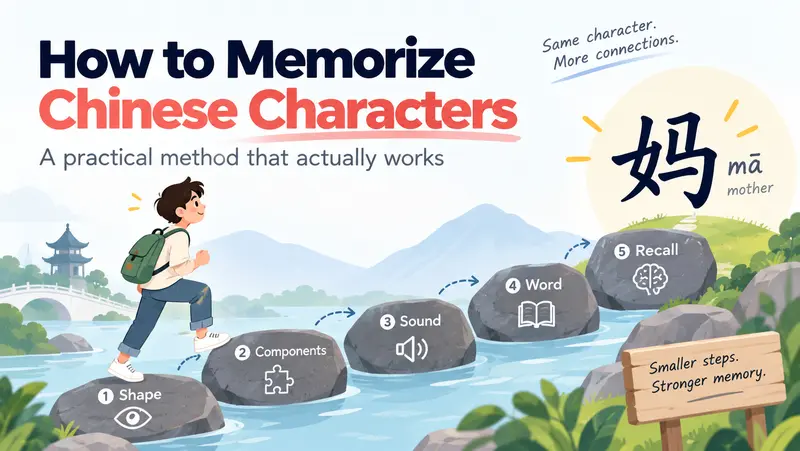
If Chinese characters keep disappearing from your memory, the problem may not be how much you study. It may be how you store each character in memory.
Trying to remember 请 as a collection of strokes gives your brain very little to work with.
It becomes easier when you connect several pieces of information:
请 → 讠 + 青 → qǐng → 请问 → recall it without looking
That is the method we will use throughout this guide.
Instead of memorizing Chinese characters as isolated drawings, build several connections to each one: its shape, components, sound, vocabulary, and retrieval cue.
We call this the 5-link character memory method:
Shape → Components → Sound → Word → Recall
You do not need an elaborate story for every character. You need enough useful connections that your brain has several ways to find the character again.
TL;DR
To memorize Chinese characters more effectively:
- See the complete character
- Break it into useful components
- Connect it to its pronunciation and tone
- Learn it inside at least one useful word
- Hide it and retrieve the information from memory
- Review difficult characters again with spaced retrieval
- Use handwriting when you need production practice, but avoid mindless copying
- Learn common characters before rare ones
- Pay special attention to recurring semantic and phonetic components
- Treat recognition, pronunciation, meaning, and handwriting as related but different memory skills
The key is not seeing a character more times.
The key is repeatedly reconstructing what you know about it without looking.
Table of Contents
Open Table of Contents
- Why Chinese Characters Are Easy to Forget
- The 5-Link Character Memory Method
- Worked Example: 妈
- Worked Example: 请
- Use Phonetic Families Instead of Learning Every Character Alone
- Learn Characters Through Words
- Use Active Recall, Not Just Repetition
- Use Spaced Retrieval
- Should You Write Chinese Characters by Hand?
- How to Remember Characters You Keep Confusing
- A 15-Minute Daily Character Routine
- A Simple 7-Day Review Example
- What Characters Should You Learn First?
- Should You Memorize Radicals First?
- Do Mnemonics Help?
- Read Chinese to Strengthen Character Memory
- Common Mistakes
- Practice the Method Yourself
- FAQ
- What is the fastest way to memorize Chinese characters?
- How many Chinese characters should I learn per day?
- Should I memorize Chinese characters or words?
- Should I learn Chinese radicals before characters?
- Do Chinese character components tell you the pronunciation?
- Does handwriting help memorize Chinese characters?
- Is spaced repetition good for Chinese characters?
- Why can I recognize Chinese characters but not write them?
- Why do I keep confusing similar Chinese characters?
- Should I use mnemonics for every Chinese character?
- How many Chinese characters do I need to know?
- What to Learn Next
- Final Thoughts
Why Chinese Characters Are Easy to Forget
Chinese characters can initially look like hundreds of unrelated visual patterns.
If you try to store each one as a complete picture, the memory task becomes unnecessarily difficult.
But there is another problem:
Knowing a character is not one single skill.
Suppose you see:
请
You might recognize that you have studied it before but still be unable to remember its pronunciation.
Or you might know:
qǐng
but be unable to write 请 from memory.
Or perhaps you recognize 请 and know its pronunciation but cannot remember how it is actually used.
These are different retrieval tasks.
Recognition
You see:
请
and recognize it.
Pronunciation
You see:
请
and retrieve:
qǐng
Meaning and Usage
You connect 请 with ideas such as asking, requesting, or inviting and recognize it in useful expressions such as:
请问
qǐngwèn
“May I ask” or “Excuse me”
Production
You want to write 请 without seeing it and can reconstruct the character.
You can be strong at one of these skills and weak at another.
That is why simply saying “I forgot this character” does not tell you exactly what needs practice.
Before reviewing a difficult character, ask:
What exactly am I forgetting?
Its shape?
Its pronunciation?
Its meaning?
The word it belongs to?
Or how to produce it from memory?
That diagnosis makes review much more efficient.
The 5-Link Character Memory Method
For each important new character, create five connections:
Shape → Components → Sound → Word → Recall
Let’s look at what each link means.
1. Shape
First, look at the complete character.
Do not immediately start copying it.
Notice its overall structure.
Is it left-right?
Top-bottom?
Does it contain pieces you already recognize?
2. Components
Break the character into useful recurring parts.
Some components provide clues related to meaning.
Others provide clues related to pronunciation.
This distinction matters.
A component is a structural part of a character. A radical is more specifically the component traditionally used to classify a character in a dictionary system.
So while radicals are useful, not every useful character component should simply be called a radical.
If this distinction is new to you, read our guide to Chinese character radicals and meanings.
3. Sound
Connect the written character to its Mandarin pronunciation and tone.
Do not learn only:
请 = please
Learn:
请 — qǐng
If tones are still difficult, review our guide to Mandarin tone marks.
4. Word
Put the character inside a useful word or expression.
For 请, you could learn:
请问
This gives the character a real linguistic home instead of leaving it as an isolated flashcard.
5. Recall
Finally, stop looking at the character.
Try to retrieve it.
Ask yourself:
- What does it mean?
- How is it pronounced?
- What tone does it use?
- What components does it contain?
- What word do I know with it?
- Can I visualize or write it?
This last step is where studying becomes memory training.
Worked Example: 妈
Let’s apply the method to a familiar beginner character:
妈
mā
mother
Link 1: Shape
妈 has a left-right structure.
Instead of remembering one complicated image, notice two components:
女 + 马
Link 2: Components
On the left is:
女
nǚ
woman or female
In 妈, this component is related to meaning.
On the right is:
马
mǎ
horse
But interpreting this as “woman + horse = mother” misses something important.
In 妈, 马 mainly provides a phonetic clue.
Compare:
妈 — mā
马 — mǎ
The tones differ, but the syllable is closely related.
That is much more useful than inventing an arbitrary story involving a woman and a horse.
Link 3: Sound
Say:
mā
and connect the first tone to 妈.
Link 4: Word
Now put it into an extremely common word:
妈妈
māma
mom
Now you are no longer memorizing only 妈.
You have connected:
妈 → 女 + 马 → mā → 妈妈
Link 5: Recall
Hide the character.
Then ask:
What character means mother, is pronounced mā, contains 女 on the left, and appears in 妈妈?
Try to visualize or write it before looking again.
That retrieval attempt is more valuable than staring at 妈 another ten times.
Worked Example: 请
Now let’s use a character that demonstrates an even more useful pattern:
请
qǐng
to ask, request, invite, or please depending on context
Link 1: Shape
请 has a left-right structure:
讠 + 青
Link 2: Components
The left side:
讠
is the simplified form of the speech-related component 言 and appears in many characters connected in some way with language or speech.
The right side is:
青
qīng
Here 青 provides a useful phonetic clue.
Compare:
青 — qīng
请 — qǐng
The initial and final are the same, although the tone changes.
This is a much stronger memory connection than treating every stroke in 请 as unrelated.
Link 3: Sound
Connect:
请 → qǐng
Link 4: Word
Learn it in:
请问
qǐngwèn
You can go one step further:
请问洗手间在哪里
qǐngwèn xǐshǒujiān zài nǎlǐ
Excuse me, where is the restroom?
Now 请 has meaning, sound, structure, vocabulary, and context.
For more examples of how 请 works in real Mandarin, see our guide to how to say please in Chinese.
Link 5: Recall
Hide 请 and reconstruct it from:
qǐng → request → 请问 → speech component + 青
If you fail, look again.
Then hide it and try once more.
That second attempt matters more than copying the answer while looking at it.
Use Phonetic Families Instead of Learning Every Character Alone
One of the most useful discoveries for Chinese learners is that many characters contain recurring phonetic components.
Consider:
青
清
情
请
These characters are not random lookalikes.
Listen:
青 — qīng
清 — qīng
情 — qíng
请 — qǐng
All four contain 青.
Their tones are not identical, but the shared component gives you a useful pronunciation pattern.
Their other components help distinguish them.
For example:
清
contains 氵, the water component.
情
contains 忄, a form of the heart-related component.
请
contains 讠, the speech-related component.
Instead of storing three completely unrelated drawings, your memory can organize them around a shared pattern.
But Phonetic Components Are Clues, Not Perfect Rules
Do not assume that a shared phonetic component guarantees identical modern Mandarin pronunciation.
Chinese pronunciation has changed over a very long history, and phonetic relationships vary in how transparent they remain today.
Treat a phonetic component as:
a useful clue
not:
a pronunciation formula that can never fail
That distinction prevents a helpful pattern from becoming a misleading rule.
Learn Characters Through Words
A character is not the same thing as a word.
This matters enormously for memory.
Suppose you learn:
学
xué
to study or learn
Do not stop there.
Connect it to useful words:
学生
xuésheng
student
and:
学校
xuéxiào
school
Now 学 is connected to vocabulary you will repeatedly encounter.
Do the same with:
生
shēng
Instead of trying to memorize every possible dictionary meaning immediately, begin with useful words such as:
学生
This gives the character context.
A good beginner rule is:
When you learn an important character, learn at least one useful word containing it.
For especially common characters, two or three words can make the memory connection even stronger.
Use Active Recall, Not Just Repetition
There is an important difference between:
seeing something again
and:
retrieving something from memory
Suppose you look at:
请
twenty times.
It becomes familiar.
But familiarity can create an illusion:
I know this.
Then someone asks you to write it or pronounce it without looking, and suddenly it is gone.
That is why active recall matters.
Try This Retrieval Drill
Study:
请
for a few seconds.
Then hide it.
Without looking, answer:
- What is the pronunciation?
- What tone is it?
- What does it commonly express?
- What are its two main components?
- What useful expression contains it?
- Can you visualize or write the character?
Then reveal the answer.
If you were wrong, correct the specific thing you forgot.
Do not simply reread everything.
This turns review into a diagnostic tool.
Use Spaced Retrieval
Active recall tells you how to review.
Spacing helps decide when to return to something.
Instead of studying a character twenty times in one sitting and then ignoring it for a month, spread retrieval attempts across time.
For example, a new character might be reviewed:
- shortly after learning it
- the next day
- a few days later
- about a week later
- later again if recall remains difficult
These intervals are not universal rules.
If you recall a character easily, increase the gap.
If you fail repeatedly, bring it back sooner.
A spaced repetition system can automate much of this scheduling, but the important part is still the retrieval attempt.
When a card appears, do not immediately flip it.
Try to remember first.
Review Weak Links, Not Just Whole Cards
Suppose you see 请 and immediately remember:
- meaning
- pronunciation
- word
but repeatedly forget how to write it.
Your problem is not “I don’t know 请.”
Your weak link is production.
Practice that.
If you can write it but always forget the tone, focus your review on:
请 → qǐng
This is more efficient than treating every failure as identical.
Should You Write Chinese Characters by Hand?
Handwriting can be extremely useful, but how you write matters.
There is a major difference between:
copying a character ten times while looking at it
and:
trying to write it once from memory
The second task requires retrieval.
Use Handwriting to Test Memory
Try this:
Look at:
好
hǎo
good
Notice:
女 + 子
Then hide the character.
Write 好 from memory.
Compare your result with the original.
Correct the mistake.
Try again later.
That process tests whether you can reconstruct the character.
You Do Not Need to Copy Everything Repeatedly
If your main goal is reading Chinese, recognition and pronunciation may deserve more of your study time than perfect handwriting.
If you need to handwrite Chinese for school, exams, work, or personal goals, production practice becomes much more important.
So there is no universal rule saying every learner must write every new character twenty times.
Match the exercise to the skill you actually need.
For more on writing, see our guide to learning Chinese writing.
How to Remember Characters You Keep Confusing
Some characters become difficult not because they are individually complex but because another character looks similar.
When this happens, do not merely review each character separately.
Compare them directly.
For example:
人
rén
person
and:
入
rù
to enter
If you repeatedly confuse them, create a contrast card or place them next to each other.
Ask:
- What visual detail separates them?
- How does each sound?
- What word or phrase helps identify each one?
For example:
人口
rénkǒu
population
and:
入口
rùkǒu
entrance
Now the contrast is not just:
人 vs 入
It becomes:
rén → person → 人口
versus:
rù → enter → 入口
This gives your memory more information to separate the two.
Do Not Create Huge Lists of Lookalikes Too Early
There is also a downside to comparison.
If you introduce ten visually similar characters before you actually confuse them, you may create confusion that did not previously exist.
Use contrast practice primarily for characters that your own memory repeatedly mixes up.
A 15-Minute Daily Character Routine
You do not need an hour-long character session every day.
A focused 15-minute routine can be more useful than a long session filled with passive repetition.
Here is a practical starting point.
Minutes 1–5: Review Old Characters
Use active recall.
Before revealing each answer, try to retrieve:
- pronunciation
- tone
- meaning
- a useful word
If handwriting matters to you, write the characters you struggle to produce.
Do not spend equal time on everything.
Spend more time on the weak links.
Minutes 6–10: Learn 3 to 5 New Characters
For each new character, use:
Shape → Components → Sound → Word → Recall
Do not race through twenty characters just to increase your daily count.
Three characters remembered tomorrow are more valuable than twenty that disappear tonight.
Minutes 11–13: Use the Characters in Words
Take the new characters and connect them to vocabulary.
For example:
学 → 学生 → 学校
Or:
请 → 请问
Minutes 14–15: Final Retrieval
Close your notes.
For each new character, ask:
- Can I recognize it?
- Can I pronounce it?
- Can I remember a word containing it?
- Can I identify a useful component?
- Can I write or visualize it?
Anything you cannot retrieve becomes a priority for the next review.
A Simple 7-Day Review Example
If you want a starting schedule, try this:
| Day | What to do |
|---|---|
| Day 1 | Learn the character and retrieve it again later |
| Day 2 | Test pronunciation, meaning and a useful word |
| Day 3 | Review only if needed or according to your SRS |
| Day 4 | Retrieve again without looking |
| Day 5 | Meet it in reading or vocabulary practice |
| Day 6 | Focus on any weak link |
| Day 7 | Test recognition and production again |
This is an example, not a fixed scientific formula.
A character you constantly forget may need more frequent review.
A character you already encounter every day may need much less deliberate practice.
The goal is not to obey a calendar.
The goal is to retrieve the character just often enough that the memory becomes increasingly stable.
What Characters Should You Learn First?
Do not begin by chasing rare characters because they look interesting.
Start with characters that give you repeated value.
Prioritize:
- high-frequency characters
- characters in vocabulary you actually need
- characters appearing in your beginner lessons
- components that recur in many other characters
- characters you repeatedly encounter while reading
For a practical starting set, see our guide to 100 common Chinese characters for beginners.
Frequency matters because repeated natural exposure becomes another form of review.
If you learn a rare character and then do not see it for six months, your brain receives very little reinforcement.
If you learn 学 and then repeatedly meet:
学生
学校
学习
the character keeps returning in meaningful contexts.
Should You Memorize Radicals First?
Learning common radicals and components is useful.
Memorizing a huge list before learning actual Chinese words is usually less useful.
You do not need to delay vocabulary study until you have mastered every traditional radical.
Instead, learn common components as they become useful.
For example, when you encounter characters containing:
氵
notice that it often appears in characters with meanings historically related to water or liquids.
When you encounter:
讠
notice its relationship with speech or language in many characters.
When you repeatedly encounter:
青
notice its role as a phonetic component in characters such as:
清
情
请
This lets structural knowledge grow alongside your vocabulary.
Do Mnemonics Help?
Yes, but they are tools rather than the entire learning system.
Mnemonics are particularly useful when:
- a character refuses to stick
- its components do not provide an obvious clue for you
- you need a temporary bridge to recall its structure
A useful mnemonic should be:
- short
- memorable
- easy to reconstruct
- connected to the actual character
Avoid creating a complicated story for every single character.
If remembering the mnemonic becomes harder than remembering the character, the mnemonic is no longer helping.
Also distinguish a historical or structural explanation from a story you invented for memory.
A mnemonic can be useful without being the true etymology of the character.
Read Chinese to Strengthen Character Memory
Flashcards help you deliberately retrieve characters.
Reading gives those characters repeated context.
You need both.
Begin with material where you can understand most of what is happening:
- graded readers
- short beginner dialogues
- simple stories
- messages
- menus
- signs
- lessons using familiar vocabulary
Suppose you deliberately studied:
学校
Then you encounter:
我在学校学中文
wǒ zài xuéxiào xué Zhōngwén
I study Chinese at school.
Now 学 and 校 are no longer just flashcard items.
They are doing real work in a sentence.
This repeated contextual exposure helps strengthen the connections you deliberately created during study.
Common Mistakes
1. Memorizing Characters as Pictures
A character may look like one visual object, but many characters contain reusable structural information.
Instead of asking:
How do I remember this picture?
ask:
What useful parts and patterns can I recognize?
2. Treating Every Component as a Radical
Radicals and components are related concepts, but they are not synonyms.
For memory, you often care about components because they can provide structural, semantic, or phonetic information.
Do not force every useful piece into the label “radical.”
3. Ignoring Phonetic Components
Beginners often focus entirely on meaning clues.
But many Chinese characters contain a component that historically provides information about pronunciation.
Learning to notice those relationships can turn isolated characters into families.
Just remember that modern pronunciation may not match perfectly.
4. Learning Characters Without Words
Knowing:
学 = study
is useful.
Knowing:
学生
and:
学校
makes 学 much easier to encounter, understand, and remember in real Chinese.
Characters and words should support each other.
5. Copying Without Retrieval
Writing:
请 请 请 请 请 请 请 请 请 请
while looking at the character may improve familiarity with the movement.
But if your goal is memory, try:
look → hide → write → check
That requires retrieval.
6. Learning Too Many New Characters
More new cards do not automatically mean more progress.
If today’s twenty characters create tomorrow’s twenty failures, reduce the load.
A smaller number learned deeply can produce faster long-term progress.
7. Ignoring Tones
Do not store:
请 = qing
Store:
请 = qǐng
The tone is part of the Mandarin pronunciation.
Listen to it:
If you need to strengthen this skill, review Chinese Pinyin and our guide to Pinyin tone marks.
8. Treating Recognition as Mastery
Seeing a character and thinking:
That looks familiar.
is not the same as retrieving its pronunciation, meaning, usage, or written form.
Test the skill you actually want.
Practice the Method Yourself
Let’s see whether you can apply the system rather than simply read about it.
Practice 1: 好
Look at:
好
hǎo
good
Notice:
女 + 子
Now connect it to:
你好
nǐ hǎo
hello
Your five links might be:
Shape: 好
Components: 女 + 子
Sound: hǎo
Word: 你好
Recall: hide 好 and reconstruct it
Now stop looking and try.
Practice 2: 休
Look at:
休
xiū
to rest
Notice:
亻 + 木
Then learn:
休息
xiūxi
to rest
Now hide 休.
Can you retrieve:
- its pronunciation?
- its meaning?
- its components?
- the word 休息?
- its written form?
If not, identify exactly which link failed.
Practice 3: 请
Now return to:
请
Do not scroll back yet.
Can you remember:
- its pinyin?
- its tone?
- the component on the left?
- the component on the right?
- one useful expression containing it?
The answers are:
qǐng
third tone
讠
青
请问
If you retrieved most of these after reading the article, you have already practiced the method.
FAQ
What is the fastest way to memorize Chinese characters?
There is no single trick that instantly makes characters permanent.
A practical method is to connect each important character to its components, pronunciation, a useful word, and repeated active recall.
This gives your memory more than one route back to the character.
How many Chinese characters should I learn per day?
There is no ideal number for everyone.
For a beginner, a small number that you can actually recall later is more useful than a large daily target that creates an unmanageable review backlog.
If five new characters per day are sticking, that may be more productive than forcing twenty.
Should I memorize Chinese characters or words?
Learn both together.
Characters help you understand the structure of written Chinese, while words show you how those characters actually function in the language.
For example, do not stop at:
学
Also learn common words such as:
学生
and:
学校
Should I learn Chinese radicals before characters?
Learn common radicals and components, but you do not need to memorize every radical before beginning characters and vocabulary.
It is often more effective to learn useful components as you repeatedly encounter them.
Do Chinese character components tell you the pronunciation?
Sometimes they provide a strong clue, but not always.
Many characters contain phonetic components, and learning common phonetic families can make pronunciation easier to remember.
However, sound relationships have changed historically, and tones or entire pronunciations can differ.
Treat phonetic components as clues rather than guaranteed rules.
Does handwriting help memorize Chinese characters?
It can, especially when you write from memory.
For memorization, look → hide → write → check is usually a more demanding retrieval exercise than repeatedly copying a visible character.
How much handwriting you need depends on whether handwriting itself is one of your learning goals.
Is spaced repetition good for Chinese characters?
Yes, especially when it is combined with active recall.
A spaced repetition system helps bring information back at useful intervals, but you should still attempt to retrieve the answer before revealing it.
Why can I recognize Chinese characters but not write them?
Recognition and production place different demands on memory.
When reading, the character itself provides a visual cue.
When writing from memory, you have to reconstruct the character without that cue.
If handwriting matters to you, include deliberate production practice rather than relying only on recognition flashcards.
Why do I keep confusing similar Chinese characters?
Similar characters may not yet have sufficiently distinct memory cues.
Compare the specific characters you confuse, identify the visual difference, connect each to its pronunciation and a useful word, and practice retrieving them separately.
Avoid studying huge lists of similar-looking characters unless you actually need to distinguish them.
Should I use mnemonics for every Chinese character?
No.
Mnemonics are useful when a character is difficult to remember, but many characters become memorable through components, phonetic patterns, vocabulary, and repeated exposure.
Use mnemonics selectively rather than forcing an elaborate story onto every character.
How many Chinese characters do I need to know?
That depends on your goal.
Instead of chasing a large number immediately, build a strong foundation of high-frequency characters that appear repeatedly in useful vocabulary.
You can start with our 100 common Chinese characters for beginners and expand through the words and texts you actually study.
What to Learn Next
Character memory becomes easier when several Chinese skills reinforce one another.
Start with 100 common Chinese characters for beginners if you need a practical set of characters to apply this method to.
Then learn how recurring pieces work with our guide to Chinese character radicals and meanings.
If pronunciation is the weak link in your character memory, review Chinese Pinyin and Pinyin tone marks.
If production is your goal, continue with learning Chinese writing.
And when you want to hear an individual character aloud, use our Chinese character pronunciation tool.
Final Thoughts
The hardest way to memorize Chinese characters is to treat every new character as an isolated drawing.
Instead, build connections.
For each important character, remember:
Shape → Components → Sound → Word → Recall
Take 请.
Do not store only its appearance.
Connect:
请
to:
讠 + 青
then:
qǐng
then:
请问
and finally test whether you can retrieve those connections without looking.
Do the same with the next character.
And the next.
Over time, Chinese writing begins to look less like thousands of unrelated symbols and more like a network of recurring components, sounds, words, and patterns.
That is the real goal.
Not to force every character into memory in one sitting, but to give each useful character enough connections that your brain can find it again when you need it.