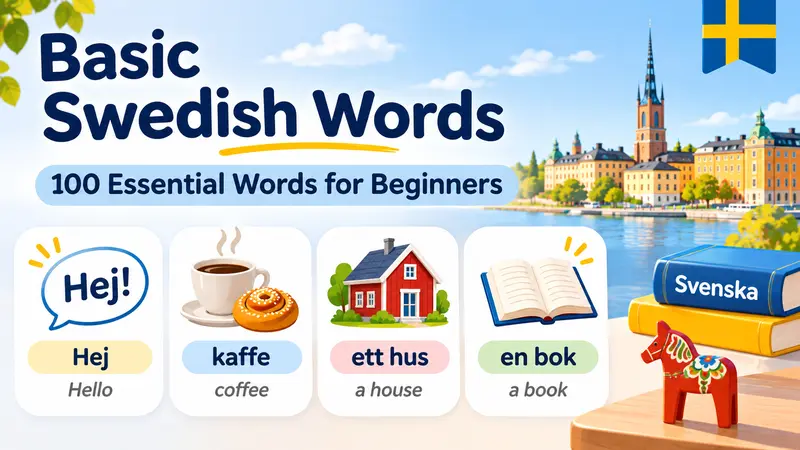
Learning a new language becomes much easier when you start with words you can actually use.
If you’re beginning to learn Swedish, you don’t need to memorize thousands of words immediately. A small collection of common words can help you understand simple conversations, recognize familiar expressions, and start building your own sentences.
This guide introduces 100 basic Swedish words for beginners, organized into practical categories such as greetings, pronouns, verbs, family, food, numbers, and everyday objects.
You’ll also learn how to pronounce important Swedish sounds, use vocabulary in natural sentences, and create a simple daily practice routine.
Whether you’re learning Swedish for travel, work, family, or personal interest, these words provide a useful starting point.
Table of Contents
Open Table of Contents
- How to Learn Basic Swedish Words Effectively
- Swedish Pronunciation Basics
- 100 Basic Swedish Words for Beginners
- 1. Swedish Greetings and Polite Expressions (1–10)
- 2. Swedish Personal Pronouns (11–20)
- 3. Common Swedish Verbs (21–35)
- 4. Swedish Family and People Words (36–45)
- 5. Swedish Food and Drink Words (46–55)
- 6. Everyday Swedish Objects (56–65)
- 7. Swedish Numbers 1–10 (66–75)
- 8. Swedish Time and Day Words (76–85)
- 9. Common Swedish Adjectives (86–95)
- 10. Essential Swedish Question Words (96–100)
- How to Turn Basic Swedish Words Into Sentences
- Common Mistakes When Learning Swedish Vocabulary
- A 7-Day Swedish Vocabulary Practice Plan
- Swedish Vocabulary Practice Exercises
- Exercise Answers
- Frequently Asked Questions
- What are the most important Swedish words for beginners?
- How many Swedish words should I learn first?
- Is Swedish difficult for English speakers?
- What is the difference between en and ett?
- How do you say hello in Swedish?
- How do you say thank you in Swedish?
- What are the three extra letters in the Swedish alphabet?
- Should I learn Swedish grammar or vocabulary first?
- How can I remember Swedish words more easily?
- Can I learn Swedish without living in Sweden?
- Final Thoughts
How to Learn Basic Swedish Words Effectively
Before memorizing vocabulary, it’s helpful to understand how Swedish words work.
Swedish is a North Germanic language, which means it shares historical roots with English, German, Norwegian, and Danish.
Some Swedish words may already look familiar to English speakers.
For example:
| Swedish | English |
|---|---|
| en bank | a bank |
| ett hotell | a hotel |
| en telefon | a telephone |
| en film | a film |
| en student | a student |
However, familiar spelling doesn’t always mean identical pronunciation.
Swedish has vowel sounds, word stress patterns, and pitch accents that may be unfamiliar to beginners.
For that reason, try to learn new vocabulary through three activities:
- Listen: Hear how the word is pronounced.
- Understand: Connect the word to its meaning.
- Use: Practice the word in a short sentence.
Instead of memorizing only vatten (water), for example, learn a useful expression:
Jag vill ha vatten. — I want some water.
Learning words in context makes it easier to understand how they work in everyday Swedish.
Swedish Pronunciation Basics
Swedish uses the Latin alphabet with three additional letters:
Å, Ä, and Ö
These letters are not simply accented versions of A and O. They represent distinct sounds and are treated as separate letters in the Swedish alphabet.
The Three Special Swedish Letters
| Letter | Example | Meaning | Pronunciation guidance |
|---|---|---|---|
| Å | år | year | Often similar to the vowel in British English “law” |
| Ä | äpple | apple | Often similar to the vowel in “bed” |
| Ö | ö | island | A rounded front vowel without a close standard English equivalent |
These comparisons are approximate. Actual pronunciation varies with surrounding sounds and Swedish dialect.
Listen to these examples:
År — year
Äpple — apple
Ö — island
Long and Short Vowels
Swedish distinguishes between long and short vowel sounds.
Vowel length can change the meaning of a word.
For example:
| Swedish | English |
|---|---|
| tak | roof |
| tack | thanks |
| glas | glass |
| glass | ice cream |
The pronunciation differences involve both vowel length and vowel quality.
In many stressed syllables, a long vowel is followed by a relatively short consonant, while a short vowel is followed by a longer consonant.
This is a useful beginner pattern, although Swedish pronunciation has exceptions.
Word Stress and Pitch Accent
Swedish also uses word stress and, in many dialects, two lexical pitch-accent patterns.
These patterns contribute to the characteristic melody of spoken Swedish.
Beginners do not need to master pitch accent immediately.
Focus first on:
- Recognizing familiar words.
- Distinguishing long and short vowels.
- Listening to natural Swedish pronunciation.
- Repeating complete words and expressions.
As your listening skills improve, you can pay more attention to Swedish rhythm and intonation.
100 Basic Swedish Words for Beginners
The following vocabulary is divided into ten categories.
The list contains exactly 100 numbered entries.
Some entries are short expressions rather than single dictionary words because they function as useful everyday vocabulary.
For nouns, the indefinite article en or ett is included where appropriate.
This helps you begin learning Swedish noun gender from the start.
1. Swedish Greetings and Polite Expressions (1–10)
Greetings are among the first Swedish expressions worth learning.
| # | Swedish | English |
|---|---|---|
| 1 | Hej | Hello / Hi |
| 2 | Hallå | Hello |
| 3 | God morgon | Good morning |
| 4 | God kväll | Good evening |
| 5 | Hej då | Goodbye |
| 6 | Vi ses | See you |
| 7 | Tack | Thank you |
| 8 | Tack så mycket | Thank you very much |
| 9 | Ursäkta | Excuse me |
| 10 | Förlåt | Sorry |
How to Use These Expressions
Hej is one of the most common Swedish greetings.
It works in both casual and many everyday professional situations.
Hej! — Hello!
For a more specific morning greeting, you can say:
God morgon! — Good morning!
To thank someone:
Tack så mycket! — Thank you very much!
When leaving:
Hej då! — Goodbye!
For more examples and usage differences, see our guides to saying hello in Swedish, good morning in Swedish, and thank you in Swedish.
2. Swedish Personal Pronouns (11–20)
Personal pronouns help you identify who is speaking, listening, or being discussed.
| # | Swedish | English |
|---|---|---|
| 11 | jag | I |
| 12 | du | you (singular) |
| 13 | han | he |
| 14 | hon | she |
| 15 | den | it (common-gender noun) |
| 16 | det | it (neuter noun) |
| 17 | vi | we |
| 18 | ni | you (plural) |
| 19 | de | they |
| 20 | man | one / people in general |
Important Pronunciation Notes
In everyday spoken Swedish, jag is often pronounced approximately like ya, although the exact pronunciation varies.
The pronoun de is commonly pronounced like dom in ordinary speech.
The distinction between den and det is also important.
Swedish nouns belong to two grammatical genders:
- Common gender: en nouns.
- Neuter gender: ett nouns.
The pronouns den and det can refer back to nouns of the corresponding gender.
For example:
En bok. Den är bra.
A book. It is good.
Ett hus. Det är stort.
A house. It is big.
The pronoun man is used for general statements.
For example:
Man lär sig genom att öva.
You learn through practice.
Here, man means people in general rather than a particular man.
Useful Pronoun Examples
Jag heter Anna. — My name is Anna.
Vi lär oss svenska. — We are learning Swedish.
De bor i Stockholm. — They live in Stockholm.
3. Common Swedish Verbs (21–35)
Verbs are essential because they allow you to describe actions, experiences, and everyday activities.
The following verbs appear in their infinitive forms.
| # | Swedish | English |
|---|---|---|
| 21 | vara | to be |
| 22 | ha | to have |
| 23 | göra | to do / make |
| 24 | gå | to walk / go |
| 25 | komma | to come |
| 26 | äta | to eat |
| 27 | dricka | to drink |
| 28 | prata | to speak / talk |
| 29 | läsa | to read |
| 30 | skriva | to write |
| 31 | se | to see |
| 32 | höra | to hear |
| 33 | vilja | to want |
| 34 | kunna | to be able to / can |
| 35 | lära | to teach / learn, depending on construction |
How Swedish Verbs Work
Unlike many European languages, Swedish verbs do not change their present-tense form according to the subject.
For example, the verb prata (to speak) becomes pratar in the present tense.
| Swedish | English |
|---|---|
| Jag pratar | I speak |
| Du pratar | You speak |
| Han pratar | He speaks |
| Vi pratar | We speak |
| De pratar | They speak |
The verb form remains the same.
Listen to an example:
Jag pratar svenska. — I speak Swedish.
Another useful verb is äta (to eat).
Jag äter frukost. — I eat breakfast.
The verb vilja is particularly useful when expressing what you want.
In the present tense, it becomes vill.
Jag vill lära mig svenska. — I want to learn Swedish.
Notice the construction lära sig.
In Swedish, learning something is commonly expressed using the reflexive construction lära sig.
For example:
- Jag lär mig svenska. — I’m learning Swedish.
- Du lär dig svenska. — You’re learning Swedish.
- Vi lär oss svenska. — We’re learning Swedish.
The verb lära can also mean “to teach” in appropriate constructions.
4. Swedish Family and People Words (36–45)
Family vocabulary is useful when introducing yourself and talking about people in your life.
| # | Swedish | English |
|---|---|---|
| 36 | en mamma | a mom |
| 37 | en pappa | a dad |
| 38 | en förälder | a parent |
| 39 | ett barn | a child |
| 40 | en son | a son |
| 41 | en dotter | a daughter |
| 42 | en bror | a brother |
| 43 | en syster | a sister |
| 44 | en vän | a friend |
| 45 | en familj | a family |
Example Sentences
Det här är min familj. — This is my family.
Jag har en bror. — I have a brother.
Hon är min vän. — She is my friend.
A Note About Swedish Family Vocabulary
Swedish has particularly specific words for grandparents.
For example:
- Mormor — maternal grandmother.
- Morfar — maternal grandfather.
- Farmor — paternal grandmother.
- Farfar — paternal grandfather.
These words distinguish whether a grandparent is related through your mother or father.
They are useful additions once you’ve learned the basic family vocabulary above.
5. Swedish Food and Drink Words (46–55)
Food vocabulary is useful in cafés, restaurants, supermarkets, and everyday conversations.
| # | Swedish | English |
|---|---|---|
| 46 | vatten | water |
| 47 | kaffe | coffee |
| 48 | te | tea |
| 49 | mjölk | milk |
| 50 | bröd | bread |
| 51 | ost | cheese |
| 52 | ett äpple | an apple |
| 53 | en banan | a banana |
| 54 | fisk | fish |
| 55 | kött | meat |
For common food and drink nouns, the table shows the everyday word without always including an article. Some can be used as uncountable nouns in their basic meanings.
Useful Food Expressions
Jag vill ha en kaffe. — I would like a coffee.
Kan jag få ett glas vatten? — Can I have a glass of water?
Jag äter ett äpple. — I’m eating an apple.
Swedish Coffee Culture: Fika
You may hear the word fika when learning Swedish.
Fika refers to a social coffee break, often involving coffee or another drink and sometimes something sweet to eat.
It can also be used as a verb.
For example:
Ska vi fika?
Shall we have a coffee break?
Learning everyday vocabulary alongside cultural expressions can make Swedish more meaningful.
6. Everyday Swedish Objects (56–65)
These words describe familiar objects and places.
| # | Swedish | English |
|---|---|---|
| 56 | ett hus | a house |
| 57 | en dörr | a door |
| 58 | ett fönster | a window |
| 59 | ett bord | a table |
| 60 | en stol | a chair |
| 61 | en bok | a book |
| 62 | en telefon | a phone |
| 63 | en dator | a computer |
| 64 | en bil | a car |
| 65 | en nyckel | a key |
Why En and Ett Matter
Swedish has two grammatical genders.
Most nouns belong to the common gender and use en.
Other nouns belong to the neuter gender and use ett.
For example:
- En bok — a book.
- En bil — a car.
- Ett hus — a house.
- Ett bord — a table.
There is no single simple rule that predicts the gender of every Swedish noun.
The best beginner strategy is to memorize the article together with the noun.
Instead of learning only bok, learn en bok.
Instead of learning only hus, learn ett hus.
Example Sentences
Jag har en bok. — I have a book.
Det finns en bil utanför huset. — There is a car outside the house.
Var är min telefon? — Where is my phone?
7. Swedish Numbers 1–10 (66–75)
Numbers are useful for shopping, telling the time, discussing prices, and exchanging information.
| # | Swedish | English |
|---|---|---|
| 66 | ett | one |
| 67 | två | two |
| 68 | tre | three |
| 69 | fyra | four |
| 70 | fem | five |
| 71 | sex | six |
| 72 | sju | seven |
| 73 | åtta | eight |
| 74 | nio | nine |
| 75 | tio | ten |
Important: Ett and En
The number one can appear as en or ett, depending on the noun.
For example:
En bok — one book / a book.
Ett hus — one house / a house.
When counting independently, ett is commonly used for the number one.
Number Examples
Jag har två böcker. — I have two books.
Vi är tre personer. — We are three people.
Det kostar tio kronor. — It costs ten kronor.
Try counting everyday objects in Swedish.
For example, count the chairs in your room, the books on your desk, or the cups in your kitchen.
8. Swedish Time and Day Words (76–85)
These words help you discuss daily routines and schedules.
| # | Swedish | English |
|---|---|---|
| 76 | idag | today |
| 77 | imorgon | tomorrow |
| 78 | igår | yesterday |
| 79 | nu | now |
| 80 | senare | later |
| 81 | morgon | morning |
| 82 | kväll | evening |
| 83 | natt | night |
| 84 | dag | day |
| 85 | vecka | week |
Example Sentences
Vi ses imorgon. — See you tomorrow.
Jag arbetar idag. — I’m working today.
Jag kommer senare. — I’ll come later.
Useful Time Expressions
Swedish also has common expressions such as:
| Swedish | English |
|---|---|
| i morse | this morning |
| ikväll | tonight / this evening |
| inatt | tonight / during the night |
| varje dag | every day |
| nästa vecka | next week |
| förra veckan | last week |
Notice the difference between morgon and imorgon.
Morgon means “morning.”
Imorgon means “tomorrow.”
The context and spelling matter.
9. Common Swedish Adjectives (86–95)
Adjectives help you describe people, objects, places, and experiences.
| # | Swedish | English |
|---|---|---|
| 86 | bra | good |
| 87 | dålig | bad |
| 88 | stor | big |
| 89 | liten | small |
| 90 | ny | new |
| 91 | gammal | old |
| 92 | varm | warm |
| 93 | kall | cold |
| 94 | glad | happy |
| 95 | trött | tired |
Swedish Adjective Agreement
Many Swedish adjectives change form depending on the noun they describe.
For example:
| Swedish | English |
|---|---|
| en stor bil | a big car |
| ett stort hus | a big house |
| stora bilar | big cars |
The adjective stor changes to stort with a singular neuter noun and stora in the indefinite plural.
Some adjectives behave differently.
For example, bra does not change in the same way.
En bra bok. — A good book.
Ett bra hus. — A good house.
Example Sentences
Jag är glad. — I’m happy.
Det är kallt idag. — It’s cold today.
Huset är stort. — The house is big.
10. Essential Swedish Question Words (96–100)
Question words are particularly useful because they help you begin real conversations.
| # | Swedish | English |
|---|---|---|
| 96 | vad | what |
| 97 | vem | who |
| 98 | var | where |
| 99 | när | when |
| 100 | varför | why |
Examples
Vad heter du? — What’s your name?
Var bor du? — Where do you live?
När börjar filmen? — When does the movie start?
Another useful question word is hur, meaning “how.”
For example:
Hur mår du?
How are you?
Although hur is not included in the numbered list of 100 words, it is worth learning alongside the other question words.
How to Turn Basic Swedish Words Into Sentences
Knowing individual words is a useful beginning, but the next step is learning how to combine them.
Fortunately, many basic Swedish sentences follow a structure familiar to English speakers.
Subject + Verb + Object
Consider:
Jag läser en bok.
I am reading a book.
The structure is:
| Part | Swedish | Function |
|---|---|---|
| Subject | Jag | I |
| Verb | läser | read / am reading |
| Object | en bok | a book |
Another example:
Hon dricker kaffe.
She drinks coffee.
This basic sentence pattern is a useful starting point.
Swedish Present Tense
Swedish verbs generally use the same present-tense form regardless of the subject.
For example:
| Swedish | English |
|---|---|
| Jag bor i Sverige. | I live in Sweden. |
| Du bor i Sverige. | You live in Sweden. |
| Han bor i Sverige. | He lives in Sweden. |
| Vi bor i Sverige. | We live in Sweden. |
Notice that bor does not change.
This makes basic present-tense conjugation relatively approachable.
Negation With Inte
To make a simple main-clause statement negative, Swedish commonly places inte after the finite verb.
For example:
Jag pratar svenska.
I speak Swedish.
Jag pratar inte svenska.
I don’t speak Swedish.
Another example:
Hon dricker kaffe.
She drinks coffee.
Hon dricker inte kaffe.
She doesn’t drink coffee.
The placement of inte changes in some other sentence structures, including subordinate clauses, but this pattern is useful for beginners.
The Swedish V2 Word Order Rule
Swedish is often described as a V2 language.
This means that the finite verb normally appears in the second position of a main declarative clause.
Compare:
Jag dricker kaffe på morgonen.
I drink coffee in the morning.
På morgonen dricker jag kaffe.
In the morning, I drink coffee.
In the second sentence, the time expression comes first, followed by the verb dricker.
The subject jag comes after the verb.
This is one of the most important differences between Swedish and English word order.
You don’t need to master every word-order rule immediately, but recognizing this pattern early can prevent common mistakes.
Common Mistakes When Learning Swedish Vocabulary
Beginners often encounter similar difficulties when learning their first Swedish words.
1. Forgetting En and Ett
Instead of memorizing only the noun, try to remember its article.
For example:
- En bok.
- Ett hus.
- En stol.
- Ett bord.
This will help later when you learn adjective agreement and definite noun forms.
2. Assuming Swedish Words Sound Like English
Some Swedish words resemble English words but have different pronunciation.
For example:
- Glass means ice cream.
- Bra means good.
- Rolig means fun or funny.
Listen to the Swedish pronunciation rather than relying only on familiar spelling.
3. Translating Every Word Directly
Swedish expressions do not always match English word for word.
For example:
Jag heter Anna.
Literally, the structure is closer to “I am called Anna,” but the natural English translation is “My name is Anna.”
Learning complete expressions helps you avoid awkward literal translations.
4. Memorizing Too Many Words at Once
Learning 100 words in one session is unlikely to be the most effective approach for most beginners.
Instead, divide the vocabulary into manageable groups.
Review familiar words before introducing new ones.
5. Ignoring Pronunciation
Swedish vowel length, vowel quality, and stress can affect meaning.
For example, tak and tack are different words.
Listening and repeating aloud can help you notice distinctions that are not obvious from spelling alone.
6. Learning Words Without Using Them
Memorizing a vocabulary list is only one part of language learning.
Try to use new words in simple sentences.
For example, after learning bok, läsa, and jag, practice:
Jag läser en bok.
I am reading a book.
This connects vocabulary with grammar and meaningful communication.
A 7-Day Swedish Vocabulary Practice Plan
You don’t need to learn all 100 words immediately.
The following plan provides a manageable starting point.
| Day | Focus | Practice activity |
|---|---|---|
| Monday | Greetings | Practice greetings and polite expressions |
| Tuesday | Pronouns | Make simple sentences using jag, du, and vi |
| Wednesday | Verbs | Practice common actions |
| Thursday | Family and food | Describe people and everyday meals |
| Friday | Objects and numbers | Name and count familiar objects |
| Saturday | Time and adjectives | Describe your day and surroundings |
| Sunday | Questions and review | Practice short conversations |
Day 1: Greetings
Learn a few common expressions:
- Hej.
- God morgon.
- Tack.
- Hej då.
Practice saying them aloud in different situations.
Day 2: Pronouns
Focus on:
- Jag.
- Du.
- Han.
- Hon.
- Vi.
Combine them with simple verbs.
For example:
Jag läser. — I read.
Hon arbetar. — She works.
Vi pratar. — We talk.
Day 3: Common Verbs
Choose five useful verbs.
For example:
- Äta.
- Dricka.
- Läsa.
- Skriva.
- Prata.
Learn their present-tense forms and create simple sentences.
Day 4: Family and Food
Practice describing your family.
Then name common foods and drinks.
For example:
Jag har en syster.
I have a sister.
Jag dricker kaffe.
I drink coffee.
Day 5: Objects and Numbers
Look around your home and name familiar objects.
Count books, chairs, or other items.
For example:
Jag har tre böcker.
I have three books.
Day 6: Time and Adjectives
Practice describing your day.
For example:
Det är kallt idag.
It’s cold today.
Jag är trött.
I’m tired.
Day 7: Questions and Review
Review the vocabulary you’ve learned.
Practice asking and answering questions.
For example:
Vad heter du?
What’s your name?
Var bor du?
Where do you live?
Don’t worry if you cannot remember every word.
The goal is to build familiarity and develop a routine you can maintain.
Swedish Vocabulary Practice Exercises
Test your understanding with these beginner-friendly exercises.
Try answering before checking the solutions.
Exercise 1: Match the Swedish Words
Match each Swedish word with its English meaning.
| Swedish | English options |
|---|---|
| 1. vatten | A. book |
| 2. bok | B. water |
| 3. vän | C. house |
| 4. hus | D. friend |
| 5. äpple | E. apple |
Exercise 2: Fill in the Missing Word
Complete each sentence.
- Jag ______ svenska. (speak)
- Hon ______ kaffe. (drinks)
- Vi ______ i Sverige. (live)
- Jag ______ en bok. (have)
- Det är ______ idag. (cold)
Exercise 3: Choose En or Ett
Choose the correct indefinite article.
- ______ bok
- ______ hus
- ______ äpple
- ______ bil
- ______ bord
Exercise 4: Translate Into Swedish
Translate the following sentences.
- My name is Anna.
- I want water.
- We are learning Swedish.
- Where do you live?
- I have two books.
Exercise Answers
Exercise 1
- vatten — B. water
- bok — A. book
- vän — D. friend
- hus — C. house
- äpple — E. apple
Exercise 2
- Jag pratar svenska.
- Hon dricker kaffe.
- Vi bor i Sverige.
- Jag har en bok.
- Det är kallt idag.
Exercise 3
- En bok.
- Ett hus.
- Ett äpple.
- En bil.
- Ett bord.
Exercise 4
- Jag heter Anna.
- Jag vill ha vatten.
- Vi lär oss svenska.
- Var bor du?
- Jag har två böcker.
Frequently Asked Questions
What are the most important Swedish words for beginners?
Some useful starting words include hej (hello), tack (thank you), ja (yes), nej (no), jag (I), du (you), vara (to be), and ha (to have).
Beginners should also learn common verbs, question words, and vocabulary related to everyday activities.
How many Swedish words should I learn first?
Learning 100 common words is a useful initial goal, but there is no universal number that guarantees conversational ability.
Focus on words you can recognize, remember, and use in simple sentences.
Is Swedish difficult for English speakers?
Swedish shares many similarities with English, including Germanic vocabulary and some familiar sentence patterns.
However, pronunciation, noun gender, adjective agreement, and word order can present challenges.
With regular practice, beginners can gradually become comfortable with these features.
What is the difference between en and ett?
Swedish nouns belong to two grammatical genders.
Common-gender nouns generally use en, while neuter nouns use ett.
For example:
- En bok — a book.
- Ett hus — a house.
Learning the article together with each noun is a useful strategy.
How do you say hello in Swedish?
The most common everyday greeting is hej.
Other greetings include hallå, god morgon, and god kväll, depending on the situation.
How do you say thank you in Swedish?
The most common word is tack.
You can also say tack så mycket to express stronger thanks.
What are the three extra letters in the Swedish alphabet?
The Swedish alphabet contains 29 letters.
The three additional letters are Å, Ä, and Ö.
They are separate letters with their own pronunciation patterns.
Should I learn Swedish grammar or vocabulary first?
Vocabulary and grammar are most useful when learned together.
Start with common words and simple sentence patterns.
As your vocabulary grows, gradually introduce more grammar.
How can I remember Swedish words more easily?
Try combining:
- Listening practice.
- Speaking aloud.
- Short example sentences.
- Spaced review.
- Reading.
- Everyday conversation.
Revisiting words in different contexts can make them easier to remember and use.
Can I learn Swedish without living in Sweden?
Yes.
You can develop Swedish skills through structured learning materials, audio, reading, online lessons, and conversations with Swedish speakers.
Living in Sweden may provide additional opportunities for immersion, but it is not a requirement for beginning to learn the language.
Final Thoughts
Learning basic Swedish vocabulary is an important first step toward understanding and speaking the language.
The 100 words in this guide cover common greetings, pronouns, verbs, family members, food, objects, numbers, time expressions, adjectives, and question words.
Rather than trying to memorize everything immediately, focus on a few words at a time.
Listen to their pronunciation, practice saying them aloud, and use them in short sentences.
As you become more comfortable, connect these words with additional vocabulary and grammar.
A strong foundation in everyday Swedish will make it easier to understand conversations, express simple ideas, and continue developing your language skills.