If you want to say one person, two books, or three cups of tea in Mandarin Chinese, you usually cannot put the number directly before the noun.
You need a measure word between them.
For example:
一个人
yí ge rén
one person
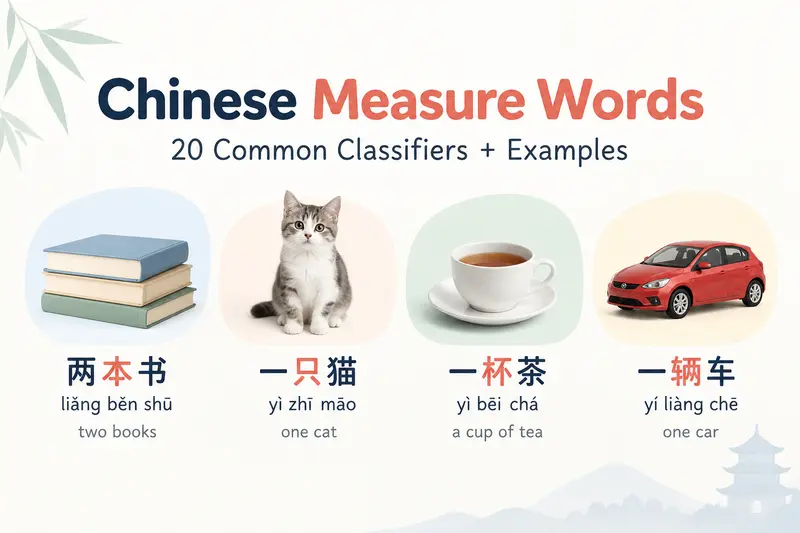
两本书
liǎng běn shū
two books
Here, 个 (ge) and 本 (běn) are measure words.
Chinese has many of them, but beginners do not need to memorize hundreds.
Learning a small group of common measure words will cover a large number of everyday situations.
This guide focuses on 20 useful Chinese measure words, how to choose between them, and how to use them naturally.
What Are Chinese Measure Words?
Chinese measure words are words placed between a number or certain determiners and a noun.
They are also commonly called classifiers.
The basic pattern is:
Number + Measure Word + Noun
For example:
三个人
sān ge rén
three people
五本书
wǔ běn shū
five books
两杯茶
liǎng bēi chá
two cups of tea
The measure word depends on what you are counting.
For example, books commonly use 本 (běn):
一本书
yì běn shū
one book
Flat objects such as tickets commonly use 张 (zhāng):
一张票
yì zhāng piào
one ticket
Vehicles commonly use 辆 (liàng):
一辆车
yí liàng chē
one vehicle
This may feel strange if your native language is English, but the pattern becomes natural once you start learning nouns together with their common measure words.
The Basic Chinese Measure Word Pattern
The most important structure to remember is:
Number + Measure Word + Noun
This is the standard counting pattern in Mandarin. The Chinese Grammar Wiki also provides a useful grammar reference if you want to explore Chinese measure words beyond the beginner examples in this guide.
Here are a few examples:
| Chinese | Pinyin | Meaning |
|---|---|---|
| 一个人 | yí ge rén | one person |
| 两本书 | liǎng běn shū | two books |
| 三张票 | sān zhāng piào | three tickets |
| 四杯茶 | sì bēi chá | four cups of tea |
| 五只猫 | wǔ zhī māo | five cats |
Notice that the measure word changes according to the noun.
You do not normally say:
两书
Instead, you say:
两本书
because 本 is the normal measure word for books.
Measure Words with 这 and 那
Measure words are also commonly used after:
这 (zhè) — this
and:
那 (nà) — that
The pattern becomes:
这 / 那 + Measure Word + Noun
For example:
这个人
zhè ge rén
this person
那本书
nà běn shū
that book
Measure Words with 几
几 (jǐ) means how many or a few/several, depending on context.
It also comes before a measure word:
几个人
jǐ ge rén
how many people
几本书
jǐ běn shū
how many books
This gives you another useful pattern:
几 + Measure Word + Noun
20 Common Chinese Measure Words
You will encounter many classifiers as your Chinese improves.
For beginners, these 20 are a practical place to start.
| Measure word | Pinyin | Common use | Example |
|---|---|---|---|
| 个 | ge | general classifier | 一个人 |
| 位 | wèi | people, politely | 一位老师 |
| 本 | běn | books and bound volumes | 两本书 |
| 张 | zhāng | flat or spread-out objects | 三张票 |
| 只 | zhī | many animals, one of a pair | 一只猫 |
| 条 | tiáo | many long or narrow things | 两条鱼 |
| 杯 | bēi | cups or glasses of drinks | 一杯茶 |
| 瓶 | píng | bottles | 一瓶水 |
| 碗 | wǎn | bowls | 一碗饭 |
| 件 | jiàn | clothing, matters, certain items | 一件衣服 |
| 双 | shuāng | pairs | 一双鞋 |
| 辆 | liàng | vehicles | 一辆车 |
| 台 | tái | machines and devices | 一台电脑 |
| 家 | jiā | businesses and establishments | 一家公司 |
| 间 | jiān | rooms | 一间房 |
| 把 | bǎ | many handled objects | 一把伞 |
| 份 | fèn | portions, copies, sets | 一份早餐 |
| 块 | kuài | pieces, chunks, blocks | 一块蛋糕 |
| 棵 | kē | trees and many plants | 一棵树 |
| 层 | céng | floors and layers | 三层楼 |
Let’s look at how each one works.
1. 个 ge — The General Measure Word
个 (ge) is the most useful Chinese measure word for beginners.
It is used with many nouns, especially people and a wide range of everyday objects or concepts.
For example:
一个人
yí ge rén
one person
三个苹果
sān ge píngguǒ
three apples
You will hear 个 constantly in everyday Mandarin.
It is a useful fallback when you are still learning classifiers, but it should not replace every specific measure word.
2. 位 wèi — A Polite Measure Word for People
位 (wèi) is used for people when you want to sound respectful or polite.
For example:
一位老师
yí wèi lǎoshī
one teacher
You may hear 位 when referring politely to:
- teachers
- guests
- customers
- professionals
- unfamiliar people
Compare:
一个老师
and:
一位老师
Both can refer to a teacher, but 位 adds respect.
3. 本 běn — Books and Bound Volumes
Use 本 (běn) for books and similar bound publications.
For example:
两本书
liǎng běn shū
two books
Another example is:
三本词典
sān běn cídiǎn
three dictionaries
A good beginner habit is to learn:
书 → 本
as a pair.
4. 张 zhāng — Flat or Spread-Out Objects
张 (zhāng) is commonly used with flat objects and things that spread out over a surface.
Common nouns include:
- paper
- tickets
- photographs
- tables
- beds
- maps
For example:
三张票
sān zhāng piào
three tickets
Another common phrase is:
一张照片
yì zhāng zhàopiàn
one photograph
Do not interpret “flat” as an absolute rule. It is a useful memory aid, but Chinese measure-word combinations are conventional and should ultimately be learned with the nouns they accompany.
5. 只 zhī — Many Animals and One of a Pair
只 (zhī) is a common measure word for many animals.
For example:
一只猫
yì zhī māo
one cat
You can also hear it with animals such as dogs and birds.
只 has other classifier uses too, including referring to one member of a pair.
For beginners, remembering it as an important animal classifier is a useful starting point.
6. 条 tiáo — Long or Narrow Things
条 (tiáo) is associated with many things that are long, narrow, flexible, or extended.
For example:
两条鱼
liǎng tiáo yú
two fish
It is also used with many nouns such as:
- roads
- rivers
- trousers
- certain long objects
Again, shape helps explain the pattern, but it is better to learn common combinations rather than assume every long object automatically takes 条.
7. 杯 bēi — Cups and Glasses of Drinks
杯 (bēi) measures drinks by the cup or glass.
For example:
一杯茶
yì bēi chá
a cup of tea
You can also say:
一杯咖啡
yì bēi kāfēi
a cup of coffee
This is especially useful when ordering drinks.
8. 瓶 píng — Bottles
瓶 (píng) is used when something is measured by the bottle.
For example:
一瓶水
yì píng shuǐ
a bottle of water
Compare:
一杯水 — a glass or cup of water
一瓶水 — a bottle of water
The noun 水 stays the same.
The measure word tells you the container or quantity.
9. 碗 wǎn — Bowls
碗 (wǎn) can function as a measure word for bowls of food.
For example:
一碗饭
yì wǎn fàn
a bowl of rice
You will also encounter it with noodles, soup, and other foods served in bowls.
10. 件 jiàn — Clothing and Matters
件 (jiàn) is commonly used for pieces of clothing.
For example:
一件衣服
yí jiàn yīfu
one item of clothing
But 件 is not limited to clothing.
It can also classify matters, events, or certain individual items.
That is a good example of why Chinese classifiers cannot always be reduced to a single physical rule.
11. 双 shuāng — Pairs
Use 双 (shuāng) for things that form a pair.
For example:
一双鞋
yì shuāng xié
a pair of shoes
It is useful for naturally paired objects and some body parts.
The important idea is that 双 counts the pair as a unit.
12. 辆 liàng — Vehicles
辆 (liàng) is a common measure word for wheeled vehicles.
For example:
一辆车
yí liàng chē
one vehicle
Another example:
两辆汽车
liǎng liàng qìchē
two cars
This is a particularly useful classifier to recognize when talking about transportation.
13. 台 tái — Machines and Devices
台 (tái) is used with many machines, appliances, and electronic devices.
For example:
一台电脑
yì tái diànnǎo
one computer
You may also encounter 台 with televisions and various pieces of equipment.
14. 家 jiā — Businesses and Establishments
You may already know 家 (jiā) as the word for home or family.
It can also function as a measure word for businesses and organizations.
For example:
一家公司
yì jiā gōngsī
one company
You can encounter it with businesses such as shops, restaurants, and companies.
15. 间 jiān — Rooms
间 (jiān) is commonly used for rooms and certain enclosed spaces.
For example:
一间房
yì jiān fáng
one room
This makes 间 useful when talking about homes, hotels, offices, and classrooms.
16. 把 bǎ — Handled or Graspable Objects
把 (bǎ) is used with a number of objects that can be held or have handles.
A common example is:
一把伞
yì bǎ sǎn
one umbrella
You will also encounter 把 with objects such as certain knives, chairs, and other graspable items.
As with other classifiers, learn the common noun pairings instead of applying the physical description mechanically.
17. 份 fèn — Portions, Copies, and Sets
份 (fèn) is useful for portions, copies, documents, jobs, gifts, and other things viewed as a portion or unit.
For example:
一份早餐
yí fèn zǎocān
one breakfast serving
This is a useful word in restaurants and other everyday situations.
18. 块 kuài — Pieces and Chunks
块 (kuài) can measure pieces, chunks, or blocks of something.
For example:
一块蛋糕
yí kuài dàngāo
a piece of cake
You may also recognize 块 from conversational Chinese when talking about money.
19. 棵 kē — Trees and Plants
棵 (kē) is used with trees and many plants.
For example:
一棵树
yì kē shù
one tree
This is a more specific classifier, but it is easy to remember once you connect:
树 → 棵
20. 层 céng — Floors and Layers
层 (céng) is used for layers and floors or storeys of a building.
For example:
三层楼
sān céng lóu
a three-storey building / three floors
The core idea behind 层 is one level or layer on top of another.
Can You Just Use 个 for Everything?
This is one of the most common beginner questions.
The short answer is:
No, but 个 can help you while you are learning.
Because 个 is extremely common, beginners sometimes start using it before every noun.
People may still understand what you mean in many situations, but that does not make every combination natural Mandarin.
For example:
两本书
is the normal way to say two books.
A learner who substitutes 个 has missed the normal classifier 本.
Similarly:
一辆车
uses 辆 for a vehicle.
And:
一张票
uses 张 for a ticket.
A better learning strategy is:
Do not memorize only the noun. Learn the noun together with a common measure word.
Instead of learning:
书 = book
learn:
一本书 = one book
Instead of:
猫 = cat
learn:
一只猫 = one cat
This helps the correct classifier become part of your vocabulary from the beginning.
两 vs 二 with Chinese Measure Words
Chinese has two important forms associated with the number two:
二 (èr)
and:
两 (liǎng)
Beginners often wonder which one to use.
Before a measure word, 两 is generally the form you will need in ordinary counting phrases.
For example:
两个人
liǎng ge rén
two people
两本书
liǎng běn shū
two books
两杯茶
liǎng bēi chá
two cups of tea
二, meanwhile, is used in contexts such as counting, digits, and ordinal numbers.
For example:
第二
dì èr
second
So for a beginner, this rule of thumb is useful:
Two + measure word → usually 两
If you already know the basic numbers, see our Chinese numbers 1–10 guide for a refresher.
Why Does 一 Sound Different in These Phrases?
You may have noticed something interesting in the pinyin.
The character:
一
is the number one and has the citation tone yī.
But in natural Mandarin, its tone can change depending on the tone that follows it.
That is why you may see:
一个人 — yí ge rén
but:
一本书 — yì běn shū
This is a pronunciation change, not a different number.
The character is still 一.
If tone changes like this are new to you, our Pinyin tone marks guide explains Mandarin tones in more detail.
Common Beginner Mistakes
Leaving Out the Measure Word
A common mistake is putting a number directly before a noun.
Instead of trying to build Chinese according to English word order, remember:
Number + Measure Word + Noun
So:
两本书
not simply a direct equivalent of “two + books.”
Using 个 for Every Noun
Using 个 may sometimes get your meaning across, but specific classifiers are an important part of natural Mandarin.
Start with the high-frequency combinations.
For example:
书 → 本
猫 → 只
票 → 张
车 → 辆
鞋 → 双
You do not need to learn every classifier at once.
Saying 二 When 两 Is More Natural
Before ordinary measure words, beginners should become comfortable with phrases such as:
两个人
两本书
两杯水
rather than automatically using 二 every time they mean “two.”
Memorizing Measure Words Without Nouns
A list like:
本 张 条 辆 把
is difficult to remember because it lacks context.
Instead, memorize:
一本书
一张票
一条鱼
一辆车
一把伞
The noun gives the classifier meaning.
Treating the Rules as Perfect Categories
It is tempting to learn:
long = 条
or:
flat = 张
These descriptions are useful, but they are not universal mathematical rules.
Measure words are part of vocabulary and usage.
The safest approach is to learn common combinations and gradually develop an intuition for the broader patterns.
How to Remember Chinese Measure Words
You do not need to memorize a dictionary of classifiers.
Use these three strategies instead.
Learn the Whole Phrase
Learn:
一本书
rather than:
本 = classifier for books
Learn:
一只猫
rather than:
只 = animal classifier
This gives your brain a complete pattern to retrieve.
Group Similar Uses
Some measure words have useful conceptual associations:
张 → many flat or spread-out things
条 → many long or narrow things
双 → pairs
辆 → vehicles
棵 → trees and plants
These groups make new vocabulary easier to organize.
Listen to the Complete Phrase
Measure words rarely exist alone in real conversation.
Practice hearing:
两本书
as one unit.
The same applies to:
三张票
and:
一杯茶
This helps you learn the classifier, tones, and rhythm together.
Quick Practice
Choose the most natural measure word.
1. Two books
Which should you use?
个 / 本 / 杯
Answer:
两本书
2. One cat
Which should you use?
只 / 辆 / 张
Answer:
一只猫
3. Three tickets
Which should you use?
张 / 棵 / 双
Answer:
三张票
4. One cup of tea
Which should you use?
杯 / 位 / 本
Answer:
一杯茶
5. One car
Which should you use?
辆 / 间 / 碗
Answer:
一辆车
6. One pair of shoes
Which should you use?
双 / 条 / 家
Answer:
一双鞋
7. One teacher in a polite context
Which is the better choice?
位 / 瓶 / 块
Answer:
一位老师
8. A bottle of water
Which should you use?
瓶 / 本 / 棵
Answer:
一瓶水
A Beginner Measure Word Cheat Sheet
If 20 measure words feel like too much, start with these 10:
| Learn this phrase | Remember |
|---|---|
| 一个人 | 个 → general |
| 一位老师 | 位 → polite for people |
| 一本书 | 本 → books |
| 一张票 | 张 → tickets and many flat things |
| 一只猫 | 只 → many animals |
| 一条鱼 | 条 → fish and many long things |
| 一杯茶 | 杯 → cups |
| 一件衣服 | 件 → clothing |
| 一双鞋 | 双 → pairs |
| 一辆车 | 辆 → vehicles |
Once these combinations feel automatic, add the other classifiers gradually.
FAQ
What is a measure word in Chinese?
A Chinese measure word is a word commonly placed between a number or certain determiners and a noun.
For example:
两本书
means two books, and 本 is the measure word.
What is the basic measure word structure in Chinese?
The basic pattern is:
Number + Measure Word + Noun
For example:
三个人
means three people.
What is the most common Chinese measure word?
个 (ge) is the most common general-purpose measure word and is one of the first classifiers beginners learn.
Can I use 个 for every noun?
No.
Although 个 is very common and may sometimes be understood as a fallback, many nouns conventionally use other classifiers.
For example, books normally use 本, while vehicles commonly use 辆.
What measure word do you use for people?
个 is very common for people.
位 is used when you want to refer to someone more politely or respectfully.
What measure word do you use for books?
Use:
本 (běn)
For example:
两本书
means two books.
What measure word do you use for animals?
只 (zhī) is common with many animals.
However, Chinese does not use one single classifier for every animal. For example, fish are commonly counted with 条.
What is the measure word for cars in Chinese?
A common measure word for cars and other wheeled vehicles is:
辆 (liàng)
For example:
一辆车
means one car/vehicle.
What is the difference between 两 and 二?
Both relate to the number two.
两 is generally used before ordinary measure words:
两个人
两本书
二 is used in contexts such as numbers, counting, and ordinal expressions like:
第二
Why do Chinese nouns need measure words?
Measure words are a normal grammatical feature of Mandarin.
They classify or quantify nouns and are commonly required between numbers or certain determiners and nouns.
For learners, the most useful approach is to learn common noun-and-classifier combinations as vocabulary.
How many Chinese measure words do I need to learn?
There is no need for a beginner to memorize every classifier.
Start with common words such as:
个 本 张 只 条 杯 件 双 辆 位
Then add more as you encounter new vocabulary.
What to Learn Next
Chinese measure words become much easier when your numbers are automatic.
If you are still building that foundation, start with our Chinese numbers 1–10 guide.
You will also see pinyin throughout Chinese learning materials. Our Chinese Pinyin guide explains how the system works, while the Pinyin tone marks guide focuses on Mandarin tones and tone notation.
If Chinese characters themselves still feel unfamiliar, read 100 Common Chinese Characters for Beginners and our guide to Chinese character radicals and meanings.
You can also practice individual Chinese characters and pronunciation with the Chinese character pronunciation tool.
Final Thoughts
Chinese measure words may seem like an extra step at first, but you do not need to memorize hundreds of them.
Start with useful combinations:
一个人 — one person
两本书 — two books
三张票 — three tickets
一只猫 — one cat
一杯茶 — a cup of tea
一辆车 — one vehicle
Then learn each new noun together with its usual measure word.
Instead of asking:
What does 本 mean?
train yourself to remember:
一本书
Instead of memorizing 辆 alone, remember:
一辆车
That small change in study method makes Chinese measure words much easier to recall and much more natural to use.