Chinese sentence structure is easier to understand once you stop trying to translate English word for word.
The most basic Mandarin sentence follows the same general order as English:
Subject + Verb + Object
For example:
我喜欢中文
wǒ xǐhuan Zhōngwén
I like Chinese.
But things become more interesting when you add time, place, questions, or negation.
A useful beginner pattern is:
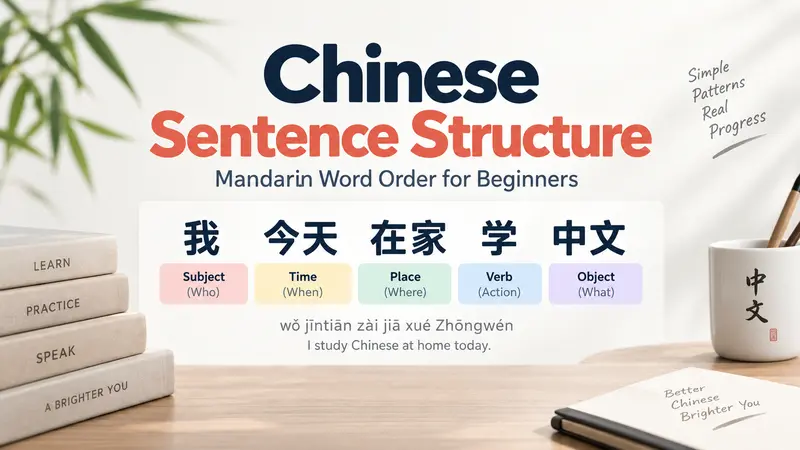
Subject + Time + Place + Verb + Object
For example:
我今天在家学中文
wǒ jīntiān zài jiā xué Zhōngwén
I study Chinese at home today.
You will not use every part of that pattern in every sentence. But understanding where these pieces normally go gives you a strong foundation for building natural Mandarin sentences.
TL;DR
-
Basic Chinese word order commonly follows Subject + Verb + Object.
-
A useful longer pattern for beginners is Subject + Time + Place + Verb + Object.
-
Time expressions usually come before the main action.
-
Locations where an action happens commonly appear before the main verb.
-
是 is not required simply because English uses am, is, or are.
-
Use 不 and 没 before the part being negated, depending on the meaning.
-
Add 吗 to many statements to create yes-or-no questions.
-
Question words such as 什么 and 哪里 generally stay where the missing information would normally appear.
Table of Contents
Open Table of Contents
- Chinese Sentence Structure at a Glance
- 1. Start with Subject + Verb + Object
- 2. Put Time Before the Verb
- 3. Put the Place Before the Main Action
- 4. Combine Time and Place
- 5. How to Use 是 in Chinese Sentences
- 6. Chinese Adjective Sentences Often Use 很
- 7. Put 不 Before the Verb for Many Negative Sentences
- 8. Use 没 for Actions That Did Not Happen
- 9. Turn a Statement into a Yes or No Question with 吗
- 10. Question Words Usually Stay Where the Answer Goes
- 11. Possession with 的
- 12. Measure Words Fit Inside the Sentence
- A Simple Chinese Word Order Formula
- Chinese vs English Word Order
- Common Chinese Word Order Mistakes
- Build Chinese Sentences Step by Step
- Quick Practice
- Beginner Chinese Sentence Structure Cheat Sheet
- FAQ
- What is the basic Chinese sentence structure?
- What is the word order in a longer Chinese sentence?
- Does time come before or after the verb in Chinese?
- Where does the place go in a Chinese sentence?
- Is Chinese always Subject + Verb + Object?
- Why does Chinese put time before the verb?
- Do Chinese adjectives need 是?
- What is the difference between 不 and 没?
- Where do Chinese question words go?
- Is Chinese sentence structure difficult?
- What to Learn Next
- Final Thoughts
Chinese Sentence Structure at a Glance
Here are some of the most useful patterns for beginners.
| Pattern | Chinese | Meaning |
|---|---|---|
| Subject + Verb + Object | 我喜欢中文 | I like Chinese |
| Subject + Time + Verb + Object | 我今天学中文 | I study Chinese today |
| Subject + Place + Verb + Object | 我在家学中文 | I study Chinese at home |
| Subject + Time + Place + Verb + Object | 我今天在家学中文 | I study Chinese at home today |
| Subject + 不 + Verb + Object | 我不喝咖啡 | I don’t drink coffee |
| Subject + 没 + Verb + Object | 我昨天没去学校 | I didn’t go to school yesterday |
| Subject + 很 + Adjective | 她很忙 | She is busy |
| Statement + 吗 | 你喜欢中文吗 | Do you like Chinese? |
Do not try to memorize this table as a grammar formula sheet.
Instead, learn a few basic patterns and then replace individual words to create new sentences.
1. Start with Subject + Verb + Object
The simplest place to begin is:
Subject + Verb + Object
In Chinese grammar, you may see this abbreviated as SVO.
Consider:
我喜欢咖啡
wǒ xǐhuan kāfēi
I like coffee.
Here:
我 — I
喜欢 — like
咖啡 — coffee
You can keep the structure and change the vocabulary:
我喜欢中文
I like Chinese.
我喜欢音乐
I like music.
我喜欢这本书
I like this book.
Another example:
他喝茶
tā hē chá
He drinks tea.
Again:
他 — subject
喝 — verb
茶 — object
This basic word order will appear constantly in beginner Mandarin.
2. Put Time Before the Verb
One important Mandarin word-order habit is putting the time expression before the main verb.
A useful pattern is:
Subject + Time + Verb + Object
For example:
我今天学中文
wǒ jīntiān xué Zhōngwén
I study Chinese today.
Here:
我 — I
今天 — today
学 — study
中文 — Chinese
Another example:
我明天去北京
wǒ míngtiān qù Běijīng
I am going to Beijing tomorrow.
And:
他晚上看电视
tā wǎnshang kàn diànshì
He watches TV in the evening.
Common time expressions include:
| Chinese | Pinyin | Meaning |
|---|---|---|
| 今天 | jīntiān | today |
| 明天 | míngtiān | tomorrow |
| 昨天 | zuótiān | yesterday |
| 早上 | zǎoshang | morning |
| 下午 | xiàwǔ | afternoon |
| 晚上 | wǎnshang | evening |
Time Can Also Come Before the Subject
You may also hear:
今天我在家工作
jīntiān wǒ zài jiā gōngzuò
Today I work at home.
So you should not treat Subject + Time as an unbreakable rule.
For beginners, however, remembering that time normally appears before the action is much more useful than trying to memorize every possible variation.
3. Put the Place Before the Main Action
When you describe where an action happens, a common pattern is:
Subject + 在 + Place + Verb + Object
For example:
我在家学中文
wǒ zài jiā xué Zhōngwén
I study Chinese at home.
Here:
我 — I
在家 — at home
学 — study
中文 — Chinese
Another example:
她在学校看书
tā zài xuéxiào kàn shū
She reads at school.
Or:
我们在饭店吃饭
wǒmen zài fàndiàn chīfàn
We eat at a restaurant.
This is an important difference from many English sentences.
English can naturally say:
I study Chinese at home.
Mandarin commonly puts the location before the action:
我 + 在家 + 学中文
Think of it as setting the scene before describing what happens there.
4. Combine Time and Place
Now we can combine the previous patterns.
A very useful structure is:
Subject + Time + Place + Verb + Object
For example:
我今天在家学中文
wǒ jīntiān zài jiā xué Zhōngwén
I study Chinese at home today.
Break it apart:
| Part | Chinese |
|---|---|
| Subject | 我 |
| Time | 今天 |
| Place | 在家 |
| Verb | 学 |
| Object | 中文 |
Another example:
他明天在学校考试
tā míngtiān zài xuéxiào kǎoshì
He has an exam at school tomorrow.
And:
我们晚上在家吃饭
wǒmen wǎnshang zài jiā chīfàn
We eat at home in the evening.
A helpful beginner memory aid is:
Who → When → Where → What happens
Again, natural Mandarin allows more variation than one formula can capture. But this pattern gives beginners a reliable starting point.
5. How to Use 是 in Chinese Sentences
是 (shì) often means to be when connecting one noun or noun phrase with another.
The pattern is:
A + 是 + B
For example:
我是学生
wǒ shì xuésheng
I am a student.
Another example:
他是我的老师
tā shì wǒ de lǎoshī
He is my teacher.
And:
这是我的书
zhè shì wǒ de shū
This is my book.
A common beginner mistake is assuming that Chinese needs 是 everywhere English uses am, is, or are.
It does not.
That becomes especially important with adjectives.
6. Chinese Adjective Sentences Often Use 很
Suppose you want to say:
She is busy.
A natural beginner sentence is:
她很忙
tā hěn máng
She is busy.
Notice that we do not normally say:
她是很忙
simply because English contains the word is.
Another example:
今天天气很好
jīntiān tiānqì hěn hǎo
The weather is very good today.
Or:
这个房间很大
zhège fángjiān hěn dà
This room is big.
Does 很 Always Mean Very?
很 (hěn) can mean very, but in simple adjective predicates it often functions naturally without carrying the same strong emphasis that English very does.
So:
她很忙
can simply be understood as:
She is busy.
This is a good example of why translating Chinese word by word can be misleading.
7. Put 不 Before the Verb for Many Negative Sentences
One of the easiest ways to make a Chinese sentence negative is 不 (bù).
A common pattern is:
Subject + 不 + Verb + Object
For example:
我不喝咖啡
wǒ bù hē kāfēi
I don’t drink coffee.
Compare:
我喝咖啡
I drink coffee.
with:
我不喝咖啡
I don’t drink coffee.
Another example:
他不喜欢茶
tā bù xǐhuan chá
He doesn’t like tea.
And:
我明天不去学校
wǒ míngtiān bú qù xuéxiào
I am not going to school tomorrow.
Notice that 不 appears before the verb it negates.
8. Use 没 for Actions That Did Not Happen
Beginners also need 没 (méi).
As a useful starting point:
不 often negates habits, general situations, intentions, or future actions.
没 often tells us that something did not happen or has not happened.
For example:
我昨天没去学校
wǒ zuótiān méi qù xuéxiào
I didn’t go to school yesterday.
Another example:
我今天没吃早饭
wǒ jīntiān méi chī zǎofàn
I didn’t eat breakfast today.
Compare:
我不喝咖啡
I don’t drink coffee.
with:
我今天没喝咖啡
wǒ jīntiān méi hē kāfēi
I didn’t drink coffee today.
The first can describe a general preference or habit.
The second refers to what did not happen today.
The full difference between 不 and 没 deserves its own lesson, but this distinction is enough for building basic sentences correctly.
9. Turn a Statement into a Yes or No Question with 吗
One of the simplest Chinese question patterns uses 吗 (ma).
Start with a statement:
你喜欢中文
nǐ xǐhuan Zhōngwén
You like Chinese.
Add 吗:
你喜欢中文吗
nǐ xǐhuan Zhōngwén ma
Do you like Chinese?
Another example:
你是学生吗
nǐ shì xuésheng ma
Are you a student?
And:
他在家吗
tā zài jiā ma
Is he at home?
The useful thing about 吗 is that the basic statement order can stay intact.
Statement:
你是学生
Question:
你是学生吗
You do not need the kind of subject-verb inversion that appears in many English questions.
10. Question Words Usually Stay Where the Answer Goes
Mandarin question-word order is another important difference from English.
Consider:
你喜欢咖啡
nǐ xǐhuan kāfēi
You like coffee.
If you do not know what the person likes, replace 咖啡 with 什么:
你喜欢什么
nǐ xǐhuan shénme
What do you like?
Now consider:
你住在上海
nǐ zhù zài Shànghǎi
You live in Shanghai.
Replace the unknown place:
你住在哪里
nǐ zhù zài nǎlǐ
Where do you live?
Another example:
他是我的老师
He is my teacher.
Ask who he is:
他是谁
tā shì shéi
Who is he?
The key idea is:
Put the question expression where the answer would normally appear.
Our Chinese question words guide explains 谁, 什么, 哪里, 什么时候, 为什么, 怎么, 几, 多少, and other common question words in detail.
11. Possession with 的
Another useful sentence-building pattern uses 的 (de).
At a beginner level, you will often see:
Possessor + 的 + Noun
For example:
我的书
wǒ de shū
my book
他的老师
tā de lǎoshī
his teacher
妈妈的手机
māma de shǒujī
Mom’s phone
These phrases can then become part of complete sentences.
For example:
这是我的书
This is my book.
Or:
那是他的手机
nà shì tā de shǒujī
That is his phone.
A useful way to think about 的 here is that the description or owner comes before the noun.
12. Measure Words Fit Inside the Sentence
Measure words do not change the basic sentence structure. They form part of the noun phrase.
For example:
我买了一本书
wǒ mǎi le yì běn shū
I bought a book.
The basic structure is still:
Subject + Verb + Object
The object is:
一本书
which contains:
一 + 本 + 书
Number + Measure Word + Noun
Another example:
她有两只猫
tā yǒu liǎng zhī māo
She has two cats.
Here the object is:
两只猫
If classifiers such as 本, 只, 个, 张, and 辆 are new to you, see our complete Chinese measure words guide.
A Simple Chinese Word Order Formula
At this point, we can combine what we have learned.
A useful beginner framework is:
Subject + Time + Place + Verb + Object
For example:
我今天在家学中文
| Element | Chinese |
|---|---|
| Subject | 我 |
| Time | 今天 |
| Place | 在家 |
| Verb | 学 |
| Object | 中文 |
Negation with 不 or 没 normally comes before the verb, adjective, or other predicate element being negated.
For example:
我今天不在家吃饭
wǒ jīntiān bú zài jiā chīfàn
I am not eating at home today.
Here, 不 comes before 在家 because the sentence is saying that eating will not happen at home.
Do not treat the word-order formula as a machine into which every Chinese word must fit.
Mandarin word order can change depending on context, emphasis, verb type, aspect, complements, topic-comment structure, and other grammatical factors.
For beginners, the formula is simply a reliable foundation.
Chinese vs English Word Order
Chinese and English share basic SVO order, but they organize some information differently.
Consider:
I study Chinese at home today.
A natural Mandarin version is:
我今天在家学中文
A rough structural comparison is:
| English | Chinese |
|---|---|
| I | 我 |
| today | 今天 |
| at home | 在家 |
| study | 学 |
| Chinese | 中文 |
Mandarin tends to establish when and where before giving the main action.
This leads to a useful mental model:
Who → When → Where → What happens
Instead of translating:
I / study / Chinese / at home / today
word by word, build the sentence according to Mandarin structure:
我 / 今天 / 在家 / 学 / 中文
Common Chinese Word Order Mistakes
Putting the Place After the Object
An English speaker may instinctively try to follow:
I study Chinese at home.
word for word.
But a natural basic Mandarin pattern is:
我在家学中文
not a direct English-order translation.
Set the location before the main action.
Putting Time at the End Because English Does
English commonly says:
I am going to Beijing tomorrow.
Mandarin naturally allows:
我明天去北京
The time comes before the action.
You may also encounter:
明天我去北京
The important beginner lesson is not to automatically push the time expression to the end simply because English does.
Using 是 Before Every Adjective
English:
She is busy.
Do not automatically translate is as 是.
A natural Mandarin sentence is:
她很忙
Likewise:
这个房间很大
means:
This room is big.
Using 不 for Every Kind of Negation
不 is extremely useful, but it is not the only negative word.
Compare:
我不喝咖啡
I don’t drink coffee.
with:
我今天没喝咖啡
I didn’t drink coffee today.
The second sentence refers to an action that did not happen and uses 没.
Moving Question Words to the Front
English says:
What do you like?
Mandarin says:
你喜欢什么
The question word 什么 occupies the same position as the missing answer.
If the answer is:
我喜欢咖啡
then the question is:
你喜欢什么
This is one of the most useful differences between English and Mandarin word order.
Adding 吗 to a Question That Already Has a Question Word
Use:
你喜欢中文吗
for:
Do you like Chinese?
But when asking:
What do you like?
use:
你喜欢什么
You normally do not add 吗 simply because the sentence is a question.
Build Chinese Sentences Step by Step
Instead of memorizing long sentences, start with something simple and add information.
Step 1: Subject + Verb
我学习
I study.
Step 2: Add an Object
我学中文
I study Chinese.
Step 3: Add Time
我今天学中文
I study Chinese today.
Step 4: Add Place
我今天在家学中文
I study Chinese at home today.
You can use the same method with other vocabulary.
Start with:
她看书
She reads.
Add time:
她晚上看书
She reads in the evening.
Add place:
她晚上在家看书
tā wǎnshang zài jiā kàn shū
She reads at home in the evening.
This approach helps you learn how Mandarin sentences grow without losing track of the basic structure.
Quick Practice
Put the words into a natural Mandarin order.
1. I drink tea
Words:
茶 / 我 / 喝
Answer:
我喝茶
2. I study Chinese today
Words:
中文 / 今天 / 我 / 学
Answer:
我今天学中文
3. I study Chinese at home
Words:
中文 / 在家 / 学 / 我
Answer:
我在家学中文
4. I study Chinese at home today
Words:
学 / 今天 / 中文 / 在家 / 我
Answer:
我今天在家学中文
5. I don’t drink coffee
Words:
咖啡 / 不 / 我 / 喝
Answer:
我不喝咖啡
6. I didn’t go to school yesterday
Words:
学校 / 昨天 / 去 / 我 / 没
Answer:
我昨天没去学校
7. Do you like Chinese?
Start with:
你喜欢中文
Answer:
你喜欢中文吗
8. What do you like?
Start with:
你喜欢咖啡
Replace the unknown object with 什么.
Answer:
你喜欢什么
9. She reads at home in the evening
Words:
看书 / 她 / 晚上 / 在家
Answer:
她晚上在家看书
10. She has two cats
Words:
两只猫 / 她 / 有
Answer:
她有两只猫
Beginner Chinese Sentence Structure Cheat Sheet
Here are the core patterns from this lesson.
| What you want to say | Pattern | Example |
|---|---|---|
| Basic action | S + V + O | 我喜欢中文 |
| Add time | S + Time + V + O | 我今天学中文 |
| Add location | S + Place + V + O | 我在家学中文 |
| Time + location | S + Time + Place + V + O | 我今天在家学中文 |
| Identity | A + 是 + B | 我是学生 |
| Adjective | S + 很 + Adjective | 她很忙 |
| General negation | S + 不 + V | 我不喝咖啡 |
| Past/non-occurrence | S + 没 + V | 我昨天没去学校 |
| Yes/no question | Statement + 吗 | 你喜欢中文吗 |
| Question word | Replace unknown information | 你喜欢什么 |
| Possession | Possessor + 的 + Noun | 我的书 |
If you remember only one expanded word-order pattern at first, use:
Subject + Time + Place + Verb + Object
Then learn the exceptions and more advanced structures gradually.
FAQ
What is the basic Chinese sentence structure?
A basic Mandarin sentence commonly follows:
Subject + Verb + Object
For example:
我喜欢中文
means:
I like Chinese.
This is similar to basic English SVO word order.
What is the word order in a longer Chinese sentence?
A useful beginner pattern is:
Subject + Time + Place + Verb + Object
For example:
我今天在家学中文
means:
I study Chinese at home today.
This is a beginner framework rather than a rule that every Mandarin sentence must follow.
Does time come before or after the verb in Chinese?
Time expressions commonly appear before the main verb.
For example:
我明天去北京
means:
I am going to Beijing tomorrow.
The time expression 明天 appears before 去.
Where does the place go in a Chinese sentence?
When describing where an action happens, the location commonly comes before the main action.
For example:
我在家学中文
means:
I study Chinese at home.
Is Chinese always Subject + Verb + Object?
No.
SVO is an important basic pattern, but real Mandarin has many other structures and allows variation depending on context, topic, emphasis, verb type, aspect, complements, and other grammatical factors.
SVO is best treated as a foundation for beginners rather than a complete description of Chinese syntax.
Why does Chinese put time before the verb?
Mandarin commonly establishes contextual information such as time before the main action.
For a beginner, it is useful to remember patterns such as:
我今天学中文
rather than translating directly from English word order.
Do Chinese adjectives need 是?
Usually not in ordinary simple adjective-predicate sentences.
For example:
她很忙
means:
She is busy.
You do not need to insert 是 simply because English uses is.
What is the difference between 不 and 没?
As a beginner guideline, 不 commonly negates habits, general situations, intentions, and future actions, while 没 commonly describes an action that did not happen or has not happened.
For example:
我不喝咖啡
I don’t drink coffee.
我今天没喝咖啡
I didn’t drink coffee today.
There are additional nuances, so this distinction should be treated as a starting point.
Where do Chinese question words go?
Chinese question expressions generally stay in the position occupied by the information being requested.
For example:
你喜欢咖啡
becomes:
你喜欢什么
when you want to ask:
What do you like?
Read our Chinese question words guide for more examples.
Is Chinese sentence structure difficult?
Basic Mandarin sentence structure is relatively systematic once you become familiar with its common word-order patterns.
The challenge for English speakers is often not SVO itself, but learning where Mandarin puts time, place, negation, question words, complements, and other information.
Learning complete sentence patterns rather than translating word by word makes this easier.
What to Learn Next
Once the basic word order feels comfortable, strengthen each part separately.
Learn Chinese question words to ask who, what, where, when, why, and how without rearranging sentences as you would in English.
Review Chinese measure words to understand noun phrases such as 一本书, 两只猫, and 三个朋友.
If pronunciation is slowing you down, start with our Chinese Pinyin guide and then learn the four Mandarin tones and Pinyin tone marks.
You can also review the 100 common Chinese characters for beginners to build the vocabulary needed to create more of your own sentences.
For individual characters and pronunciation practice, use the Chinese character pronunciation tool.
Final Thoughts
Chinese sentence structure becomes much easier when you build sentences in layers.
Start with:
Subject + Verb + Object
我喜欢中文
Then add time:
我今天学中文
Then add place:
我今天在家学中文
For many beginner sentences, think:
Who → When → Where → What happens
Also remember a few important differences from English:
- Time usually comes before the main action.
- A location where an action occurs commonly comes before that action.
- Do not automatically translate English is as 是.
- Put 不 or 没 before the part being negated.
- Add 吗 to many statements to form yes-or-no questions.
- Question words such as 什么 usually stay where the answer would go.
Once these patterns become familiar, stop translating entire English sentences word by word. Build the Mandarin sentence directly from the structure you want to express.
That is when Chinese word order starts to feel much more natural.