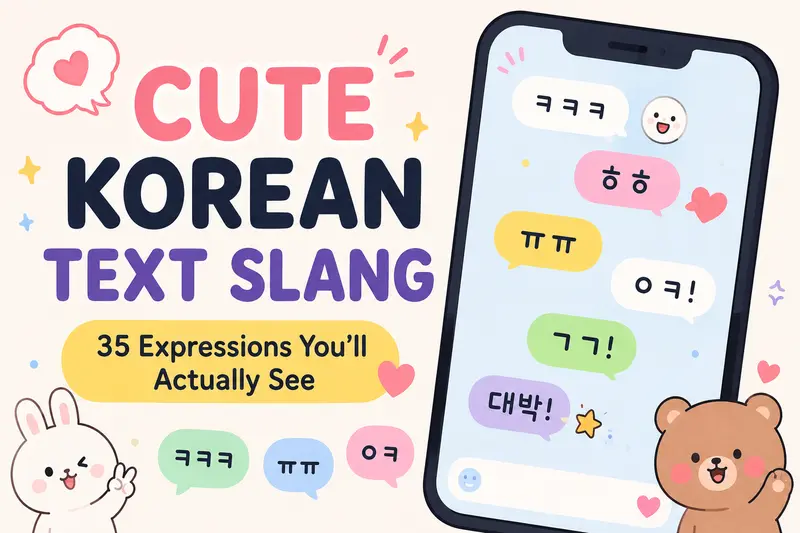
If you’ve ever chatted with Korean friends, watched K-dramas with live comments, or browsed Korean social media, you’ve probably seen messages that look nothing like the Korean you learned in class.
Things like:
- ㅋㅋㅋㅋ
- ㅎㅎ
- ㅠㅠ
- ㅜㅜ
- ㄱㄱ
- ㅇㅋ
- ㄴㄴ
At first glance, they can look like random letters.
They’re not.
These are some of the most common Korean text slang expressions, and native speakers use them every day in text messages, KakaoTalk, YouTube comments, and social media.
This guide introduces the cutest and most useful Korean texting slang so you can understand real conversations instead of just textbook Korean.
TL;DR
If you’re new to Korean texting, start with these:
| Slang | Meaning |
|---|---|
| ㅋㅋ | lol |
| ㅎㅎ | haha |
| ㅠㅠ | crying |
| ㅜㅜ | crying |
| ㄱㄱ | let’s go |
| ㄴㄴ | no |
| ㅇㅋ | OK |
| ㄷㄷ | wow / that’s scary |
| ㅇㅇ | yes |
| ㄹㅇ | for real |
These ten alone will help you understand a huge amount of Korean online conversations.
Why does Korean text slang look so different?
Unlike English internet slang, Korean texting often uses individual Hangul letters instead of full words.
Some represent:
- laughter
- crying
- agreement
- surprise
- shortened words
Others are simply abbreviations made from the first consonants of longer phrases.
Once you know the patterns, they become surprisingly easy to read. Before long, you’ll start recognizing them in KakaoTalk chats, YouTube comments, and Korean online communities.
Korean laughter
ㅋㅋ
Probably the most famous Korean internet slang.
Meaning:
- lol
- haha
The more you type, the stronger the laughter.
Examples:
- ㅋㅋ
- ㅋㅋㅋ
- ㅋㅋㅋㅋㅋㅋ
Learn more in our full guide:
ㅎㅎ
Also means laughter.
Compared with ㅋㅋ:
- softer
- friendlier
- often feels softer and friendlier
- can sound less intense than ㅋㅋ
Think of it as:
haha
instead of
LOL
Korean crying
ㅠㅠ
The shape looks like two crying eyes.
Meaning:
- I’m sad.
- That’s unfortunate.
- I’m crying.
ㅜㅜ
Exactly the same idea.
Some people simply prefer typing ㅜ instead of ㅠ.
Cute Korean agreement
ㅇㅇ
Meaning:
Yes.
Very casual.
Friends use it constantly.
ㅇㅋ
Meaning:
OK.
Similar to:
- okay
- got it
- sounds good
ㄴㄴ
Meaning:
No.
Equivalent to:
- nope
Korean action slang
ㄱㄱ
Meaning:
Go!
Let’s go!
Used before:
- games
- trips
- eating
- studying
ㄱㅅ
Short for 감사 (“thanks”).
It’s a very casual abbreviation, similar to typing “thx” instead of “thanks” in English.
Meaning:
Thanks.
Very casual.
Surprise and reactions
ㄷㄷ
Comes from:
덜덜
Originally means trembling.
Online it usually means:
- wow
- that’s crazy
- that’s scary
헐
One of the most useful Korean reactions.
Meaning:
- what?!
- seriously?
- no way!
대박
Literally:
big success
Often means:
- amazing!
- awesome!
- unbelievable!
Cute symbols Koreans use
Besides abbreviations, Korean messages often include symbols.
^^
Smiling eyes.
Friendly.
Warm.
^_^
A bigger smile.
Still very common.
~
The tilde softens the tone.
Example:
고마워~
“Thanks~”
It sounds friendlier than simply writing:
고마워.
♡
Hearts are used constantly.
Not always romantic.
Friends often use them too.
Korean text slang list
Not every Korean speaker uses every expression. Some slang is more common among younger people, while others have been popular across generations for many years. Context always matters, especially when texting someone you don’t know well.
| Slang | Meaning |
|---|---|
| ㅋㅋ | lol |
| ㅎㅎ | haha |
| ㅠㅠ | crying |
| ㅜㅜ | crying |
| ㄱㄱ | let’s go |
| ㄴㄴ | no |
| ㅇㅇ | yes |
| ㅇㅋ | OK |
| ㄱㅅ | thanks |
| ㄷㄷ | wow |
| 헐 | what?! |
| 대박 | awesome |
| ^^ | smile |
| ^_^ | happy smile |
| ~ | friendly tone |
| ♡ | affection |
Which Korean text slang is the cutest?
Many Korean learners wonder which texting expressions sound the cutest to native speakers.
In general, expressions like ㅎㅎ, ^^, ♡, and adding a ~ at the end of a sentence make messages sound softer and friendlier. They’re common between close friends, couples, and family members.
Examples include:
- ㅎㅎ
- ^^
- ^_^
- ♡
- 보고 싶어~
- 고마워~
- 잘 자♡
Rather than sounding childish, they simply make messages feel warmer.
Common beginner mistakes
Thinking every Korean message is abbreviated
It isn’t.
Many conversations use completely normal Korean.
Slang appears naturally, not in every sentence.
Using ㄴㄴ with older people
This is very casual.
Use full Korean when speaking politely.
If you’re unsure, our guide to Korean Honorifics Explained for Beginners explains when casual speech is appropriate.
Confusing ㅋㅋ with ㅎㅎ
Both express laughter.
Generally:
- ㅋㅋ = stronger
- ㅎㅎ = softer
Learn these next
If you’re learning everyday Korean, these guides go well with Korean texting slang:
- What Does ㅋㅋ Mean in Korean?
- How to Say “How Are You?” in Korean Naturally
- How to Say “I Miss You” in Korean Naturally
- Sorry in Korean: Which Expression Should You Use?
- Thank You in Korean: How to Say It Correctly
- Korean Language Learning: Complete Guide
FAQ
What is the most common Korean text slang?
The most common are ㅋㅋ, ㅎㅎ, ㅠㅠ, ㅇㅇ, ㅇㅋ, and ㄱㄱ.
What does ㅋㅋ mean?
It represents laughter and is similar to “LOL.” Read our full explanation in What Does ㅋㅋ Mean in Korean?.
Why do Koreans type ㅠㅠ?
The letters look like tears running down a face, so they represent crying or sadness.
Is Korean texting slang rude?
Not usually. Most expressions are simply casual. However, you shouldn’t use them in formal conversations or with someone who expects polite language.
Should beginners learn Korean text slang?
Yes. Even learning ten common expressions will make K-dramas, YouTube comments, KakaoTalk, and social media much easier to understand.
Final thoughts
Texting is one of the fastest ways to see Korean as it’s actually used today.
While textbooks teach grammar and vocabulary, Korean text slang shows how native speakers joke, react, laugh, and express emotions in everyday conversations.
You don’t need to memorize dozens of Korean abbreviations overnight. Start with a handful of the most common ones—ㅋㅋ, ㅎㅎ, ㅠㅠ, ㅇㅋ, and ㄱㄱ—and you’ll begin recognizing them naturally in KakaoTalk conversations, YouTube comments, and K-drama fan communities.
The more authentic Korean content you read, the more these expressions will become part of your everyday vocabulary.