
Learning Czech can seem challenging at first because of its pronunciation, grammar system, and unfamiliar word endings.
However, Czech is also a very logical language once you understand its patterns.
The best way to learn Czech is not to memorize random vocabulary lists. Instead, build your skills step by step:
- Learn Czech pronunciation and sounds.
- Build useful everyday vocabulary.
- Understand basic grammar patterns.
- Practice real conversations regularly.
This beginner guide explains how to start learning Czech, what challenges to expect, and how to create an effective study plan.
TL;DR
| Stage | What to Learn | Why It Matters |
|---|---|---|
| 1 | Czech alphabet and pronunciation | Helps you read and pronounce words correctly |
| 2 | Basic Czech words and phrases | Allows you to handle everyday situations |
| 3 | Grammar foundations | Helps you create your own sentences |
| 4 | Listening and speaking practice | Builds real communication skills |
| 5 | Cultural understanding | Helps you use Czech naturally |
For most beginners, the most important first step is:
Learn how Czech sounds before trying to memorize complicated grammar rules.
Czech pronunciation is much more consistent than English, meaning that once you learn the sound rules, reading becomes much easier.
Why Learn Czech?
Czech is spoken by more than 10 million people, mainly in the Czech Republic (Czechia).
It is a West Slavic language closely related to:
- Slovak
- Polish
- Sorbian languages
Learning Czech can open the door to much more than just communication.
Travel with more confidence
Prague is one of Europe’s most visited cities, but Czech culture extends far beyond the capital.
Knowing basic Czech helps you:
- order food in local restaurants
- communicate outside tourist areas
- understand signs and menus
- connect with local people
A simple “Dobrý den” (Good day) or “Děkuji” (Thank you) can create a much warmer interaction.
If you are starting with everyday expressions, you may also enjoy our guides:
Understand Czech culture
Language carries the history and personality of a country.
Learning Czech allows you to better appreciate:
- Czech literature
- films and television
- music
- traditions
- humor and expressions
Many jokes and cultural references lose their meaning when translated because they depend on the structure and rhythm of the language.
Build personal connections
Some learners study Czech because of:
- Czech family heritage
- relationships with Czech speakers
- moving to Czechia
- studying or working there
Even a basic level of Czech can make daily interactions easier and more meaningful.
Is Czech Hard to Learn?
The difficulty of Czech depends on your native language and learning background.
For English speakers, Czech is usually considered more challenging than languages such as Spanish or French because the grammar system is very different.
However, Czech also has advantages:
- spelling is highly consistent
- pronunciation rules are predictable
- many words follow clear patterns
- once the basics are understood, progress becomes easier
The biggest challenges for beginners are usually:
- Czech pronunciation
- noun cases
- word endings
- listening to natural speech
Understanding these challenges early helps you choose a better learning strategy.
Step 1: Learn Czech Pronunciation and Alphabet
One of the best things about Czech is that its spelling system is much more consistent than English.
In many cases, Czech words are pronounced almost exactly as they are written.
For example:
- dobrý → DO-bree (good)
- děkuji → DYE-koo-yi (thank you)
- ano → AH-no (yes)
However, Czech has several sounds that are unfamiliar to many beginners.
Learning these sounds early will make listening and speaking much easier.
Czech Letters Beginners Should Learn First
The Czech alphabet uses the Latin alphabet but adds several special characters.
The most important ones are:
| Letter | Approximate sound | Example |
|---|---|---|
| č | ”ch” as in English chair | čaj (tea) |
| š | ”sh” as in ship | škola (school) |
| ž | like the “s” in measure | žena (woman) |
| ř | unique Czech sound between r and zh | řeka (river) |
| ě | softens the previous consonant | děkuji (thank you) |
| ů | long “u” sound | dům (house) |
Among these, ř is the most famous Czech sound.
How to Pronounce the Czech “ř” Sound
The letter ř is often considered one of the hardest sounds in the world for language learners.
It combines:
- a rolled r
- with a soft “zh” sound
There is no exact equivalent in English.
For beginners, do not worry about making it perfect immediately.
A practical approach:
- Learn the basic Czech pronunciation rules.
- Listen to native speakers.
- Practice gradually.
The goal at the beginning is clear communication, not perfect pronunciation.
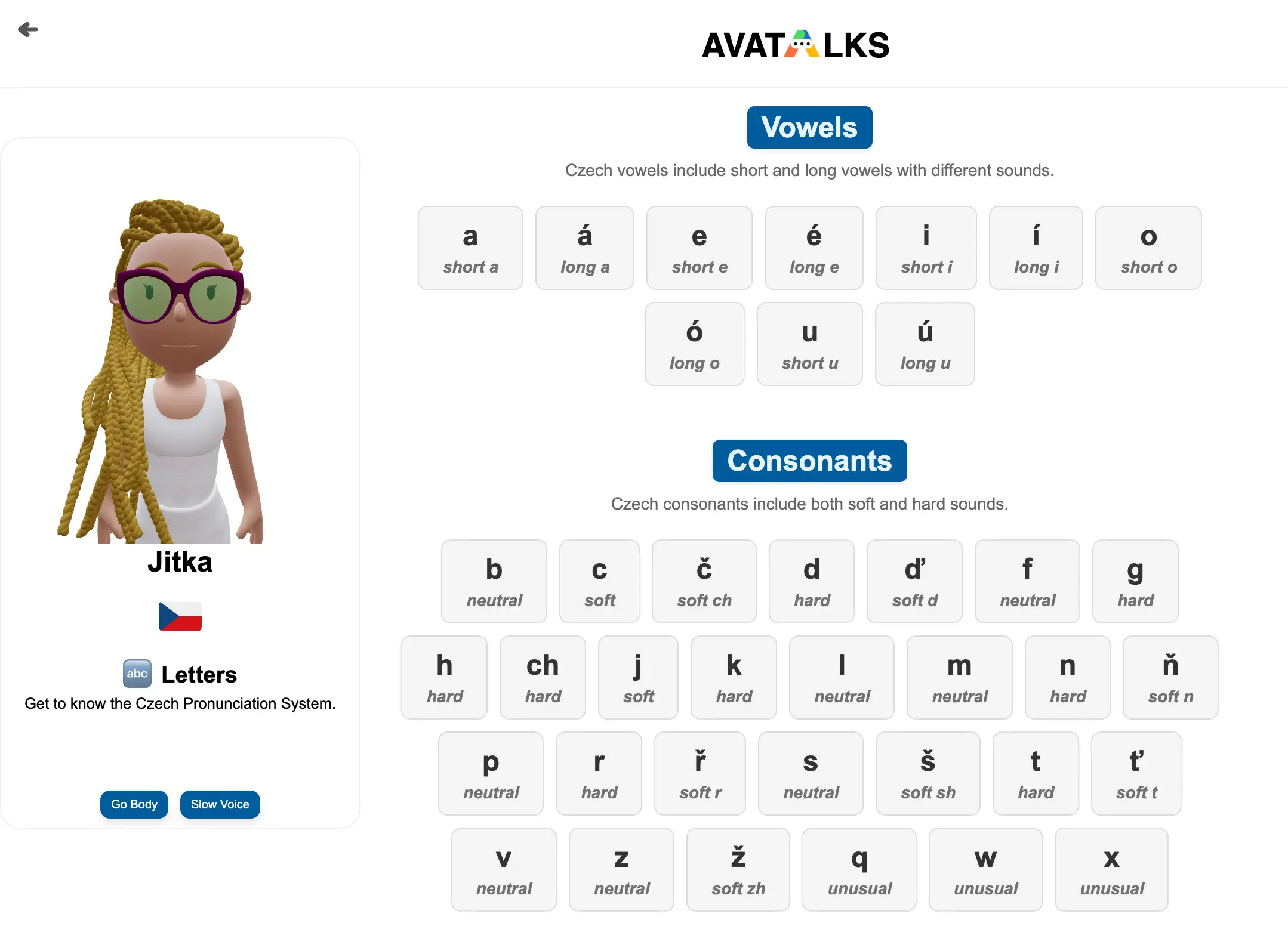
You can practice Czech letters and sounds with our interactive tool:
Step 2: Build Your Czech Vocabulary with Useful Words
Many beginners make the mistake of learning thousands of isolated words.
A better approach is to learn vocabulary around real situations.
Start with:
- greetings
- introductions
- numbers
- food
- transportation
- shopping
- daily activities
For example:
| Czech | English |
|---|---|
| Ahoj | Hello / Bye |
| Dobrý den | Good day |
| Prosím | Please / You’re welcome |
| Děkuji | Thank you |
| Ano | Yes |
| Ne | No |
These simple expressions immediately make everyday interactions easier.
You can continue with our beginner vocabulary guide:
Step 3: Learn Czech Through Real Phrases
Knowing individual words is useful, but phrases help you communicate faster.
For example, instead of only learning:
děkuji = thank you
learn:
Děkuji vám.
Thank you.
Instead of only learning:
kde = where
learn:
Kde je toaleta?
Where is the bathroom?
Learning complete phrases helps your brain recognize natural Czech sentence patterns.
For more practical examples, see:
A Beginner Czech Learning Roadmap
A structured plan prevents learners from feeling overwhelmed.
Here is a realistic beginner roadmap:
Month 1: Build Your Foundation
Focus on:
- Czech pronunciation
- alphabet and sounds
- greetings
- numbers
- basic vocabulary
- simple sentences
Goal:
Understand and produce basic everyday expressions.
Months 2–3: Start Building Conversations
Focus on:
- present tense verbs
- common sentence structures
- asking questions
- describing yourself
- daily activities
Examples:
- introducing yourself
- ordering food
- asking for directions
- talking about hobbies
At this stage, speaking practice becomes increasingly important.
Months 4–6: Expand Communication Skills
Focus on:
- past tense
- future tense
- more vocabulary
- listening practice
- longer conversations
You should begin understanding slower Czech conversations and expressing your own ideas.
Intermediate Level: Develop Natural Czech
At B1–B2 level, learners usually focus on:
- idioms
- complex grammar
- news and media
- professional conversations
- cultural expressions
At this stage, the goal changes from “learning Czech” to “using Czech naturally.”
Understanding Czech Grammar Basics
Czech grammar is often the part that surprises beginners.
Unlike English, Czech uses a system of grammatical cases.
A noun can change its ending depending on its role in a sentence.
For example, the word for “friend”:
- kamarád
- kamaráda
- kamarádovi
The meaning changes depending on how the word is used.
Czech has seven grammatical cases:
| Case | Main function |
|---|---|
| Nominative | Subject of a sentence |
| Genitive | Possession, after some prepositions |
| Dative | Indirect object |
| Accusative | Direct object |
| Vocative | Directly addressing someone |
| Locative | Location and certain prepositions |
| Instrumental | Means or accompaniment |
This may look complicated at first, but these patterns become easier through repeated exposure.
A good Czech course should introduce grammar gradually instead of overwhelming beginners with rules.
Best Ways to Learn Czech
There is no single perfect way to learn Czech.
The most effective approach usually combines several methods:
- structured lessons for grammar and vocabulary
- listening practice for natural speech
- speaking practice for confidence
- cultural content for deeper understanding
Different learning methods work better for different goals.
Czech Classes and Structured Courses
Traditional Czech courses are useful for learners who prefer a clear curriculum.
A good Czech course should guide you through:
- beginner pronunciation
- everyday vocabulary
- grammar foundations
- conversation practice
- listening comprehension
Structured courses are especially helpful because Czech grammar builds on previous concepts.
For example:
Learning noun cases becomes much easier after understanding:
- noun gender
- basic sentence structure
- common prepositions
A well-designed course should gradually move from:
A1 Beginner → A2 Elementary → B1 Intermediate → B2 Upper Intermediate
rather than introducing advanced grammar too early.
Online Czech Lessons
Online learning has become one of the most flexible ways to study Czech.
Advantages:
| Benefit | Why It Helps |
|---|---|
| Learn anywhere | Study without attending physical classes |
| Flexible schedule | Practice around your daily routine |
| Repeat lessons | Review difficult topics multiple times |
| More resources | Combine videos, exercises, and tools |
Online lessons work especially well for independent learners who can maintain a regular study habit.
Czech Tutors and Conversation Practice
Grammar knowledge alone does not automatically create speaking ability.
Many learners understand Czech sentences but hesitate when they need to respond.
Conversation practice helps you:
- build confidence
- improve pronunciation
- learn natural expressions
- understand real speaking speed
Even short conversations several times per week can make a significant difference.
Language Apps and Self-Study Tools
Apps can be useful for building daily consistency.
They work well for:
- vocabulary review
- beginner phrases
- pronunciation practice
- short daily exercises
However, apps alone may not provide enough speaking practice.
A balanced approach is usually better:
Learn → Practice → Speak → Review
AI Conversation Practice for Czech
AI language tools provide another way to practice Czech conversations.
They can help learners:
- practice without worrying about mistakes
- repeat conversations many times
- receive instant feedback
- simulate real-life situations
For example, beginners can practice situations such as:
- introducing themselves
- ordering food
- asking for directions
- making small talk
AI conversation practice is especially useful between lessons because it allows more frequent exposure to the language.
Common Mistakes Czech Learners Make
Learning Czech becomes easier when you avoid common beginner mistakes.
1. Ignoring Pronunciation at the Beginning
Some learners focus only on vocabulary and grammar.
However, Czech pronunciation affects:
- listening ability
- speaking confidence
- understanding native speakers
Learning sounds like:
- č
- š
- ž
- ř
early will save time later.
2. Translating English Sentences Word by Word
Czech sentence structure does not always follow English patterns.
A direct translation can sound unnatural.
Instead of memorizing translations, learn complete expressions.
For example:
Do not only learn:
děkuji = thank you
Learn:
Děkuji vám.
Thank you.
Context helps your brain understand how Czech is actually used.
3. Learning Grammar Without Practice
Czech grammar contains many rules.
It can be tempting to spend months studying grammar before speaking.
However, grammar becomes easier when connected to real examples.
A better approach:
- learn a grammar pattern
- see it in sentences
- use it in conversation
4. Studying Irregularly
Language learning depends heavily on consistency.
Studying Czech for 15 minutes every day is often more effective than studying for several hours once a week.
A realistic routine:
| Daily Time | Activity |
|---|---|
| 5 minutes | Review vocabulary |
| 5 minutes | Listen to Czech |
| 5 minutes | Practice speaking or writing |
Small daily progress creates long-term improvement.
How Avatalks Can Help You Practice Czech
After building a foundation, the next challenge is using Czech actively.
Avatalks helps learners practice Czech through interactive language activities, including:
- conversation practice with AI tutors
- vocabulary and grammar exercises
- pronunciation-focused learning activities
- real-life speaking scenarios
Instead of only memorizing Czech words, learners can practice applying them in conversations.
For example, you can practice situations such as:
- introducing yourself
- ordering at a restaurant
- asking for travel information
- having everyday conversations
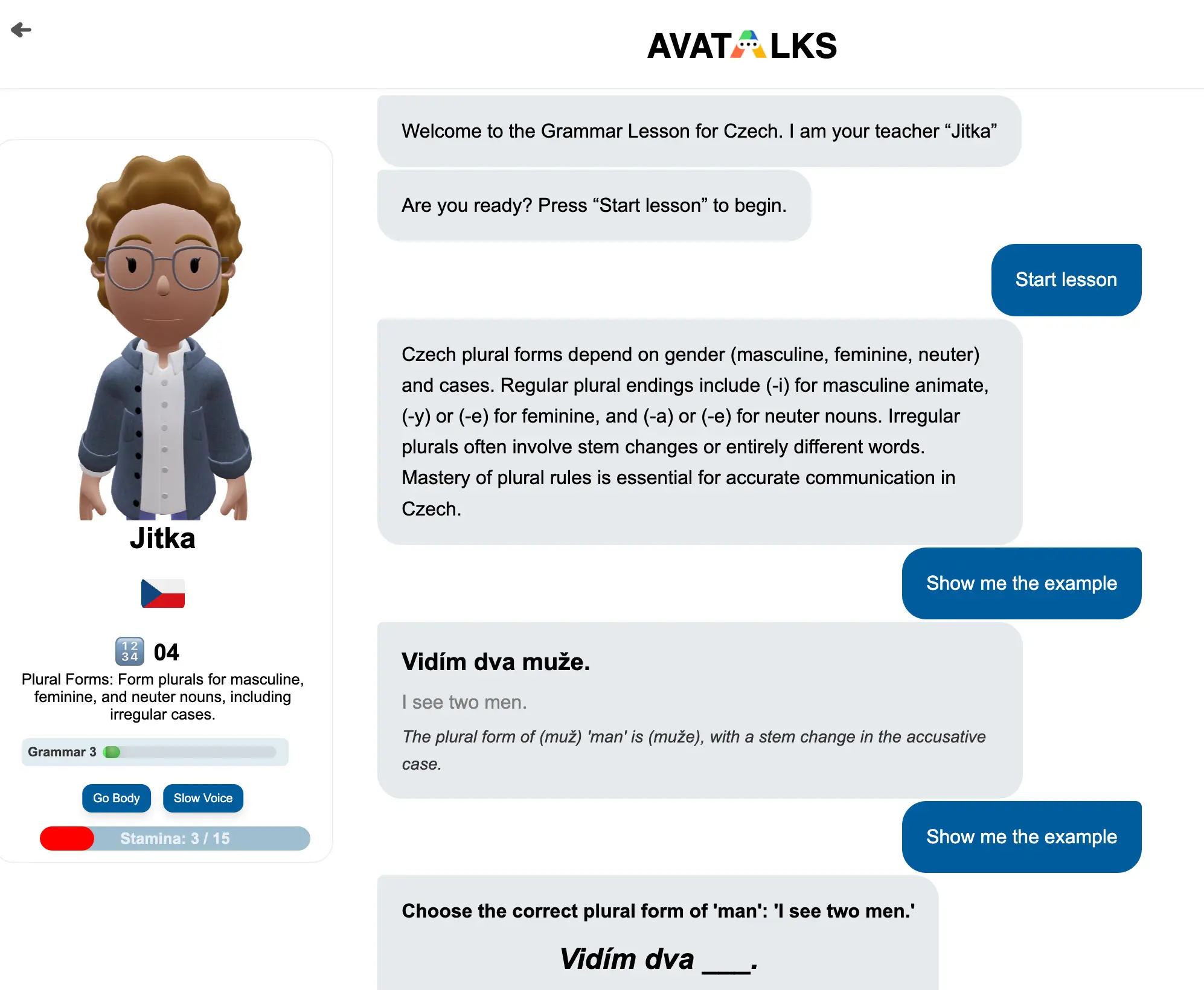
You can start practicing Czech with our AI language tools: