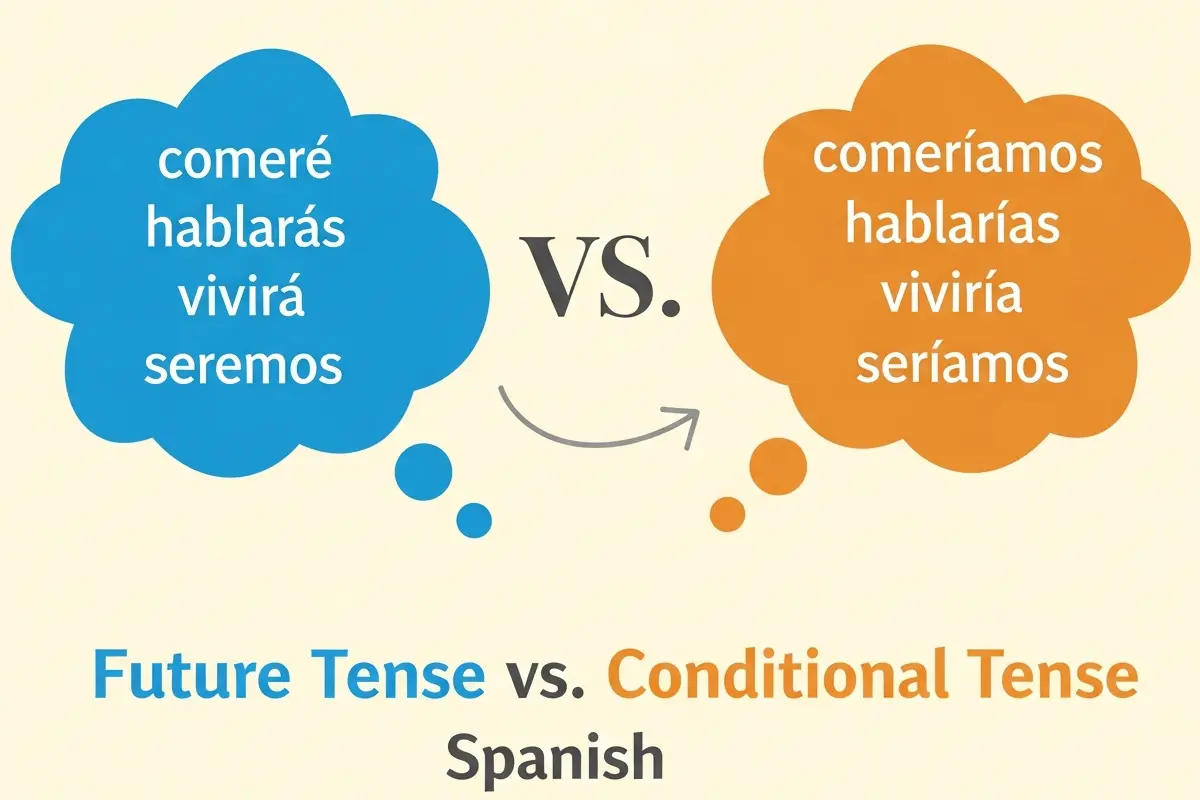
TL;DR
- Future tense expresses predictions, intentions, promises, and assumptions.
- Conditional tense expresses hypotheticals, politeness, and what would happen if conditions were met.
- Both tenses use the same irregular stems, but different endings.
- The future tense projects forward; the conditional imagines possibilities.
- Core formula:
- Future: infinitive + -é, -ás, -á, -emos, -éis, -án
- Conditional: infinitive + -ía, -ías, -ía, -íamos, -íais, -ían
What’s the Difference Between the Future Tense vs Conditional Tense in Spanish?
The future tense describes what will happen; the conditional describes what would happen.
Both rely on the infinitive form of the verb, but the meaning, tone, and endings differ.
Learners often confuse the two because they share identical irregular stems (har-, dir-, tendr-, podr-, etc.). The difference lies in intention vs. possibility.
What Does the Future Tense Express?
The future tense (futuro simple) communicates:
-
Predictions
Lloverá mañana. — It will rain tomorrow. -
Strong intentions
Estudiaré esta noche. — I will study tonight. -
Promises and commitments
Siempre te apoyaré. — I will always support you. -
Assumptions about the present
Estará en casa. — He is probably home.
Quick Future Tense Conjugation (Regular Verbs)
| Subject | Ending |
|---|---|
| yo | -é |
| tú | -ás |
| él/ella/usted | -á |
| nosotros | -emos |
| vosotros | -éis |
| ellos/ustedes | -án |
Example (hablar → hablaré):
- Yo hablaré
- Tú hablarás
- Él hablará
This tense is also covered in depth in Conjugation for Future Tense in Spanish.
What Does the Conditional Tense Express?
The conditional tense (condicional simple) expresses:
-
Hypothetical actions
Viajaría más si tuviera dinero. — I would travel more if I had money. -
Polite requests
¿Podrías ayudarme? — Could you help me? -
Suggestions
Yo que tú, lo pensaría. — If I were you, I would think about it. -
Speculation about the past
Serían las diez. — It was probably ten o’clock.
Quick Conditional Conjugation (Regular Verbs)
| Subject | Ending |
|---|---|
| yo | -ía |
| tú | -ías |
| él/ella/usted | -ía |
| nosotros | -íamos |
| vosotros | -íais |
| ellos/ustedes | -ían |
Example (comer → comería):
- Yo comería
- Nosotros comeríamos
Do Future and Conditional Share the Same Irregular Stems?
✔ Yes — stems are identical.
| Infinitive | Stem | Future Example | Conditional Example |
|---|---|---|---|
| tener | tendr- | tendré | tendría |
| poder | podr- | podré | podría |
| decir | dir- | diré | diría |
| hacer | har- | haré | haría |
| venir | vendr- | vendré | vendría |
This pattern is also explained in Spanish Future Tense Stem-Changing Rules and Irregular Future Tense Verbs in Spanish.
👉 Takeaway:
If you know the stem for the future tense, you automatically know it for the conditional.
When Should You Use the Future Tense?
Use the future tense to express:
1. Predictions
Habrá tráfico más tarde. — There will be traffic later.
2. Firm decisions
Mañana terminaré el proyecto. — I will finish the project tomorrow.
3. Assumptions about the present
Estarán en clase. — They’re probably in class.
4. Formal announcements
News, signs, and official documents often use the futuro simple.
When Should You Use the Conditional Tense?
Use the conditional tense to express:
1. Hypothetical outcomes
Yo iría, pero estoy cansado. — I would go, but I’m tired.
2. Polite requests
¿Me podría explicar eso? — Could you explain that to me?
3. Wishes or dreams
Me encantaría viajar por España. — I would love to travel through Spain.
4. Speculation about the past
Serían las ocho cuando llegó. — It was probably eight when he arrived.
Side-by-Side Comparison
| Function | Future Tense | Conditional Tense |
|---|---|---|
| Meaning | will happen | would happen |
| Use case | predictions, certainty | hypotheticals, politeness |
| Example | Iré mañana. | Iría si pudiera. |
| Time reference | present → future | present → imagined future |
| Irregular stems | same | same |
| Register | neutral/formal | softer, polite |
👉 Shortcut rule:
Use the future tense when you mean will, and the conditional when you mean would.
Authoritative Grammar Explanation
According to the Real Academia Española (RAE):
-
The futuro simple expresses acción venidera, conjetura o probabilidad en el presente
(“future action, conjecture, or probability in the present”). -
The condicional simple expresses posibilidad, probabilidad o acción hipotética
(“possibility, probability, or hypothetical action”).
Source: Nueva gramática de la lengua española (RAE/ASALE).
👉 Why it matters: Future = projection; Conditional = hypothetical reasoning.
Same Sentence, Different Meaning
| Spanish Sentence | Meaning |
|---|---|
| Irá a la fiesta. | He will go to the party. |
| Iría a la fiesta. | He would go to the party. |
| Será médico. | He is probably a doctor. |
| Sería médico. | He was probably a doctor. |
Tiny changes → major meaning shifts.
Quick Practice
Complete the sentences with the correct tense:
- Yo ______ (salir) mañana temprano.
- Yo ______ (salir) si no estuviera lloviendo.
- ¿Qué hora ______ (ser)?
- ¿Qué hora ______ (ser) cuando llamaron?
Answers:
- saldré
- saldría
- será (assumption)
- sería (past speculation)
FAQ
❓ When do Spanish speakers prefer the conditional instead of “would” clauses?
Spanish uses the conditional for both would do and polite requests, even without an explicit “if” clause.
¿Podrías ayudarme?
❓ Is the future tense used often in everyday speech?
Less than in English — many speakers prefer ir + a + infinitive in conversation.
But futuro simple is still common in writing, predictions, and assumptions.
❓ Do regular -ar, -er, -ir verbs follow the same pattern?
Yes. Both tenses use the infinitive as the base, adding their endings regardless of verb class.
❓ Can the future tense express present probability?
Yes —
Estará en casa. → “He’s probably at home.”
❓ Are future and conditional required for exams?
Yes — DELE and AP Spanish consistently test both forms through conjugation, reading, and context questions.
Final Takeaway
The key difference between the future tense vs conditional tense in Spanish lies in meaning: the future states what will happen, while the conditional imagines what would happen. Once you understand their shared stems but different intentions, reading and speaking with nuance becomes much easier.