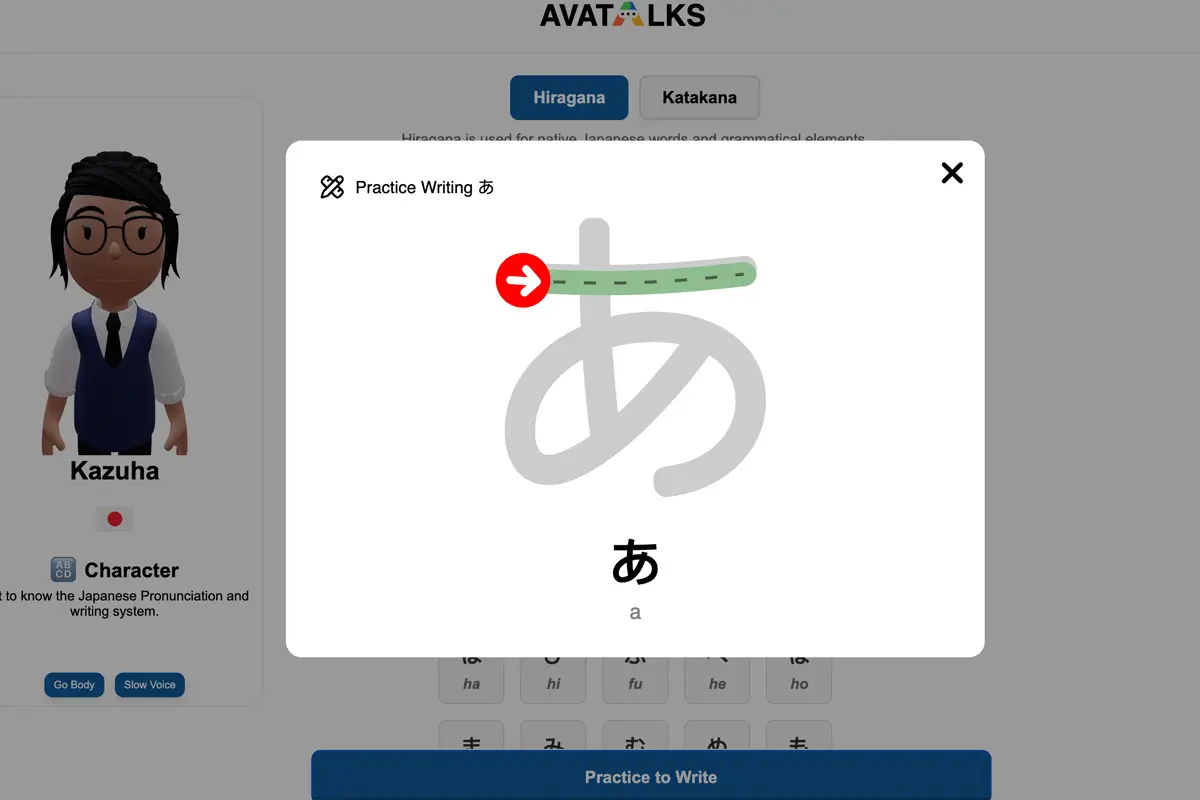
If you want to master Japanese handwriting, the Hiragana stroke order chart is your best starting point. Hiragana is one of the three writing systems in Japanese, alongside Katakana and Kanji. Following the correct stroke order helps you write beautifully, read more fluently, and build a strong foundation for learning the Japanese language.
In this guide, we’ll break down each Hiragana character, explain the correct stroke order, give visual charts, and share practical tips to help you write naturally—just like native speakers.
Why Stroke Order Matters in Hiragana
Many beginners underestimate stroke order, thinking as long as the character looks right, the sequence doesn’t matter. In reality, stroke order:
- Ensures consistent handwriting that is easy to read.
- Helps you write faster and more fluidly.
- Makes it easier to transition from handwriting to typing in Japanese.
- Reinforces memory through physical writing practice.
By following the Hiragana stroke order chart, you are training your brain and muscles to form each character efficiently.
The Basics of Writing Hiragana
Before we dive into the full chart, here are some essential rules:
- Top to bottom, left to right – Most strokes start from the upper-left corner and move downward or rightward.
- Straight before curves – Draw straight lines before adding curves.
- Closed shapes last – For characters with enclosed areas, close them at the end.
- Consistent spacing – Each character should occupy the same space, giving your writing a clean, balanced look.
The Full Hiragana Stroke Order Chart
Here’s the complete chart with stroke diagrams. Each Hiragana character has 1–4 strokes. Follow the arrows and numbering for accuracy.
The Full Hiragana Stroke Order Chart
Here’s the complete chart for reference.
To practice interactively, try our Hiragana & Katakana practice writing table.
| Hiragana | Romaji | Stroke Order |
|---|---|---|
| あ | a | Short diagonal from top left to bottom right – vertical line with a small hook – counterclockwise loop starting at the top right |
| い | i | Short vertical line on the left – short vertical line on the right |
| う | u | Short top tick from left to right – long curved line sweeping down and to the left |
| え | e | Short horizontal line from left to right – curved diagonal sweeping down to the left |
| お | o | Short diagonal from top left – vertical line with small hook – counterclockwise loop starting from the top right |
| か | ka | Short horizontal line – vertical line down through it – small diagonal curve on the right |
| き | ki | Short horizontal line – vertical line down – middle horizontal line – curved stroke to the right |
| く | ku | Single curved diagonal stroke sweeping down to the right |
| け | ke | Short horizontal line – vertical line down – short diagonal curve on the right |
| こ | ko | Upper horizontal line – lower horizontal line slightly longer |
| さ | sa | Short horizontal line – vertical line down – curved stroke to the right |
| し | shi | Single curved line sweeping down and left |
| す | su | Short vertical line – curved line looping down and right |
| せ | se | Short horizontal line – vertical line down – curved stroke to the right |
| そ | so | Curved stroke sweeping down – loop with upward flick |
| た | ta | Short horizontal line – vertical line down – curved stroke to the right |
| ち | chi | Curved stroke down and left – looping curve at the bottom |
| つ | tsu | Single curved stroke sweeping down and left |
| て | te | Short horizontal line – long vertical line down |
| と | to | Curved stroke sweeping down and left |
| な | na | Short horizontal line – vertical line down – looped curve to the right |
| に | ni | Short vertical line – long horizontal line – shorter horizontal line below |
| ぬ | nu | Short vertical line – long vertical with hook – looped curve starting at the bottom |
| ね | ne | Short horizontal – vertical line down – looped curve starting from midline |
| の | no | Single clockwise loop |
| は | ha | Short vertical line – second short vertical – horizontal line across – curved stroke to the right |
| ひ | hi | Curved diagonal line sweeping down and left |
| ふ | fu | Three short curved strokes, each sweeping differently |
| へ | he | Single upward diagonal stroke |
| ほ | ho | Short vertical – second short vertical – horizontal line across – curved stroke to the right |
| ま | ma | Short horizontal – vertical down – middle horizontal – looped curve at the bottom |
| み | mi | Three connected loops from top to bottom |
| む | mu | Looping curve down and left – small hook stroke |
| め | me | Slanted downward stroke – looped curve at the bottom |
| も | mo | Short horizontal – second short horizontal – vertical line down – small hook |
| や | ya | Short horizontal – vertical down – curved stroke to the right |
| ゆ | yu | Looping stroke – short curve to the right |
| よ | yo | Short horizontal – second short horizontal – looping curve |
| ら | ra | Short horizontal – curved stroke sweeping down |
| り | ri | Two short curved vertical strokes |
| る | ru | Looping curve ending with a short diagonal |
| れ | re | Short vertical – looping curve to the right |
| ろ | ro | Large clockwise loop |
| わ | wa | Short vertical – looping curve to the right |
| を | wo | Short horizontal – vertical down – looping curve |
| ん | n | Curved diagonal sweeping down and to the left |
How to Practice Writing Hiragana
- Use grid paper – It helps maintain uniform size and alignment.
- Follow the chart daily – Even 10 minutes a day makes a difference.
- Say the sound as you write – Reinforces memory through multiple senses.
- Write without looking – Test your recall by writing from memory.
- Mix with vocabulary – Practice by writing actual Japanese words that use the characters you’ve learned.
Common Mistakes Beginners Make
- Writing strokes in the wrong order.
- Making characters too big or too small.
- Ignoring small diagonal details.
- Writing in a rushed, sloppy manner.
Remember: Consistency beats speed at the beginning. Speed will naturally improve as your muscle memory develops.
Using the Hiragana Stroke Order Chart for Faster Learning
The chart is not just for reference—it’s a learning tool:
- Print it and hang it on your study wall.
- Keep a pocket version for review during commutes.
- Use digital stroke order apps for animated guidance.
- Pair it with spaced repetition to retain shapes over time.
Moving from Hiragana to Katakana and Kanji
Once you’ve mastered Hiragana stroke order:
- Learn Katakana (used for foreign words).
- Progress to Kanji, where stroke order is even more crucial.
- Combine all three scripts for full Japanese literacy.
Final Tips for Success
- Write daily, even if only for 30 minutes.
- Join Japanese language learning communities for feedback.
- Watch Japanese videos with subtitles to connect writing with listening.
- Test your skills with Japanese Language Proficiency Test (JLPT) practice sheets.
- Treat stroke order as part of your language learning journey, not just a technicality.
By mastering the Hiragana stroke order chart, you’re laying the groundwork for fluent Japanese writing and reading skills—a skill that will serve you throughout your study.