TL;DR
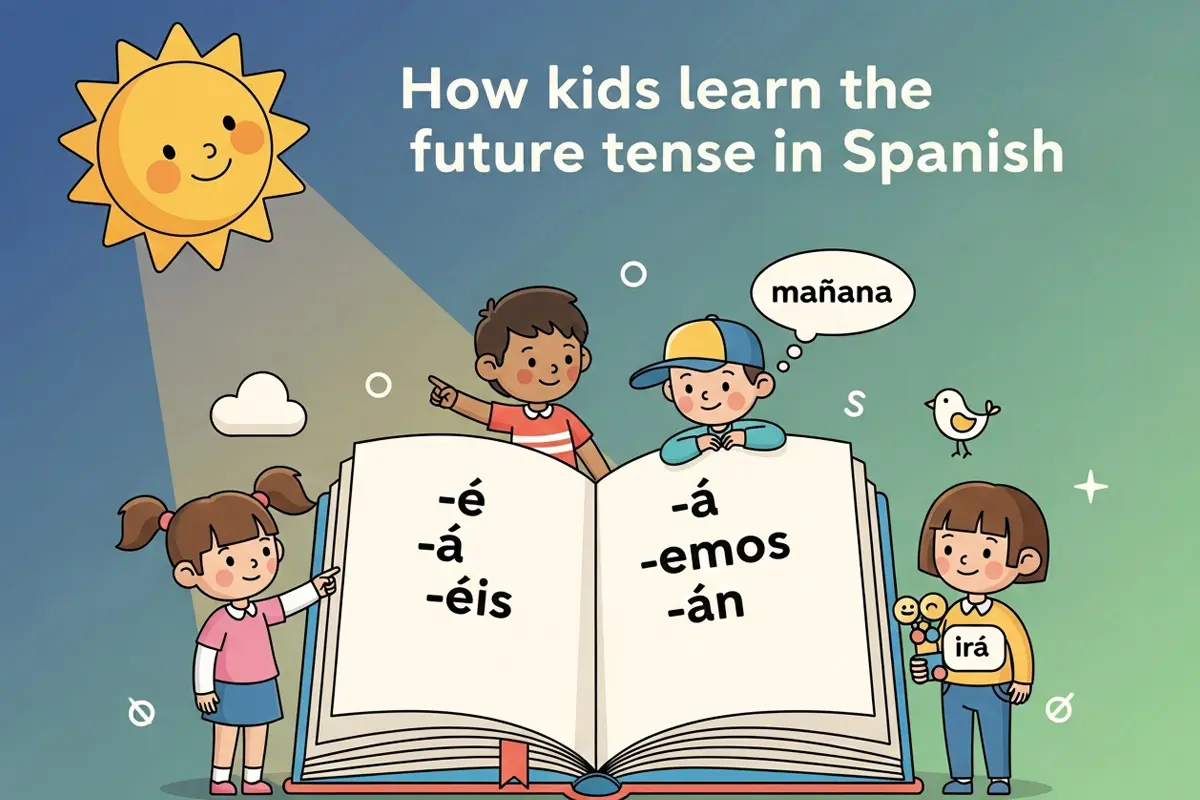
- How kids learn the future tense in Spanish follows a natural progression, not formal grammar rules.
- Children first express the future using the present tense and ir + a + infinitive.
- The simple future tense comes later and is learned through meaning, not memorization.
- Kids understand future meaning through context, routines, and repetition, not conjugation charts.
How Kids Learn the Future Tense in Spanish — Quick Answer
Kids learn the future tense in Spanish gradually by using meaning-based constructions—like the present tense and ir + a + infinitive—long before they learn formal future tense conjugations.
Instead of starting with rules, children acquire future meaning through daily routines, predictable language patterns, and repeated exposure, which mirrors how native speakers naturally use Spanish.
Why Kids Don’t Start With the Simple Future Tense
❓ Why don’t children learn “will” forms first in Spanish?
Because Spanish does not rely on one future tense in real communication.
In both child language development and beginner classrooms, the future is usually expressed with:
- the simple present tense, or
- ir + a + infinitive
Examples kids hear early:
- Mañana jugamos.
- Vamos a comer.
👉 Key takeaway: Kids learn future meaning before future conjugation.
This mirrors real usage explained in Future tense vs present tense in Spanish.
Stage 1: Using the Present Tense to Talk About the Future
❓ How do kids first talk about the future in Spanish?
By using the present tense with time words.
Common child-friendly examples:
- Mañana voy a la escuela.
- Hoy jugamos en el parque.
- Después comemos.
This stage works because:
- the verb stays familiar,
- time expressions carry the future meaning,
- no new conjugations are required.
👉 Key takeaway: Children use the present tense to express future actions when context makes timing clear.
Stage 2: Learning Ir + A + Infinitive Naturally
❓ Why is ir + a + infinitive so easy for kids?
Because it matches how children think about intention.
Structure:
ir (present tense) + a + verb in its infinitive
Examples kids hear constantly:
- Voy a jugar.
- Vamos a leer.
- Va a llover.
This structure:
- feels concrete,
- connects movement with action,
- avoids abstract endings.
👉 Key takeaway: Ir + a becomes the main “future tense” for kids.
This is why it’s also the first future form taught to beginners in Spanish grammar all future-related constructions.
Stage 3: Understanding Future Meaning Without Grammar Labels
❓ Do kids understand “future tense” as a concept?
No. They understand intention, sequence, and expectation.
Children learn future meaning through:
- routines (mañana, después, más tarde),
- repeated phrases,
- cause-and-effect situations.
Example:
- Si terminas, vamos a jugar.
👉 Key insight: Kids learn when, not what tense.
When Do Kids Learn the Simple Future Tense?
❓ At what point does the simple future appear?
Only after kids already control future meaning.
The simple future tense (comeré, jugará, iremos) appears:
- later in school instruction,
- often through stories or promises,
- not in early spontaneous speech.
Examples kids encounter:
- Te ayudaré.
- Mañana iremos al zoo.
👉 Key takeaway: The simple future is learned as a meaning upgrade, not a starting point.
For adult learners, this matches the patterns described in Common mistakes when using the Spanish future tense.
Why Irregular Verbs Don’t Block Learning
❓ Do irregular verbs confuse kids?
Not at first—because kids don’t analyze them.
High-frequency future verbs kids hear:
- va a haber
- será
- tendrá
- irá
Children acquire these as chunks, not conjugation sets.
👉 Key takeaway: Frequency beats regularity in language acquisition.
Role of Repetition and Routines
Kids learn future meaning through repetition in:
- classroom schedules,
- bedtime routines,
- games and songs.
Example routine language:
- Ahora leemos, después vamos a dormir.
- Mañana es viernes.
👉 Key insight: Predictable language builds tense understanding.
Why Kids Rarely Use the Future Tense for Guessing
Spanish adults often say:
- Estará cansado.
- ¿Dónde estará?
Kids, however, prefer:
- Está cansado.
- ¿Dónde está?
👉 Key takeaway: Probability uses of the future tense develop much later.
This advanced usage is explained in When to use the future tense in Spanish for probability.
How Teachers and Parents Can Support This Process
Best practices that match natural acquisition:
- Use present tense + time words early
- Introduce ir + a before future endings
- Delay conjugation charts
- Repeat high-frequency verbs
- Focus on meaning, not labels
👉 Key takeaway: Teaching should follow acquisition order, not textbook order.
Comparison: Kids vs Adult Learners
| Aspect | Kids | Adults |
|---|---|---|
| First future form | Present tense | Simple future |
| Grammar awareness | Low | High |
| Learning method | Exposure | Explanation |
| Error type | Omission | Overuse |
👉 Key insight: Adults need to relearn how kids acquire tense.
FAQ
❓ Do kids need to learn future tense conjugations early?
No.
They need understanding of future meaning before formal conjugation.
❓ Is ir + a + infinitive enough for children?
Yes, for a long time.
It covers most real future communication needs.
❓ When should the simple future tense be introduced?
After kids are comfortable expressing plans and intentions naturally.
❓ Do native Spanish-speaking kids use the future tense often?
No.
They rely more on present tense and ir + a in daily speech.
❓ Does this learning order match adult Spanish?
Yes.
Native adults still prefer the same constructions kids learn first.
Final Takeaway
How kids learn the future tense in Spanish is not about mastering endings—it’s about mastering meaning.
Children naturally acquire future constructions through context, repetition, and intention, starting with the present tense and ir + a + infinitive long before they ever learn the simple future.
If adults learned Spanish the same way kids do, far fewer future-tense mistakes would exist.