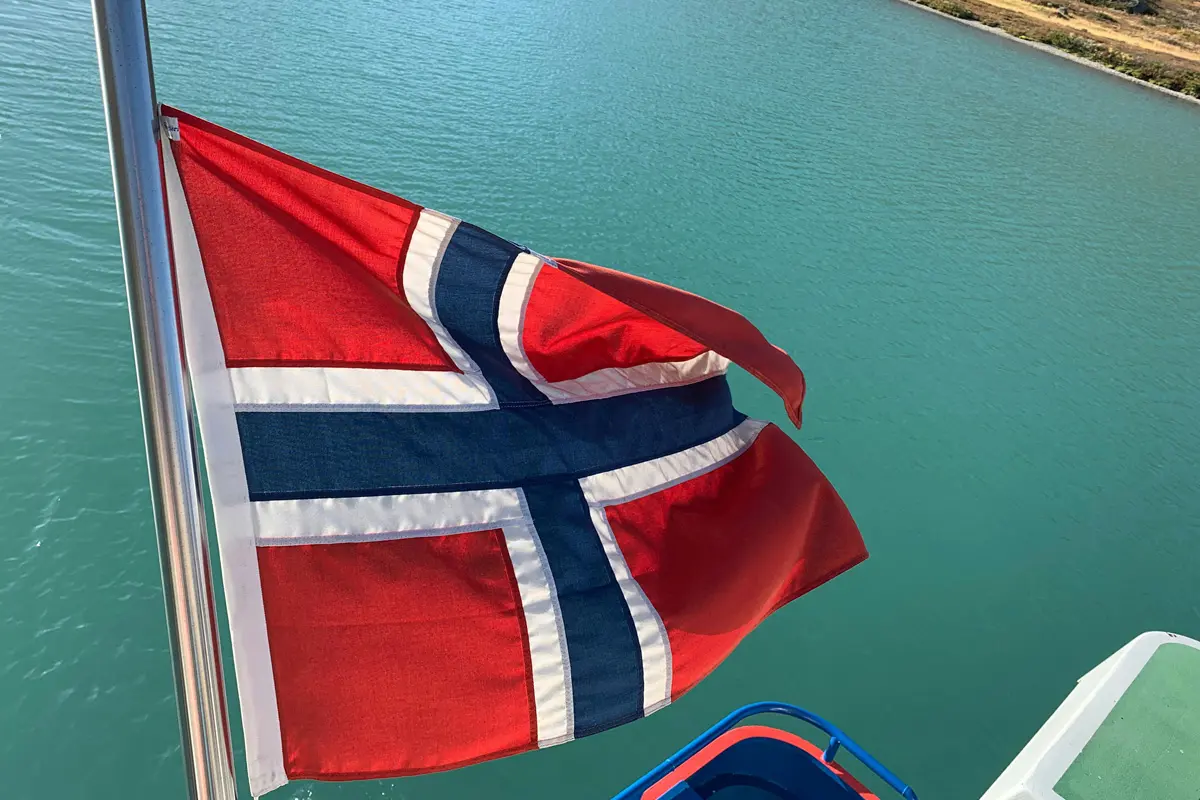
The most common way to say hello in Norwegian is hei.
It means both hi and hello, and it works in most everyday situations: meeting a friend, entering a shop, greeting a coworker, checking into a hotel, or speaking to someone for the first time.
If you’re only going to learn one Norwegian greeting, make it hei.
Norwegian also has other useful greetings, including heisann, hallo, god morgen, and god kveld. This guide explains when each one sounds natural and how to continue the conversation after saying hello.
How to Say Hello in Norwegian: Quick Guide
| Norwegian | English | Typical use |
|---|---|---|
| Hei | Hi / Hello | The safest everyday greeting |
| Hei hei | Hi / Hello | Friendly, cheerful greeting |
| Heisann | Hey / Hi there | Friendly and informal |
| Hallo | Hello | Phone calls, getting attention, some casual situations |
| Halla | Hey | Very informal/slang |
| God morgen | Good morning | Morning greeting |
| God dag | Good day | More traditional/polite greeting |
| God kveld | Good evening | Evening greeting |
| Hei på deg | Hi there / Hi to you | Warm, playful, familiar |
For most learners, hei, god morgen, and god kveld are more than enough to get started.
1. Hei — The Most Common Norwegian Hello
Hei is the standard everyday Norwegian greeting.
It corresponds closely to both English hi and hello.
You can say hei when:
- meeting someone for the first time
- greeting a friend
- entering a shop
- talking to restaurant or hotel staff
- arriving at work
- starting a casual conversation
- answering someone who greets you
For example:
A: Hei!
B: Hei!
That’s a completely normal Norwegian greeting exchange.
You don’t need to search for a more formal expression just because you’re speaking to a stranger. Hei is extremely versatile.
If you’re learning more everyday vocabulary, see our guide to basic Norwegian words for travel and daily life.
How Do You Pronounce Hei?
Norwegian hei sounds quite similar to English hi, which makes it one of the easiest Norwegian words for English speakers to learn.
Listen to the Norwegian pronunciation:
Rather than relying entirely on an English pronunciation spelling, imitate the audio and pay attention to the Norwegian speaker’s vowel and intonation.
2. Hei Hei — A Friendlier Double Greeting
You may also hear:
Hei hei!
Literally, it’s just hei said twice.
It can make the greeting sound cheerful, warm, or casual.
You might hear hei hei between friends, acquaintances, neighbors, coworkers, or in other relaxed situations.
You don’t need to treat it as a completely different word. Think of it as a friendly variation of ordinary hei.
3. Heisann — Hey There
Another friendly Norwegian greeting is:
Heisann!
Depending on the situation and tone, English equivalents might include:
Hey!
Hi there!
Well, hello!
It generally feels more expressive than a neutral hei.
For example, if you unexpectedly run into someone you know:
Heisann! Lenge siden sist!
Hey! Long time no see!
As a beginner, it’s useful to recognize heisann, but hei remains the safer default.
4. Hallo — Hello
Norwegian also has:
Hallo!
It obviously resembles English hello, but hei is usually the more useful everyday greeting to learn first.
Hallo is especially useful on the phone or when trying to get someone’s attention.
For example:
Hallo, er du der?
Hello, are you there?
Depending on tone, hallo! can also express surprise or draw attention, much as hello? can in English.
So although Norwegian hallo exists, don’t assume it must always be your default translation of English hello.
For normal face-to-face greetings, hei is usually easier.
5. Halla — A Very Casual Hi
You may hear the informal greeting:
Halla!
It’s a casual/slang greeting, closer to something like hey.
It’s worth recognizing if you listen to informal Norwegian speech, especially among younger speakers, but beginners don’t need to force it into conversations.
Use hei until you have a better feel for the social context.
6. Hei på deg — A Warm, Playful Greeting
You might also hear:
Hei på deg!
Literally, the words are something like hi to you, but that isn’t how you should translate it mechanically.
In natural English, depending on tone, it might correspond to:
Hi there!
or simply:
Hello!
It can sound warm, friendly, or playful.
It’s not a phrase you need in every conversation, but you’ll understand it when someone says it to you.
How to Say Good Morning in Norwegian
The Norwegian phrase for good morning is:
God morgen.
Use it as a morning greeting.
For example, when you meet your hotel host at breakfast:
God morgen!
Good morning!
You could also simply say hei. Norwegian does not require you to switch away from hei based on the time of day.
How to Say Good Day in Norwegian
God dag means:
Good day.
It is a perfectly valid Norwegian greeting, but beginners shouldn’t assume that everyday polite conversation requires god dag instead of hei.
Modern Norwegian interaction is often relatively informal, and hei works in a wide range of contexts.
Learn god dag so you recognize it, but don’t worry about replacing hei with it whenever you meet someone you don’t know.
How to Say Good Evening in Norwegian
In the evening, you can say:
God kveld.
It means:
Good evening.
Again, hei is still available. Time-specific greetings give you more variety, but they aren’t mandatory.
Is God Natt a Greeting?
God natt means good night.
Unlike god morgen or god kveld, it’s normally associated with going to bed or saying good night rather than greeting someone when you first meet them.
So don’t treat god natt as simply the nighttime equivalent of hello.
How to Ask “How Are You?” After Saying Hello
Once you’ve said hei, you can continue with:
Hvordan går det?
It means:
How’s it going?
or:
How are you?
A simple exchange might be:
A: Hei! Hvordan går det?
B: Bra, takk. Og med deg?
A: Bare bra.
Listen to the complete exchange:
Hei! Hvordan går det?
Hi! How’s it going?
Bra, takk. Og med deg?
Good, thanks. And you?
This is much more useful than memorizing a greeting in isolation.
How to Introduce Yourself in Norwegian
After saying hello, the simplest introduction is:
Hei, jeg heter Anna.
It means:
Hi, my name is Anna.
The useful pattern is:
Jeg heter + your name
For example:
Jeg heter Lars.
My name is Lars.
Another useful phrase is:
Hyggelig å møte deg.
It means:
Nice to meet you.
So a beginner introduction could be:
A: Hei! Jeg heter Maria.
B: Hei! Jeg heter Lars.
A: Hyggelig å møte deg.
That’s enough for a natural basic introduction.
Do Norwegian Greetings Change in Formal Situations?
Less than many learners expect.
English-language learning materials sometimes make Norwegian greetings look more formal than everyday Norwegian actually is.
You certainly can hear expressions such as:
God morgen
God dag
God kveld
But hei remains appropriate in many workplaces, shops, hotels, and other interactions where English speakers might expect a separate formal greeting.
You also don’t normally need titles such as the Norwegian equivalents of Mr. or Mrs. for ordinary introductions.
For beginners, the practical rule is:
When in doubt, say hei.
It’s simple, polite, and natural in a very broad range of situations.
Norwegian Greetings at Work
At work, you might hear:
God morgen!
when coworkers arrive in the morning.
Later in the day:
Hei!
is perfectly natural.
A workplace conversation might begin:
A: God morgen!
B: God morgen! Hvordan går det?
You don’t need to invent a special business greeting simply because the context is professional.
How Do You Answer the Phone in Norwegian?
You may hear hallo when someone answers or checks whether another person is on the line.
But hei is also very useful when beginning a phone conversation.
For example:
Hei, det er Anna.
Hi, this is Anna.
For learners, don’t worry about memorizing one supposedly universal Norwegian phone greeting. Actual usage depends on context and speaker.
What Should You Say in a Shop, Café, or Hotel?
Keep it simple.
When entering or approaching someone:
Hei!
Then continue with your request.
At a café:
Hei! Kan jeg få en kaffe?
Hi! Can I have a coffee?
At a hotel:
Hei! Jeg har en reservasjon.
Hello! I have a reservation.
This shows why hei is such a useful first word: you can attach it naturally to almost any beginner interaction.
How to Say Goodbye in Norwegian
A greeting guide isn’t complete without knowing how to leave.
The most useful goodbye is:
Ha det.
It means:
Bye.
You may also hear:
Ha det bra
Ha det bra!
This can convey something like take care or bye.
Vi ses
Vi ses!
It means:
See you!
For beginners, the easiest greeting pair to remember is therefore:
Hei!
and:
Ha det!
Hei, Hej, or Hey?
If you’re learning several Scandinavian languages, spelling can become confusing.
In Norwegian:
hei
In Swedish:
hej
They are related greetings and sound fairly similar, but the standard Norwegian spelling is hei.
So if you’re writing Norwegian, use:
Hei!
not:
Hej!
Is It Takk or Tack in Norwegian?
The Norwegian word for thank you is:
takk
The Swedish spelling is tack.
If you’d like to go beyond a basic takk, see our complete guide to how to say thank you in Norwegian, including tusen takk, takk for hjelpen, takk for maten, and natural ways to reply.
Common Mistakes With Norwegian Greetings
Using Hallo Everywhere Because It Looks Like “Hello”
Norwegian hallo is real, but hei is generally the better first greeting for learners.
Instead of translating:
hello → hallo
as a fixed rule, learn:
hello / hi → hei
for ordinary everyday greetings.
Trying to Be Too Formal
You don’t need god dag simply because you’re speaking to someone older, hotel staff, or a stranger.
In many situations, hei sounds completely natural.
Treating God Natt as a Nighttime Hello
God natt means good night and is associated with leaving for the night or going to bed.
For an evening greeting, use:
God kveld
or simply:
Hei
Assuming Every Norwegian Speaks the Same Way
Norway has substantial dialect variation.
You may hear differences in pronunciation, vocabulary, and intonation depending on where you are.
Learning a clear, widely understood hei gives you a reliable starting point regardless of region.
Norwegian Greeting Practice
Start with these five expressions.
Hei
Hi / Hello
God morgen
Good morning
Hvordan går det?
How are you? / How’s it going?
Hyggelig å møte deg
Nice to meet you
Ha det
Goodbye / Bye
If you can use those naturally, you can already begin and end a basic Norwegian interaction.
For more travel vocabulary, questions, food words, numbers, and everyday expressions, continue with our basic Norwegian words guide.
FAQ
How do you say hello in Norwegian?
The most common way to say hello in Norwegian is hei.
It works like both English hi and hello and can be used in most everyday situations.
How do you say hi in Norwegian?
Say hei.
The Norwegian word hei is the standard everyday equivalent of English hi.
Is hei formal or informal?
Hei works across a broad range of everyday situations. You can use it with friends, coworkers, strangers, shop staff, hotel staff, and people you’ve just met.
Norwegian often requires less greeting formality than learners expect.
What does heisann mean?
Heisann is a friendly, somewhat more expressive greeting similar to hey, hi there, or well, hello, depending on tone and situation.
Do Norwegians say hallo?
Yes. Hallo exists in Norwegian and is used in situations such as phone conversations, calling for someone’s attention, and some informal interactions.
For a simple face-to-face greeting, beginners will usually get more use from hei.
How do you say good morning in Norwegian?
Say god morgen.
How do you say good evening in Norwegian?
Say god kveld.
How do you ask “How are you?” in Norwegian?
A common expression is:
Hvordan går det?
It corresponds naturally to How’s it going? or How are you?
How do you say nice to meet you in Norwegian?
Say:
Hyggelig å møte deg.
How do you say goodbye in Norwegian?
One of the most common and useful expressions is:
Ha det.
You can also say ha det bra or vi ses.
Do Norwegians say hej?
Hej is the standard Swedish spelling. In Norwegian, write hei.
Final Thoughts
If you’re wondering how to say hello or hi in Norwegian, you only need one word to get started:
Hei!
It works with friends, strangers, coworkers, shop staff, hotel staff, and in most other everyday situations.
Once hei feels automatic, add:
God morgen — good morning
Heisann — hey / hi there
Hvordan går det? — how’s it going?
Hyggelig å møte deg — nice to meet you
Ha det — goodbye
Those phrases are enough to begin having simple Norwegian interactions rather than just memorizing isolated vocabulary.
Next, continue building your Norwegian with our basic Norwegian words for travel and daily life or learn several natural ways to say thank you in Norwegian.
Ha det!