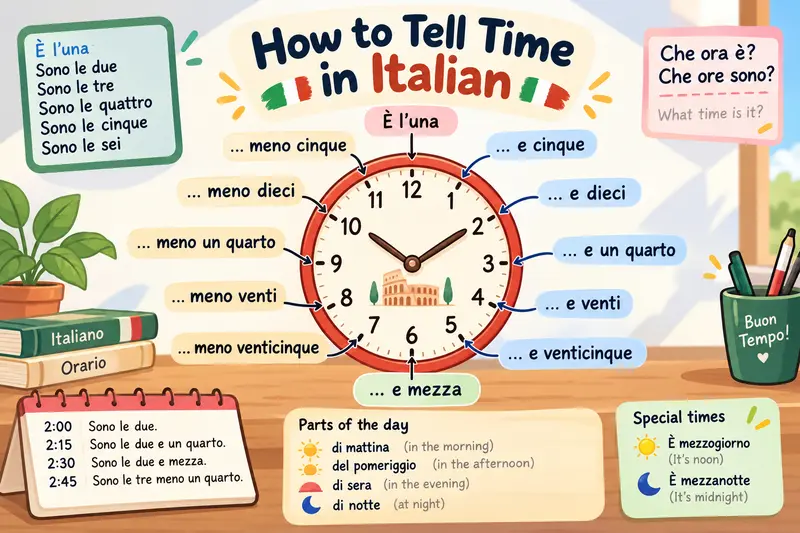
Knowing how to tell time in Italian is essential when you’re catching a train, booking a restaurant, meeting friends, or asking when a museum closes. Fortunately, Italian time expressions follow a few simple patterns.
For most hours, Italians say sono le followed by the hour. The main exception is one o’clock, which uses è l’una. To add minutes, you can use e (and) or meno (minus).
For example, 3:15 is sono le tre e un quarto, while 3:45 can be sono le quattro meno un quarto.
In this guide, you’ll learn how to ask for the time, read a clock, express hours and minutes, understand Italian schedules, and avoid common mistakes. You’ll also find pronunciation audio and exercises to help you practice.
Table of Contents
Open Table of Contents
- How Do You Tell Time in Italian? Quick Answer
- How to Ask “What Time Is It?” in Italian
- Rule 1: Use Sono Le for Most Hours
- Rule 2: Say È L’Una for One O’Clock
- Rule 3: Add Minutes with E
- Rule 4: Use Un Quarto for Quarter Past
- Rule 5: Use Mezza for Half Past
- Rule 6: Use Meno for Minutes Before the Next Hour
- How to Say Quarter To in Italian
- How to Say Noon and Midnight in Italian
- How to Say AM and PM in Italian
- The 24-Hour Clock in Italian
- How to Say “At What Time?” in Italian
- How to Say “At One” and “At Two” in Italian
- Telling Time in Italian: Four Everyday Dialogues
- Common Mistakes When Telling Time in Italian
- Practice Exercises: Can You Tell Time in Italian?
- A Five-Day Plan to Master Italian Time Expressions
- Frequently Asked Questions About Telling Time in Italian
- How do you ask what time it is in Italian?
- How do you say one o’clock in Italian?
- How do you say two o’clock in Italian?
- How do you say half past three in Italian?
- How do you say quarter past four in Italian?
- How do you say quarter to five in Italian?
- What is the difference between E and Meno?
- How do you say noon in Italian?
- How do you say midnight in Italian?
- Does Italy use the 12-hour or 24-hour clock?
- How do you say “at three o’clock” in Italian?
- Is Italian time difficult to learn?
- Key Takeaways
- Final Thoughts
How Do You Tell Time in Italian? Quick Answer
The most important rule is simple:
Use “sono le” for most hours, but “è l’una” for one o’clock.
| Time | Italian | English |
|---|---|---|
| 1:00 | È l’una. | It’s one o’clock. |
| 2:00 | Sono le due. | It’s two o’clock. |
| 3:15 | Sono le tre e un quarto. | It’s quarter past three. |
| 4:30 | Sono le quattro e mezza. | It’s half past four. |
| 5:45 | Sono le sei meno un quarto. | It’s quarter to six. |
| 7:10 | Sono le sette e dieci. | It’s seven ten. |
| 8:50 | Sono le nove meno dieci. | It’s ten to nine. |
| 12:00 | È mezzogiorno. | It’s noon. |
| 00:00 | È mezzanotte. | It’s midnight. |
These expressions are common in everyday conversation.
When reading a digital schedule, Italians may instead use a more direct format, such as le quindici e trenta for 15:30.
We’ll explain both approaches below.
How to Ask “What Time Is It?” in Italian
The two most useful questions are:
Che ore sono?
What time is it?
And:
Che ora è?
What time is it?
Both are correct and natural.
The difference is grammatical:
- Che ore sono? uses the plural ore (hours).
- Che ora è? uses the singular ora (hour).
You don’t need to worry about choosing one over the other. Both work in ordinary conversation.
How to Ask Politely
If you’re asking a stranger, you can say:
Scusi che ore sono
Excuse me, what time is it?
In written Italian, the sentence would normally include punctuation:
Scusi, che ore sono?
The audio text above omits punctuation to match our pronunciation practice format.
You can also use:
Mi scusi, sa che ore sono?
Excuse me, do you know what time it is?
This is a polite and natural way to ask someone for the time.
Rule 1: Use Sono Le for Most Hours
The basic structure for telling time is:
Sono le + hour
The phrase sono le literally means “they are the,” referring to the plural hours.
For example:
Sono le due.
It’s two o’clock.
Sono le cinque.
It’s five o’clock.
Here are the main hours:
| Time | Italian |
|---|---|
| 2:00 | Sono le due. |
| 3:00 | Sono le tre. |
| 4:00 | Sono le quattro. |
| 5:00 | Sono le cinque. |
| 6:00 | Sono le sei. |
| 7:00 | Sono le sette. |
| 8:00 | Sono le otto. |
| 9:00 | Sono le nove. |
| 10:00 | Sono le dieci. |
| 11:00 | Sono le undici. |
You can use these expressions on their own when someone asks for the time.
You don’t need to add an Italian equivalent of “o’clock.”
Rule 2: Say È L’Una for One O’Clock
One o’clock is the main exception.
Instead of sono le uno, say:
È l’una.
It’s one o’clock.
Why?
The word ora (hour) is feminine, and the singular form is understood in l’una.
Compare:
- È l’una. — It’s one o’clock.
- Sono le due. — It’s two o’clock.
- Sono le tre. — It’s three o’clock.
This is one of the first rules beginners should memorize.
What About 1:15 or 1:30?
The singular structure continues when you add minutes.
For example:
È l’una e un quarto.
It’s quarter past one.
È l’una e mezza.
It’s half past one.
È l’una e dieci.
It’s ten past one.
The verb remains è, not sono.
Rule 3: Add Minutes with E
To express minutes after the hour, use:
Sono le + hour + e + minutes
The word e means “and.”
For example:
Sono le tre e dieci.
It’s 3:10.
Sono le sei e venti.
It’s 6:20.
Sono le nove e cinque.
It’s 9:05.
Here’s a quick reference:
| Time | Italian |
|---|---|
| 2:05 | Sono le due e cinque. |
| 3:10 | Sono le tre e dieci. |
| 4:15 | Sono le quattro e quindici. |
| 5:20 | Sono le cinque e venti. |
| 6:25 | Sono le sei e venticinque. |
| 7:30 | Sono le sette e trenta. |
| 8:35 | Sono le otto e trentacinque. |
All these forms are understandable.
In casual conversation, however, Italians often prefer expressions such as un quarto and mezza for common fractions of an hour.
Rule 4: Use Un Quarto for Quarter Past
A quarter of an hour is fifteen minutes.
In Italian, un quarto means “a quarter.”
To say quarter past an hour, use:
Sono le + hour + e un quarto
For example:
Sono le tre e un quarto.
It’s quarter past three.
Other examples:
| Time | Italian |
|---|---|
| 1:15 | È l’una e un quarto. |
| 2:15 | Sono le due e un quarto. |
| 4:15 | Sono le quattro e un quarto. |
| 7:15 | Sono le sette e un quarto. |
| 10:15 | Sono le dieci e un quarto. |
You can also say sono le tre e quindici.
Both are correct.
However, e un quarto is especially useful for conversational Italian.
Rule 5: Use Mezza for Half Past
To say half past an hour, use e mezza.
For example:
Sono le quattro e mezza.
It’s half past four.
The word mezza is feminine because it refers to half an hour.
Compare:
| Time | Italian |
|---|---|
| 1:30 | È l’una e mezza. |
| 2:30 | Sono le due e mezza. |
| 3:30 | Sono le tre e mezza. |
| 6:30 | Sono le sei e mezza. |
| 9:30 | Sono le nove e mezza. |
You may also hear e mezzo in some time expressions, but e mezza is the standard beginner-friendly form when referring to half an hour.
Can You Say E Trenta?
Yes.
For example:
Sono le quattro e trenta.
It’s 4:30.
This is grammatically correct and especially straightforward when reading digital times.
In everyday conversation, sono le quattro e mezza is often more natural.
Rule 6: Use Meno for Minutes Before the Next Hour
When the time is approaching the next hour, Italians often use meno, meaning “minus.”
This works similarly to English expressions such as “ten to five.”
The structure is:
Sono le + next hour + meno + minutes
For example:
Sono le cinque meno dieci.
It’s 4:50.
Literally, this means “It’s five minus ten.”
Here are some examples:
| Digital Time | Italian | English |
|---|---|---|
| 2:50 | Sono le tre meno dieci. | Ten to three |
| 3:55 | Sono le quattro meno cinque. | Five to four |
| 5:40 | Sono le sei meno venti. | Twenty to six |
| 7:50 | Sono le otto meno dieci. | Ten to eight |
| 9:55 | Sono le dieci meno cinque. | Five to ten |
The key is to name the next hour, not the current hour.
For example, at 4:50:
- Current hour: four
- Next hour: five
- Minutes remaining: ten
Therefore:
Sono le cinque meno dieci.
Can You Use E Instead?
Yes.
At 4:50, you can also say:
Sono le quattro e cinquanta.
Both expressions are correct.
The difference is mainly the way the time is expressed.
How to Say Quarter To in Italian
One of the most useful expressions is:
Meno un quarto
It means “a quarter to.”
For example:
Sono le sei meno un quarto.
It’s 5:45.
Other examples:
| Time | Italian |
|---|---|
| 1:45 | Sono le due meno un quarto. |
| 3:45 | Sono le quattro meno un quarto. |
| 5:45 | Sono le sei meno un quarto. |
| 8:45 | Sono le nove meno un quarto. |
| 10:45 | Sono le undici meno un quarto. |
You can also say:
Sono le cinque e quarantacinque.
It’s 5:45.
However, sono le sei meno un quarto is often more conversational.
Special Case: Quarter to One
At 12:45, the next hour is one.
Therefore, the singular structure returns:
È l’una meno un quarto.
It’s quarter to one.
This is a useful reminder that è l’una is not limited to exactly 1:00.
How to Say Noon and Midnight in Italian
Two important words are:
Mezzogiorno — Noon
Mezzanotte — Midnight
To say it’s noon:
È mezzogiorno.
To say it’s midnight:
È mezzanotte.
These expressions are common in both spoken and written Italian.
You may also hear:
Sono le dodici.
It’s twelve o’clock.
But without context, this doesn’t tell you whether it’s noon or midnight.
Using mezzogiorno or mezzanotte makes the meaning clear.
What About 12:30?
You can say:
Sono le dodici e mezza.
It’s 12:30.
Or:
È mezzogiorno e mezzo.
It’s half past noon.
Both are understandable, but sono le dodici e mezza is a straightforward everyday expression.
How to Say AM and PM in Italian
Italian doesn’t usually rely on the English abbreviations AM and PM in ordinary speech.
Instead, speakers may add a phrase indicating the part of the day.
Common expressions include:
| Italian | Meaning |
|---|---|
| di mattina | in the morning |
| del pomeriggio | in the afternoon |
| di sera | in the evening |
| di notte | at night |
For example:
Sono le otto di mattina.
It’s eight in the morning.
Sono le tre del pomeriggio.
It’s three in the afternoon.
Sono le nove di sera.
It’s nine in the evening.
È l’una di notte.
It’s one in the morning.
The boundaries between morning, afternoon, evening, and night depend on context.
For example, 6:00 PM might be described as le sei del pomeriggio or le sei di sera.
The 24-Hour Clock in Italian
Italy commonly uses the 24-hour clock for written schedules, including train timetables, business hours, appointments, and event listings.
For example:
| 24-Hour Time | 12-Hour Equivalent |
|---|---|
| 08:00 | 8:00 AM |
| 12:00 | 12:00 PM |
| 13:00 | 1:00 PM |
| 15:30 | 3:30 PM |
| 18:45 | 6:45 PM |
| 21:15 | 9:15 PM |
| 23:00 | 11:00 PM |
You may see:
Il treno parte alle 18:45.
The train leaves at 6:45 PM.
When reading the time aloud in a formal or schedule-related context, you can say:
Alle diciotto e quarantacinque.
At 18:45.
In casual conversation, someone might instead say:
Alle sette meno un quarto.
At quarter to seven.
Both refer to the same time.
Common 24-Hour Examples
| Written Time | Spoken Italian |
|---|---|
| 13:00 | Le tredici |
| 14:15 | Le quattordici e quindici |
| 15:30 | Le quindici e trenta |
| 16:45 | Le sedici e quarantacinque |
| 18:20 | Le diciotto e venti |
| 20:00 | Le venti |
| 22:10 | Le ventidue e dieci |
These forms are particularly useful when understanding announcements or confirming reservations.
If you already know Italian numbers 1–100, you have the numerical foundation needed to understand these times.
How to Say “At What Time?” in Italian
So far, we’ve focused on telling someone what time it is.
But in real conversations, you’ll also need to ask when something happens.
The most useful question is:
A che ora?
At what time?
For example:
A che ora parte il treno?
What time does the train leave?
A che ora apre il museo?
What time does the museum open?
A che ora ci vediamo?
What time shall we meet?
These questions are especially useful for travelers.
How to Say “At One” and “At Two” in Italian
When expressing the time of an event, use alle for most hours.
For example:
Alle tre.
At three o’clock.
Alle sette e mezza.
At half past seven.
However, one o’clock uses all’una.
Compare:
| English | Italian |
|---|---|
| At one | All’una |
| At two | Alle due |
| At three | Alle tre |
| At four thirty | Alle quattro e mezza |
| At seven fifteen | Alle sette e un quarto |
This is another important singular-versus-plural distinction.
Example: Making Plans
Ci vediamo alle sei.
See you at six.
La riunione inizia all’una.
The meeting starts at one.
Notice that alle and all’una answer the question when something happens.
By contrast, sono le and è l’una answer the question what time it is.
This distinction is essential for natural Italian.
Telling Time in Italian: Four Everyday Dialogues
Let’s see how these expressions work in realistic situations.
Dialogue 1: Asking a Stranger for the Time
A: Scusi, che ore sono?
Excuse me, what time is it?
B: Sono le quattro e venti.
It’s 4:20.
A: Grazie mille!
Thank you very much!
B: Prego!
You’re welcome!
This is a simple exchange you could use almost anywhere.
For more ways to express gratitude, see our guide to saying thank you in Italian.
Dialogue 2: Meeting a Friend
A: A che ora ci vediamo?
What time shall we meet?
B: Alle sette e mezza.
At 7:30.
A: Perfetto, a dopo!
Perfect, see you later!
The key expression here is alle sette e mezza.
It’s used because the speakers are discussing when an event will happen.
Dialogue 3: At a Train Station
A: A che ora parte il treno per Roma?
What time does the train to Rome leave?
B: Alle diciotto e quarantacinque.
At 18:45.
A: Quindi alle sette meno un quarto?
So, quarter to seven?
B: Esatto.
Exactly.
This example shows how the 24-hour and conversational formats can refer to the same time.
Dialogue 4: Asking About Opening Hours
A: A che ora apre il museo?
What time does the museum open?
B: Alle nove di mattina.
At nine in the morning.
A: E a che ora chiude?
And what time does it close?
B: Alle sei di sera.
At six in the evening.
This dialogue is especially useful when visiting attractions or planning a day out.
Common Mistakes When Telling Time in Italian
Even beginners who know Italian numbers sometimes make mistakes when discussing time.
Here are the most important ones to avoid.
Mistake 1: Saying Sono Le Uno
Incorrect:
Sono le uno.
Correct:
È l’una.
One o’clock uses the singular form.
Mistake 2: Saying È Le Due
Incorrect:
È le due.
Correct:
Sono le due.
Use sono le for most hours.
Mistake 3: Confusing E with Meno
Compare:
Sono le cinque e dieci.
It’s 5:10.
Sono le cinque meno dieci.
It’s 4:50.
A small word changes the meaning by twenty minutes.
Mistake 4: Using Alle to Answer What Time It Is
Incorrect:
Alle tre.
As a standalone answer to Che ore sono?, this is not the usual complete response.
Correct:
Sono le tre.
Use alle tre when answering A che ora?
Mistake 5: Saying È L’Uno
Incorrect:
È l’uno.
Correct:
È l’una.
The understood noun ora is feminine.
Mistake 6: Translating English Word for Word
English:
It’s half past six.
Natural Italian:
Sono le sei e mezza.
Italian uses e mezza rather than a word-for-word equivalent of “half past.”
Practice Exercises: Can You Tell Time in Italian?
Try these exercises without looking at the earlier tables.
Exercise 1: Translate the Times
Write the following times in Italian.
- 1:00
- 2:10
- 3:15
- 4:30
- 5:45
- 6:20
- 8:50
- 9:05
- 12:00 noon
- 12:00 midnight
Answers
- È l’una.
- Sono le due e dieci.
- Sono le tre e un quarto.
- Sono le quattro e mezza.
- Sono le sei meno un quarto.
- Sono le sei e venti.
- Sono le nove meno dieci.
- Sono le nove e cinque.
- È mezzogiorno.
- È mezzanotte.
Some questions have more than one correct answer.
For example, 5:45 can also be expressed as sono le cinque e quarantacinque.
Exercise 2: Choose the Correct Expression
1. It’s one o’clock.
A. Sono le uno.
B. È l’una.
2. It’s half past seven.
A. Sono le sette e mezza.
B. Sono le sette meno mezza.
3. It’s quarter to nine.
A. Sono le nove e un quarto.
B. Sono le nove meno un quarto.
4. At three o’clock.
A. Alle tre.
B. Sono le tre.
5. It’s 4:50.
A. Sono le cinque meno dieci.
B. Sono le quattro meno dieci.
Answers: 1-B, 2-A, 3-B, 4-A, 5-A.
Exercise 3: Translate Everyday Sentences
Translate the following sentences into Italian.
1. What time is it?
Answer:
Che ore sono?
2. It’s eight in the morning.
Answer:
Sono le otto di mattina.
3. The meeting starts at one.
Answer:
La riunione inizia all’una.
4. See you at six.
Answer:
Ci vediamo alle sei.
5. What time does the train leave?
Answer:
A che ora parte il treno?
Try saying each answer aloud.
If you find a sentence difficult, return to the corresponding audio example.
A Five-Day Plan to Master Italian Time Expressions
You don’t need to memorize every expression in one session.
A short practice plan can help you develop confidence.
Day 1: Learn the Basic Hours
Practice:
- È l’una.
- Sono le due.
- Sono le tre.
- Sono le quattro.
- Sono le cinque.
Continue until you can name any hour without hesitation.
Day 2: Practice Minutes After the Hour
Use the structure:
Sono le + hour + e + minutes
Try examples such as 2:10, 4:20, and 7:25.
Day 3: Learn Quarter and Half-Hour Expressions
Practice:
- E un quarto
- E mezza
- Meno un quarto
These expressions are common in spoken Italian.
Day 4: Practice Schedules
Look at imaginary train or restaurant schedules.
Convert times such as 14:30, 18:45, and 21:15 into spoken Italian.
Day 5: Practice Real Conversations
Ask and answer:
Che ore sono?
A che ora ci vediamo?
A che ora parte il treno?
Use different times each time you practice.
For more everyday conversation examples, you can also explore our essential Italian phrases guide.
Frequently Asked Questions About Telling Time in Italian
How do you ask what time it is in Italian?
You can say Che ore sono? or Che ora è?
Both mean “What time is it?” and are commonly used.
How do you say one o’clock in Italian?
Say È l’una.
Unlike most other hours, one o’clock uses a singular structure.
How do you say two o’clock in Italian?
Say Sono le due.
For most hours, use sono le followed by the number.
How do you say half past three in Italian?
Say Sono le tre e mezza.
You can also say sono le tre e trenta.
How do you say quarter past four in Italian?
Say Sono le quattro e un quarto.
The phrase un quarto means fifteen minutes.
How do you say quarter to five in Italian?
Say Sono le cinque meno un quarto.
Literally, this means “five minus a quarter.”
What is the difference between E and Meno?
E adds minutes after the hour.
Meno subtracts minutes from the next hour.
For example:
- Sono le quattro e dieci = 4:10
- Sono le quattro meno dieci = 3:50
How do you say noon in Italian?
Noon is mezzogiorno.
You can say è mezzogiorno to mean “It’s noon.”
How do you say midnight in Italian?
Midnight is mezzanotte.
You can say è mezzanotte to mean “It’s midnight.”
Does Italy use the 12-hour or 24-hour clock?
Italy uses both.
The 24-hour clock is common in written schedules, transport information, and official contexts.
In everyday speech, the 12-hour clock is also common, often with expressions such as di mattina, del pomeriggio, or di sera.
How do you say “at three o’clock” in Italian?
Say alle tre.
Use alle when discussing when something happens.
For one o’clock, use all’una.
Is Italian time difficult to learn?
Italian time expressions are relatively systematic.
The most important rules are è l’una, sono le, e, meno, un quarto, and mezza.
Once you understand these patterns, you can express most times confidently.
Key Takeaways
Here’s what you should remember:
- Che ore sono? means “What time is it?”
- È l’una means “It’s one o’clock.”
- Sono le is used for most other hours.
- E adds minutes after the hour.
- Meno expresses minutes before the next hour.
- E un quarto means “quarter past.”
- E mezza means “half past.”
- Meno un quarto means “quarter to.”
- Alle and all’una are used when describing when something happens.
- Italy commonly uses the 24-hour clock in written schedules.
The best way to remember these expressions is to practice with real times throughout your day.
Final Thoughts
Learning how to tell time in Italian is a practical step toward understanding everyday conversations.
Whether you’re arranging a meeting, reading a train timetable, or asking when a café opens, the same basic structures appear again and again.
Start by memorizing è l’una and sono le. Then practice adding minutes with e, subtracting minutes with meno, and using common expressions such as e mezza and un quarto.
Once these patterns feel natural, you’ll be able to discuss times and schedules with much greater confidence.