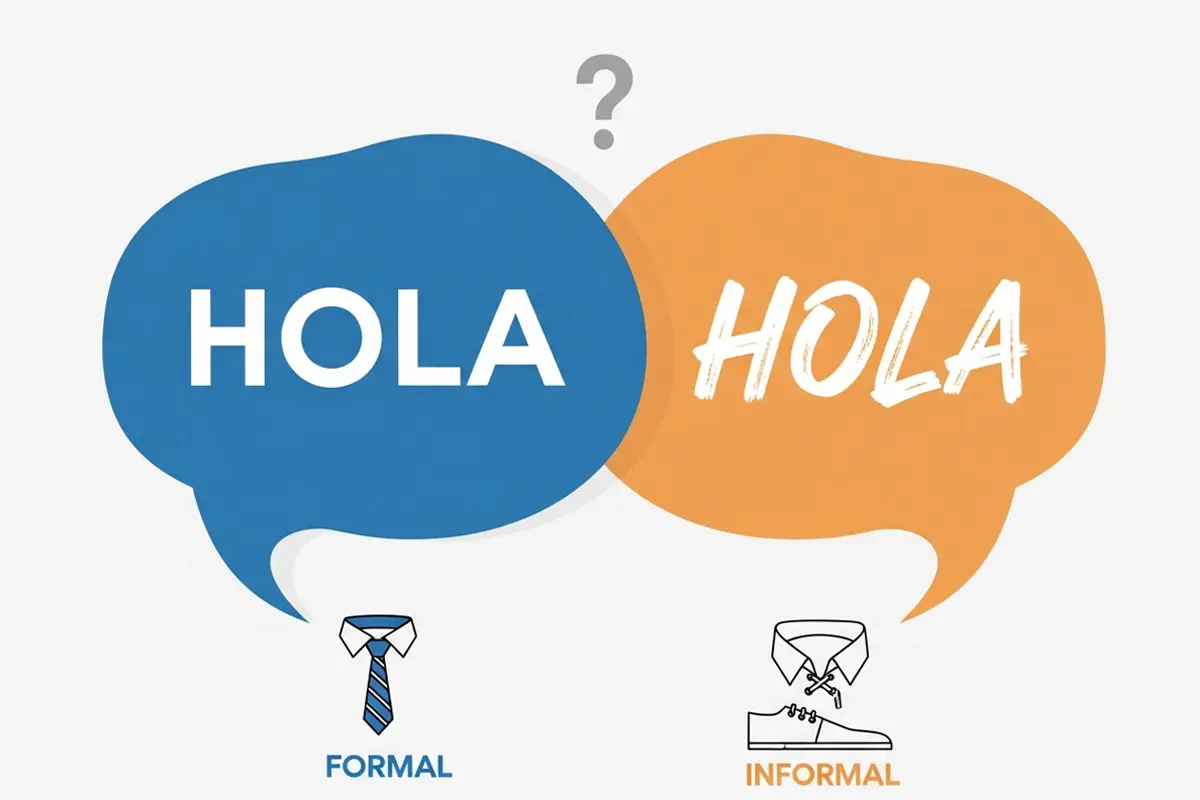
TL;DR
- Hola is usually informal. It’s the default “hi” for people you tú (friends, classmates, coworkers you’re close with).
- In formal settings, start with Buenos días / Buenas tardes / Buenas noches, especially with usted.
- You can safely use a mixed greeting like “Hola, buenos días” when you want to sound friendly but still respectful.
- Tone depends on relationship + context, not just the word hola.
Is hola formal or informal?
“Hola” is generally informal in Spanish, but it can be acceptable in semi-formal situations if your tone is respectful—especially when combined with a time-based greeting like “Hola, buenos días.”
In Spanish, greeting choice often matches the same social logic as tú vs. usted: casual greetings for close or equal relationships, and more formal greetings for professional or respectful distance.
What does “hola” mean in Spanish?
“Hola” is an interjection used as a greeting—basically “hi/hello.”
You’ll see it listed in major references as a greeting word. For a dictionary definition, see the entry for “hola” in the Diccionario de la lengua española by the Real Academia Española.
Real Academia Española definition of “hola”
When is “hola” informal?
❓ Is “hola” informal with friends?
Yes. With friends, family, classmates, and people you tú, “hola” is the most normal greeting.
Examples:
- Hola, ¿qué tal?
- Hola, ¿cómo estás?
- ¡Hola! ¿Listo para salir?
In these contexts, hola sounds natural and friendly—not rude.
When should you avoid “hola”?
❓ Is “hola” too casual for job interviews?
Usually, yes. In job interviews and formal emails, start with a time-based greeting instead.
Better options:
- Buenos días.
- Buenas tardes.
- Buenas noches.
Why? Because Spanish often uses Buenos días for people you address as usted, while Hola is commonly used for people you tutear (use tú with). This contrast is discussed in teaching materials from the Instituto Cervantes.
Instituto Cervantes on greeting choices and tú/usted
What’s the safest “polite hello” in Spanish?
❓ What should I say if I’m not sure?
Use “Buenos días / Buenas tardes / Buenas noches.” It’s polite and never weird.
Quick rule:
- Buenos días = morning (roughly until early afternoon)
- Buenas tardes = afternoon/evening
- Buenas noches = night (also used when arriving, not only leaving)
If you want to be friendly and respectful:
- Hola, buenos días.
- Hola, buenas tardes.
That mix works well when you’re meeting someone new but don’t want to sound cold.
Is “hola” formal in emails?
❓ Can I start an email with “Hola”?
With coworkers you know well, yes. With clients or first contact, it’s safer to start with “Buenos días/tardes.”
Email openings (simple + natural):
Informal / friendly
- Hola, Ana:
- Hola, ¿qué tal?
More formal
- Buenos días, Ana:
- Buenas tardes, Sr. García:
Tip: In Spanish, formality often comes from title + last name and usted verbs, not only the greeting.
Hola vs. buenos días: what’s the difference?
“Hola” is relationship-based (casual), while “Buenos días/tardes/noches” is register-based (polite).
| Greeting | Typical tone | Best for |
|---|---|---|
| Hola | informal / friendly | friends, peers, casual chats |
| Buenos días | polite / neutral | customer service, first meetings, professionals |
| Hola, buenos días | friendly + respectful | semi-formal, “not sure” situations |
Does “hola” change with country or region?
❓ Is “hola” used differently in Spain vs Latin America?
Not in meaning—“hola” is universal Spanish—but the “default level of formality” can vary by culture and setting.
In many places, people are warm and use hola quickly, but professional situations still prefer Buenos días/tardes at the start.
When in doubt: choose the polite option first. You can always become more casual later.
Common mistakes with “hola”
- Using “hola” with very formal titles
- Awkward: Hola, señor director… (sounds too casual)
- Better: Buenos días, señor director…
- Forgetting the follow-up in formal settings
- Too bare: Hola. (can feel abrupt)
- Better: Buenos días. Mucho gusto. / Buenos días. Encantado/a.
- Mixing tú/usted signals
- Example: Hola, ¿cómo está? (hola = casual, está = usted)
This can happen and isn’t “wrong,” but it may sound inconsistent. Prefer: - Buenos días, ¿cómo está? (formal)
- Hola, ¿cómo estás? (informal)
Practice: choose the better greeting
Pick the best option:
-
You meet your friend’s mom for the first time.
A) Hola
B) Hola, buenas tardes
C) Qué onda
Best: B -
You walk into a job interview at 10:00.
A) Hola
B) Buenos días
C) Buenas noches
Best: B -
You message a close coworker on Slack.
A) Hola, ¿tienes un minuto?
B) Muy señor mío…
C) Buenas noches (at noon)
Best: A
Quick wrap-up
So, is hola formal or informal?
Most of the time, hola is informal, and Buenos días/tardes/noches is the safer choice for formal or first-time situations. When you want a friendly-but-polite tone, “Hola, buenos días” is a great middle ground.
If you’re also building confidence in Spanish, you may like: