If you are learning future tense Spanish, one thing becomes clear very quickly:
Spanish does not talk about the future in just one way.
Sometimes speakers use the simple future.
Sometimes they use ir + a + infinitive.
Sometimes they even use the present tense for future meaning.
That is exactly why this topic can feel confusing at first.
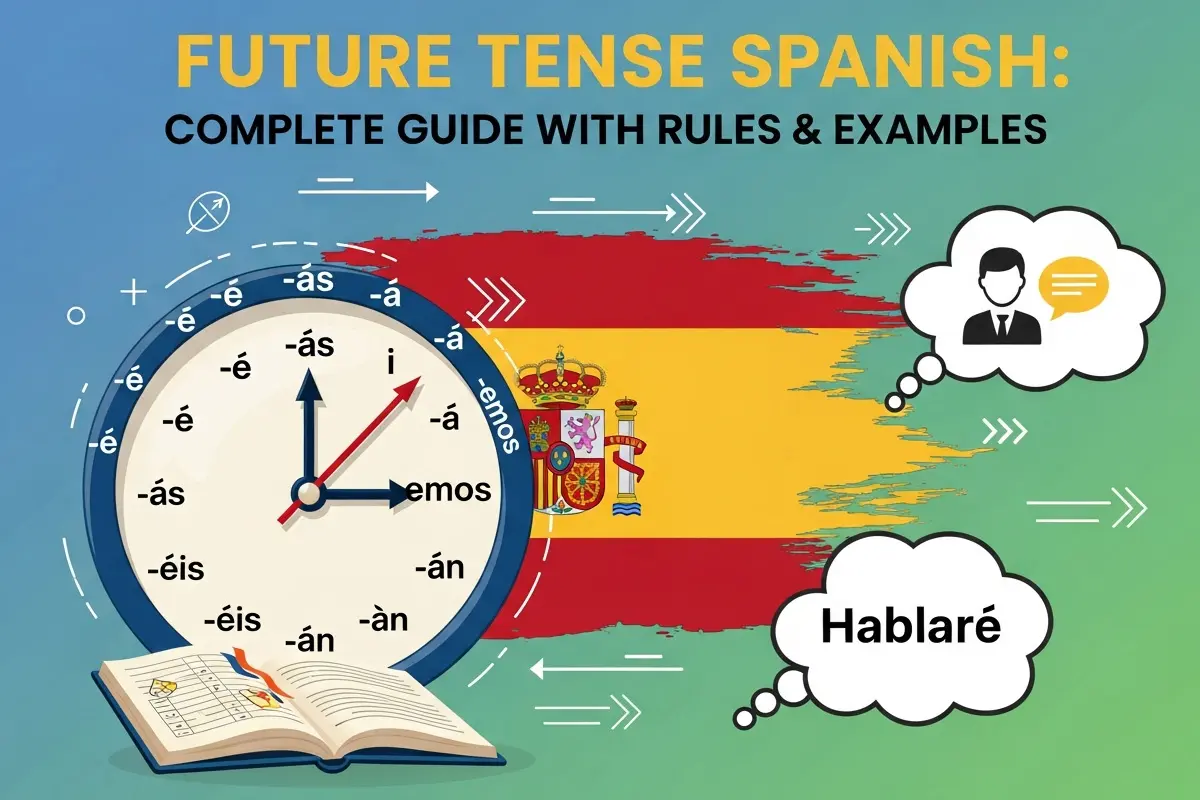
A lot of learners think the future tense is only about memorizing endings like -é, -ás, -á. But that is only part of the picture. Real Spanish chooses future forms based on meaning:
- Is it a plan?
- Is it a promise?
- Is it a prediction?
- Is it a guess?
- Is it something already scheduled?
This guide shows you how the system really works, so you can stop treating future Spanish as one tense and start seeing it as a set of useful choices.
TL;DR
The future in Spanish is not expressed with only one form.
Spanish commonly uses:
- present tense for schedules and near-certain future events
- ir + a + infinitive for plans and intentions
- simple future for promises, predictions, and more formal future meaning
- simple future also for probability or guesses about the present
- future perfect for things that will already be completed by a future point
If you only want the most practical rule first:
- use ir + a + infinitive for everyday plans
- use simple future for stronger predictions, promises, and formal future statements
What is the future tense in Spanish?
The future tense in Spanish is the set of structures used to talk about actions, events, or situations that happen after the present moment.
That sounds simple, but Spanish handles future meaning with more flexibility than English.
In English, learners often expect a direct equivalent of will.
Spanish does have a simple future tense:
- hablaré
- comerás
- vivirán
But native speakers also use:
- voy a hablar
- mañana hablo con ella
- habré terminado
So the real question is not only:
“How do I conjugate the future tense?”
It is also:
“Which future form sounds right in this situation?”
The core idea behind future tense Spanish
The biggest mistake learners make is thinking future forms are chosen only by time.
In real Spanish, the choice often depends more on:
- certainty
- intention
- tone
- context
For example:
-
Mañana voy a estudiar.
I’m going to study tomorrow. -
Mañana estudiaré.
I will study tomorrow.
Both refer to the future, but they do not feel exactly the same.
The first sounds more like a plan.
The second can sound more definite, more formal, or more like a promise or prediction.
That is why the future tense in Spanish is better understood as a system of choices, not just one chart.
The simple future tense: how to form it
The simple future tense is one of the easiest Spanish tenses to conjugate.
Why?
Because you keep the full infinitive and add the endings directly.
Regular future endings
| Person | Ending |
|---|---|
| yo | -é |
| tú | -ás |
| él / ella / usted | -á |
| nosotros / nosotras | -emos |
| vosotros / vosotras | -éis |
| ellos / ellas / ustedes | -án |
Example with hablar
| Person | Form |
|---|---|
| yo | hablaré |
| tú | hablarás |
| él / ella / usted | hablará |
| nosotros / nosotras | hablaremos |
| vosotros / vosotras | hablaréis |
| ellos / ellas / ustedes | hablarán |
Example with comer
| Person | Form |
|---|---|
| yo | comeré |
| tú | comerás |
| él / ella / usted | comerá |
| nosotros / nosotras | comeremos |
| vosotros / vosotras | comeréis |
| ellos / ellas / ustedes | comerán |
Example with vivir
| Person | Form |
|---|---|
| yo | viviré |
| tú | vivirás |
| él / ella / usted | vivirá |
| nosotros / nosotras | viviremos |
| vosotros / vosotras | viviréis |
| ellos / ellas / ustedes | vivirán |
One reason learners like this tense is that -ar, -er, and -ir verbs all use the same endings.
If you want a focused conjugation walkthrough, see conjugation for future tense in Spanish.
Irregular future tense verbs in Spanish
The good news is that future irregulars are not random in the way some other Spanish tenses are.
The endings stay the same.
What changes is the stem.
Common irregular stems
| Infinitive | Future stem |
|---|---|
| tener | tendr- |
| venir | vendr- |
| decir | dir- |
| hacer | har- |
| poder | podr- |
| poner | pondr- |
| salir | saldr- |
| saber | sabr- |
| querer | querr- |
| haber | habr- |
Examples
-
Tendré tiempo mañana.
I will have time tomorrow. -
Haré la tarea más tarde.
I will do the homework later. -
Podremos salir después.
We will be able to leave later. -
Habrá un problema.
There will be a problem.
The pattern is much easier once you realize that the endings are still regular.
For a full breakdown, see irregular future tense verbs in Spanish.
When Spanish uses the present tense for the future
This is one of the first things that surprises learners.
Spanish often uses the present tense for future meaning when the event feels scheduled, fixed, or obvious from context.
Examples
-
Mañana trabajo.
I’m working tomorrow. -
El tren sale a las ocho.
The train leaves at eight. -
Nos vemos luego.
See you later.
This is very common in real conversation.
It usually sounds more natural than forcing the simple future every time.
The present tense often works well when:
- the plan is already arranged
- the event is on a schedule
- the future time is already clear
If you want to compare these choices more closely, see future tense vs present tense in Spanish.
When to use ir + a + infinitive
This is one of the most useful future structures in everyday Spanish.
Structure
ir (present tense) + a + infinitive
Examples
-
Voy a estudiar esta noche.
I’m going to study tonight. -
Vamos a viajar en julio.
We’re going to travel in July. -
¿Vas a llamar a tu madre?
Are you going to call your mother?
This structure usually feels:
- more conversational
- more immediate
- more plan-based
That is why learners hear it constantly.
If you are talking about something you intend to do, ir + a + infinitive is often the most natural choice.
When to use the simple future tense
Even though spoken Spanish often prefers ir + a, the simple future is still important.
It is commonly used for:
1. Predictions
-
Lloverá mañana.
It will rain tomorrow. -
Será un partido difícil.
It will be a difficult match.
2. Promises
-
Te llamaré mañana.
I will call you tomorrow. -
Lo haré, te lo prometo.
I will do it, I promise.
3. Formal statements
- El evento comenzará a las nueve.
The event will begin at nine.
4. Stronger, firmer future meaning
- Volveré.
I will come back.
The simple future often sounds a little stronger, more definite, or more formal than ir + a.
The future tense for probability
One of the most interesting uses of the Spanish future tense has nothing to do with future time.
Spanish also uses the simple future to express:
- probability
- conjecture
- polite guessing about the present
Examples
-
Estará en casa.
He’s probably at home. -
¿Dónde estará Ana?
Where could Ana be? -
Serán las ocho.
It’s probably eight o’clock.
This use matters because many learners only learn the “will” meaning and miss a very common real-life function.
For a deeper explanation, see when to use the future tense in Spanish for probability.
The future perfect
Spanish also has a future perfect tense.
Structure
haber in the future + past participle
Examples
-
Habré terminado para mañana.
I will have finished by tomorrow. -
Cuando llegues, ya habremos comido.
When you arrive, we will already have eaten.
This tense is used when you want to show that one future action will be completed before another future point.
It is less common than ir + a or the simple future in daily conversation, but still useful and important.
If you want to compare it clearly with the simple future, see Spanish simple future vs future perfect tense.
Real examples of future tense Spanish
Here are some realistic examples of how these future forms work in context.
Plans
-
Voy a descansar este fin de semana.
I’m going to rest this weekend. -
Mañana salgo temprano.
I’m leaving early tomorrow.
Predictions
-
El examen será difícil.
The exam will be difficult. -
Llegarán tarde.
They will arrive late.
Promises
-
Te ayudaré con eso.
I will help you with that. -
Nunca te olvidaré.
I will never forget you.
Probability
-
Tendrá hambre.
He’s probably hungry. -
Estarán ocupados ahora.
They’re probably busy now.
Completed future action
- Para el lunes, habré terminado el informe.
By Monday, I will have finished the report.
If you want more beginner-friendly models, see Spanish future tense example sentences for beginners.
Future tense vs conditional tense in Spanish
Learners often mix these up because the forms look similar.
Future
- hablaré
- tendré
- hará
Conditional
- hablaría
- tendría
- haría
The core difference is meaning:
- future = what will happen
- conditional = what would happen
Compare
-
Iré si tengo tiempo.
I will go if I have time. -
Iría si tuviera tiempo.
I would go if I had time.
If this contrast still feels slippery, see future tense vs conditional tense Spanish.
Common mistakes learners make
1. Overusing the simple future
Many learners think every future idea must use the simple future.
That sounds too stiff in many daily situations.
For example:
- Mañana comeré con mi amiga.
This is correct.
But in casual conversation, many speakers would more naturally say:
- Mañana voy a comer con mi amiga.
2. Translating English “will” directly
English often uses “will” in places where Spanish chooses another structure.
3. Forgetting that present tense can express the future
This is extremely common in Spanish and sounds very natural.
4. Memorizing endings without learning meaning
This is the biggest problem of all.
If you only memorize charts, you may conjugate correctly but still choose the wrong form for the situation.
If you want a focused error guide, see common mistakes when using the Spanish future tense.
A quick decision guide
When you want to talk about the future in Spanish, ask yourself this:
Is it already scheduled or obvious from context?
Use the present tense.
- Mañana tengo clase.
Is it a plan or intention?
Use ir + a + infinitive.
- Voy a estudiar después.
Is it a prediction, promise, or stronger future statement?
Use the simple future.
- Te llamaré mañana.
Is it a guess about the present?
Use the simple future for probability.
- Estará en casa.
Is it something that will be completed before another future point?
Use the future perfect.
- Habré terminado para entonces.
Practice: choose the best future form
Try answering these mentally before checking.
1. You already bought a ticket and the train leaves at 9.
Best choice:
- El tren sale a las nueve.
2. You plan to study tonight.
Best choice:
- Voy a estudiar esta noche.
3. You promise a friend you will help.
Best choice:
- Te ayudaré.
4. You guess someone is tired.
Best choice:
- Estará cansado.
5. You want to say a report will already be done by tomorrow.
Best choice:
- Habré terminado el informe para mañana.
FAQ
Is the simple future the main future tense in Spanish?
It is an important future tense, but not the only way Spanish talks about the future. In everyday conversation, ir + a + infinitive and even the present tense are also very common.
Is ir + a + infinitive more common than the simple future?
In casual spoken Spanish, very often yes. It usually sounds more immediate and conversational for plans.
Do all regular verbs use the same future endings?
Yes. The simple future uses the same endings for -ar, -er, and -ir verbs.
Are future irregular verbs completely irregular?
No. Usually only the stem changes. The endings stay regular.
Can the future tense mean “probably” in Spanish?
Yes. Spanish often uses the simple future to express probability or guesses about the present.
Final takeaway
The future tense in Spanish is not just one chart of endings.
It is a system that includes:
- the present tense
- ir + a + infinitive
- the simple future
- the future perfect
- and even the future used for probability
That is why the best way to learn future tense Spanish is not to memorize one form in isolation.
Instead, learn the question behind the form:
- Is this a plan?
- A promise?
- A schedule?
- A prediction?
- A guess?
Once you start thinking that way, future Spanish becomes much easier to understand and much easier to use naturally.