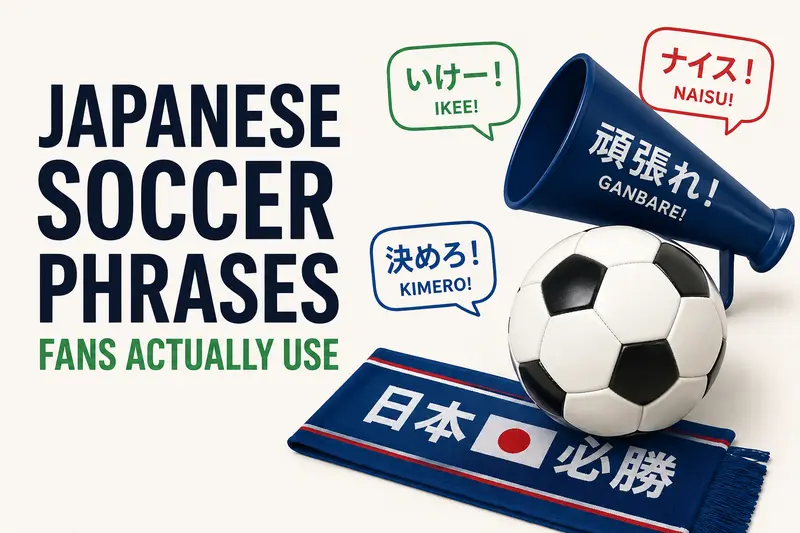
If you watch soccer in Japanese, you quickly notice something:
Fans do not speak the way textbooks do.
They shout, react fast, repeat short phrases, and speak in a way that is built more for emotion than careful grammar.
That is why learning a few real Japanese soccer phrases can make matches much easier to follow and much more fun. You do not need advanced Japanese to follow the energy. Even a small set of phrases helps you understand what fans are yelling, what commentators mean, and how people react when the game suddenly changes.
This guide focuses on the expressions fans actually use:
- to cheer
- to react
- to complain
- to praise a play
- and to follow the flow of a match
TL;DR
If you only learn a few Japanese soccer phrases first, start with these:
- 頑張れ! = Come on! / Do your best!
- いけー! = Go!
- ナイス! = Nice!
- 決めろ! = Finish it!
- チャンス! = Chance!
- 惜しい! = So close!
- 守れ! = Defend!
- やった! = Yes! / We did it!
- 反則! = Foul!
- 逆転! = Comeback!
These are short, emotional, and easy to hear during a game.
Why soccer Japanese feels different from textbook Japanese
A lot of beginner Japanese materials teach polite conversation first.
That makes sense for daily life, but sports language works differently.
At a match, people usually say:
- shorter phrases
- stronger commands
- emotional reactions
- repeated words
- casual language
For example, a textbook might teach:
- 頑張ってください。
But at a match, fans are much more likely to shout:
- 頑張れ!
That difference matters because sports Japanese is built for speed and energy.
The most useful Japanese soccer phrases fans actually use
1. 頑張れ!
Ganbare!
Meaning: Come on! / Do your best!
This is one of the most common encouragement phrases in Japanese sports.
Fans use it when:
- a player is under pressure
- the team needs energy
- someone is fighting for the ball
- the match feels tense
Example
- 頑張れ、日本!
Come on, Japan!
This is probably the safest and most useful phrase on the whole list.
2. いけー!
Ike!
Meaning: Go! / Push forward!
This is a very common shout when a player starts an attack or has space to move.
Fans use it when:
- a winger starts running
- a striker gets behind the defense
- a team pushes forward quickly
Example
- いけー!そのまま!
Go! Keep going!
This is short, loud, and very easy to hear in exciting moments.
3. ナイス!
Naisu!
Meaning: Nice!
This comes from English, but it is very natural in Japanese sports.
Fans say it after:
- a clean pass
- a strong tackle
- a good save
- a smart defensive move
Example
-
ナイスパス!
Nice pass! -
ナイスセーブ!
Nice save!
Sports Japanese uses a lot of these short loanwords, especially in fast reactions.
4. 決めろ!
Kimero!
Meaning: Finish it! / Score it!
This is the phrase people shout when a player is in a great scoring position.
Fans use it when:
- someone is one-on-one with the keeper
- there is a clear chance in the box
- a header or shot is about to happen
Example
- 決めろ!決めろ!
Finish it! Finish it!
It has a strong emotional feel, so it fits key attacking moments.
5. チャンス!
Chansu!
Meaning: Chance!
This is another very common loanword in Japanese sports.
Fans shout it when:
- the defense makes a mistake
- the team breaks forward
- a dangerous ball enters the box
Example
- チャンスだ!
It’s a chance!
This phrase often comes right before:
- 決めろ!
6. 惜しい!
Oshii!
Meaning: So close! / Almost!
This is one of the most useful reaction words in Japanese.
Fans say it when:
- a shot misses by a little
- a pass almost works
- a header hits the post
- a player nearly scores
Example
- 今のは惜しい!
That was so close!
This is a great phrase to know because you can use it in many sports, not only soccer.
7. やった!
Yatta!
Meaning: Yes! / We did it!
This is the reaction when something goes right.
Fans use it after:
- a goal
- a huge save
- a late winner
- a dramatic comeback moment
Example
- やった!入った!
Yes! It went in!
It is emotional, simple, and very natural.
8. 守れ!
Mamore!
Meaning: Defend!
This comes up when the team is under pressure.
Fans use it when:
- the other team attacks
- there is a corner kick
- the team is protecting a lead
- the last minutes feel dangerous
Example
- しっかり守れ!
Defend well!
This phrase often appears in tense endings.
9. 反則!
Hansoku!
Meaning: Foul!
This is what fans yell when they think something illegal happened.
It comes up when:
- a player gets pushed
- there is a rough tackle
- someone handles the ball
- the referee misses a call
Example
- 今の反則でしょ!
That was a foul, right?
Fans often shout this in frustration, especially when the referee does not blow the whistle.
10. 逆転!
Gyakuten!
Meaning: Comeback! / Turnaround!
This is a high-energy word in Japanese sports.
Fans use it when:
- a losing team equalizes and pushes on
- the game suddenly changes
- a comeback feels possible or already happened
Example
-
逆転できる!
We can come back! -
逆転ゴール!
Comeback goal!
This is one of the most exciting sports words in Japanese.
11. シュート!
Shūto!
Meaning: Shoot!
This is the Japanese loanword for “shoot,” and fans use it exactly the way you would expect.
Fans shout it when:
- a player waits too long
- there is space outside the box
- a chance opens for a quick shot
Example
- 打て!シュート!
Hit it! Shoot!
This often overlaps with other attack phrases.
12. 打て!
Ute!
Meaning: Shoot it! / Hit it!
This is another very common command.
Compared with シュート!, this can sound a little sharper and more forceful.
Example
- そこで打て!
Shoot from there!
This is especially common when fans want the player to stop passing and take the shot.
13. 入った!
Haitta!
Meaning: It went in!
This is the instant reaction when the ball crosses the line.
Fans use it when:
- the goal happens fast
- they react before even celebrating fully
- they want to confirm the shot scored
Example
- 入った!やった!
It went in! Yes!
Short reaction words like this are very common because they match the speed of the moment.
14. オフサイド!
Ofusaido!
Meaning: Offside!
Another essential loanword.
Fans say this when:
- the striker looks clearly offside
- the assistant referee raises the flag
- the team scores but the goal may not count
Example
- それ、オフサイドじゃない?
Isn’t that offside?
Because soccer has many English-origin terms, some expressions are easier to recognize than learners expect.
15. PK
Pī Kē
Meaning: Penalty kick
In Japanese soccer talk, people often just say PK.
Fans use it when:
- a penalty is awarded
- they argue that one should have been awarded
- a penalty shootout starts
Example
-
PKだ!
It’s a penalty! -
PK戦だ。
It’s going to penalties.
This is a very useful phrase if you watch knockout matches.
Short reaction phrases you will hear all the time
Not every useful soccer phrase is soccer-specific.
A lot of match reactions use general Japanese reaction words.
Common ones
- すごい! = Amazing!
- 危ない! = Dangerous!
- うまい! = So good! / Skillful!
- 速い! = Fast!
- 強い! = Strong!
- いいね! = Nice!
Example
-
うまい!そのパス!
Nice! That pass! -
危ない!
Careful! / That was dangerous!
These are excellent phrases to learn because they work in many real situations outside sports too.
A few soccer nouns that help a lot
Even if your goal is mostly phrases, learning a few key nouns makes match Japanese much easier to follow.
| Japanese | Reading | Meaning |
|---|---|---|
| ゴール | gōru | goal |
| 試合 | shiai | match / game |
| 前半 | zenhan | first half |
| 後半 | kōhan | second half |
| 延長戦 | enchōsen | extra time |
| 決勝戦 | kesshōsen | final |
| 勝利 | shōri | victory |
| 敗戦 | haisen | defeat |
| 引き分け | hikiwake | draw |
| 監督 | kantoku | coach / manager |
These help a lot when listening to commentators or reading match headlines.
Mini dialogues: what fans actually sound like
1. Big chance
- A: チャンス!
- B: 決めろ!
- A: ああ、惜しい!
English:
- Chance!
- Finish it!
- Ah, so close!
2. Goal
- A: 入った!
- B: やったー!
- A: ナイスシュート!
English:
- It went in!
- Yes!
- Nice shot!
3. Late defense
- A: 危ない!
- B: 守れ!
- A: ナイスセーブ!
English:
- Dangerous!
- Defend!
- Nice save!
These short exchanges are more realistic than long textbook conversations because fan language is usually fast and repetitive.
How to sound natural when using these phrases
A few things make sports Japanese sound more natural.
1. Keep it short
Fans usually do not say long full sentences during a live play.
Short reactions sound better:
- 惜しい!
- いけー!
- ナイス!
2. Match the emotion
The same phrase changes feeling depending on:
- volume
- speed
- excitement
- frustration
3. Do not overuse polite forms
At a match, people usually sound casual, not formal.
4. Repeat when the moment is intense
Japanese sports reactions often repeat:
- 決めろ、決めろ!
- 頑張れ、頑張れ!
That sounds natural in stadium energy.
Common mistakes learners make
1. Using only textbook Japanese
That makes sports talk sound too careful and unnatural.
2. Trying to build full sentences every time
In sports, short reactions are more realistic.
3. Ignoring loanwords
Japanese soccer language uses many words from English, so learning those helps quickly.
4. Focusing only on literal translation
A phrase like 頑張れ! is not always best translated word-for-word. What matters more is how it functions in the moment.
How to practice these phrases
A simple practice routine works best.
Try this
- Pick 5 phrases from this page.
- Say each one out loud three times.
- Watch a soccer clip.
- Pause and react using the phrase that fits.
- Repeat with new clips.
If you want a broader base of everyday Japanese before sports phrases, Japanese basic phrases is a useful companion. If your kana still feel slow, hiragana practice and learn katakana will also help because sports words use a lot of katakana.
FAQ
What is the most useful Japanese soccer phrase to learn first?
頑張れ! is probably the best first one because it is common, easy, and works in many sports.
Do Japanese soccer fans use a lot of English loanwords?
Yes. Words like ナイス, チャンス, シュート, オフサイド, and PK are very common.
Is sports Japanese more casual than textbook Japanese?
Yes. It is usually shorter, more emotional, and less polite.
Can I use these phrases for sports other than soccer?
Many of them work in other sports too, especially:
- 頑張れ!
- ナイス!
- やった!
- 惜しい!
- 逆転!
Do I need advanced Japanese to enjoy soccer in Japanese?
No. A small set of core reactions already helps a lot, especially if you want to follow fan energy, commentator reactions, and key moments during a match.
Final Thoughts
Japanese soccer phrases are useful because they teach a side of the language that textbooks often miss.
They are:
- short
- emotional
- memorable
- and connected to real situations
That makes them fun to learn.
You do not need to memorize everything here at once.
Start with:
- 頑張れ!
- いけー!
- ナイス!
- 惜しい!
- やった!
Once those feel natural, add a few more.
The next time you watch a match in Japanese, you will hear much more than noise. You will start hearing the rhythm of how fans actually react.