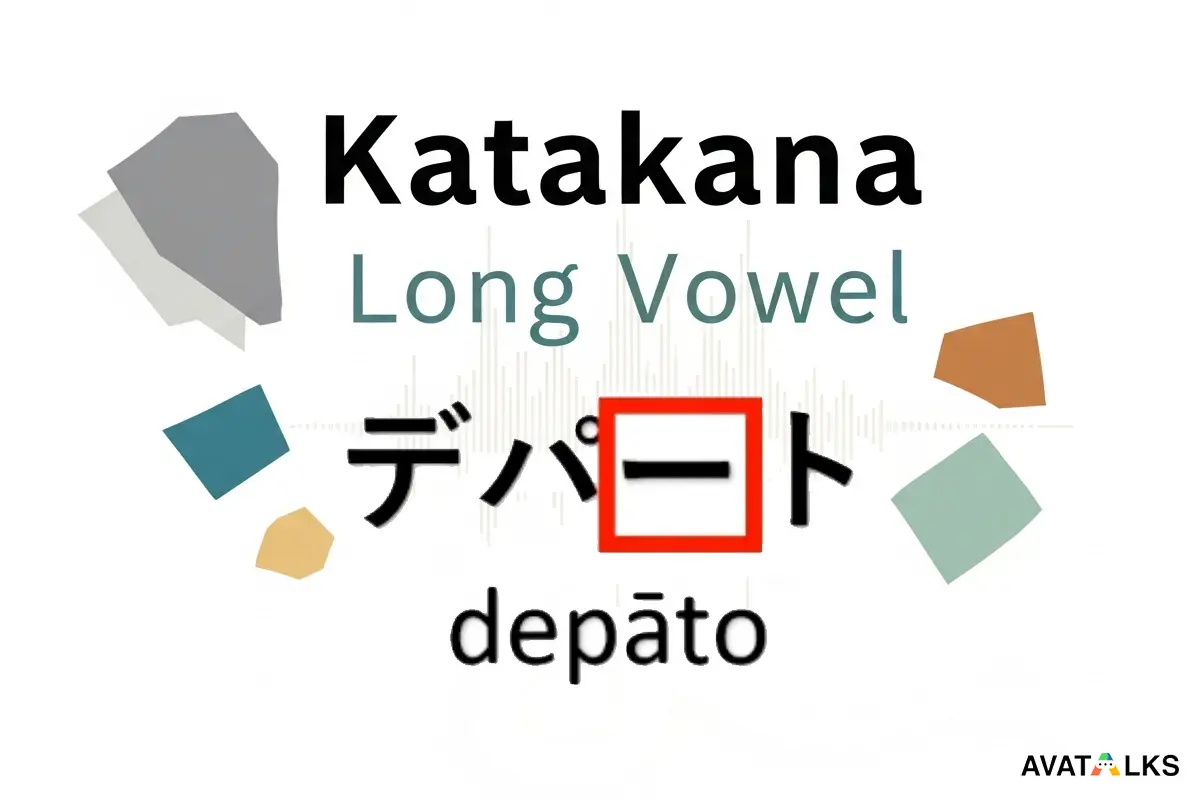
If you are learning katakana, one small symbol causes a lot of confusion:
ー
It looks simple, but it changes how a word is read and how natural your Japanese sounds.
A lot of beginners first treat it like a dash or ignore it completely. That causes the usual problems:
- vowels sound too short
- katakana words sound choppy
- different words start sounding the same
- pronunciation feels less Japanese and more like guessed English
This guide explains what the katakana long vowel mark does, how to read it, and how to practice it without overcomplicating things.
TL;DR
- ー means: hold the vowel sound before it longer.
- It does not add a new syllable.
- In katakana, it is one of the main ways Japanese marks long vowels.
- Long vowels matter because they can change how a word sounds and sometimes what listeners understand.
- The best way to learn it is by practicing real katakana words out loud.
Learn Katakana in 7 Days
If you want the bigger katakana system, use our full katakana guide with reading, writing, and review practice.
Go to the main guide →What the katakana long vowel mark means
The symbol ー is used in katakana to stretch the vowel sound that comes right before it.
That is the core rule.
Basic idea
- コ = ko
- コー = kō
So ー does not mean “add another vowel sound after it.”
It means: keep the previous vowel going longer
In Japanese, this matters because sound length is part of normal pronunciation.
A few easy examples
コーラ
コーヒー
テーブル
メール
What learners usually get wrong
1. Reading ー like a separate sound
This is the most common mistake.
For example, some learners see:
- コーラ
and mentally read it like:
- ko-a-ra
That is not how it works.
A better way to think of it is:
- ko + longer o
2. Ignoring it completely
If you skip the long vowel mark, the word becomes too short.
For example:
- ビール sounds different from ビル
Even when the listener still understands you, the timing sounds off.
3. Stressing the vowel like English
Japanese long vowels are about length, not heavy English-style stress.
So the goal is not to say the vowel louder. The goal is to say it a little longer.
The easiest rule to remember
If you only remember one thing, remember this:
ー stretches the vowel before it.
That is enough to read a lot of katakana more accurately.
Why it matters so much in katakana
Katakana is full of loanwords and modern vocabulary, and many of those words use ー.
Examples:
- スーパー
- ノート
- ケーキ
- スポーツ
- メーカー
So if you do not get comfortable with the long vowel mark, katakana keeps feeling harder than it really is.
Common katakana words with ー
Everyday words
スーパー
ノート
メーカー
Food and drink words
ケーキ
チーズ
ラーメン
Good beginner trap words
These are useful because they make the long vowel easy to notice.
コーラ
トースト
スポーツ
How to practice the long vowel mark
You do not need a complicated system.
A simple method works well.
Step 1: Read the word in chunks
Examples:
- コーラ → コ + ー + ラ
- メール → メ + ー + ル
- コーヒー → コ + ー / ヒ + ー
This helps you see where the long vowel actually happens.
Step 2: Listen and repeat
Listen once.
Then repeat the whole word slowly.
Then repeat it again at a more natural speed.
Step 3: Say the long part clearly
Do not exaggerate it too much, but do not shorten it either.
The goal is controlled timing.
Step 4: Write and say it together
Writing the word while saying it out loud helps a lot with memory.
A short practice list
Use these words as a mini drill:
- コーラ
- コーヒー
- メール
- ノート
- スーパー
- ケーキ
- チーズ
- ラーメン
- スポーツ
- メーカー
Read them slowly first, then naturally.
Katakana vs hiragana long vowels
A useful beginner point is this:
- katakana often uses ー
- hiragana usually shows long vowels in other ways, often by writing extra vowel kana
So learners should not assume that ー works everywhere in Japanese writing the same way.
This symbol is especially important in katakana.
How to type ー
When Japanese input is active, many learners can type the long vowel mark using the regular hyphen key.
That is why words like:
- me-ru
- ko-hi-
- su-pa-
can convert into:
- メール
- コーヒー
- スーパー
The exact behavior depends on your Japanese input settings, but the important thing for learners is just recognizing the symbol when reading.
Related practice
If you want to use the words above in a more interactive way, practice them here:
And if you want the bigger katakana roadmap, go here:
FAQ
Is ー just a dash?
No. It is a writing symbol that marks a long vowel in katakana.
Do I say a new vowel after it?
No. You hold the vowel that came before it.
Why does it matter?
Because Japanese cares about sound length, and katakana words use long vowels very often.
Is it only used in katakana?
It is mainly associated with katakana, though you may sometimes see it elsewhere for stylistic reasons.
Final thoughts
The katakana long vowel mark looks small, but it does a lot of work.
Once you understand that ー simply stretches the vowel before it, many katakana words become much easier to read and pronounce.
Start with a few common words. Repeat them out loud. Pay attention to timing, not just spelling.
That is usually enough to make the long vowel mark stop feeling strange and start feeling normal.