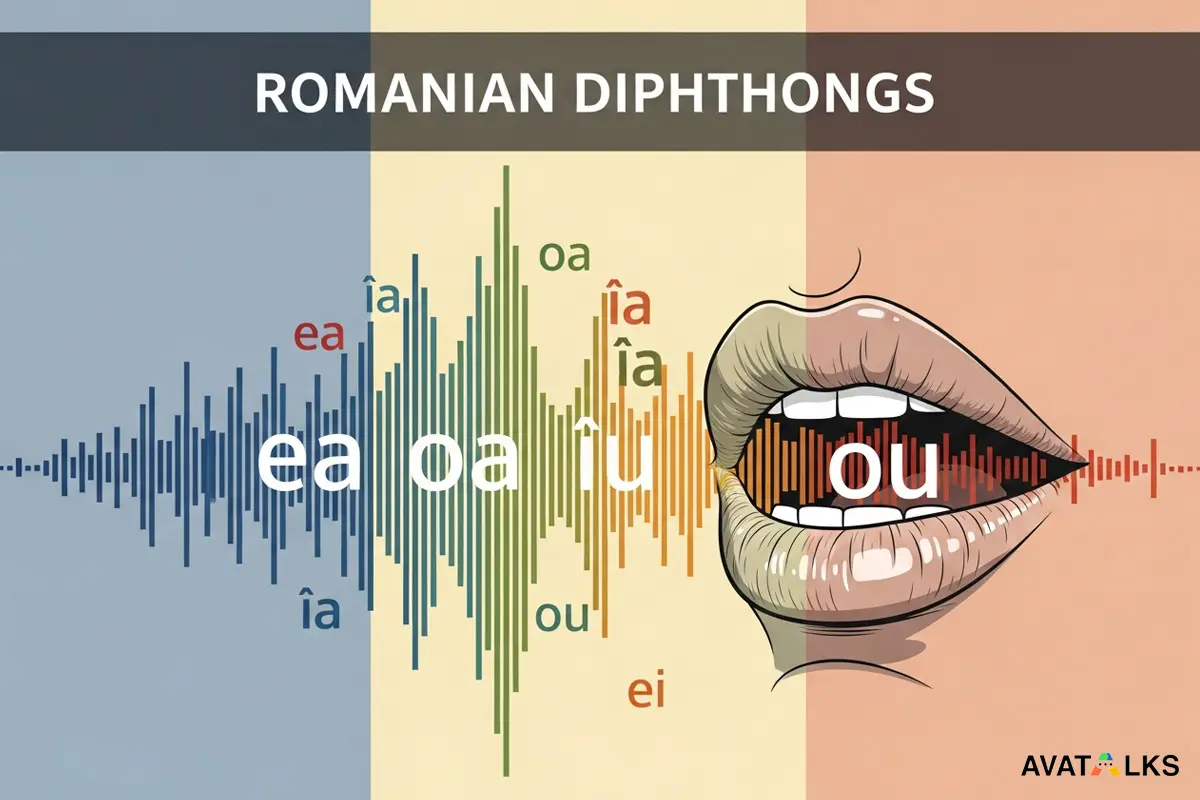
If Romanian words like noapte, foarte, or cafea still feel hard to pronounce, the problem is usually not the whole word.
It is often one small vowel combination inside it.
That is why Romanian diphthongs matter so much. A learner may know every single letter, but still hesitate when two vowels appear together and do not behave the way English would suggest.
This guide keeps the focus on the combinations learners notice most:
- oa
- ea
- ia
You do not need a heavy phonology lesson first. You need clear examples, real words, and a way to hear the pattern.
TL;DR
- The most important Romanian vowel combinations for learners are oa and ea.
- These are the combinations you will notice again and again in common Romanian words.
- ia is also very common, but learners should think of it as a frequent sound combination, not automatically the same kind of pattern as oa and ea.
- The biggest mistake is splitting these combinations too much or flattening them into plain vowels.
- The best way to practice is through whole words, not isolated letter theory.
Romanian alphabet pronunciation hub
If you want the bigger pronunciation system behind these sounds, start with the Romanian alphabet pronunciation hub.
Explore the practice hub →What Romanian diphthongs are
In simple learner terms, a Romanian diphthong is a vowel combination pronounced as one smooth syllable movement, not as two fully separate vowels.
That is the important idea.
You do not need to memorize a lot of terminology. You mainly need to hear the difference between:
- a smooth combined sound inside one syllable
- and two vowels pronounced more separately across the word
For most learners, the most useful starting point is oa and ea, because they show up often and strongly affect how natural Romanian sounds.
The three combinations learners notice most
1. oa
This is one of the most recognizable Romanian sound patterns.
You hear it in words like:
- noapte = night
- foarte = very
- broască = frog
noapte
foarte
broască
What to listen for
Do not pronounce this like a hard break:
- no-ap-te
Instead, try to hear oa as one smooth sound movement inside the stressed part of the word.
2. ea
This is another very common Romanian pattern.
You hear it in words like:
- cafea = coffee
- mea = my, feminine
- seară = evening
cafea
mea
seară
What to listen for
Do not force two separate beats like:
- ca-fe-a
In these common words, the goal is a smoother transition.
3. ia
Learners also notice ia very early because it appears in a lot of everyday words.
Examples:
- iar = and / while / again, depending on context
- iarnă = winter
- viață = life
iar
iarnă
viață
What to listen for
For English speakers, ia often feels a bit like a y + vowel transition.
That is why it can sound easier than oa or ea, even though it still deserves practice.
Other common Romanian vowel combinations
You will also see combinations like:
- ai
- ei
- au
Examples:
- rai
- lei
- sau
These are common and useful, but they usually cause less confusion for beginners than oa and ea.
That is why most learners should spend their first pronunciation energy on oa and ea.
Not every vowel combination behaves the same way
This is where learners often get confused.
Just because a word has two vowels next to each other does not mean they behave the same way.
For example:
- poezie
This is not pronounced as one simple diphthong chunk.
poezie
So the real lesson is this:
do not guess from spelling alone.
Listen to real words and notice how the syllables move.
Why oa and ea matter so much
These two patterns matter because they show up in highly common Romanian words and strongly shape how natural your pronunciation sounds.
They also stand out more than many other vowel combinations.
If a learner says:
- foarte
- noapte
- cafea
with the wrong vowel movement, the word is still often understandable, but it sounds less natural immediately.
That is why these are worth deliberate practice.
Common pronunciation mistakes
Mistake 1: splitting the sound too much
Example:
- saying no-ap-te too mechanically instead of a smoother noapte
Mistake 2: flattening the diphthong into one plain vowel
Example:
- saying foarte almost like forte
Mistake 3: practicing the letters but not the word stress
Romanian pronunciation stays clearer when you hear the sound inside the full word, especially in the stressed syllable.
A better way to practice Romanian diphthongs
1. Practice inside real words
This is much better than repeating only:
- oa
- ea
- ia
Use:
- noapte
- foarte
- cafea
- seară
- iarnă
2. Repeat the stressed part clearly
The stressed syllable helps your ear notice the pattern more easily.
3. Compare similar words
Try listening for the difference between:
- plain o and oa
- plain e and ea
4. Repeat short phrases, not only word lists
This helps the sound become more natural in connected speech.
A short drill list
oa drill
- noapte
- foarte
- broască
ea drill
- cafea
- mea
- seară
ia drill
- iar
- iarnă
- viață
Repeat each word slowly first, then naturally.
How this fits into Romanian pronunciation overall
Romanian diphthongs make much more sense once you already feel comfortable with:
- basic Romanian vowels
- stress
- letter-sound consistency
If you need that bigger foundation, these pages fit well with this topic:
Final thoughts
Romanian diphthongs do not need to feel mysterious.
For most learners, the real job is simple:
- notice oa
- notice ea
- hear them in real words
- repeat them enough that your mouth stops hesitating
Start there, and words like noapte, foarte, and cafea begin to feel much more manageable.