
Can OpenClaw Help You Learn a Language?
Many people think of OpenClaw as a powerful AI automation tool or a system for building AI workflows. But with the right setup, it can also become a personal language learning assistant.
Instead of relying only on traditional apps or textbooks, OpenClaw allows you to create a customized study environment. You can practice conversations, generate exercises, review vocabulary, and receive writing corrections — all within a flexible AI system.
This flexibility is what makes OpenClaw interesting for language learners. Most language apps follow a fixed curriculum, but OpenClaw allows you to design your own study routine.
In this guide, we explore practical ways to use OpenClaw for language learning while also examining the advantages, limitations, and potential risks of using AI tools in education. If you’re also exploring the bigger picture of AI language learning, see our guide on AI language learning.
Why AI Tools Work Well for Language Learning
Artificial intelligence has significantly changed how people practice languages. Modern AI systems can generate examples, simulate conversations, and provide instant feedback.
Several features make AI particularly useful for learners:
- Immediate feedback when practicing grammar or writing
- Unlimited conversation practice without needing a partner
- Personalized exercises based on your interests
- On-demand explanations for vocabulary or grammar
Unlike traditional courses that follow a strict sequence, AI systems allow learners to focus on exactly what they need at a specific moment.
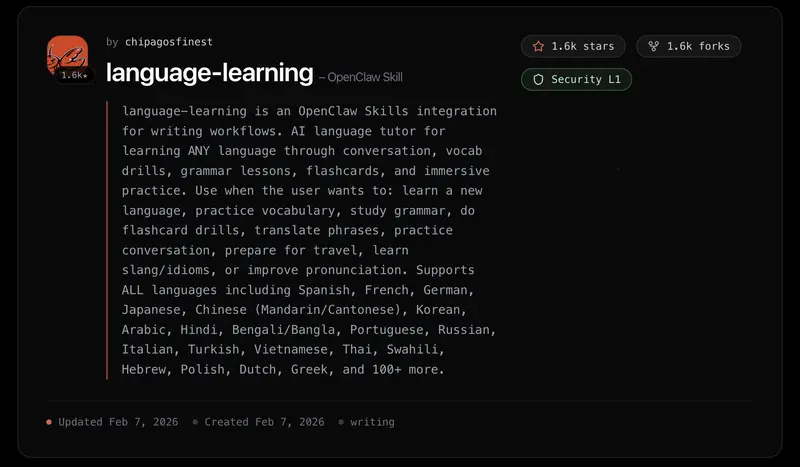
For example, learners can ask AI to generate:
- restaurant vocabulary in Spanish
- travel dialogues in Japanese
- grammar drills for French verbs
- pronunciation practice sentences in Korean
The result is a learning environment that adapts to individual goals.
What Makes OpenClaw Different From Language Apps
OpenClaw is not a traditional language learning platform. Instead, it is a self-hosted AI system capable of connecting to multiple channels and workflows.
Because of this design, it offers several unique advantages.
Flexible Learning Environment
Instead of following pre-built lessons, you can create your own study structure.
For example, one OpenClaw session could focus on:
- conversation practice
- grammar explanations
- vocabulary review
Another session could focus only on writing corrections.
This flexibility allows learners to focus on their real weaknesses rather than completing generic lessons.
Multi-Channel Access
OpenClaw can interact through different messaging platforms or interfaces.
This means you can practice language skills through:
- chat interfaces
- messaging apps
- browser dashboards
Being able to practice from tools you already use can reduce friction and make learning easier to maintain.
Personal Data Control
Because OpenClaw is self-hosted, users can control their own learning data.
Study sessions, corrections, and conversation logs remain within the user’s environment instead of being stored on external language-learning platforms.
For learners who value privacy and data ownership, this can be an important advantage.
Five Powerful Ways to Use OpenClaw for Language Learning
The best way to use OpenClaw is to assign it specific roles in your study routine.
Here are five practical approaches.
1. Use It as a Conversation Partner
Speaking practice is often the most difficult part of learning a language.
OpenClaw can simulate conversations at different levels of difficulty.
Example prompt:
Speak with me in Spanish at A2 level. Correct my biggest grammar mistake after each reply.
This creates a low-pressure environment to practice speaking regularly.
Over time, consistent conversation practice helps improve:
- fluency
- confidence
- sentence structure
2. Build Custom Vocabulary Lists
Instead of memorizing random vocabulary lists, OpenClaw can generate vocabulary based on real-life situations.
Examples include:
- travel vocabulary
- workplace language
- daily conversations
- hobby-related phrases
Example prompt:
Create 15 common Italian words used in restaurants. Include pronunciation and example sentences.
Learning vocabulary within context makes it easier to remember and apply.
3. Request Simple Grammar Explanations
Grammar explanations in textbooks can sometimes be overly complex.
With OpenClaw, learners can request explanations adapted to their level.
Example prompt:
Explain the difference between the French passé composé and imparfait in simple English.
Learners can then ask for additional examples or exercises.
Breaking grammar into small explanations often makes learning easier.
4. Improve Writing Through AI Feedback
Writing is one of the most effective ways to improve accuracy in a new language.
OpenClaw can review short texts and provide corrections.
Example prompt:
Correct my German paragraph. Show the corrected version first, then explain my three biggest mistakes.
Regular writing practice helps strengthen:
- grammar accuracy
- vocabulary range
- sentence structure
5. Practice Pronunciation and Shadowing
Listening and pronunciation are often overlooked in self-study routines.
You can ask OpenClaw to generate short sentences for pronunciation practice.
Example prompt:
Create 10 short Japanese sentences for beginner learners. I will repeat them aloud.
This technique, known as shadowing, helps improve pronunciation and speech rhythm.
Advantages of Using OpenClaw for Language Learning
While OpenClaw was not designed specifically for education, it offers several benefits for learners.
Customizable Learning
Learners can build routines tailored to their own needs.
For example, one person might focus on speaking practice, while another prioritizes writing correction.
Unlimited Practice
Unlike human tutors, AI tools are always available. Learners can repeat exercises, generate dialogues, and practice conversations at any time.
Integration With Existing Workflows
OpenClaw can fit into personal productivity systems, messaging platforms, or note-taking environments.
This can reduce friction and help learners practice more frequently.
Potential Risks and Limitations of Using AI for Language Learning
Despite its advantages, AI-based learning tools also have limitations.
AI Responses May Contain Errors
Language models occasionally produce incorrect explanations or unnatural phrasing. This is one reason many educators recommend treating AI output as support rather than unquestioned authority. For a broader academic look at how generative AI is affecting language learning, see this study on AI-generated feedback on writing.
Learners should treat AI feedback as helpful guidance rather than a perfect authority.
Consulting reliable grammar references can help confirm important rules.
Lack of Structured Curriculum
OpenClaw provides flexibility but does not automatically guide learners through a structured learning path.
Beginners may struggle without a clear sequence of lessons.
Structured courses often provide better foundations for complete beginners.
Over-Reliance on AI
Another risk is becoming overly dependent on AI corrections.
If learners rely on AI to fix every sentence, they may avoid developing independent language skills.
A healthier approach is to attempt expression first, then review corrections afterward.
Privacy and Security Considerations
Because OpenClaw may integrate with multiple tools and systems, configuration matters.
Users should follow basic security practices:
- limit unnecessary integrations
- protect system access credentials
- update software regularly
Responsible configuration helps ensure both privacy and security.
OpenClaw vs Traditional Language Learning Apps
| Feature | OpenClaw | Traditional Language Apps |
|---|---|---|
| Learning Structure | User-defined | Pre-built curriculum |
| Conversation Practice | Unlimited AI conversation | Scripted dialogues |
| Personalization | Very high | Moderate |
| Beginner Friendliness | Lower | Higher |
Traditional apps may be better for beginners, while OpenClaw can become a powerful supplementary learning tool for more experienced learners.
Using AI Responsibly for Language Learning
AI tools are most effective when used as part of a balanced study approach.
A strong language learning routine should still include:
- reading authentic content
- listening to native speakers
- practicing real conversations
- reviewing grammar resources
AI can accelerate learning, but true fluency still requires exposure to real language and consistent practice.
Final Thoughts
OpenClaw was not originally built for language learning, but its flexibility allows it to function as a powerful study assistant.
With the right setup, it can become:
- a conversation partner
- a grammar explainer
- a vocabulary generator
- a writing coach
- a study organizer
The key is building a simple learning workflow and maintaining consistent practice.
AI tools cannot replace human interaction entirely, but they can make language learning far more accessible and flexible than before. If you want to compare this kind of workflow with a more structured AI tutor experience, explore Avatalks.