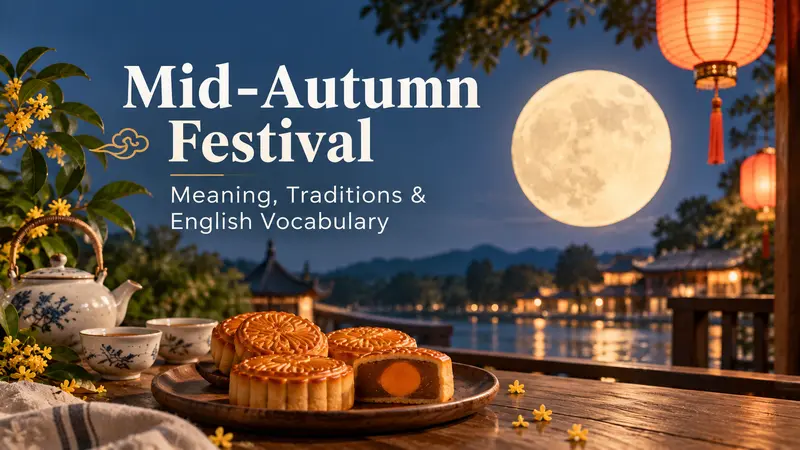
The Mid-Autumn Festival in Chinese is 中秋节 (Zhōngqiū Jié).
It is one of the best-known traditional Chinese festivals and is closely associated with the full moon, family reunions, mooncakes, and lanterns.
If you are learning Mandarin, 中秋节 is also a great cultural topic for learning practical Chinese vocabulary.
In this short guide, you will learn how to say Mid-Autumn Festival in Chinese, how to wish someone a happy Mid-Autumn Festival, and useful words and sentences for talking about the celebration.
TL;DR
Mid-Autumn Festival:
中秋节 — Zhōngqiū Jié
Happy Mid-Autumn Festival:
中秋节快乐 — Zhōngqiū Jié kuàilè
Essential vocabulary:
| Chinese | Pinyin | English |
|---|---|---|
| 中秋节 | Zhōngqiū Jié | Mid-Autumn Festival |
| 月亮 | yuèliang | moon |
| 月饼 | yuèbǐng | mooncake |
| 满月 | mǎnyuè | full moon |
| 灯笼 | dēnglong | lantern |
| 团圆 | tuányuán | reunion |
| 赏月 | shǎngyuè | admire the moon |
| 嫦娥 | Cháng’é | Chang’e |
The easiest greeting to remember is:
中秋节快乐!
It means Happy Mid-Autumn Festival!
How do you say Mid-Autumn Festival in Chinese?
Mid-Autumn Festival is:
中秋节
Zhōngqiū Jié
Let’s break it down:
- 中 (zhōng) = middle
- 秋 (qiū) = autumn
- 节 (jié) = festival
So 中秋节 literally refers to the Mid-Autumn Festival.
You may already recognize 中 from words such as 中国 (Zhōngguó), meaning China.
秋 means autumn.
For example:
秋天 — qiūtiān — autumn
And 节 appears in the names of many festivals.
For example:
春节 — Chūnjié — Spring Festival
Learning these characters as parts of real words can make them much easier to remember than studying them in isolation.
If you are working on character memory, see our guide to how to memorize Chinese characters.
How to say Happy Mid-Autumn Festival in Chinese
The most useful greeting is:
中秋节快乐!
Zhōngqiū Jié kuàilè!
It means:
Happy Mid-Autumn Festival!
The important word here is:
快乐 — kuàilè — happy
This pattern appears in other Chinese greetings too.
For example:
生日快乐 — shēngrì kuàilè — Happy birthday
So the structure:
occasion + 快乐
is worth remembering.
Another useful Mid-Autumn greeting
You may also hear:
祝你中秋节快乐
Zhù nǐ Zhōngqiū Jié kuàilè
This means:
Wishing you a happy Mid-Autumn Festival.
Break it down:
- 祝 (zhù) = to wish
- 你 (nǐ) = you
- 中秋节快乐 = Happy Mid-Autumn Festival
You can use this when sending someone a message or greeting them during the festival.
For a more respectful version, you can replace 你 (nǐ) with 您 (nín):
祝您中秋节快乐
Zhù nín Zhōngqiū Jié kuàilè
Essential Mid-Autumn Festival vocabulary
You do not need dozens of specialized words to talk about 中秋节.
Start with these:
月亮 — yuèliang — moon
月亮
月亮 (yuèliang) is the everyday Chinese word for the moon.
Example:
今晚的月亮很漂亮
Jīnwǎn de yuèliang hěn piàoliang
The moon is beautiful tonight.
月饼 — yuèbǐng — mooncake
月饼
月 (yuè) = moon
饼 (bǐng) can refer to various round or flat cake-like or bread-like foods depending on the word.
Together:
月饼 = mooncake
A useful sentence is:
我喜欢吃月饼
Wǒ xǐhuan chī yuèbǐng
I like eating mooncakes.
满月 — mǎnyuè — full moon
满月
满 (mǎn) means full.
月 (yuè) means moon.
So 满月 means full moon.
团圆 — tuányuán — reunion
团圆
团圆 (tuányuán) describes loved ones coming together again, especially family.
This is an important idea during 中秋节.
You may hear:
一家人团圆
Yì jiā rén tuányuán
It refers to the family being reunited or together.
赏月 — shǎngyuè — admire the moon
赏月
赏 (shǎng) means to appreciate or admire.
月 (yuè) means moon.
So 赏月 means appreciating or admiring the moon.
For example:
我们一起赏月
Wǒmen yìqǐ shǎngyuè
We admire the moon together.
灯笼 — dēnglong — lantern
灯笼
This means lantern.
Lantern traditions vary by region, but lanterns are commonly associated with Mid-Autumn celebrations in many places.
Why is the moon important during 中秋节?
The full moon is strongly connected with the idea of 团圆 (tuányuán) — reunion.
A round moon can symbolize family members being together.
That is why several important Mid-Autumn words are connected with the moon:
- 月亮 — moon
- 满月 — full moon
- 月饼 — mooncake
- 赏月 — admire the moon
Notice the repeated character:
月
yuè
It means moon, and it also appears in Chinese words connected with months.
Seeing the same character across related vocabulary is a useful way to build your Chinese vocabulary.
What do people do during 中秋节?
Traditions differ between families and regions, but common Mid-Autumn activities can include:
- family gatherings
- eating mooncakes
- admiring the moon
- giving mooncakes as gifts
- displaying or carrying lanterns
- having dinner with relatives
Here are a few simple Chinese sentences you can use.
We eat mooncakes
我们吃月饼
Wǒmen chī yuèbǐng
Our family eats dinner together
我们一家人一起吃饭
Wǒmen yì jiā rén yìqǐ chīfàn
We admire the moon together
我们一起赏月
Wǒmen yìqǐ shǎngyuè
These are simple enough for beginners but useful in real conversation.
Who is Chang’e?
Another word you may encounter around the Mid-Autumn Festival is:
嫦娥
Cháng’é
Chang’e is a famous figure in Chinese mythology associated with the moon.
Stories about Chang’e have several versions, so Chinese learners do not need to memorize one detailed version simply to understand the festival.
For everyday conversation, you can remember:
嫦娥和月亮有关
Cháng’é hé yuèliang yǒuguān
Chang’e is associated with the moon.
A short Mid-Autumn Festival conversation
Here is a simple dialogue you can practice.
A: 你喜欢中秋节吗?
Nǐ xǐhuan Zhōngqiū Jié ma?
Do you like the Mid-Autumn Festival?
B: 喜欢,我很喜欢吃月饼。
Xǐhuan, wǒ hěn xǐhuan chī yuèbǐng.
Yes. I really like eating mooncakes.
A: 你们中秋节做什么?
Nǐmen Zhōngqiū Jié zuò shénme?
What do you do during the Mid-Autumn Festival?
B: 我们一家人一起吃饭,然后赏月。
Wǒmen yì jiā rén yìqǐ chīfàn, ránhòu shǎngyuè.
Our family eats dinner together and then admires the moon.
Practice these Mid-Autumn sentences
Try reading each sentence aloud.
Then cover the Chinese and see whether you can recreate it from the English meaning.
Happy Mid-Autumn Festival
中秋节快乐
Zhōngqiū Jié kuàilè
I like eating mooncakes
我喜欢吃月饼
Wǒ xǐhuan chī yuèbǐng
The moon is beautiful tonight
今晚的月亮很漂亮
Jīnwǎn de yuèliang hěn piàoliang
We admire the moon together
我们一起赏月
Wǒmen yìqǐ shǎngyuè
Our family eats dinner together
我们一家人一起吃饭
Wǒmen yì jiā rén yìqǐ chīfàn
For more beginner vocabulary and character practice, you can continue with 100 common Chinese characters for beginners or review Chinese Pinyin.
FAQ
How do you say Mid-Autumn Festival in Chinese?
Mid-Autumn Festival is:
中秋节 — Zhōngqiū Jié
How do you say Happy Mid-Autumn Festival in Chinese?
Say:
中秋节快乐!
Zhōngqiū Jié kuàilè!
What does 中秋节 literally mean?
中 means middle, 秋 means autumn, and 节 means festival.
Together, 中秋节 means the Mid-Autumn Festival.
What is mooncake in Chinese?
Mooncake is:
月饼 — yuèbǐng
What is moon in Chinese?
The common everyday word for moon is:
月亮 — yuèliang
The character 月 (yuè) itself also means moon and appears in many related words.
What does 赏月 mean?
赏月 (shǎngyuè) means to admire or enjoy looking at the moon.
It is strongly associated with the Mid-Autumn Festival.
What does 团圆 mean?
团圆 (tuányuán) means reunion or being reunited, particularly with family.
Family reunion is an important theme associated with 中秋节.
Final thoughts
If you are learning Chinese, you do not need to memorize a long list of Mid-Autumn Festival vocabulary.
Start with these five:
中秋节 — Zhōngqiū Jié — Mid-Autumn Festival
中秋节快乐 — Zhōngqiū Jié kuàilè — Happy Mid-Autumn Festival
月饼 — yuèbǐng — mooncake
月亮 — yuèliang — moon
赏月 — shǎngyuè — admire the moon
Then put them into real sentences:
我喜欢吃月饼
我们一起赏月
中秋节快乐
Once you can recognize, pronounce, and use those expressions yourself, you have learned more than festival vocabulary—you have turned the Mid-Autumn Festival into practical Mandarin practice.