TL;DR
Learning Polish numbers is much easier than many beginners expect.
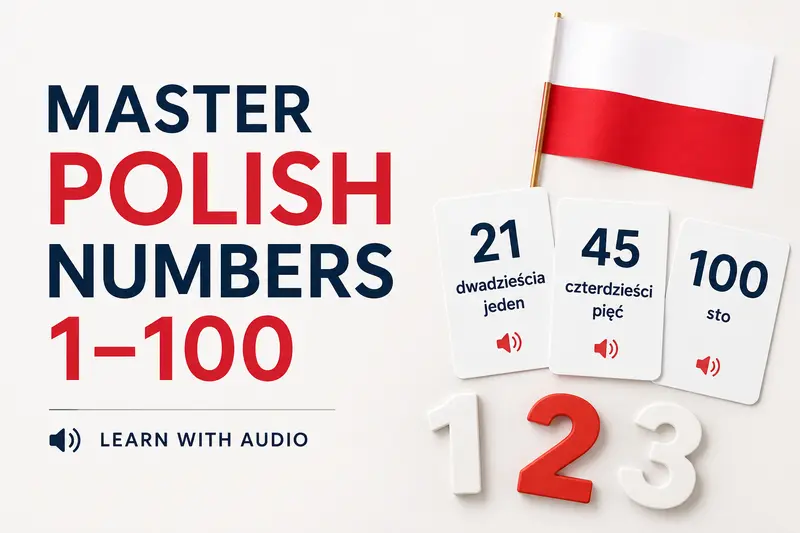
Instead of memorizing one hundred separate words, you’ll discover that Polish numbers follow clear patterns. Once you know the numbers from 1 to 20 and the names of the tens, you can confidently build almost every number up to 100.
In this guide you’ll learn:
- Numbers 1–100 with native-quality audio
- How Polish numbers are constructed
- Easy pronunciation tips
- Common counting patterns
- Practical examples for shopping, telling your age, dates, and more
If you’re just getting started with Polish, you may also enjoy our Learn the Polish Alphabet guide before continuing.
Why learning Polish numbers is easier than you think
At first glance, Polish numbers may look unfamiliar.
Words like czterdzieści (40) or osiemdziesiąt (80) can seem intimidating, especially if you’ve never studied a Slavic language before.
Fortunately, Polish counting is actually very logical.
Unlike English, where some numbers have irregular spelling, Polish follows predictable patterns.
Once you understand how the building blocks fit together, you’ll be able to recognize and create new numbers almost automatically.
Instead of memorizing 100 different words, you’ll mainly learn:
- Numbers 1–19
- The tens (20, 30, 40…90)
- How to combine them
That’s all.
How Polish numbers are built
Think of Polish numbers like building blocks.
For example, English speakers naturally understand:
twenty + one = twenty-one
Polish uses the same idea.
For example:
| Number | Polish |
|---|---|
| 20 | dwadzieścia |
| 21 | dwadzieścia jeden |
| 22 | dwadzieścia dwa |
| 23 | dwadzieścia trzy |
Once you’ve learned the tens, creating larger numbers becomes surprisingly easy.
We’ll start with the most important numbers first.
Polish numbers 1–10
These are the foundation of everything else.
Spend extra time practicing them because you’ll use them every day.
| Number | Polish | Audio |
|---|---|---|
| 1 | jeden | |
| 2 | dwa | |
| 3 | trzy | |
| 4 | cztery | |
| 5 | pięć | |
| 6 | sześć | |
| 7 | siedem | |
| 8 | osiem | |
| 9 | dziewięć | |
| 10 | dziesięć |
Tips for remembering 1–10
Rather than trying to memorize all ten numbers in one sitting, try this approach:
- Listen to each audio several times.
- Say the number aloud.
- Cover the Polish word and try to recall it.
- Count from 1 to 10 without looking.
- Count backwards from 10 to 1.
Repeating this short exercise for a few minutes each day will help the numbers become automatic.
Polish numbers 11–19
After learning the first ten numbers, you’ll notice another helpful pattern.
Many numbers from 11 to 19 end with -naście, making them easier to remember as a group.
| Number | Polish | Audio |
|---|---|---|
| 11 | jedenaście | |
| 12 | dwanaście | |
| 13 | trzynaście | |
| 14 | czternaście | |
| 15 | piętnaście | |
| 16 | szesnaście | |
| 17 | siedemnaście | |
| 18 | osiemnaście | |
| 19 | dziewiętnaście |
Don’t worry if they seem long at first.
After a few practice sessions, you’ll notice the shared ending and begin recognizing the pattern instead of treating each number as a completely new word.
The tens: 20, 30, 40…90
After learning the numbers from 1 to 19, you only need to memorize the names of the tens.
| Number | Polish | Audio |
|---|---|---|
| 20 | dwadzieścia | |
| 30 | trzydzieści | |
| 40 | czterdzieści | |
| 50 | pięćdziesiąt | |
| 60 | sześćdziesiąt | |
| 70 | siedemdziesiąt | |
| 80 | osiemdziesiąt | |
| 90 | dziewięćdziesiąt |
Instead of memorizing every number individually, think of these words as the “building blocks” for everything between 20 and 99.
Build every number from 21 to 99
Here’s the good news:
Once you know the tens and the numbers from 1 to 9, you’ve already learned almost every number below 100.
The pattern is wonderfully consistent.
Numbers 21–29
| Number | Polish |
|---|---|
| 21 | dwadzieścia jeden |
| 22 | dwadzieścia dwa |
| 23 | dwadzieścia trzy |
| 24 | dwadzieścia cztery |
| 25 | dwadzieścia pięć |
| 26 | dwadzieścia sześć |
| 27 | dwadzieścia siedem |
| 28 | dwadzieścia osiem |
| 29 | dwadzieścia dziewięć |
Notice what’s happening.
You simply say:
20 + the second number
Exactly like English:
twenty-one
twenty-two
The same idea works for every other decade.
More examples
| Number | Polish |
|---|---|
| 31 | trzydzieści jeden |
| 42 | czterdzieści dwa |
| 56 | pięćdziesiąt sześć |
| 67 | sześćdziesiąt siedem |
| 78 | osiemdziesiąt osiem |
| 99 | dziewięćdziesiąt dziewięć |
Once you’ve mastered this pattern, you’ve essentially learned every number from 20 to 99.
Quick tip
Don’t try to memorize 79 separate numbers.
Instead, memorize:
- Numbers 1–19
- The eight tens
- The construction pattern
That’s only about 27 core number words, and they’ll let you create every number from 1 to 99.
Polish number 100
Fortunately, reaching 100 is easy.
| Number | Polish | Audio |
|---|---|---|
| 100 | sto |
Unlike many of the previous numbers, 100 doesn’t follow the “tens + ones” pattern.
It’s a completely new word, so it’s worth memorizing on its own.
The good news is that you’ll hear sto frequently in everyday Polish, making it easy to remember with practice.
Common pronunciation tips
Some Polish number words look much longer than their English equivalents.
Don’t let that discourage you.
Here are a few suggestions that make pronunciation easier.
Learn the rhythm before the spelling
Instead of reading every letter carefully, listen to the complete word first.
Repeat it naturally.
Your ears will remember the rhythm much faster than your eyes memorize the spelling.
Practice in groups
Instead of studying random numbers, practice them in small groups.
For example:
- 1–10
- 11–19
- 20–29
- 30–39
This helps your brain recognize patterns instead of isolated vocabulary.
Count every day
One of the easiest ways to remember numbers is simply to count.
Count:
- steps while walking,
- books on your shelf,
- pieces of fruit,
- people waiting in line.
The more often you use numbers in real life, the faster they’ll become automatic.
Complete Polish numbers 1–100 chart
Now that you understand how Polish numbers are built, use this chart as a quick reference whenever you need it.
You don’t need to memorize every row immediately. Focus on recognizing the patterns you’ve already learned.
Numbers 1–20
| Number | Polish | Audio |
|---|---|---|
| 1 | jeden | |
| 2 | dwa | |
| 3 | trzy | |
| 4 | cztery | |
| 5 | pięć | |
| 6 | sześć | |
| 7 | siedem | |
| 8 | osiem | |
| 9 | dziewięć | |
| 10 | dziesięć | |
| 11 | jedenaście | |
| 12 | dwanaście | |
| 13 | trzynaście | |
| 14 | czternaście | |
| 15 | piętnaście | |
| 16 | szesnaście | |
| 17 | siedemnaście | |
| 18 | osiemnaście | |
| 19 | dziewiętnaście | |
| 20 | dwadzieścia |
Numbers 21–100
Rather than listing eighty more rows, remember the pattern:
tens + ones
For example:
| Number | Polish |
|---|---|
| 21 | dwadzieścia jeden |
| 25 | dwadzieścia pięć |
| 30 | trzydzieści |
| 34 | trzydzieści cztery |
| 40 | czterdzieści |
| 47 | czterdzieści siedem |
| 50 | pięćdziesiąt |
| 58 | pięćdziesiąt osiem |
| 60 | sześćdziesiąt |
| 69 | sześćdziesiąt dziewięć |
| 70 | siedemdziesiąt |
| 73 | siedemdziesiąt trzy |
| 80 | osiemdziesiąt |
| 86 | osiemdziesiąt sześć |
| 90 | dziewięćdziesiąt |
| 99 | dziewięćdziesiąt dziewięć |
| 100 | sto |
Once you understand this pattern, you can confidently read every number between 1 and 100.
Use Polish numbers in everyday life
Learning numbers becomes much easier when you use them in real situations.
Saying your age
Mam dwadzieścia pięć lat.
I am 25 years old.
Shopping
Poproszę dwa jabłka.
Two apples, please.
Talking about prices
To kosztuje trzydzieści złotych.
It costs thirty złoty.
Reading years
For example:
2026
is read differently from simply saying “two thousand twenty-six” in English.
As your Polish improves, you’ll learn the standard way native speakers read years, dates, and larger numbers.
Phone numbers
When giving a phone number, Polish speakers often read each digit individually.
For example:
731
can be spoken as:
siedem trzy jeden
Listening practice is especially helpful here because native speakers sometimes group digits slightly differently in casual conversation.
Common mistakes beginners make
Trying to memorize all 100 numbers
You don’t need to.
Instead, memorize:
- Numbers 1–19
- The tens
- The construction pattern
Everything else follows naturally.
Ignoring pronunciation
Reading numbers silently isn’t enough.
Always listen to native pronunciation and repeat aloud.
Speaking helps reinforce your memory much faster than reading alone.
Only studying once
Numbers appear everywhere.
Practice them daily by reading prices, counting objects, telling the time, or saying your age.
Small amounts of daily practice are much more effective than one long study session.
Frequently asked questions
Are Polish numbers difficult?
Not really.
Most beginners find the spelling unfamiliar at first, but the overall system is highly predictable.
Do Polish numbers follow patterns?
Yes.
Once you’ve learned the numbers from 1–19 and the names of the tens, you can build nearly every number up to 100.
What’s the best way to memorize Polish numbers?
Use them every day.
Count objects around you, say prices aloud, practice your age, and listen to native audio regularly.
Should I learn numbers before grammar?
Yes.
Numbers are some of the most useful words in everyday conversations, making them an excellent place to start building vocabulary.
Final thoughts
Mastering Polish numbers doesn’t require memorizing one hundred completely different words.
Instead, learn the basic building blocks, recognize the repeating patterns, and practice them regularly in real-life situations.
With just a few minutes of daily listening and speaking practice, you’ll soon find yourself counting naturally in Polish.
If you’re continuing your Polish learning journey, don’t miss our Learn the Polish Alphabet guide. Once you’re comfortable with numbers, you’ll also be ready for future lessons on telling time, shopping, dates, and everyday Polish conversations.