TL;DR
The most common way to say “thank you” in Polish is:
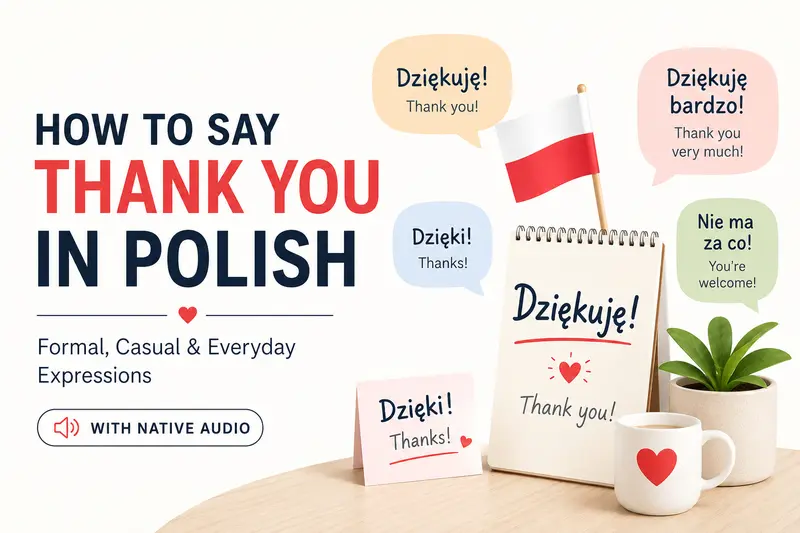
Dziękuję
You’ll hear this expression everywhere in Poland, from cafés and shops to hotels and everyday conversations.
Other useful expressions include:
| Polish | English | Situation |
|---|---|---|
| Dziękuję | Thank you | Standard |
| Dzięki | Thanks | Casual |
| Dziękuję bardzo | Thank you very much | Polite |
| Serdecznie dziękuję | Thank you sincerely | Formal writing |
| Nie ma za co | You’re welcome | Reply |
| Proszę | You’re welcome / Please | Reply or request |
If you’re just starting to learn Polish, remember these three expressions:
- Dziękuję for almost every situation.
- Dzięki with friends.
- Nie ma za co when someone thanks you.
How do you say “thank you” in Polish?
Expressing gratitude is one of the easiest ways to make a good impression when speaking Polish.
Whether you’re ordering coffee, asking for directions, or meeting someone for the first time, saying Dziękuję shows politeness and respect.
The good news is that Polish doesn’t require dozens of different expressions.
With just a few common phrases, you’ll be able to thank people naturally in almost every situation.
In this guide, you’ll learn:
- the most common ways to say thank you,
- when each expression sounds natural,
- native pronunciation with audio,
- how to reply when someone thanks you,
- and a few cultural tips that will help you sound more like a native speaker.
Quick gratitude cheat sheet
Need a quick answer?
Here’s which expression to use.
| Situation | Best expression |
|---|---|
| Thanking a cashier | Dziękuję |
| Thanking a friend | Dzięki |
| Thanking your teacher | Dziękuję bardzo |
| Writing a formal email | Serdecznie dziękuję |
| Replying to “Thank you” | Nie ma za co |
| Offering something | Proszę |
We’ll explain each expression in detail below.
Dziękuję
If you only learn one phrase from this article, make it Dziękuję.
It’s the standard way to say “Thank you” in Polish and works in almost every situation.
You’ll hear it:
- in shops,
- restaurants,
- hotels,
- public transport,
- workplaces,
- and everyday conversations.
Whether you’re speaking to a stranger or someone you know well, Dziękuję always sounds polite.
Example
Dziękuję.
Thank you.
Simple, natural, and appropriate almost everywhere.
Dzięki
Dzięki is the casual equivalent of “Thanks.”
It’s commonly used with:
- friends,
- classmates,
- siblings,
- and people you know well.
Because it’s informal, avoid using it in business meetings, formal emails, or when speaking with someone much older whom you’ve just met.
Example
Dzięki!
Thanks!
If a friend lends you a pen or helps you with homework, Dzięki sounds perfectly natural.
Dziękuję bardzo
Adding bardzo (“very much”) makes your gratitude stronger.
It’s equivalent to saying:
“Thank you very much.”
Although it’s slightly more formal than Dziękuję, it’s still common in everyday life.
You’ll often hear it when:
- thanking shop assistants,
- hotel staff,
- teachers,
- or someone who has gone out of their way to help you.
Example
Dziękuję bardzo.
Thank you very much.
This expression sounds warm, polite, and sincere without being overly formal.
Which expression should you use?
If you’re wondering which phrase sounds the most natural, here’s a simple guide.
| Expression | Best used with | Naturalness |
|---|---|---|
| Dziękuję | Almost everyone | ⭐⭐⭐⭐⭐ |
| Dzięki | Friends and family | ⭐⭐⭐⭐⭐ |
| Dziękuję bardzo | Polite situations | ⭐⭐⭐⭐ |
| Serdecznie dziękuję | Formal writing | ⭐⭐⭐ |
For most learners, Dziękuję and Dzięki are the expressions you’ll use every day.
In the next section, we’ll learn more formal ways to express gratitude, discover how native speakers reply when someone thanks them, and practice real conversations you’ll hear in everyday Polish.
Serdecznie dziękuję
If you want to express especially sincere gratitude, Serdecznie dziękuję is an excellent choice.
It literally means “I sincerely thank you” and is more formal than Dziękuję bardzo.
You’ll often see it in:
- business emails,
- thank-you letters,
- speeches,
- formal messages,
- and written correspondence.
Although it’s perfectly correct in conversation, native speakers usually reserve it for situations where they want to sound especially respectful or heartfelt.
Example
Serdecznie dziękuję.
Thank you very sincerely.
How to reply when someone says “thank you”
Knowing how to respond is just as important as knowing how to say Dziękuję.
Fortunately, Polish has several simple replies that you’ll hear every day.
Nie ma za co
This is probably the most common reply.
It literally means:
“There’s nothing to thank me for.”
In natural English, it’s equivalent to:
- You’re welcome.
- Don’t mention it.
- No problem.
You’ll hear it everywhere—from cafés and shops to conversations between friends.
Example
A
Dziękuję.
Thank you.
B
Nie ma za co.
You’re welcome.
Proszę
Proszę is one of the most versatile words in Polish.
Depending on the situation, it can mean:
- Please.
- You’re welcome.
- Here you are.
- Go ahead.
When someone thanks you after you’ve handed them something, simply replying Proszę sounds completely natural.
Example
A
Dziękuję bardzo.
Thank you very much.
B
Proszę.
You’re welcome.
Which reply sounds the most natural?
Here’s a quick comparison.
| Someone says… | Natural reply |
|---|---|
| Dziękuję | Nie ma za co |
| Dziękuję bardzo | Proszę |
| Dzięki | Nie ma sprawy (informal) |
| Serdecznie dziękuję | Cała przyjemność po mojej stronie (very formal) |
As a beginner, you only need to remember two replies:
- Nie ma za co
- Proszę
These cover the vast majority of everyday conversations.
Real conversations
Rather than memorizing individual phrases, practice complete conversations.
This will help you remember the expressions naturally.
At a café
Customer
Dziękuję.
Thank you.
Barista
Proszę.
You’re welcome.
A friend helps you
A
Dzięki!
Thanks!
B
Nie ma sprawy.
No problem.
Thanking a teacher
Student
Dziękuję bardzo.
Thank you very much.
Teacher
Nie ma za co.
You’re welcome.
Polish gratitude etiquette
Polish people generally appreciate sincere politeness.
A simple Dziękuję accompanied by a smile is appropriate in almost every situation.
You’ll often hear people say Dziękuję when:
- receiving change in a shop,
- getting off a bus,
- being served in a restaurant,
- receiving directions,
- accepting a small favor.
When someone helps you in a more meaningful way, Dziękuję bardzo adds warmth without sounding overly formal.
For formal emails, letters, or professional messages, Serdecznie dziękuję is a natural choice that expresses genuine appreciation.
Remember that politeness in Polish is less about using complicated vocabulary and more about choosing the right expression for the situation.
Common mistakes learners make
Even simple expressions of gratitude can sound unnatural if they’re used in the wrong situation.
Here are a few common mistakes—and how to avoid them.
Using Dzięki in formal situations
Because Dzięki is short and easy to remember, many beginners use it everywhere.
However, it’s best reserved for:
- friends,
- classmates,
- family members,
- and close coworkers.
If you’re speaking with a teacher, hotel staff, a stranger, or someone in a professional setting, Dziękuję is usually the better choice.
When you’re unsure, choosing the more polite expression is always a safe option.
Thinking Proszę only means “please”
One of the biggest surprises for learners is that Proszę has several meanings.
Depending on the situation, it can mean:
- Please.
- You’re welcome.
- Here you are.
- Go ahead.
Native speakers understand the meaning from the context, so don’t be surprised if you hear the same word used in different situations.
Using Serdecznie dziękuję too often
Although Serdecznie dziękuję is a beautiful expression, it’s more formal than everyday speech.
You’ll mostly hear it in:
- formal emails,
- speeches,
- official letters,
- or messages expressing heartfelt appreciation.
For most daily conversations, Dziękuję or Dziękuję bardzo will sound much more natural.
Frequently asked questions
What’s the most common way to say thank you in Polish?
The most common expression is Dziękuję.
It’s appropriate in almost every situation, whether you’re thanking a cashier, a waiter, a colleague, or a stranger.
What’s the difference between Dziękuję and Dzięki?
Dziękuję is polite and works almost everywhere.
Dzięki is informal and is mainly used with friends, family members, and people you know well.
Can I say Dziękuję bardzo all the time?
Yes.
Dziękuję bardzo is simply a warmer, more appreciative version of Dziękuję.
It’s especially common when someone has helped you or provided excellent service.
How do Polish people reply to “thank you”?
The two most common replies are:
- Nie ma za co
- Proszę
Both are natural, polite responses that you’ll hear every day in Poland.
Does Proszę really mean both “please” and “you’re welcome”?
Yes.
Like many common Polish words, Proszę has several meanings.
Native speakers rely on the context to understand whether it means “please,” “you’re welcome,” “here you are,” or “go ahead.”
Final thoughts
Learning how to say thank you in Polish is one of the quickest ways to sound more polite and confident.
The good news is that you don’t need to memorize dozens of different expressions.
For most everyday situations, these four phrases are all you need:
- Dziękuję
- Dzięki
- Dziękuję bardzo
- Nie ma za co
As you continue learning Polish, try listening to the native audio throughout this guide and repeat each phrase aloud. Paying attention to pronunciation and rhythm will help you sound more natural and make conversations feel easier.
A sincere Dziękuję may be a small phrase, but it’s often the beginning of a positive conversation—and a great way to connect with Polish speakers.
Further reading
Ready to build your everyday Polish? These beginner-friendly guides will help you expand your vocabulary and communicate more naturally.