TL;DR — Spanish Direct vs Indirect Object Pronouns Practice
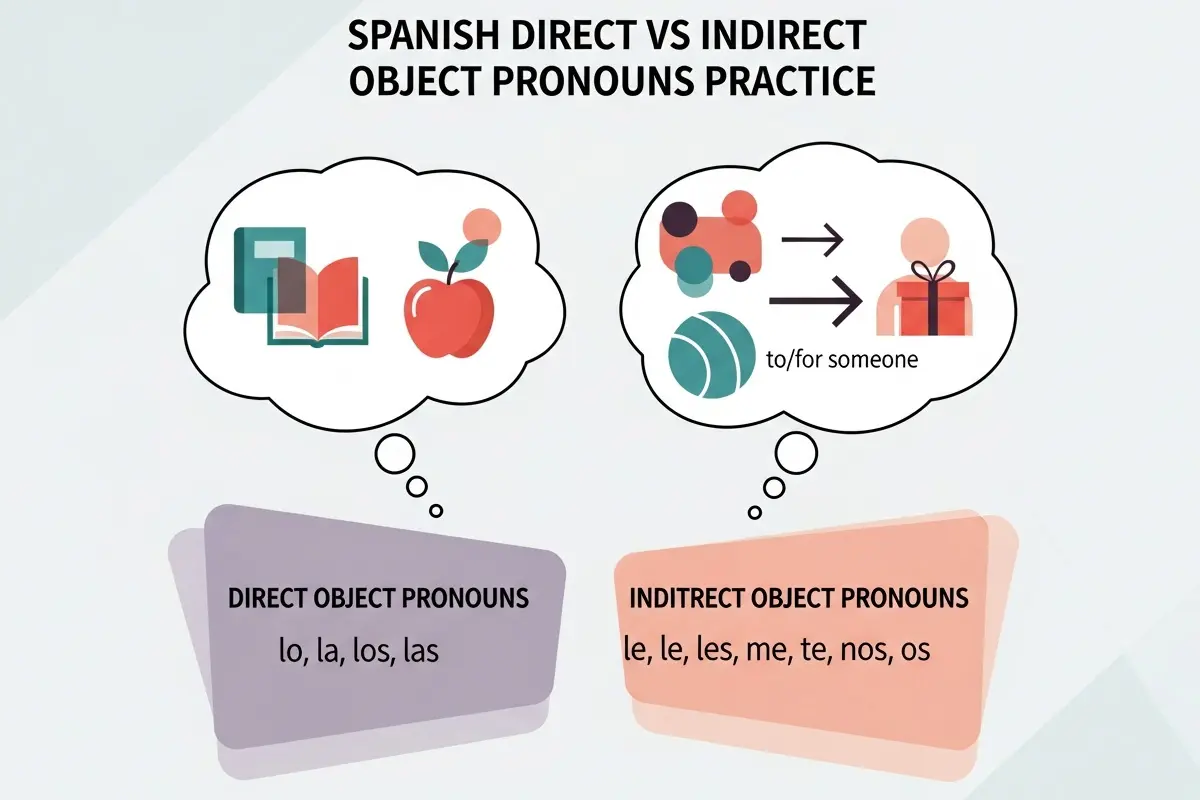
- Direct object pronouns replace what or whom receives the action (lo, la, los, las)
- Indirect object pronouns replace to whom or for whom the action is done (me, te, le, nos, les)
- When both appear together, indirect comes first
- Le → se when combined with lo / la / los / las
- The fastest way to improve is spanish direct vs indirect object pronouns practice with real sentences
Spanish Direct vs Indirect Object Pronouns Practice — Short Answer
Direct object pronouns replace the thing directly affected by the verb, while indirect object pronouns show who benefits from or receives that action.
When both appear together, Spanish follows strict word-order rules that you learn fastest through spanish direct vs indirect object pronouns practice, not long memorization.
If you want a bigger “map” of all pronouns (subject, object, reflexive, etc.), keep this guide open too: Spanish pronoun chart with clear examples.
Spanish Direct vs Indirect Object Pronouns Practice: Try It Yourself
Choose the correct pronoun combination based on meaning, not translation.
👇 Do more Spanish Object Pronouns Practice on Avatalks:
Use direct and indirect object pronouns (lo, la, le).
What Are Direct Object Pronouns in Spanish?
Direct object pronouns replace the noun that directly receives the action of the verb.
Common Direct Object Pronouns
| Pronoun | Meaning |
|---|---|
| lo | it (masculine) |
| la | it (feminine) |
| los | them (masculine) |
| las | them (feminine) |
Example:
- Compro el libro. → Lo compro.
(I buy the book → I buy it.)
Takeaway: If you can ask “what?” or “whom?”, you’re dealing with a direct object.
Quick note: “lo/la” agree with the noun you replace (el libro → lo, la casa → la). They do not agree with the person doing the action.
What Are Indirect Object Pronouns in Spanish?
Indirect object pronouns show who receives or benefits from the action.
Common Indirect Object Pronouns
| Pronoun | Meaning |
|---|---|
| me | to/for me |
| te | to/for you |
| le | to/for him/her (or you formal) |
| nos | to/for us |
| les | to/for them / to you all (formal in some regions) |
Example:
- Doy el libro a Ana. → Le doy el libro.
(I give the book to her.)
Takeaway: If you can ask “to whom?” or “for whom?”, you need an indirect object pronoun.
Spanish Direct vs Indirect Object Pronouns: Key Difference
Short answer:
- Direct object = what is given
- Indirect object = who receives it
Example:
- Doy el regalo a mi madre.
- el regalo → direct object
- a mi madre → indirect object
With pronouns:
- Se lo doy.
Takeaway: Spanish clearly separates what from who.
If Spanish word order still feels “backwards,” this explainer helps a lot: Spanish sentence structure for beginners.
What Happens When You Use Both Pronouns Together?
When both pronouns appear in the same sentence:
- Indirect object comes first
- Le / les → se (only before lo/la/los/las)
- Pronouns go before a conjugated verb, or attach to an infinitive/gerund
Example:
- Le doy el libro. → ❌ le lo doy
- ✅ Se lo doy
Takeaway: The order is mechanical. Your job is to identify who and what, then plug in the pronouns.
Why Does “Le” Change to “Se”?
Spanish avoids awkward sound combinations.
Instead of:
- ❌ le lo doy
Spanish uses:
- ✅ se lo doy
This rule applies only when le/les combine with lo, la, los, las.
Takeaway: In se lo, se is a sound-change form of le/les, not reflexive “se”.
Where Do Object Pronouns Go in a Sentence?
Spanish allows two main positions:
1) Before a Conjugated Verb
- Se lo doy hoy.
- Te la explico ahora.
2) Attached to an Infinitive or Gerund
- Voy a dárselo
- Estoy explicándotelo
And with affirmative commands, pronouns attach to the end:
- Dímelo. (Tell it to me.)
- Dénselo. (Give it to them.)
If you’re practicing the subjunctive or commands at the same time, these patterns overlap a lot—this article pairs nicely: Spanish subjunctive practice with trigger phrases.
Takeaway: Position changes, but pronoun order does not.
Common Mistakes in Spanish Direct vs Indirect Object Pronouns Practice
- Translating word-for-word from English
- Forgetting le → se
- Reversing pronoun order
- Picking lo/la based on the person (it’s based on the noun)
Wrong: Le lo digo
Correct: Se lo digo
Takeaway: Most mistakes come from skipping the two questions: “to whom?” and “what?”.
If you want a general routine for building accuracy fast, use the same method across topics: how to learn Spanish fast with short daily practice.
FAQ — Spanish Direct vs Indirect Object Pronouns Practice
What is the difference between direct and indirect object pronouns in Spanish?
Direct object pronouns replace what receives the action, while indirect object pronouns show who benefits from or receives that action.
Why does le change to se?
Le changes to se when used with lo, la, los, or las to avoid awkward pronunciation.
Which pronoun comes first?
The indirect object pronoun always comes before the direct object pronoun.
Can both pronouns appear in one sentence?
Yes, and they frequently do in natural Spanish.
What is the best way to practice object pronouns?
Sentence-based spanish direct vs indirect object pronouns practice with quick feedback is the fastest method.
Final Thoughts on Spanish Direct vs Indirect Object Pronouns Practice
These pronouns follow clear mechanical rules, not mystery exceptions.
Once you understand function (who vs what), order, and the le → se sound rule, the system becomes predictable.
Consistent spanish direct vs indirect object pronouns practice is what turns rules into instinct.