TL;DR
- Spanish future tense stem-changing rules affect only the verb stem — never the endings, even when the verb is irregular.
- Most irregular verbs follow three predictable patterns based on how the root verb changes.
- Only 12 verbs use irregular stems — most are high-frequency -er and -ir verbs.
- The same irregular stems apply to both future tense and the conditional.
- Ir + a + infinitive is still widely used in spoken Spanish, but future tense conjugation appears more in writing, exams, and formal speech.
Table of Contents
Open Table of Contents
- What Are Spanish Future Tense Stem-Changing Rules?
- Which Verbs Change in the Future Tense?
- The 3 Future Tense Stem-Changing Patterns
- Do These Same Stems Apply to the Conditional?
- When Do Spanish Speakers Use the Future Tense?
- Internal Learning Connections
- FAQ
- ❓ Do all irregular future tense verbs in Spanish follow stem-changing rules?
- ❓ Are there any -ar verbs with irregular future stems?
- ❓ Are these future tense stem changes also used in the conditional tense?
- ❓ When should I use the simple future instead of “ir + a + infinitive”?
- ❓ Why do Spanish future stems change?
- ❓ How can I memorize Spanish future tense stem-changing rules faster?
- ❓ Which irregular future stem is the most frequently used?
- Final Takeaway
What Are Spanish Future Tense Stem-Changing Rules?
Spanish future tense stem-changing rules are spelling changes applied to the verb’s root before adding the regular future tense endings.
Even if the verb is irregular, the endings are the same as for regular verbs in the future tense, which makes conjugation patterns easier to memorize compared to the present tense.
The endings always stay the same:
| Subject | Ending |
|---|---|
| yo | -é |
| tú | -ás |
| él/ella/usted | -á |
| nosotros | -emos |
| vosotros | -éis |
| ellos/ustedes | -án |
So the formula is:
modified stem + future ending
Example:
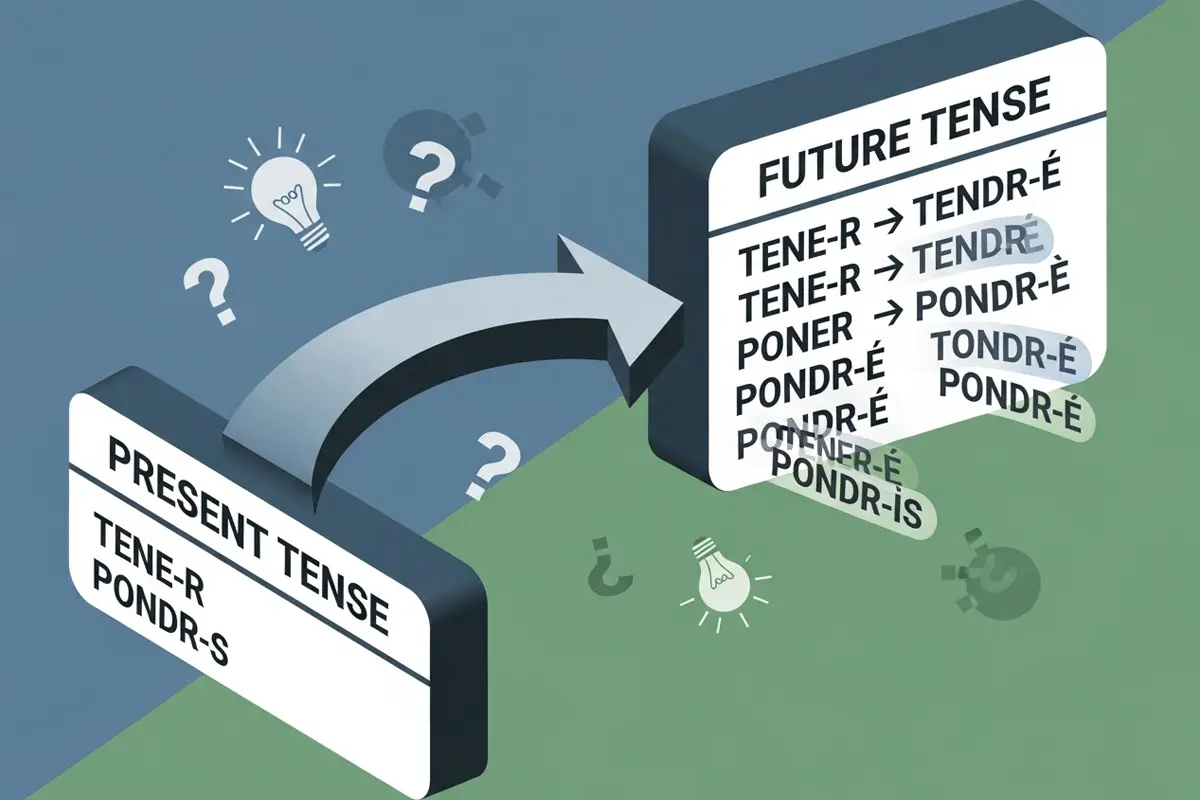
tener → tendr- → tendré (I will have).
According to the *Spanish verbs — Future tense* reference from Wikipedia, irregular future forms share the same endings as regular verbs, modifying only the stem.
Which Verbs Change in the Future Tense?
There are only twelve commonly taught irregular stems:
| Verb | Meaning | Irregular Stem | Example |
|---|---|---|---|
| decir | to say/tell | dir- | yo diré |
| hacer | to do/make | har- | yo haré |
| querer | to want/love | querr- | yo querré |
| saber | to know | sabr- | yo sabré |
| poder | to be able to | podr- | yo podré |
| haber | there will be | habr- | habrá |
| poner | to put/place | pondr- | yo pondré |
| salir | to go out/leave | saldr- | yo saldré |
| tener | to have | tendr- | yo tendré |
| venir | to come | vendr- | yo vendré |
| valer | to be worth | valdr- | yo valdré |
| caber | to fit | cabr- | yo cabré |
🧠 Tip: These irregular verbs are some of the most frequently used in real Spanish communication — especially verbs like tener, decir, poder, venir, and the verb ir. Their shortened stems reflect older forms preserved through frequent use.
The 3 Future Tense Stem-Changing Patterns
These patterns help you predict how an irregular stem forms, even if you haven’t memorized the list. They apply only to -er and -ir verbs — no -ar verbs change in the future tense because their stems remain regular.
1️⃣ Drop the -e
These verbs simply lose the internal vowel:
| Verb | Irregular Stem | Example Sentence |
|---|---|---|
| poder | → podr- | Podré ayudarte mañana. (I will be able to help you tomorrow.) |
| saber | → sabr- | Sabrás la respuesta muy pronto. |
| querer | → querr- | ¿Querrás venir conmigo? |
| caber | → cabr- | No cabrá en la mochila. |
| haber | → habr- | Habrá una fiesta esta noche. |
Takeaway: When you see an -er/-ir verb ending in -aber, -eber, -er, or -er, check this pattern.
2️⃣ Replace -e / -i → -d
These verbs insert a -d- to smooth pronunciation:
| Verb | Irregular Stem | Example |
|---|---|---|
| tener | → tendr- | Tendré más tiempo mañana. |
| venir | → vendr- | Vendrán más tarde. |
| salir | → saldr- | Saldremos temprano. |
| poner | → pondr- | ¿Pondrás la mesa? |
| valer | → valdr- | Valdrá la pena. |
Takeaway: If the infinitive has a soft internal vowel before the ending, expect a -d-.
3️⃣ Remove -ec / -ce
Only two verbs follow this high-frequency shortcut:
| Verb | Irregular Stem | Example |
|---|---|---|
| decir | → dir- | Te diré la verdad. |
| hacer | → har- | Haré mi tarea luego. |
Takeaway: These are extremely common verbs — so they evolved into shortened forms.
Do These Same Stems Apply to the Conditional?
✔ Yes. All irregular future stems are reused in the conditional tense, which means:
Learn them once → use them in two tenses.
This connection also helps reinforce patterns when reviewing Spanish grammar or working through verb conjugation drills.
Example:
| Verb | Future | Conditional |
|---|---|---|
| tener | tendré | tendría |
| poder | podré | podría |
| hacer | haré | haría |
| decir | diré | diría |
When Do Spanish Speakers Use the Future Tense?
The future tense isn’t only used for future actions. In real Spanish, it often expresses:
- Predictions: Lloverá mañana. (It will rain tomorrow.)
- Promises: Te llamaré. (I will call you.)
- Probability or speculation:
¿Dónde estará Juan? → (Where might Juan be?)
In conversational Latin American Spanish, learners will also hear:
ir + a + infinitive
Example: Voy a estudiar después. (I’m going to study later.)
Both are correct — but future tense appears more in news, writing, exams, and formal contexts.
Internal Learning Connections
If you’re building confidence in verb conjugation, especially transitions between present tense, future tense, and conditional forms, these lessons connect directly:
- Irregular Future Tense Verbs in Spanish
- Conjugation for Future Tense in Spanish
- Tenses in Spanish Chart: Full Guide
- Past Tense Conjugation Spanish
- Master the Present Perfect Tense in Spanish
These help reinforce patterns and make tense relationships easier to remember.
FAQ
❓ Do all irregular future tense verbs in Spanish follow stem-changing rules?
Yes — all irregular future tense verbs use one of the three stem-changing patterns before adding the standard future tense endings. The endings never change, only the stem.
❓ Are there any -ar verbs with irregular future stems?
No — irregular future tense stems occur only in -er and -ir verbs. All -ar verbs are completely regular in the future tense.
❓ Are these future tense stem changes also used in the conditional tense?
✔ Yes. The exact same stems are used in both tenses.
Example:
- future: tendré
- conditional: tendría
Learning one automatically gives you the other.
❓ When should I use the simple future instead of “ir + a + infinitive”?
Use simple future for:
- predictions (Lloverá mañana.)
- promises or commitments (Te llamaré.)
- speculation (¿Dónde estará ella?)
Use ir + a + infinitive for:
- near-future plans (Voy a estudiar ahora.)
- casual spoken conversation
Both forms are correct, but purpose changes usage.
❓ Why do Spanish future stems change?
Irregular stems come from historical sound simplification. Over time, the most common verbs became shortened for faster speech, and those older forms survived into modern Spanish.
❓ How can I memorize Spanish future tense stem-changing rules faster?
Learners usually succeed when they:
- Group verbs by the three stem patterns
- Repeat them aloud in full sentences
- Use flashcards with stems highlighted
- Practice in context (not isolated lists)
A quick drill example:
podré → podrás → podrá → podremos → podrán
❓ Which irregular future stem is the most frequently used?
“Habr-”, especially the form habrá, is extremely common and means “there will be.”
You’ll see it in news reports, schedules, and predictions.
Final Takeaway
Spanish future tense stem-changing rules look complex at first, but they follow just three predictable patterns, and they affect only twelve high-frequency verbs. Once you recognize the stems — podr-, tendr-, sabr-, har-, dir- and the others — reading and speaking about future events becomes smoother and more natural.