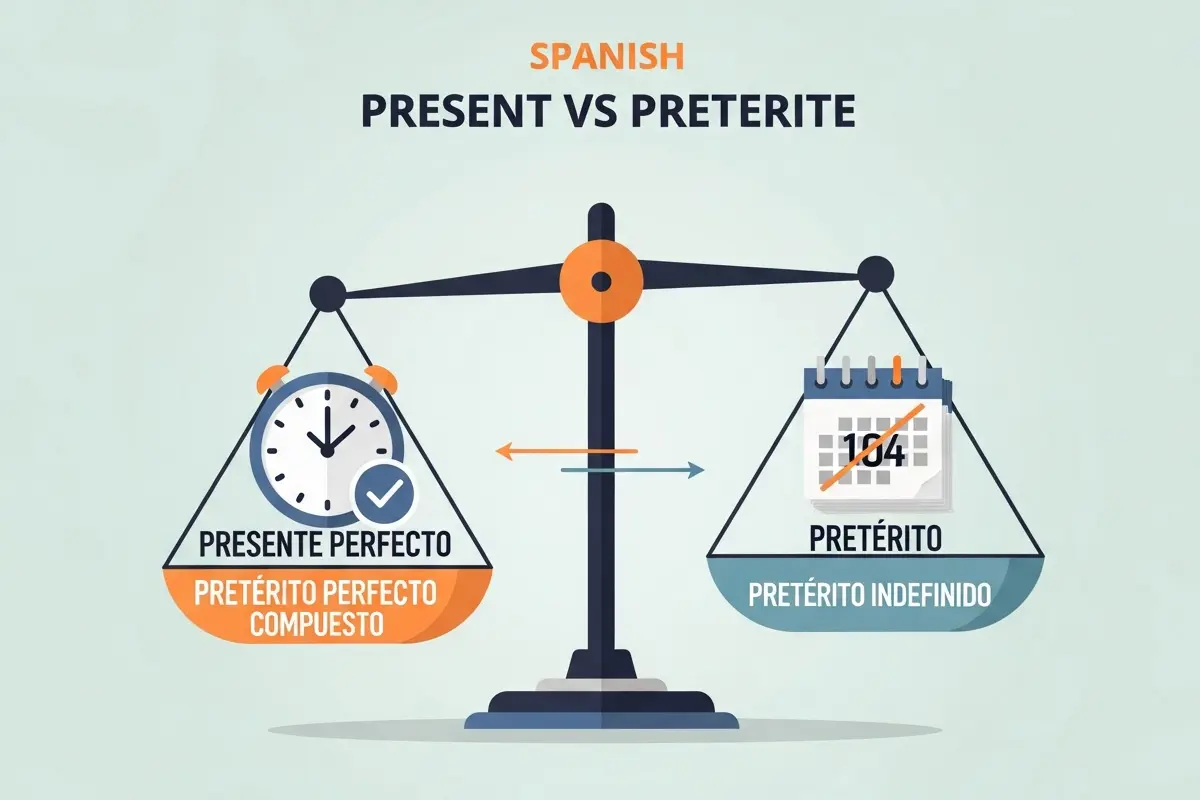
If you keep hesitating between he comido and comí, you are dealing with one of the most common tense problems in Spanish.
The confusion usually comes from two things:
- both tenses talk about the past
- different Spanish-speaking regions do not always prefer the same tense in the same situation
That is why this page focuses on Spanish present perfect vs preterite practice, not just grammar definitions.
The goal is simple:
- understand the difference
- notice the common time markers
- see the regional pattern
- practice choosing the more natural option
TL;DR
- The present perfect usually connects a past action to the present:
- he hablado
- hemos comido
- The preterite usually presents the action as finished and complete:
- hablé
- comimos
- In Spain, the present perfect is common with time expressions like:
- hoy
- esta semana
- ya
- todavía no
- In much of Latin America, the preterite is often preferred in those same everyday situations.
- With clearly finished past time markers like ayer or el año pasado, the preterite is the safest choice.
The basic difference
The fastest way to understand the contrast is this:
Present perfect
Use it when the speaker treats the past action as still connected to the present.
Examples:
- Hoy he hablado con Ana.
- Ya hemos comido.
- Nunca he estado en Perú.
Preterite
Use it when the speaker presents the action as completed and closed.
Examples:
- Ayer hablé con Ana.
- Comimos a las dos.
- El año pasado fui a Perú.
This is the core idea you want to practice.
The forms
Present perfect
Structure:
haber (present) + past participle
- he hablado
- has comido
- ha vivido
- hemos visto
Preterite
This is the simple past form:
- hablé
- comiste
- vivió
- fuimos
If you still need a refresher on the forms themselves, see our Spanish verb conjugation chart with English and past tense conjugation Spanish.
The clearest rule for beginners
A very practical beginner rule is:
Use the preterite with finished past time expressions
Examples:
- ayer
- anoche
- la semana pasada
- el año pasado
Example sentences:
- Ayer hablé con mi profesor.
- La semana pasada tuvimos un examen.
- El año pasado fui a España.
Use the present perfect when the time period still includes the present
Examples:
- hoy
- esta semana
- este mes
- ya
- todavía no
- nunca
Example sentences:
- Hoy he hablado con mi jefe.
- Esta semana hemos tenido mucho trabajo.
- Ya has terminado.
- Nunca he probado eso.
This rule works especially well for learners who are following standard Spain-based textbook usage.
Why this gets confusing: Spain vs Latin America
This is the part many learners are not told clearly enough.
In Spain, the present perfect is often used for actions in a current time frame, such as:
- hoy
- esta mañana
- esta semana
- este mes
Examples:
- Hoy he comido tarde.
- Esta semana hemos trabajado mucho.
In much of Latin America, speakers often use the preterite in those same situations.
Examples:
- Hoy comí tarde.
- Esta semana trabajamos mucho.
That does not make one version “wrong.” It means regional usage differs.
So if you have ever thought:
“But I learned that hoy should use the present perfect”
you are not imagining things. That is a real pattern, but it is not the only standard pattern in the Spanish-speaking world.
Spanish Present Perfect vs Preterite Practice Exercises
Choose the option that sounds more natural for the region shown.
👇 Do more Spanish tense practice on Avatalks:
Practice Spanish tense choices with guided grammar lessons and review.
The time markers that usually decide everything
If you want a quick way to improve, memorize the most common time markers.
Usually preterite
- ayer
- anoche
- la semana pasada
- el mes pasado
- el año pasado
- hace dos días
Often present perfect
- hoy
- esta semana
- este mes
- ya
- todavía no
- nunca
- alguna vez
This is not a perfect universal rule for every region, but it is a very good practice tool.
Real example pairs
These examples make the contrast easier to feel.
Finished time
- Ayer comí con Marta.
- Yesterday I ate with Marta.
Current time frame
- Hoy he comido con Marta.
More typical in Spain. - Hoy comí con Marta.
Common in much of Latin America.
Life experience
- Nunca he visto esa película.
- I have never seen that movie.
Closed past event
- La vi el año pasado.
- I saw it last year.
Common learner mistakes
1. Using the present perfect because it feels more advanced
Many learners overuse he hablado, he comido, and similar forms because they sound “more correct.” That often leads to unnatural choices.
2. Translating directly from English
English and Spanish do not line up perfectly here.
3. Ignoring regional usage
A sentence can be grammatically correct and still sound less natural in a particular region.
4. Forgetting the time marker
Very often, the time expression gives you the answer.
A simple practice method that works
Use this order:
Step 1
Look for the time marker.
Step 2
Ask:
- is the time period finished?
- or does it still connect to the present?
Step 3
Ask:
- am I aiming for Spain-style usage?
- or a more typical Latin American preference?
Step 4
Say the full sentence aloud.
This is better than memorizing one rigid rule and forcing it everywhere.
FAQ
What is the difference between the Spanish present perfect and preterite?
The present perfect usually presents a past action as connected to the present, while the preterite usually presents it as finished and closed.
When should I use the preterite in Spanish?
Use it with clearly finished past time expressions such as ayer, anoche, or el año pasado.
When should I use the present perfect in Spanish?
It is commonly used for past actions linked to the present, especially with expressions like hoy, esta semana, ya, todavía no, and nunca.
Is this different in Spain and Latin America?
Yes. In Spain, the present perfect is more common in current time frames. In much of Latin America, the preterite is often preferred in those same situations.
Which tense should beginners learn first?
You should learn both, but start by mastering the easiest contrast:
- finished time = preterite
- present connection = present perfect
Final thoughts
This tense contrast gets much easier once you stop looking for one magic rule that works everywhere.
A better approach is:
- notice the time marker
- think about whether the action feels closed or still connected to now
- remember that regional usage matters
That is how present perfect vs preterite starts to feel less like a trick question and more like a normal speaking choice.