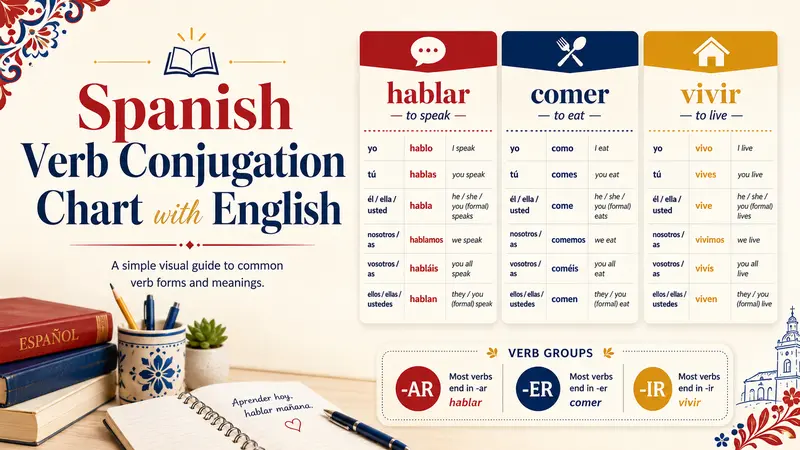
If you are looking for a Spanish verb conjugation chart with English, you probably want something very simple:
- the Spanish subject
- the verb form
- the English meaning
That is what this page gives you.
Instead of trying to teach every tense at once, this guide focuses on the part beginners need first: how to read a basic Spanish verb chart, especially in the present tense.
If you want a bigger overview later, see our full guide to future tense Spanish or our wider tenses in Spanish chart.
TL;DR
A Spanish verb conjugation chart shows how one verb changes for different subjects like yo, tú, él, and nosotros.
The fastest way to use a chart is:
- find the subject
- find the verb form
- match it to the English meaning
For beginners, the best place to start is the present tense.
What is a Spanish verb conjugation chart?
A Spanish verb conjugation chart is a table that shows how a Spanish verb changes depending on:
- the subject
- the tense
- whether the verb is regular or irregular
Spanish changes verb endings much more than English does. That is why charts are so useful.
For example, English says:
- I speak
- you speak
- we speak
But Spanish changes the verb each time:
- hablo
- hablas
- hablamos
If you want a grammar reference from an academic source, the Centro Virtual Cervantes A1–A2 grammar inventory includes regular present-tense verb paradigms. The RAE also explains how the present tense works in standard Spanish grammar in its entry on el presente.
How to read a Spanish verb conjugation chart
Every basic chart has the same logic.
| Subject | Meaning in English |
|---|---|
| yo | I |
| tú | you (informal singular) |
| él / ella / usted | he / she / you (formal singular) |
| nosotros / nosotras | we |
| vosotros / vosotras | you all (Spain) |
| ellos / ellas / ustedes | they / you all |
So when you read a chart, do not just memorize the Spanish form. Also connect it to the English subject.
Spanish verb conjugation chart with English: present tense
The present tense is the best place to start because it is used every day.
-ar verb chart: hablar = to speak
| Subject | Spanish | English |
|---|---|---|
| yo | hablo | I speak |
| tú | hablas | you speak |
| él / ella / usted | habla | he speaks / she speaks / you speak |
| nosotros / nosotras | hablamos | we speak |
| vosotros / vosotras | habláis | you all speak |
| ellos / ellas / ustedes | hablan | they speak / you all speak |
-er verb chart: comer = to eat
| Subject | Spanish | English |
|---|---|---|
| yo | como | I eat |
| tú | comes | you eat |
| él / ella / usted | come | he eats / she eats / you eat |
| nosotros / nosotras | comemos | we eat |
| vosotros / vosotras | coméis | you all eat |
| ellos / ellas / ustedes | comen | they eat / you all eat |
-ir verb chart: vivir = to live
| Subject | Spanish | English |
|---|---|---|
| yo | vivo | I live |
| tú | vives | you live |
| él / ella / usted | vive | he lives / she lives / you live |
| nosotros / nosotras | vivimos | we live |
| vosotros / vosotras | vivís | you all live |
| ellos / ellas / ustedes | viven | they live / you all live |
The three basic verb groups
Spanish infinitives usually end in:
- -ar
- -er
- -ir
That is why beginner charts usually start with one example from each group:
- hablar = to speak
- comer = to eat
- vivir = to live
Once you understand those patterns, many regular verbs become easier to read.
If you want a bigger beginner refresher, our guide to present tense Spanish fits well with this chart.
One easy pattern to notice
For regular verbs in the present tense, the endings follow a pattern.
-ar endings
- o
- as
- a
- amos
- áis
- an
-er endings
- o
- es
- e
- emos
- éis
- en
-ir endings
- o
- es
- e
- imos
- ís
- en
You do not need to memorize every tense right now. Just learn how the chart is built.
A small irregular chart with English
Not every Spanish verb follows the regular pattern. Some of the most common verbs are irregular.
ser = to be
| Subject | Spanish | English |
|---|---|---|
| yo | soy | I am |
| tú | eres | you are |
| él / ella / usted | es | he is / she is / you are |
| nosotros / nosotras | somos | we are |
| vosotros / vosotras | sois | you all are |
| ellos / ellas / ustedes | son | they are / you all are |
ir = to go
| Subject | Spanish | English |
|---|---|---|
| yo | voy | I go |
| tú | vas | you go |
| él / ella / usted | va | he goes / she goes / you go |
| nosotros / nosotras | vamos | we go |
| vosotros / vosotras | vais | you all go |
| ellos / ellas / ustedes | van | they go / you all go |
These are worth learning early because they appear constantly in real Spanish.
How to use the chart in real sentences
A chart becomes useful when you connect it to real examples.
hablar
- Yo hablo español. = I speak Spanish.
- Nosotros hablamos mucho. = We speak a lot.
comer
- Tú comes temprano. = You eat early.
- Ellos comen en casa. = They eat at home.
vivir
- Yo vivo en Madrid. = I live in Madrid.
- Ella vive con su familia. = She lives with her family.
This is the easiest way to study:
- read the chart
- say the forms out loud
- use them in short sentences
If you want more sentence-based practice after this, our article on Spanish sentence structure guide is a natural next step.
Common beginner mistakes
1. Memorizing forms without knowing the subject
A chart only helps if you know who the verb matches.
2. Mixing -er and -ir nosotros forms
- comemos
- vivimos
These are easy to confuse at first.
3. Forgetting that English and Spanish do not match word for word
Spanish verb forms often carry more meaning than English ones.
4. Trying to learn all tenses too early
Start with the present tense chart first. It gives you the strongest foundation.
FAQ
What is a Spanish verb conjugation chart with English?
It is a chart that shows Spanish verb forms next to their English meaning, so beginners can see both the conjugation and the translation clearly.
What tense should I learn first?
Start with the present tense. It is the most useful everyday tense and the easiest chart to begin with.
What are the 3 main Spanish verb groups?
They are:
- -ar
- -er
- -ir
Do I need to learn irregular verbs early?
Yes, at least the most common ones like ser, ir, and tener, because they appear very often.
Final thoughts
If Spanish verb charts have felt confusing before, that is normal.
At first, they can look like a lot of small changes all at once. But once you know how to read the chart row by row, they become much easier to use.
A simple way to study is:
- start with one verb
- match each subject to its form
- say the English meaning
- use it in a short sentence
That is enough to make real progress.
You do not need to memorize every tense today. Start with the present tense, get comfortable with the basic pattern, and then build from there.
Little by little, the chart stops looking like a grammar table and starts feeling like something you can actually use when you speak and read Spanish.