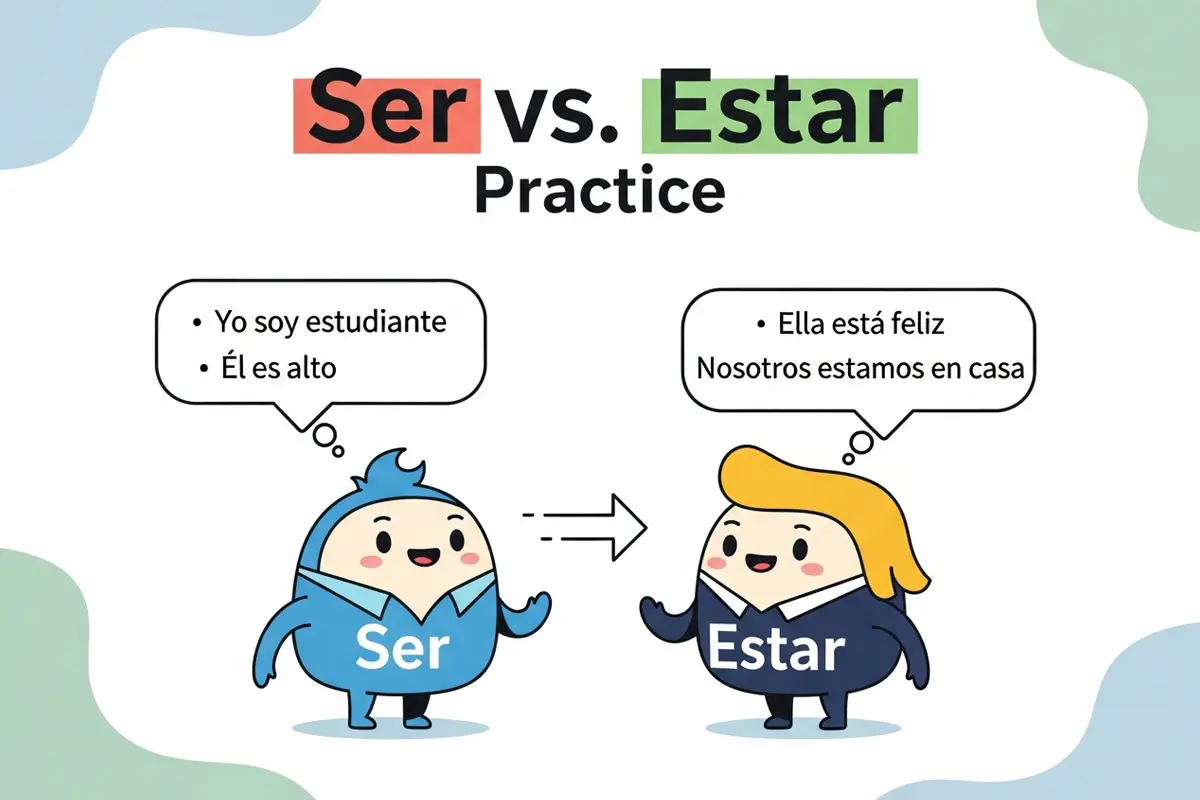
TL;DR — Spanish Ser vs Estar Practice
- Both ser and estar mean “to be,” but they are used differently.
- Use ser for identity, origin, and permanent traits.
- Use estar for location, temporary states, and conditions.
- Many adjectives change meaning depending on ser or estar.
- Practice with real sentences is the fastest way to master the difference.
Spanish Grammar Practice Hub
If you’re working through multiple grammar topics, our main Spanish grammar practice hub organizes exercises by topic so you can practice efficiently and build accuracy step by step.
Explore the practice hub →Spanish Ser vs Estar Practice — Short Answer
In Spanish ser vs estar practice, use ser for what something is in general, and estar for how or where something is right now.
The key is not memorizing lists, but understanding whether you’re describing identity or condition.
Why Is Spanish Ser vs Estar So Confusing?
❓ Why does Spanish have two verbs for “to be”?
Spanish separates essential characteristics from temporary states.
English uses one verb (“to be”), but Spanish makes this distinction clear with ser and estar.
Once you train your brain to ask “Is this permanent or temporary?”, the choice becomes easier.
When Do You Use Ser?
❓ What situations require ser?
Use ser to talk about identity, definition, and inherent traits.
Common uses of ser
- Identity: Ella es doctora. (She is a doctor.)
- Origin: Somos de México. (We are from Mexico.)
- Time & dates: Hoy es lunes.
- Characteristics: El café es caliente. (Coffee is hot, in general.)
- Relationships: Juan es mi hermano.
Think of ser as answering “What is it?”
If you want to review sentence patterns where ser appears naturally, see our guide on Spanish sentence structure.
When Do You Use Estar?
❓ What situations require estar?
Use estar for temporary states, locations, and conditions.
Common uses of estar
- Location: Madrid está en España.
- Feelings: Estoy cansado.
- Conditions: La puerta está abierta.
- Actions in progress: Estoy estudiando español.
Think of estar as answering “How is it right now?”
Listening to real conversations helps you internalize these patterns quickly. Our article on listen and learn Spanish explains how to do this daily.
Ser vs Estar With Adjectives (The Tricky Part)
❓ Why does meaning change with ser vs estar?
Some adjectives describe character with ser and state with estar.
Common examples
| Adjective | Ser | Estar |
|---|---|---|
| aburrido | Es aburrido (boring person) | Está aburrido (feels bored) |
| listo | Es listo (smart) | Está listo (ready) |
| verde | Es verde (green color) | Está verde (unripe) |
| malo | Es malo (bad person) | Está malo (feels sick) |
This is where focused spanish ser vs estar practice matters most.
A Simple Rule That Actually Works
❓ Is there a shortcut to choosing ser or estar?
Yes — ask this question:
Is this describing what something is, or how it is right now?
- What it is → ser
- How it is right now → estar
This won’t cover every edge case, but it works for most real conversations.
Spanish Ser vs Estar Practice: Fill the Blanks
Try these before checking the answers.
- Mi hermana ___ muy inteligente.
- Mi hermana ___ muy cansada hoy.
- El café ___ frío ahora.
- El café ___ una bebida popular en España.
Answers:
- es
- está
- está
- es
Short, repeated exercises like this build intuition faster than long explanations.
Common Mistakes Learners Make
❌ Using estar for identity
Incorrect: Estoy profesor.
Correct: Soy profesor.
❌ Using ser for feelings
Incorrect: Soy cansado.
Correct: Estoy cansado.
❌ Translating directly from English
English logic often leads you astray here. Spanish uses its own system.
If you’re early in your learning journey, reviewing how long it takes to learn Spanish can help you set realistic expectations.
How to Practice Ser vs Estar Effectively
❓ What’s the best way to practice ser vs estar?
The fastest method combines thinking + speaking + feedback.
Try this routine:
- Describe yourself using ser (identity, traits).
- Describe your current state using estar.
- Say the same adjective with both verbs and notice the meaning change.
- Practice out loud, not just in writing.
Avoid memorizing long grammar tables without usage.
Real-Life Ser vs Estar Examples
Madrid es grande, pero hoy está muy tranquila.
Madrid is big, but today it’s very calm.
La comida es buena aquí, pero ahora está fría.
The food is good here, but right now it’s cold.
These mixed sentences are excellent spanish ser vs estar practice because they show contrast clearly.
How Long Does It Take to Master Ser vs Estar?
❓ Will this always feel hard?
No. Most learners:
- Understand the basics in 2–3 weeks
- Make fewer mistakes after 2–3 months
- Use ser and estar naturally within 6 months
The key factor is practice frequency, not talent.
Final Practice Tip
Don’t aim for perfection — aim for correction.
Every mistake with ser vs estar teaches your brain something useful.
With consistent spanish ser vs estar practice, the choice becomes automatic.