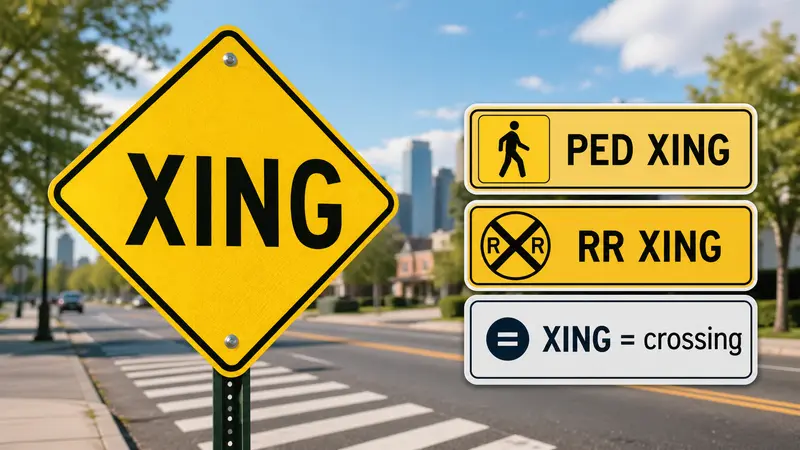
If you have seen XING on a road sign or painted on the street, it means crossing.
This is one of those small pieces of English that can confuse learners because it does not look like a normal full word. But once you know it, the meaning is simple.
On roads, XING is a shortened form of crossing. It is used to save space and make signs easier to read quickly.
In this guide, you will learn what XING means on the road, why signs use it, and how to understand common forms like PED XING and RR XING.
The short answer
XING = crossing
That is the main meaning.
When drivers see XING, they should understand that something may cross the road there, such as:
- people
- trains
- animals
- bikes
- traffic from another direction
So the basic idea is:
XING = watch for a crossing area
Why do road signs use XING?
The biggest reason is space.
Road signs need to be short, clear, and easy to read fast. The full word crossing is longer. XING is shorter and still easy to understand once you know the pattern.
Road English often uses short forms like this:
- PED = pedestrian
- RR = railroad
- XING = crossing
That is why XING appears so often in traffic signs and road markings.
Common road signs with XING
Here are the most common ones.
PED XING
PED XING means pedestrian crossing.
- PED = pedestrian
- XING = crossing
So this sign warns drivers that people may cross the road there.
You may see it near:
- schools
- hospitals
- busy sidewalks
- marked crosswalks
RR XING
RR XING means railroad crossing.
- RR = railroad
- XING = crossing
This warns drivers that a train crossing is ahead.
SCHOOL XING
This means school crossing.
It warns drivers to slow down and watch for children crossing the road.
DEER XING
This means deer crossing.
It warns drivers that deer may cross in that area.
What does XING mean in normal English?
For English learners, this is an important point:
XING is mainly road-sign English.
In normal conversation, people usually say the full word:
- crossing
- pedestrian crossing
- railroad crossing
So if someone is speaking normally, they will usually not say:
- “I saw a xing”
They are much more likely to say:
- “I saw a crossing sign”
- “There is a pedestrian crossing ahead”
That is why XING feels unusual at first. It belongs more to signs than to everyday conversation.
Is XING the same as crosswalk?
Not exactly.
A crosswalk is a specific place where pedestrians cross the street.
XING is broader. It simply means crossing and can refer to different kinds of crossing areas, not only crosswalks.
For example:
- PED XING = pedestrian crossing
- RR XING = railroad crossing
- DEER XING = deer crossing
So a crosswalk is one kind of crossing, but not every XING sign is about a crosswalk.
How to understand PED XING clearly
Many learners first notice PED XING, so it helps to break it down clearly.
PED XING = pedestrian crossing
That means:
- people may cross here
- drivers should slow down
- drivers should be ready to stop
This is one of the most useful road abbreviations to learn in English.
Easy examples
Here are some easy examples of how the sign works:
- PED XING ahead = pedestrian crossing ahead
- Slow down near the school xing = slow down near the school crossing
- RR XING = railroad crossing
- Watch for deer xing = watch for deer crossing
Even when the exact wording changes, the meaning of XING stays the same: crossing.
Common mistake learners make
A common mistake is thinking XING is a completely separate word with a special traffic meaning.
It is not.
It simply means crossing, written in a short sign style.
Another mistake is thinking it only refers to people. It does not. It can refer to:
- pedestrians
- trains
- animals
- school crossings
So always look at the word before XING.
Quick meaning guide
Here is the simple version:
| Sign | Meaning |
|---|---|
| crossing | |
| PED XING | pedestrian crossing |
| RR XING | railroad crossing |
| SCHOOL XING | school crossing |
| DEER XING | deer crossing |
FAQ
What does XING mean on the road?
It means crossing.
What does PED XING mean?
It means pedestrian crossing.
What does RR XING mean?
It means railroad crossing.
Is XING a normal English word?
Not in everyday conversation. It is mainly a shortened form used on road signs and road markings.
Is XING the same as crosswalk?
No. A crosswalk is one kind of crossing, but XING can refer to several kinds of crossing areas.
Final thoughts
XING looks strange the first time you see it, but the meaning is simple.
It is just a short road-sign way of saying crossing.
Once you know that, signs like PED XING, RR XING, and SCHOOL XING become much easier to understand. And that is exactly the kind of small real-world English that helps learners feel more confident outside the classroom.