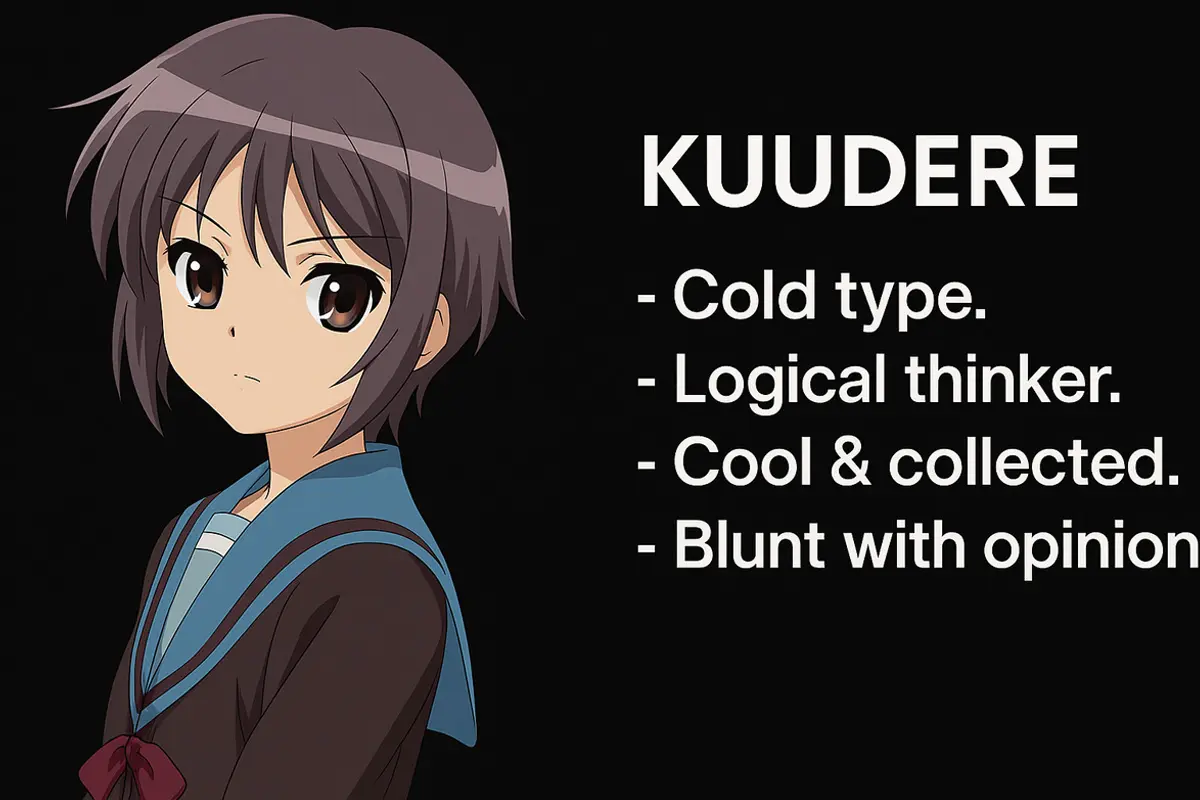
Kuudere meaning refers to a Japanese anime and manga character type that appears calm, cool, and emotionally controlled on the outside but is actually caring, loyal, and affectionate underneath.
In simple terms:
A Kuudere is “cool outside, soft inside.”
The character may seem distant or difficult to read at first, but as the story develops, their warmer personality becomes visible through small actions, loyalty, and quiet moments of affection.
Kuudere is one of several popular anime personality labels, alongside related types such as tsundere, yandere, and other “dere” character categories.
What is a Kuudere? (Quick definition)
A Kuudere is an anime character who typically:
- stays calm under pressure
- shows limited emotion in public
- speaks in a quiet or direct way
- takes time to open up
- shows care through actions rather than words
A Kuudere is not necessarily cold or unfriendly.
The key contrast is:
Outside:
- calm
- serious
- emotionally controlled
Inside:
- caring
- loyal
- affectionate
- protective
This contrast is what makes Kuudere characters popular among anime fans.
How to pronounce Kuudere
Kuudere is usually pronounced:
koo-deh-reh
In Japanese writing:
クーデレ (kūdere)
The pronunciation is separated into three parts:
| Part | Japanese | Sound |
|---|---|---|
| Kuu | クー | koo (similar to “cool” without the final l sound) |
| De | デ | deh |
| Re | レ | reh |
Japanese loanwords often adapt foreign words into Japanese pronunciation, which is why “cool” becomes kuu (クー) rather than sounding exactly like English.
When Japanese speakers pronounce クーデレ, each syllable is clear:
クー・デ・レ
kuu - de - re
Learning the pronunciation helps you recognize the term when discussing anime, manga, and Japanese fandom culture.
What does “Kuudere” mean in Japanese?
Kuudere is not a traditional Japanese personality category.
Instead, it is an anime and fandom term created by combining ideas from Japanese-style character naming.
The word is generally understood as:
- Kuu (クー) → from the English word “cool”
- Dere (デレ) → from deredere (デレデレ), meaning affectionate, lovestruck, or showing romantic feelings
So the basic idea is:
cool + affectionate
This naming pattern is common in anime fandom.
Other examples include:
- Tsundere → characters who appear harsh or cold but become affectionate
- Dandere → quiet characters who slowly open up
- Yandere → affectionate characters with an extreme or obsessive side
- Deredere → openly loving and cheerful characters
These labels are mainly used to describe fictional character patterns, not real personality categories.
Is Kuudere a real Japanese word?
No.
Kuudere is not a standard psychological term or a traditional Japanese personality classification.
It is mainly used by:
- anime fans
- manga readers
- gaming communities
- online fandom groups
Like many anime character labels, it works as a storytelling shortcut.
Instead of explaining:
“This character appears emotionally distant but gradually reveals deep care and loyalty”
fans can simply say:
“This character is Kuudere.”
It helps describe a recognizable character style quickly.
Where did the Kuudere archetype come from?
Kuudere became popular as anime and manga communities started categorizing recurring character patterns.
Many anime stories use strong personality contrasts because they create interesting character development.
A Kuudere character often begins as someone who seems:
- mysterious
- difficult to understand
- emotionally unavailable
As the story progresses, viewers discover:
- hidden kindness
- strong loyalty
- personal struggles
- emotional depth
This slow reveal is one of the reasons Kuudere characters often leave a strong impression.
Compared with louder or more dramatic characters, Kuudere characters often become the emotional anchor of a story.
They may not express feelings openly, but their actions reveal what they truly care about.
Core traits of a Kuudere character
Kuudere characters can look very different depending on the anime or manga, but they usually share a few common traits.
The important point is that a Kuudere is not simply “a quiet character.”
The defining feature is the contrast between emotional control on the outside and hidden warmth on the inside.
1. Calm and composed
A Kuudere usually remains calm even when other characters become emotional.
They may:
- think before speaking
- avoid dramatic reactions
- stay focused during stressful situations
- solve problems logically
This calm personality often makes them appear mature and reliable.
2. Limited emotional expression
A common misunderstanding is that Kuudere characters have no emotions.
That is not true.
A Kuudere usually has feelings but does not express them openly.
Instead of saying:
“I care about you.”
they may show it through actions:
- helping someone quietly
- remembering small details
- protecting someone without asking for attention
- staying beside someone during difficult moments
Their emotions are often subtle rather than dramatic.
3. Quiet affection
Kuudere affection is usually shown through behavior rather than words.
Examples:
- bringing something someone needs without being asked
- noticing when someone is uncomfortable
- offering support in a practical way
- showing loyalty when it matters most
This is why Kuudere characters are often associated with “actions speaking louder than words.”
4. Strong self-control
Many Kuudere characters have excellent emotional control.
They rarely:
- panic immediately
- overreact
- reveal their feelings too quickly
This does not mean they are emotionless.
It means they choose carefully when and how to show emotions.
5. A memorable emotional breakthrough
One reason fans enjoy Kuudere characters is the contrast between their usual personality and rare emotional moments.
A small change can feel meaningful:
- a genuine smile
- an honest confession
- showing vulnerability
- openly expressing affection
Because these moments are uncommon, they often feel more powerful.
Kuudere vs. other dere types
Anime fans often compare Kuudere with other popular “dere” character types.
Understanding the differences makes the terms easier to remember.
| Type | Core personality | Difference from Kuudere |
|---|---|---|
| Kuudere | Cool outside, caring inside | Calm, controlled, quietly affectionate |
| Tsundere | Harsh outside, sweet inside | More emotionally reactive and often embarrassed by feelings |
| Dandere | Quiet and shy | Silence usually comes from shyness or social anxiety |
| Yandere | Loving but obsessive | Affection can become extreme or unhealthy |
| Deredere | Openly affectionate | Shows love and happiness directly |
Kuudere vs Tsundere
This is one of the most common comparisons.
Both types may hide their feelings, but they do it differently.
Tsundere:
- reacts strongly
- may deny their feelings
- becomes embarrassed easily
- often has a “hot and cold” personality
Example:
“I-I didn’t do this for you!”
Kuudere:
- stays calm
- rarely shows embarrassment
- expresses care quietly
- opens up slowly
Example:
“I noticed you needed help.”
The difference is emotional style:
Tsundere = emotional resistance
Kuudere = emotional restraint
Kuudere vs Dandere
These two are sometimes confused because both can appear quiet.
The difference is the reason behind the silence.
Dandere:
A Dandere character is usually quiet because they are:
- shy
- nervous around people
- lacking confidence
They often become more talkative after gaining trust.
Kuudere:
A Kuudere character is usually quiet because they are:
- naturally calm
- emotionally controlled
- reserved
They may be confident even when they speak very little.
A simple way to remember:
Dandere: “I want to talk, but I am shy.”
Kuudere: “I do not need many words to express myself.”
Kuudere vs Yandere
These two character types are almost opposites.
A Kuudere usually:
- controls emotions
- protects quietly
- respects boundaries
A Yandere character often:
- shows intense attachment
- becomes possessive
- may act in extreme ways because of love
Both can appear devoted, but the expression of that devotion is very different.
Is every quiet anime character a Kuudere?
No.
A quiet character is not automatically Kuudere.
A character may be quiet because they are:
- shy
- serious
- lonely
- mysterious
- inexperienced socially
A Kuudere specifically has the pattern:
Calm exterior + hidden emotional warmth
For example:
A character who rarely speaks but is secretly kind and protective may be Kuudere.
A character who rarely speaks because they are afraid of people may be closer to Dandere.
Why do people love Kuudere anime characters?
Kuudere characters are popular because they offer a different type of emotional experience.
They feel reliable
Because they remain calm during difficult situations, they often become characters viewers trust.
They create slow-burn development
Instead of revealing everything immediately, Kuudere characters often develop gradually.
Fans enjoy discovering:
- what they truly feel
- what motivates them
- what makes them vulnerable
Small moments feel meaningful
When an openly emotional character shows affection, it is expected.
When a Kuudere character shows affection, it often feels special because it breaks their usual pattern.
They balance energetic characters
Kuudere characters often work well alongside:
- cheerful characters
- emotional characters
- impulsive characters
The contrast creates interesting relationships.
Famous Kuudere characters (examples)
Character classifications can be subjective because fictional characters often have multiple personality traits.
The following characters are commonly discussed as Kuudere or Kuudere-like examples.
| Character | Anime | Why fans associate them with Kuudere |
|---|---|---|
| Rei Ayanami | Neon Genesis Evangelion | Quiet, emotionally reserved, and mysterious |
| Kanade Tachibana | Angel Beats! | Calm personality with hidden kindness |
| Homura Akemi | Puella Magi Madoka Magica | Controlled, serious, and deeply protective |
| Mikazuki Augus | Mobile Suit Gundam: Iron-Blooded Orphans | Quiet, focused, and emotionally restrained |
| Saeko Busujima | Highschool of the Dead | Composed, capable, and calm under pressure |
A useful reminder:
Not every fan will agree on every example.
Character labels like Kuudere are informal fandom categories, so overlap is normal.
How to identify a Kuudere character
If you want to quickly recognize a Kuudere, look for this pattern:
✅ Speaks calmly and directly
✅ Rarely shows strong emotions publicly
✅ Stays composed during stressful situations
✅ Helps others without seeking attention
✅ Shows care through actions
✅ Slowly becomes more open with trusted people
The biggest clue is usually the contrast:
At first:
“This character seems cold.”
Later:
“This character actually cares deeply.”
That emotional reveal is the heart of the Kuudere archetype.
Kuudere characters in romance stories
When a Kuudere character appears as a romantic interest, the relationship usually develops slowly.
Unlike characters who openly express affection from the beginning, Kuudere characters often reveal their feelings through small moments.
A typical Kuudere romance pattern looks like this:
Stage 1: Emotional distance
At first, the character may seem:
- difficult to understand
- quiet
- uninterested in romance
- focused on their own goals
Other characters may misunderstand them as cold.
Stage 2: Building trust
As the relationship develops, the Kuudere begins showing small signs of care:
- spending time together
- offering support
- remembering important details
- helping without expecting anything back
These actions reveal that the character is more caring than they first appear.
Stage 3: Showing vulnerability
A major emotional moment often happens when the Kuudere finally reveals their true feelings.
This may be:
- admitting they care
- sharing a personal fear
- showing sadness or happiness openly
- expressing affection directly
Because the character normally controls their emotions, these moments often feel meaningful.
How to write a good Kuudere character
If you are creating a fictional character, a good Kuudere should not simply be “cold.”
The most interesting Kuudere characters have a reason behind their emotional control.
Here are some ways to make the character feel realistic.
1. Give them a reason for being reserved
A Kuudere character may hide emotions because of:
- past experiences
- responsibility
- personal beliefs
- fear of vulnerability
- a desire to protect others
Their calm personality should have an internal logic.
2. Show care through actions
Instead of making them suddenly become emotional, show their personality through small details.
Examples:
- quietly helping a friend
- noticing someone is uncomfortable
- preparing something useful before a difficult situation
- remembering something important
Small actions often communicate more than dramatic speeches.
3. Let their personality develop naturally
A common writing mistake is making a Kuudere character completely emotionless at the beginning and suddenly affectionate later.
A better approach is gradual change.
The audience should slowly notice:
- small smiles
- warmer conversations
- increased trust
- more honest expressions
4. Avoid making them only “cold”
A Kuudere should have personality beyond being quiet.
Give them:
- interests
- humor
- personal goals
- opinions
- strengths and weaknesses
The “cool outside, soft inside” contrast works because there is a complete person behind the calm exterior.
Frequently asked questions about Kuudere
What does kuudere mean?
Kuudere describes an anime character who appears calm, cool, and emotionally controlled on the outside but is caring, loyal, and affectionate underneath.
In simple terms:
Cool outside, soft inside.
What does kuudere mean in anime?
In anime, Kuudere refers to a character type that hides emotions behind a calm personality but gradually reveals warmth, kindness, and affection.
It is mainly used as a fandom label for fictional characters.
Is kuudere the same as emotionless?
No.
A Kuudere character usually has emotions but expresses them quietly.
They may care deeply about others while avoiding dramatic emotional reactions.
What is the difference between kuudere and dandere?
The main difference is the reason behind the quiet personality.
Dandere:
- quiet because of shyness or anxiety
- becomes more social after gaining confidence
Kuudere:
- quiet because of calmness or emotional control
- often remains composed even around others
What is the difference between kuudere and tsundere?
The difference is how they handle emotions.
Tsundere:
- reacts strongly
- may deny their feelings
- often shows embarrassment
Kuudere:
- stays calm
- reveals feelings slowly
- shows affection through actions
Can a Kuudere be male?
Yes.
Kuudere can describe characters of any gender.
The defining feature is not gender, but the personality pattern:
a calm exterior combined with hidden warmth.
Is kuudere a real Japanese word?
Kuudere is not a traditional Japanese personality term.
It is an anime fandom expression created from Japanese-style character naming conventions.
It is mainly used to discuss fictional characters, not real psychological personality types.
Is Kuudere a real personality type?
No.
Kuudere is not a psychological category or diagnosis.
It is a storytelling and fandom label used to describe a recurring fictional character pattern.
Real people can be calm, quiet, or emotionally private, but calling someone “Kuudere” is usually an informal comparison to anime characters.
Related anime character types
If you enjoy learning about anime personality categories, you may also like:
Final thoughts
Kuudere characters are popular because they show that emotions do not always need to be loud.
A character who rarely says what they feel can still show deep care through actions, loyalty, and quiet moments.
The main idea behind Kuudere is simple:
A calm exterior does not mean a person has no emotions.
Whether you are watching anime, reading manga, or studying Japanese fandom culture, understanding terms like Kuudere helps you recognize the different ways stories portray personality and relationships.
Sometimes the quietest characters have the strongest feelings.