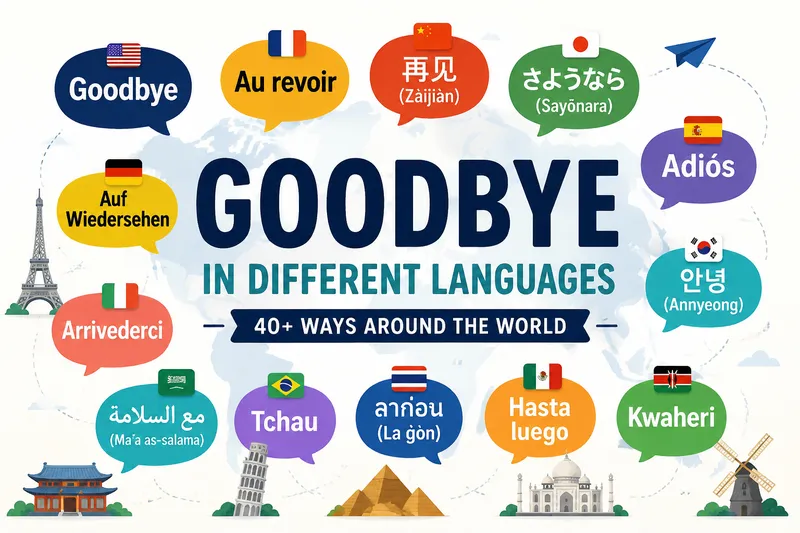
Learning simple farewell expressions is one of the easiest ways to start communicating in a new language.
While many languages have a direct translation for “goodbye,” native speakers often use different expressions depending on the situation, relationship, and culture.
In this guide, you’ll learn how to say goodbye in different languages, including common formal and informal farewell expressions from Europe, Asia, Africa, and other regions around the world.
TL;DR
Here are some common ways to say goodbye around the world:
| Language | Goodbye expression | Pronunciation |
|---|---|---|
| English | Goodbye / Bye | guh-dbye |
| Spanish | Adiós | ah-dee-os |
| French | Au revoir | oh ruh-vwar |
| German | Auf Wiedersehen | owf vee-der-zay-en |
| Italian | Arrivederci | ah-ree-veh-der-chee |
| Portuguese | Tchau | chow |
| Dutch | Tot ziens | tot zeens |
| Swedish | Hej då | hey doh |
| Finnish | Näkemiin | nah-keh-meen |
| Russian | До свидания (Do svidaniya) | doh svee-dah-nee-ya |
| Polish | Do widzenia | doh veed-zeh-nya |
| Czech | Na shledanou | nah shleh-dah-now |
| Chinese | 再见 (Zàijiàn) | dzye-jyen |
| Japanese | さようなら (Sayōnara) | sah-yoh-nah-rah |
| Korean | 안녕히 가세요 (Annyeonghi gaseyo) | an-nyeong-hee ga-se-yo |
| Arabic | مع السلامة (Ma’a as-salama) | ma-as sa-la-ma |
| Turkish | Hoşça kal | hosh-cha kal |
| Swahili | Kwaheri | kwa-heh-ri |
| Afrikaans | Totsiens | tot-seens |
| Zulu | Hamba kahle / Sala kahle | ham-ba kah-leh / sah-la kah-leh |
These examples show an important pattern:
Many languages do not use a direct translation of “goodbye.” Instead, farewell expressions often mean:
- see you again
- stay safe
- go well
- until next time
The best goodbye expression depends on:
- who you are speaking to
- the level of formality
- the relationship between speakers
- the culture of the language
How we selected these farewell expressions
The expressions in this guide focus on:
- common everyday usage
- beginner-friendly phrases
- formal and informal situations
- expressions that learners are most likely to hear in real conversations
Language changes by region, so some countries and communities may use additional farewell expressions.
How to say goodbye in European languages
English 🇬🇧🇺🇸
English has several common ways to say goodbye.
| Expression | Meaning | When to use |
|---|---|---|
| Goodbye | Standard farewell | Formal or general situations |
| Bye | Casual goodbye | Friends, family, everyday conversations |
| See you | See you again | Informal situations |
| Take care | Friendly farewell | Friends and coworkers |
Examples:
Goodbye, it was nice meeting you.
Bye! See you tomorrow.
In everyday English, “Bye” is much more common than the longer “goodbye.”
If you want to learn more natural English farewell expressions, check out:
Different Ways to Say Goodbye in English
Spanish 🇪🇸🇲🇽
Spanish has several ways to say goodbye depending on the situation.
| Expression | Meaning | Usage |
|---|---|---|
| Adiós | Goodbye | General farewell |
| Hasta luego | See you later | Very common |
| Hasta mañana | See you tomorrow | When you expect to meet again |
| Nos vemos | See you | Casual |
Examples:
¡Adiós! Que tengas un buen día.
(Goodbye! Have a good day.)
Nos vemos mañana.
(See you tomorrow.)
Interestingly, many Spanish speakers use expressions meaning “see you later” instead of a final goodbye, because they sound warmer and more connected.
French 🇫🇷
French farewell expressions change depending on formality.
| Expression | Meaning | Usage |
|---|---|---|
| Au revoir | Goodbye | Standard and polite |
| Salut | Bye / Hi | Informal |
| À bientôt | See you soon | When expecting to meet again |
| À demain | See you tomorrow | Specific future meeting |
Examples:
Au revoir, Madame.
Salut, à bientôt!
French learners should remember that salut works both as “hello” and “bye” in casual situations.
For French learners, knowing everyday farewell expressions helps you communicate naturally from the beginning.
German 🇩🇪
German has clear differences between formal and informal goodbyes.
| Expression | Meaning | Usage |
|---|---|---|
| Auf Wiedersehen | Goodbye / Until we meet again | Formal |
| Tschüss | Bye | Informal |
| Bis bald | See you soon | Friendly |
| Bis morgen | See you tomorrow | Specific future meeting |
Examples:
Auf Wiedersehen, Herr Schmidt.
Tschüss! Bis morgen.
The phrase Auf Wiedersehen literally means something like “until seeing each other again,” showing the idea that the goodbye is not necessarily permanent.
If you are learning German, understanding everyday expressions is an important step after learning basic vocabulary.
Continue learning with our dedicated guide:
Italian 🇮🇹
Italian has several common farewell expressions.
| Expression | Meaning | Usage |
|---|---|---|
| Arrivederci | Goodbye | Standard farewell |
| Ciao | Bye / Hi | Informal |
| A presto | See you soon | Friendly |
| A domani | See you tomorrow | Specific |
Examples:
Arrivederci!
Ciao, ci vediamo presto.
The word ciao is one of the most internationally recognized Italian words. However, it is mainly used in informal situations.
Portuguese 🇵🇹🇧🇷
Portuguese goodbye expressions vary slightly between Portugal and Brazil.
| Expression | Meaning | Usage |
|---|---|---|
| Tchau | Bye | Informal |
| Adeus | Goodbye | More final or formal |
| Até logo | See you later | Common |
| Até amanhã | See you tomorrow | Specific |
In Brazil, tchau is extremely common in everyday conversations.
Example:
Tchau! Até amanhã.
(Bye! See you tomorrow.)
Dutch 🇳🇱
| Expression | Meaning | Usage |
|---|---|---|
| Tot ziens | Goodbye / See you | Standard |
| Doei | Bye | Informal |
| Tot later | See you later | Casual |
Examples:
Tot ziens!
Doei, tot morgen!
Dutch has many similarities with English and German, which makes some expressions easier for speakers of those languages to recognize.
If you are learning Dutch, you can explore more common farewell expressions in our dedicated guide:
How to Say Goodbye in Dutch: Common Farewells
Nordic languages 🇸🇪🇳🇴🇩🇰🇫🇮
The Nordic countries share some similarities between their languages, but each has its own natural way to say goodbye.
Swedish 🇸🇪
| Expression | Meaning | Usage |
|---|---|---|
| Hej då | Goodbye | Most common everyday farewell |
| Vi ses | See you | Informal |
| Adjö | Goodbye | More formal or traditional |
Examples:
Hej då! Vi ses imorgon.
(Bye! See you tomorrow.)
In Swedish, hej can mean both “hello” and “hi,” while hej då specifically means goodbye.
Norwegian 🇳🇴
| Expression | Meaning | Usage |
|---|---|---|
| Ha det | Take care / Bye | Very common |
| Farvel | Goodbye | More formal |
| Vi sees | See you | Informal |
Examples:
Ha det bra!
(Take care!)
Norwegian speakers often use ha det in daily conversations because it sounds friendly and natural.
Danish 🇩🇰
| Expression | Meaning | Usage |
|---|---|---|
| Farvel | Goodbye | Standard farewell |
| Vi ses | See you | Casual |
| Hej hej | Bye bye | Friendly |
Example:
Farvel, vi ses snart.
(Goodbye, see you soon.)
Finnish 🇫🇮
| Expression | Meaning | Usage |
|---|---|---|
| Näkemiin | Goodbye | Standard / polite |
| Moi moi | Bye bye | Informal |
| Hei hei | Bye | Casual |
Finnish has a particularly interesting farewell expression:
Näkemiin
Näkemiin carries the idea of “until we see each other again.”
This idea is similar to many other European languages where goodbye expresses the hope of meeting again.
Eastern European languages
Russian 🇷🇺
Russian has several farewell expressions depending on the situation.
| Expression | Meaning | Usage |
|---|---|---|
| До свидания (Do svidaniya) | Goodbye | Formal |
| Пока (Poka) | Bye | Informal |
| До встречи (Do vstrechi) | Until we meet again | Friendly |
Examples:
До свидания!
(Goodbye.)
Пока!
(Bye!)
For beginners, До свидания is the safest choice because it works in most polite situations.
Polish 🇵🇱
| Expression | Meaning | Usage |
|---|---|---|
| Do widzenia | Goodbye | Formal |
| Cześć | Hi / Bye | Informal |
| Na razie | See you / Bye for now | Casual |
Polish is interesting because Cześć works both as a greeting and a farewell among friends.
Czech 🇨🇿
| Expression | Meaning | Usage |
|---|---|---|
| Na shledanou | Goodbye | Formal |
| Ahoj | Hi / Bye | Informal |
| Měj se | Take care | Friendly |
Example:
Na shledanou!
(Goodbye.)
For more Czech farewell expressions, including formal and casual situations, see:
Goodbye in Czech Language: Formal and Casual Farewells
Greek 🇬🇷
| Expression | Meaning | Usage |
|---|---|---|
| Αντίο (Adío) | Goodbye | General |
| Γεια σου (Ya sou) | Bye / Hello | Informal |
| Τα λέμε (Ta léme) | See you | Casual |
Greek uses Γεια σου in many everyday situations because it can mean both hello and goodbye.
Asian languages
Asian languages often have more complex farewell systems because politeness levels and social relationships play a major role.
Chinese 🇨🇳
In Mandarin Chinese, the most common goodbye expression is:
| Expression | Meaning | Usage |
|---|---|---|
| 再见 (Zàijiàn) | Goodbye | General |
| 拜拜 (Báibái) | Bye bye | Casual |
| 回头见 (Huítóu jiàn) | See you later | Informal |
Example:
再见!
(Zàijiàn!)
The characters 再见 literally mean:
- 再 = again
- 见 = see
So the expression carries the idea of:
“See you again.”
This is similar to many goodbye expressions around the world.
If you are learning Mandarin Chinese, you can continue practicing everyday expressions with our beginner guide:
How to Say Bye Bye in Chinese (With Tone Tips & Examples)
Japanese 🇯🇵
Japanese has several farewell expressions depending on the situation, relationship, and how long you expect to be apart.
| Expression | Meaning | Usage |
|---|---|---|
| さようなら (Sayōnara) | Goodbye | Formal / longer separation |
| またね (Mata ne) | See you | Casual |
| じゃあね (Jā ne) | Bye | Friends |
| また明日 (Mata ashita) | See you tomorrow | Specific future meeting |
Many beginners learn さようなら (Sayōnara) first because it is the standard translation of “goodbye.”
However, in everyday Japanese conversations, native speakers often use shorter expressions when they expect to meet again soon, such as:
- またね (Mata ne) — See you
- じゃあね (Jā ne) — Bye
- また明日 (Mata ashita) — See you tomorrow
A common beginner mistake is using さようなら in every situation. While it is correct, it can sound more formal or suggest a longer separation, depending on the context.
The best expression depends on your relationship with the other person and whether you plan to meet again soon.
If you are learning Japanese, understanding everyday expressions is just as important as learning vocabulary and grammar.
Korean 🇰🇷
Korean goodbye expressions change depending on whether the person leaving is the speaker or the listener.
| Expression | Meaning | Usage |
|---|---|---|
| 안녕히 가세요 (Annyeonghi gaseyo) | Goodbye (to someone leaving) | Polite |
| 안녕히 계세요 (Annyeonghi gyeseyo) | Goodbye (when you leave) | Polite |
| 안녕 (Annyeong) | Bye | Casual |
This difference is important for Korean learners.
Korean does not simply use one universal “goodbye.”
The expression changes depending on the situation:
- The person leaving → 안녕히 가세요
- The person staying → 안녕히 계세요
This distinction is one of the first cultural differences Korean learners notice because English uses one general “goodbye,” while Korean considers whether someone is leaving or staying.
Thai 🇹🇭
| Expression | Meaning | Usage |
|---|---|---|
| ลาก่อน (La gòn) | Goodbye | General |
| สวัสดี (Sawasdee) | Hello / Goodbye | Polite |
| แล้วเจอกัน (Laew jer gan) | See you | Casual |
Thai often uses polite particles depending on the speaker’s gender:
- ครับ (khrap) for male speakers
- ค่ะ / คะ (kha) for female speakers
Vietnamese 🇻🇳
| Expression | Meaning | Usage |
|---|---|---|
| Tạm biệt | Goodbye | Standard |
| Chào nhé | Bye | Friendly |
| Hẹn gặp lại | See you again | Polite |
Vietnamese farewell expressions often include the idea of meeting again.
Indonesian 🇮🇩
| Expression | Meaning | Usage |
|---|---|---|
| Selamat tinggal | Goodbye (to someone leaving) | General |
| Sampai jumpa | See you again | Friendly |
| Dadah | Bye bye | Informal |
Indonesian distinguishes between leaving and staying situations.
For example:
- Selamat tinggal is used when someone leaves.
- Selamat jalan can be used when wishing someone a safe journey.
Hindi 🇮🇳
| Expression | Meaning | Usage |
|---|---|---|
| अलविदा (Alvida) | Goodbye | Formal |
| फिर मिलेंगे (Phir milenge) | See you again | Friendly |
| नमस्ते (Namaste) | Hello / Goodbye | Respectful |
Many Indian languages use expressions that emphasize meeting again rather than a final goodbye.
Arabic 🌍
Arabic is spoken across many countries, and goodbye expressions can vary by region.
| Expression | Meaning | Usage |
|---|---|---|
| مع السلامة (Ma’a as-salama) | Go with peace | Common |
| إلى اللقاء (Ila al-liqa’) | Until we meet again | Formal |
| باي (Bye) | Bye | Casual |
The phrase مع السلامة literally carries the meaning of wishing someone safety and peace.
Turkish 🇹🇷
| Expression | Meaning | Usage |
|---|---|---|
| Hoşça kal | Stay well | Said to the person staying |
| Güle güle | Go smiling | Said to the person leaving |
| Görüşürüz | See you | Common |
Turkish has an interesting distinction:
- Hoşça kal → said by the person leaving
- Güle güle → said by the person staying
This reflects how the language pays attention to the relationship between the speaker and listener.
African languages
Farewell expressions in many African languages often reflect ideas of respect, safety, and staying connected.
Swahili 🌍
Swahili is widely spoken in East Africa, including Kenya, Tanzania, Uganda, and surrounding regions.
| Expression | Meaning | Usage |
|---|---|---|
| Kwaheri | Goodbye | Standard farewell |
| Tutaonana | We will see each other | See you again |
| Kwa heri | Go with goodness | Polite |
Example:
Kwaheri! Tutaonana tena.
(Goodbye! We will see each other again.)
Swahili farewell expressions often emphasize future meetings rather than separation.
Afrikaans 🇿🇦
Afrikaans is mainly spoken in South Africa and Namibia.
| Expression | Meaning | Usage |
|---|---|---|
| Totsiens | Goodbye | Standard |
| Tot later | See you later | Casual |
| Sien jou | See you | Informal |
Example:
Totsiens, tot môre!
(Goodbye, see you tomorrow.)
Afrikaans has many similarities with Dutch, so some expressions may look familiar to Dutch speakers.
Zulu 🇿🇦
| Expression | Meaning | Usage |
|---|---|---|
| Hamba kahle | Go well | Said to someone leaving |
| Sala kahle | Stay well | Said to someone staying |
Similar to Korean, Turkish, and Indonesian, Zulu distinguishes between the person leaving and the person staying.
This shows an interesting pattern across languages:
Many cultures do not view goodbye as a simple ending. They focus on wishing the other person safety and wellbeing.
Goodbye expressions that do not literally mean “goodbye”
One interesting thing about languages around the world is that many farewell expressions are not direct translations of “goodbye.”
Instead, they express ideas like:
- see you again
- take care
- stay well
- go safely
- until next time
Here are some examples:
| Language | Expression | Literal idea |
|---|---|---|
| German | Auf Wiedersehen | Until seeing each other again |
| Chinese | 再见 | See again |
| Spanish | Hasta luego | Until later |
| Arabic | مع السلامة | With peace / safety |
| Turkish | Hoşça kal | Stay well |
| Swahili | Kwaheri | Go with goodness |
These expressions reveal something important:
Many cultures see farewell as a temporary separation rather than a final ending.
How beginners should practice farewell expressions
When learning a new language, don’t memorize only the word “goodbye.”
Learn three things together:
- The expression itself
- When native speakers use it
- A complete example situation
For example:
German:
Formal: Auf Wiedersehen.
Used in:
- shops
- workplaces
- polite conversations
Casual: Tschüss!
Used with:
- friends
- classmates
- people you know
Learning expressions in context helps you choose the right phrase naturally instead of translating word by word.
Frequently asked questions
What is the most common way to say goodbye?
The most common goodbye depends on the language and culture.
However, the expression people use most often in daily conversations is usually the shorter, more casual form.
- English: Goodbye / Bye
- Spanish: Adiós
- French: Au revoir
- German: Auf Wiedersehen
- Chinese: 再见
- Japanese: さようなら
However, everyday speakers often use shorter or more casual expressions.
Is “bye” used in other languages?
Yes.
Many languages have adopted a version of the English word “bye,” especially among younger speakers and in informal communication.
Examples:
- Chinese: 拜拜 (Báibái)
- Japanese: バイバイ (Baibai)
- Korean: 바이바이 (Baibai)
However, traditional local expressions are still important in formal situations.
Do all languages have a word for goodbye?
Languages around the world have ways to express farewell, although not every language uses a single word that directly translates to “goodbye.”
Some languages prefer expressions that mean:
- see you again
- stay safe
- go well
- until next time
The idea of saying farewell exists everywhere, but the expression reflects each culture.
Which goodbye should I learn first?
Start with the goodbye expression that matches your learning goal.
For example:
- Traveling → learn polite and common expressions
- Making friends → learn casual expressions
- Business → learn formal expressions
The most useful goodbye is not always the most literal translation—it is the one native speakers actually use.
Final thoughts
Learning how to say goodbye in different languages is a small step, but it creates meaningful connections.
A simple farewell can show respect, curiosity, and appreciation for another culture.
You do not need to memorize hundreds of phrases.
Start with a few languages that interest you:
- learn the pronunciation
- understand when to use each expression
- practice it in real situations
Every new language you explore gives you another way to connect with people around the world.
A simple “hello” starts a conversation.
A thoughtful “goodbye” leaves a lasting impression.