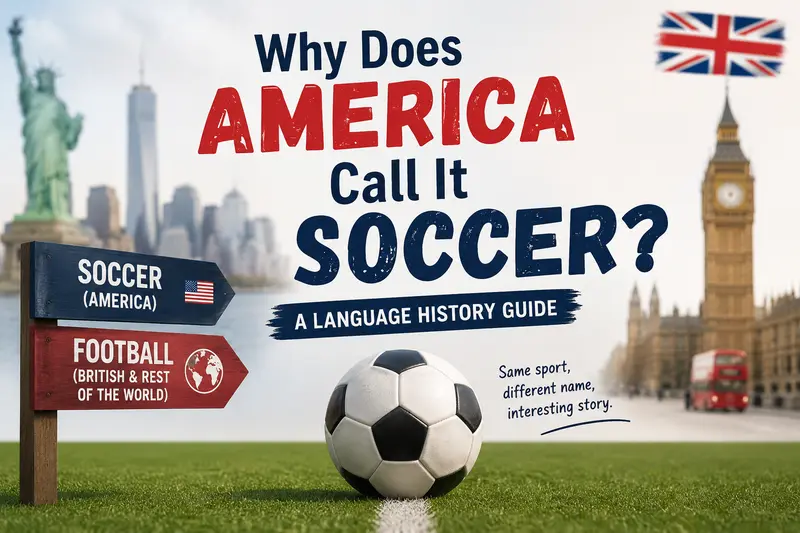
If you have ever asked “Why does America call it soccer?”, the surprising answer is this:
The word “soccer” did not start in America. It started in Britain.
That is what makes this topic so interesting from a language point of view.
A lot of people assume soccer is an American invention and football is the only original name. But the real story is more complicated than that. It is about how English changes across countries, how sports names compete, and how one older British nickname stayed common in the United States while it faded in Britain.
This guide explains that history in plain English and shows what English learners can take from it.
TL;DR
The short answer is:
- soccer came from association football
- the word was created in Britain
- Americans kept using soccer because football already referred to American football
- Britain later moved more strongly toward football
- so today the biggest difference is not origin, but regional usage
In other words:
- soccer is British in origin
- soccer is American in everyday modern use
- football is the default word in Britain and in most of the world
Why does America call it soccer?
America calls it soccer mainly because English in the United States needed a clear way to distinguish the sport from American football.
That is the practical answer.
Once football became the normal word for the American sport in the U.S., the word soccer stayed useful for the other game.
So the American usage was not random. It solved a vocabulary problem.
The surprising part: “soccer” started in Britain
This is the part many readers do not expect.
The word soccer is widely explained as coming from association football, the formal name used to separate the sport from other kinds of football. In British slang, association was shortened and reshaped into soccer, much like rugby produced rugger.
If you want authoritative explanations of that history, Britannica, Merriam-Webster, and History all explain the same basic origin clearly:
- Britannica: Why Do Some People Call Football Soccer?
- Merriam-Webster on the British slang origin of soccer
- History: Why Do Some People Call It Soccer?
So if you only remember one fact, remember this:
America did not invent the word “soccer.” Britain did.
What “association football” means
In the 1800s, Britain had several football-like games.
To make rules clearer, the sport governed by the Football Association became known as association football.
That longer name helped separate it from other football codes, especially rugby football.
From there, the nickname soccer developed.
So the basic path looks like this:
- football
- association football
- assoc.
- soccer
That is the language history behind the word.
Why didn’t America just call it football?
Because football in the United States came to mean something else.
As American football grew in popularity, the word football became strongly attached to that sport in U.S. English.
So Americans had a simple need:
- one word for American football
- another word for association football
Using soccer made that distinction easy.
That is one reason the American usage stayed stable even after British English moved more strongly toward football.
Why do British people usually say “football” now?
Because language changes over time.
Even though soccer started in Britain, football gradually became the stronger everyday term there for association football.
Meanwhile, in the U.S., soccer remained useful and normal.
So today the contrast looks bigger than it really is historically:
- Britain created the word
- America kept using it
- Britain shifted away from it in everyday speech
That is why many people now wrongly assume soccer must be an American invention.
For a useful vocabulary-focused explanation of this shift, see:
A quick timeline in simple English
Here is the story in a very short version:
19th-century Britain
Different football games existed. The sport governed by the Football Association became known as association football.
Later in Britain
The nickname soccer developed from association in British slang.
20th century United States
In the U.S., football became the main word for American football, so soccer stayed useful for association football.
Today
Most Americans say soccer, while most British and international speakers say football.
Soccer vs football: which word should learners use?
That depends on who you are talking to.
Use soccer when:
- you are speaking American English
- your audience is mainly American
- you want to be clear in a U.S. context
- you need to distinguish it from American football
Use football when:
- you are speaking to most people outside the U.S.
- your audience is British or international
- the context is clearly about association football
- you want the more global default term
A simple learner rule is:
- in the U.S., say soccer
- in most other places, say football
What English learners should notice
The real lesson here is not only about sports.
It is about regional English.
A lot of learners look for one global “correct” word, but English often works differently. The more useful question is:
Which word sounds natural in this region or context?
In this case:
- soccer sounds normal in American English
- football sounds normal in British English and in most international contexts
That same pattern appears in many other word pairs too, such as:
- apartment / flat
- elevator / lift
- truck / lorry
- vacation / holiday
Once you understand that, the difference between soccer and football makes much more sense.
Common misunderstandings
1. “Soccer is an American-made word”
No. The word is British in origin.
2. “Americans changed the name from football to soccer”
Not exactly. Americans kept using a British-origin word that already existed.
3. “Football is the only correct word”
That depends on region. In international English, football is more common, but in American English, soccer is standard and normal.
4. “Soccer and football are totally different sports”
That depends on country. In the U.S., football usually means American football. In many other countries, football means soccer.
Example sentences for learners
These examples show the regional difference clearly.
American English
- My son plays soccer after school.
- Do you watch soccer or football more?
- Soccer is growing fast in the U.S.
British or international English
- Football is the most popular sport in the world.
- He plays football every weekend.
- Do you like football?
Talking about the language difference
- Americans usually call it soccer.
- British people usually call it football.
- The word soccer is actually British in origin.
Is one word more correct?
No.
This is not really a question of correctness. It is a question of usage.
The better question is not:
- “Which word is correct?”
It is:
- “Which word fits this audience?”
That is usually the smarter way to think about English vocabulary differences.
What should English learners remember?
If you want one practical takeaway, it is this:
Learn both words, but match the word to the audience.
That gives you:
- better listening comprehension
- more natural speaking
- less confusion when reading sports media from different countries
This is especially useful if you regularly read both American and British English online.
FAQ
Why does America call it soccer instead of football?
Because football in the United States came to refer mainly to American football, so soccer stayed as the everyday word for association football.
Did America invent the word soccer?
No. The word soccer came from Britain, from association football.
Why do British people dislike the word soccer now?
Mostly because modern British usage strongly prefers football, so soccer now feels foreign or American to many speakers, even though the word itself began in Britain.
Should I say soccer or football in English?
Use soccer in American English contexts. Use football in most British and international contexts.
Is soccer wrong?
No. It is completely normal in American English.
Final Thoughts
The reason America calls it soccer is not that Americans invented a strange new word.
It is that English history took an unexpected path:
- Britain created the nickname
- America kept it
- Britain moved away from it
That is what makes the story so interesting for language learners.
It is not just about sports. It is about how English changes, how words survive in different places, and how one small vocabulary difference can carry a lot of history.
Once you know that, soccer vs football stops feeling like an argument and starts feeling like a very good example of how language really works.