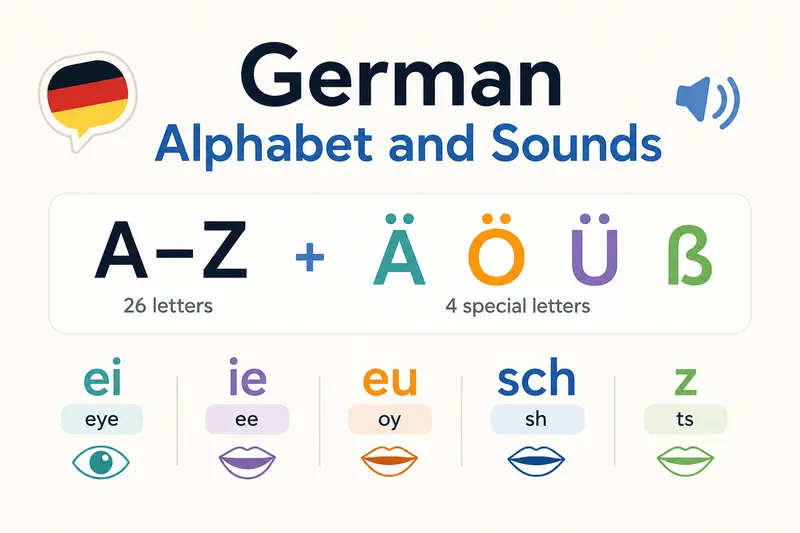
Learning the German alphabet is one of the easiest ways to start learning German. If you already know the English alphabet, you’ll immediately recognize most German letters because both languages share the same 26 basic letters (A–Z).
The biggest difference is that German also uses four additional letters: Ä, Ö, Ü, and ß. The first three are umlauted vowels, while ß is called Eszett or scharfes S (“sharp S”). These letters are an important part of standard German spelling and appear in many everyday words.
In this guide, you’ll learn:
- How many letters are in the German alphabet
- The 26 standard letters (A–Z)
- The four additional German letters
- How the German alphabet differs from English
- Tips for learning and remembering the alphabet
Whether you’re planning to travel, study, or simply enjoy learning languages, mastering the alphabet will give you a solid foundation for reading, spelling, and recognizing German words.
TL;DR
- German uses the same 26 basic letters (A–Z) as English.
- German also includes four additional letters: Ä, Ö, Ü, and ß.
- Ä, Ö, and Ü are umlauted vowels, while ß is called Eszett or scharfes S.
- These four letters are an important part of standard German spelling.
- Learning the alphabet makes reading, spelling, and recognizing German words much easier.
Table of Contents
Open Table of Contents
- Is the German alphabet different from English?
- How many letters are in the German alphabet?
- German alphabet pronunciation guide
- The four additional German letters
- German alphabet vs English alphabet
- Why learning the German alphabet matters
- Understanding umlauts
- Understanding ß (Eszett)
- Tips for learning the German alphabet
- Frequently asked questions about the German alphabet
- Final thoughts
Is the German alphabet different from English?
Not very.
The German alphabet includes the same 26 letters (A–Z) used in English, so English speakers already know most of the alphabet before they begin learning German.
The main difference is that German adds four additional letters:
- Ä
- Ö
- Ü
- ß (called Eszett or scharfes S, meaning “sharp S”)
These letters are part of standard German spelling. They are not decorative marks or optional characters, and replacing them with ordinary letters can change the meaning of a word.
For example:
| German | English |
|---|---|
| schon | already |
| schön | beautiful |
Although these two words differ by only one letter, they have completely different meanings.
Fortunately, these four additional letters are easy to recognize, and you’ll naturally become familiar with them as your German vocabulary grows.
How many letters are in the German alphabet?
The modern German alphabet contains 30 letters.
It consists of:
- 26 standard letters (A–Z)
- 3 umlauted vowels (Ä, Ö, and Ü)
- 1 special letter (ß)
Here’s a quick overview.
| Type | Letters |
|---|---|
| Standard letters | A–Z |
| Additional vowels | Ä Ö Ü |
| Special letter | ß |
Because the first 26 letters are identical to English, most beginners only need to become familiar with the four additional letters before they can comfortably recognize the complete German alphabet.
German alphabet pronunciation guide
German uses the same 26 basic letters (A–Z) as English. The table below shows how each letter name is pronounced in German, along with a rough English sound to help beginners.
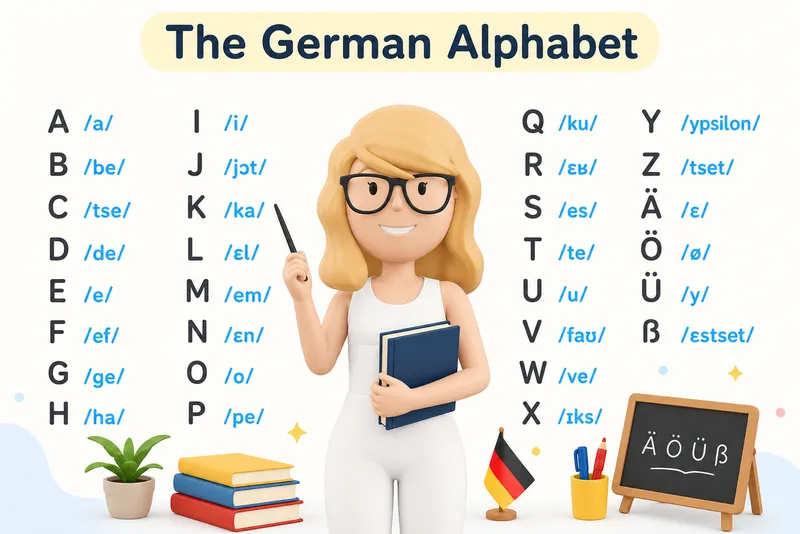
Note: These English spellings are only approximate pronunciation guides. German contains several sounds that don’t exist in English, so listening to native audio is the best way to learn accurate pronunciation.
| Letter | Pronunciation | Example word |
|---|---|---|
| A a | ah | |
| B b | bay | |
| C c | tsay | |
| D d | deh | |
| E e | ay | |
| F f | eff | |
| G g | geh | |
| H h | hah | |
| I i | ee | |
| J j | yot | |
| K k | kah | |
| L l | ell | |
| M m | em | |
| N n | en | |
| O o | oh | |
| P p | pay | |
| Q q | koo | |
| R r | air | |
| S s | es | |
| T t | tay | |
| U u | oo | |
| V v | fow | |
| W w | vay | |
| X x | iks | |
| Y y | Ypsilon (oop-see-lohn) | |
| Z z | tset |
German also includes four additional letters that do not exist in English.
| Letter | Pronunciation | Example word |
|---|---|---|
| Ä ä | eh | |
| Ö ö | oeh | |
| Ü ü | ueh | |
| ß (Eszett, scharfes S) | ess-tset |
These letter names are used whenever German speakers spell words aloud. Learning them will make it much easier to understand names, addresses, email addresses, and other information when someone spells something letter by letter.
The four additional German letters
Besides the 26 basic letters, German also uses Ä, Ö, Ü, and ß in standard spelling.
The first three (Ä, Ö, and Ü) are called umlauts, while ß is known as Eszett or scharfes S (“sharp S”).
These letters are not optional accent marks. Replacing them with ordinary letters can change the meaning of a word.
For example:
| Without | With |
|---|---|
The letter ß also appears in many everyday German words.
Straße — street
Fuß — foot
If your keyboard doesn’t include ß, you’ll sometimes see ss used instead. However, when reading books, newspapers, or learning standard German spelling, it’s important to recognize ß because it appears frequently in everyday German.
German alphabet vs English alphabet
If you already know the English alphabet, you’re off to a great start because German uses the same 26 basic letters.
The biggest difference is that German adds four additional letters: Ä, Ö, Ü, and ß.
Here’s a quick comparison.
| English alphabet | German alphabet |
|---|---|
| 26 letters | 30 letters |
| A–Z | A–Z + Ä, Ö, Ü, ß |
| No umlauts | Three umlauted vowels |
| No ß | Includes ß (Eszett) |
For English speakers, this means there are only four new letters to learn.
Once you recognize them, reading German becomes much easier because you’ll encounter these letters everywhere—from books and newspapers to restaurant menus, road signs, and websites.
Why learning the German alphabet matters
The alphabet is one of the first building blocks of learning German.
Knowing the alphabet will help you:
- Read unfamiliar German words with more confidence.
- Spell your name, address, and email during conversations.
- Look up words in dictionaries more easily.
- Recognize vocabulary more quickly.
- Follow beginner German lessons with greater confidence.
Even if your goal is simply to travel in Germany, Austria, or Switzerland, becoming familiar with the alphabet makes everyday situations much less intimidating.
Understanding umlauts
One of the first things English speakers notice when learning German is the two dots that appear above some vowels.
These dots are called umlauts.
An umlaut is not simply an accent mark. In German, it creates a different letter with its own pronunciation and spelling.
For example:
| Letter | Umlaut |
|---|---|
| A | Ä |
| O | Ö |
| U | Ü |
Because these are separate letters, replacing them with A, O, or U can completely change the meaning of a word.
For example:
| Without umlaut | With umlaut |
|---|---|
When typing on an English keyboard, you’ll sometimes see these replacements if the actual umlaut characters aren’t available:
- Ä → Ae
- Ö → Oe
- Ü → Ue
Although these spellings are widely understood, using the actual umlaut letters is always preferred whenever possible.
Understanding ß (Eszett)
The letter ß is unique to German.
Its official name is Eszett, although you’ll also hear scharfes S, meaning “sharp S.”
Unlike the other letters of the alphabet:
- ß never appears at the beginning of a word.
- It usually appears after a vowel in the middle or at the end of a word.
- In Switzerland, ß is generally replaced with ss in modern writing.
Some common examples include:
Straße — street
Fuß — foot
If your keyboard doesn’t include ß, writing ss is widely understood in emails, URLs, and other situations where the character isn’t available. However, learning to recognize ß is still important because it appears frequently in books, newspapers, and standard German spelling.
Tips for learning the German alphabet
Most beginners can learn the German alphabet in just a few days because it is so similar to English.
Here are a few study tips that work well.
1. Learn the four additional letters first
Since you already know the other 26 letters, focus your attention on:
- Ä
- Ö
- Ü
- ß
These are the only letters that will feel completely new.
2. Practice spelling aloud
Try spelling your own:
- name
- city
- country
- email address
This helps you remember the German names of each letter and builds confidence when spelling information in real conversations.
3. Listen and repeat
Whenever you see a new letter or word, listen to the native pronunciation and repeat it aloud.
Even just a few minutes of listening practice each day will help the alphabet become much more familiar.
4. Read a little every day
Children’s books, menus, street signs, product labels, and short news headlines are all excellent places to recognize letters in real German.
Don’t worry if you don’t understand every word. Your goal is simply to become comfortable seeing the alphabet used naturally.
5. Don’t try to memorize everything at once
Instead of studying all 30 letters repeatedly, review a few each day.
As your vocabulary grows, you’ll naturally remember the alphabet through regular exposure.
Frequently asked questions about the German alphabet
Does German have a different alphabet from English?
German uses the same 26 basic letters (A–Z) as English, but it also includes four additional letters: Ä, Ö, Ü, and ß. Together, they make up the modern German alphabet taught to beginners.
How many letters are in the German alphabet?
The German alphabet contains 30 letters:
- 26 standard letters (A–Z)
- 3 umlauted vowels (Ä, Ö, Ü)
- 1 special letter (ß)
Are Ä, Ö, and Ü separate letters?
Yes.
Although they are related to A, O, and U, they are treated as distinct letters in German spelling. Replacing an umlaut with the base letter can change the meaning of a word.
Is ß the same as SS?
Not exactly.
The letter ß (Eszett) is its own letter in German. While you’ll sometimes see ss used when ß isn’t available on a keyboard, the two are not always interchangeable in standard German spelling.
Is ß used in every German-speaking country?
No.
Germany and Austria commonly use ß in standard writing. In Switzerland, however, ß has largely been replaced with ss, so you’ll often see Strasse instead of Straße.
Can I learn the German alphabet quickly?
Yes.
Because English and German share the same 26 basic letters, most English speakers only need to become familiar with Ä, Ö, Ü, and ß. With a little daily practice, many beginners can confidently recognize the entire alphabet within a few days.
Do I need to memorize the alphabet before learning German?
Not necessarily, but it helps.
Learning the alphabet early makes it easier to read signs, use dictionaries, spell words, and recognize new vocabulary as you continue learning German.
Final thoughts
The German alphabet is one of the easiest parts of the language for English speakers to learn. Since you already know the 26 standard letters, your main task is becoming familiar with Ä, Ö, Ü, and ß and recognizing them in everyday words.
Don’t worry about memorizing everything in a single study session. Instead, spend a few minutes each day reading simple German words, listening to native audio, and practicing spelling. Over time, the alphabet will become second nature.
To build on what you’ve learned here, try our German Pronunciation Tool. It includes interactive audio for German vowels, consonants, and common pronunciation patterns, making it easy to connect written letters with their real spoken sounds.
Once you’re comfortable with the alphabet and pronunciation, you’ll be well prepared to move on to German vocabulary, grammar, and everyday conversations.