TL;DR
Knowing how to tell time in German is one of the first practical skills every learner needs. Whether you’re catching a train, meeting friends, or attending a class, you’ll hear time expressions every day.
The good news is that German time isn’t difficult once you understand a few common patterns.
In this guide, you’ll learn:
- How to ask and answer the time
- Hours, minutes, and common expressions
- Why halb neun means 8:30
- When Germans use the 24-hour clock
- Everyday phrases you’ll actually hear
Table of Contents
Open Table of Contents
- Why learning time in German matters
- How do you ask the time in German?
- The easiest pattern: Whole hours
- Minutes past the hour
- Minutes before the hour
- Quarter past and quarter to
- Why does halb neun mean 8:30?
- Formal vs. informal ways of telling time
- The 24-hour clock in Germany
- Useful German time expressions
- When do Germans actually use each style?
- Regional differences: You might hear other ways of telling time
- Common beginner mistakes
- How to practise telling time in German
- Frequently Asked Questions
- Final thoughts
Why learning time in German matters
Imagine you’re visiting Germany.
Someone asks:
Wie spät ist es?
Or maybe your hotel receptionist says:
Das Frühstück beginnt um sieben Uhr.
At the train station you read:
Abfahrt: 16:42
Even if your German is still at a beginner level, understanding time helps you navigate everyday situations with confidence.
You’ll use it when:
- catching trains and buses
- making appointments
- ordering at restaurants
- attending classes
- arranging to meet friends
- checking store opening hours
The vocabulary is fairly small, but there are a few expressions that surprise English speakers.
One of the biggest is this:
Es ist halb neun.
If you’re thinking “half past nine”, you’re not alone.
It actually means 8:30.
We’ll explain why later in this guide.
How do you ask the time in German?
There are two common ways to ask the time.
1. Wie spät ist es?
Literally:
How late is it?
This is the expression you’ll hear most often in everyday conversation.
Example conversation
A:
Wie spät ist es?
B:
Es ist drei Uhr.
2. Wie viel Uhr ist es?
Literally:
How much clock is it?
Although the literal translation sounds unusual in English, it’s perfectly natural in German.
Example conversation
A:
Wie viel Uhr ist es?
B:
Es ist zehn Uhr.
Both questions are correct.
If you’re unsure which one to use, Wie spät ist es? is the safest choice in everyday conversations.
The easiest pattern: Whole hours
Let’s begin with whole hours.
German uses a very simple pattern:
Es ist + number + Uhr.
For example:
Es ist drei Uhr.
literally means:
It is three o’clock.
The word Uhr means o’clock (or clock), and you’ll hear it constantly in everyday German.
Unlike English, Germans often continue using Uhr even when giving more exact times, especially in formal situations.
Here are all twelve full hours.
| German | English |
|---|---|
| It’s one o’clock. | |
| It’s two o’clock. | |
| It’s three o’clock. | |
| It’s four o’clock. | |
| It’s five o’clock. | |
| It’s six o’clock. | |
| It’s seven o’clock. | |
| It’s eight o’clock. | |
| It’s nine o’clock. | |
| It’s ten o’clock. | |
| It’s eleven o’clock. | |
| It’s twelve o’clock. |
Notice something interesting.
Only one o’clock uses ein instead of eins:
- ✅ Es ist ein Uhr.
- ❌ Es ist eins Uhr.
That’s because ein modifies the noun Uhr, much like an adjective.
Don’t worry too much about the grammar right now—simply remember that one o’clock is always ein Uhr.
If you’re still learning German numbers, our German Numbers Guide is a helpful companion. Once you’re comfortable counting from one to twelve, reading the clock becomes much easier.
Minutes past the hour
Once you know the hours, adding minutes is easy.
German commonly uses the word:
nach = past
Think of nach as meaning after.
For example:
fünf nach zwei
literally means:
five after two
This is very similar to English, which is why it’s one of the easiest German time expressions to learn.
Here are some common examples.
| German | English |
|---|---|
| It’s five past two. | |
| It’s ten past four. | |
| It’s quarter past eight. | |
| It’s twenty past seven. | |
| It’s twenty-five past eleven. | |
| It’s twenty-nine past one. |
As you can see, the pattern is always the same:
Es ist + minutes + nach + hour.
Once you’re comfortable with nach, learning vor (“to” or “before”) is just as straightforward.
Minutes before the hour
To talk about the time before the next hour, German uses another simple word:
vor = before or to
For example:
fünf vor drei
literally means:
five before three
In natural English, we’d usually say:
five to three
Once you understand nach (past) and vor (before), you’ll be able to tell many everyday times with ease.
Here are some common examples.
| German | English |
|---|---|
| It’s five to three. | |
| It’s ten to six. | |
| It’s quarter to nine. | |
| It’s twenty to eight. | |
| It’s twenty-five to twelve. | |
| It’s twenty-nine to one. |
Quick pattern
Es ist + minutes + vor + hour
Examples:
- Es ist fünf vor drei.
- Es ist zehn vor sechs.
- Es ist zwanzig vor acht.
Notice how the structure mirrors the previous section.
- nach = past
- vor = before / to
Once you know these two words, you’ll already understand a large number of everyday German time expressions.
Quarter past and quarter to
Just like English, German has special expressions for 15 minutes.
Instead of saying:
fünfzehn nach zwei
native speakers normally say:
Viertel nach zwei
Likewise, instead of saying:
fünfzehn vor drei
they usually say:
Viertel vor drei
These expressions sound much more natural in everyday conversations.
Here are some common examples.
| German | English |
|---|---|
| It’s quarter past two. | |
| It’s quarter to three. | |
| It’s quarter past eight. | |
| It’s quarter to nine. | |
| It’s quarter past eleven. | |
| It’s quarter to twelve. |
Quick pattern
- Viertel nach = quarter past
- Viertel vor = quarter to
These expressions are used throughout Germany and are considered standard German.
As you’ll see later in this guide, some regions have additional ways of expressing quarter hours, but Viertel nach and Viertel vor are understood everywhere and are the best place to start.
If you’re still getting comfortable with German pronunciation, play the audio several times and repeat each sentence aloud.
This kind of shadowing practice is one of the fastest ways to make these expressions feel natural.
Why does halb neun mean 8:30?
This is the part that confuses almost every English speaker.
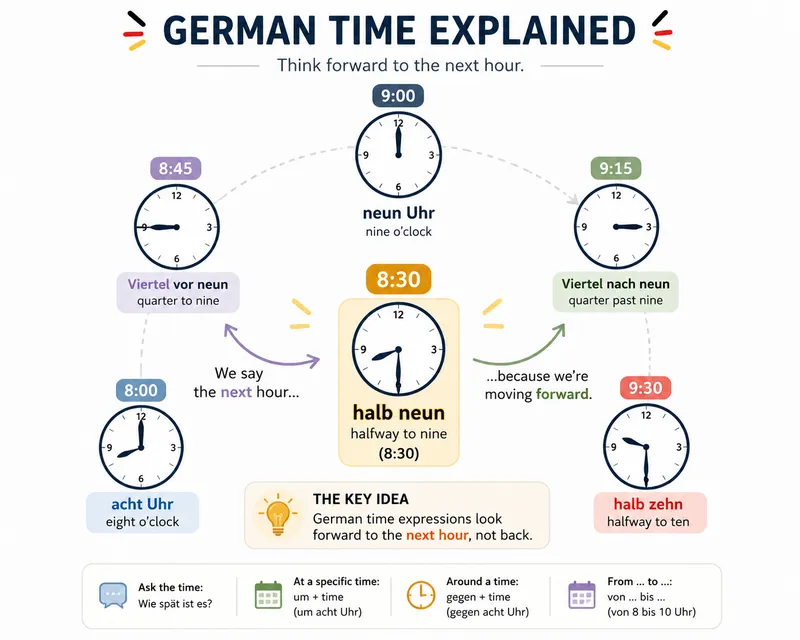
Imagine it’s 8:30.
In English, you’d normally say:
Half past eight.
Many beginners naturally expect German to be:
❌ halb acht
But that’s not how German works.
Instead, Germans say:
✅ Es ist halb neun.
So why?
Think about it this way.
German isn’t saying half past eight.
It’s saying:
Halfway to nine.
Once you picture the next hour instead of the previous one, the expression suddenly makes sense.
Here’s a simple timeline.
| Time | German | English |
|---|---|---|
| 8:00 | acht Uhr | eight o’clock |
| 8:15 | Viertel nach acht | quarter past eight |
| 8:30 | halb neun | half past eight |
| 8:45 | Viertel vor neun | quarter to nine |
| 9:00 | neun Uhr | nine o’clock |
Instead of looking backward, German looks forward.
That’s why halb neun means you’re halfway to nine o’clock.
Once you understand this idea, you’ll never need to memorize it again.
A quick memory trick
If you’re ever unsure, ask yourself:
“What hour am I moving toward?”
If it’s 7:30…
you’re moving toward 8.
Es ist halb acht.
If it’s 10:30…
you’re moving toward 11.
Es ist halb elf.
If it’s 5:30…
you’re moving toward 6.
Es ist halb sechs.
Thinking about the next hour makes German time expressions much easier to remember.
Formal vs. informal ways of telling time
German has two common ways of expressing time.
The first is the conversational style you’ll hear among friends and family.
The second is the more precise style often used in schedules, announcements, business settings, and transportation.
Informal (everyday conversation)
These expressions sound natural in daily life.
| Time | German |
|---|---|
| 2:15 | Viertel nach zwei |
| 2:30 | halb drei |
| 2:45 | Viertel vor drei |
If you’re chatting with friends, this is usually what you’ll hear.
Formal (exact time)
For appointments and official situations, Germans often state the exact hour and minutes.
| Time | German |
|---|---|
| 14:15 | vierzehn Uhr fünfzehn |
| 14:30 | vierzehn Uhr dreißig |
| 14:45 | vierzehn Uhr fünfundvierzig |
You’ll often hear this style:
- at train stations
- in airports
- during business meetings
- at hospitals
- when making appointments
For example:
Der Zug fährt um sechzehn Uhr zweiundvierzig ab.
The train leaves at 4:42 p.m.
Both styles are correct.
The situation simply determines which one sounds more natural.
The 24-hour clock in Germany
Unlike many English-speaking countries, Germany uses the 24-hour clock much more frequently.
You’ll see it on:
- train and bus timetables
- doctor’s appointments
- calendars
- television schedules
- work schedules
- official documents
For example:
| 24-hour | Spoken German | English |
|---|---|---|
| 13:00 | dreizehn Uhr | 1:00 p.m. |
| 15:30 | fünfzehn Uhr dreißig | 3:30 p.m. |
| 18:20 | achtzehn Uhr zwanzig | 6:20 p.m. |
| 20:15 | zwanzig Uhr fünfzehn | 8:15 p.m. |
Don’t worry if this feels unfamiliar at first.
After a few days of seeing train schedules or appointment times, the 24-hour clock quickly becomes second nature.
Useful German time expressions
Learning the clock is only part of the story.
You’ll also need a few small words to talk about schedules.
um — at
Use um when giving a specific time.
Examples:
Der Film beginnt um acht Uhr.
The movie starts at eight.
Wir treffen uns um halb sieben.
We’re meeting at 6:30.
gegen — around
If the exact time isn’t important, use gegen.
Examples:
Ich komme gegen sechs Uhr.
I’ll arrive around six.
Wir essen gegen halb acht.
We’ll eat around 7:30.
von … bis … — from … to …
This expression describes a period of time.
Examples:
Ich arbeite von neun bis fünf.
I work from nine to five.
Das Geschäft ist von zehn bis achtzehn Uhr geöffnet.
The shop is open from 10:00 to 18:00.
seit — since
Use seit to describe something that started in the past and is still true.
Example:
Ich lerne Deutsch seit einem Jahr.
I’ve been learning German for a year.
Although seit isn’t used to tell the current time, you’ll hear it frequently when talking about dates, schedules, and daily life.
When do Germans actually use each style?
One question many learners have is:
“Should I always use halb drei and Viertel vor, or should I use the exact time?”
The answer depends on the situation.
| Situation | Natural German |
|---|---|
| Talking with friends | halb drei |
| Family conversations | Viertel nach acht |
| Restaurant reservation | halb sieben |
| Doctor’s appointment | fünfzehn Uhr |
| Train station | sechzehn Uhr zweiundvierzig |
| Airport departure board | 18:55 |
| TV schedule | zwanzig Uhr fünfzehn |
A good rule of thumb is:
- In conversation, rounded expressions like halb, Viertel nach, and Viertel vor sound the most natural.
- For official times, appointments, and transportation, the 24-hour clock is more common.
As you listen to native speakers, you’ll quickly notice which style fits each situation.
Regional differences: You might hear other ways of telling time
If you travel around Germany, Austria, or parts of Switzerland, you may occasionally hear time expressions that look unfamiliar.
For example, instead of saying:
Viertel nach acht (8:15)
some people say:
Viertel neun
Likewise, instead of:
Viertel vor neun (8:45)
you might hear:
Dreiviertel neun
These expressions are common in some eastern and southern German-speaking regions.
For beginners, however, there’s no need to learn them immediately.
The standard expressions taught in most German courses—
- Viertel nach
- halb
- Viertel vor
—are understood everywhere and are the safest choice when you’re starting out.
As your German improves, you’ll naturally encounter regional variations through travel, movies, podcasts, or conversations with native speakers.
Common beginner mistakes
Learning to tell time in German isn’t difficult, but there are a few mistakes that almost every beginner makes.
Mistake 1: Saying halb acht for 8:30
This is by far the most common mistake.
❌
halb acht
(7:30)
✅
halb neun
(8:30)
Remember:
German looks forward to the next hour.
Think:
Halfway to nine.
Mistake 2: Forgetting Uhr
When talking about whole hours, don’t forget Uhr.
❌
Es ist fünf.
✅
Es ist fünf Uhr.
As you become more advanced, native speakers sometimes omit Uhr when the meaning is obvious, but beginners should include it.
Mistake 3: Mixing nach and vor
A quick way to remember them is:
- nach = after / past
- vor = before / to
Examples:
zehn nach drei = 3:10
zehn vor drei = 2:50
Mistake 4: Using the 12-hour clock everywhere
In English-speaking countries, saying
3:30
is usually enough.
In Germany, you’ll often encounter the 24-hour clock, especially in written communication.
For example:
| Written | Spoken |
|---|---|
| 15:30 | fünfzehn Uhr dreißig |
| 18:20 | achtzehn Uhr zwanzig |
| 21:15 | einundzwanzig Uhr fünfzehn |
Becoming comfortable with both systems will make everyday life much easier.
How to practise telling time in German
Learning the rules is only the beginning.
The best way to become comfortable with German time expressions is to notice them throughout your day.
Try this simple five-minute routine.
- Check the time on your phone.
- Say it aloud in German.
- Use both the conversational and the 24-hour version whenever possible.
- Create one sentence using um, gegen, or von … bis.
- Repeat several times throughout the day.
For example:
09:00
Es ist neun Uhr.
15:30
Es ist fünfzehn Uhr dreißig.
or
Es ist halb vier.
The more often you connect real moments with German expressions, the faster they become automatic.
If you’d like more opportunities to use these expressions naturally, our guide on German Speaking Practice: Fun Ways to Build Confidence includes simple activities for practising everyday conversations.
Frequently Asked Questions
How do you ask the time in German?
The two most common questions are:
Wie spät ist es?
and
Wie viel Uhr ist es?
Both mean “What time is it?”, although Wie spät ist es? is slightly more common in everyday conversation.
Why do Germans say halb neun?
German counts toward the next hour, not the previous one.
So:
halb neun
literally means you’re halfway to nine o’clock.
That’s why it refers to 8:30.
Do Germans use AM and PM?
Not very often.
In everyday speech, the context usually makes the meaning clear.
Instead of saying 3:00 PM, Germans often say:
15 Uhr
especially for appointments, timetables, and official schedules.
Is the 24-hour clock common in Germany?
Yes.
You’ll see it on train timetables, calendars, business schedules, medical appointments, and many digital devices.
In casual conversations, however, people often switch back to the more relaxed conversational style.
Should I learn the regional expressions like Viertel neun?
Not at first.
Standard expressions such as Viertel nach, halb, and Viertel vor are understood throughout the German-speaking world.
Once you’re comfortable with those, you’ll gradually recognize regional variations as well.
Final thoughts
Learning to tell time in German is about much more than reading a clock.
It’s one of the most practical language skills you’ll use every day, whether you’re catching a train, meeting a friend, attending a class, or making an appointment.
Fortunately, German time expressions follow clear patterns.
Once you understand nach, vor, halb, and the 24-hour clock, most everyday conversations become much easier to follow.
If you remember only one idea from this guide, let it be this:
German often looks toward the next hour, not the previous one.
That’s why halb neun means 8:30—and once that concept clicks, many other time expressions start to feel surprisingly logical.
Keep listening to native speakers, practise saying the time whenever you check your phone, and don’t worry about getting everything perfect immediately.
With regular exposure, telling time in German will soon become second nature.