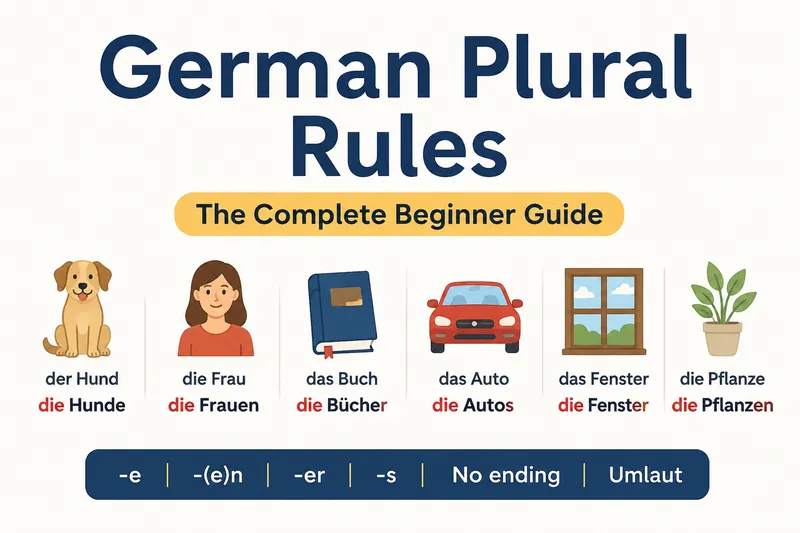
One of the biggest challenges for German learners is forming plural nouns.
In English, making a noun plural is usually simple—just add -s or -es.
| English | Plural |
|---|---|
| book | books |
| car | cars |
| student | students |
German works differently.
Instead of using one plural ending, German has multiple plural patterns, and the correct form often depends on the noun itself.
For example:
| Singular | Plural | English |
|---|---|---|
| dog → dogs | ||
| child → children | ||
| car → cars | ||
| woman → women | ||
| teacher → teachers |
At first, German plurals can seem unpredictable. Fortunately, they aren’t random.
Most nouns follow a small number of common plural patterns. Once you understand these patterns and learn to recognize them, remembering German plurals becomes much easier.
In this guide, you’ll learn:
- The six most common German plural patterns
- Which plural endings are most common
- When umlauts appear in plural nouns
- Practical memory tricks used by successful learners
- Common exceptions and mistakes to avoid
- How to guess the plural of unfamiliar German nouns
Whether you’re preparing for the A1 exam, traveling to Germany, or simply building your vocabulary, understanding German plural rules will help you speak and write much more naturally.
TL;DR
German doesn’t have a single plural ending.
Instead, most German nouns use one of these six plural patterns:
| Pattern | Example |
|---|---|
| -e | Hund → Hunde |
| -(e)n | Frau → Frauen |
| -er | Kind → Kinder |
| -s | Auto → Autos |
| No ending | Lehrer → Lehrer |
| Umlaut change | Mutter → Mütter |
You don’t need to memorize thousands of plural forms individually. Learning these common patterns will help you recognize and remember the majority of German plurals.
Table of Contents
Open Table of Contents
- Why are German plurals difficult?
- The six main German plural patterns
- 1. The -e plural
- 2. The -(e)n plural
- 3. The -er plural
- 4. The -s plural
- 5. No plural ending
- Understanding umlaut changes in German plurals
- How to guess the plural of a German noun
- German plural cheat sheet
- Frequently asked questions about German plural rules
- Final thoughts
Why are German plurals difficult?
Unlike English, German doesn’t have one universal plural ending.
Instead, nouns may:
- add -e
- add -er
- add -(e)n
- add -s
- stay exactly the same
- change their vowel with an umlaut
- or combine an umlaut with another ending
That sounds overwhelming at first, but there’s good news.
German plural forms are not random. Many nouns follow predictable patterns based on their spelling, gender, or origin.
As you learn more vocabulary, you’ll begin to recognize these patterns naturally.
The key is to learn patterns, not isolated words.
For example, instead of memorizing only:
learn:
Learning the article together with the singular and plural form is one of the most effective ways to build long-term vocabulary and avoid common mistakes.
The six main German plural patterns
German learners commonly encounter six main plural patterns. These patterns can overlap because an umlaut may appear by itself or together with another plural ending.
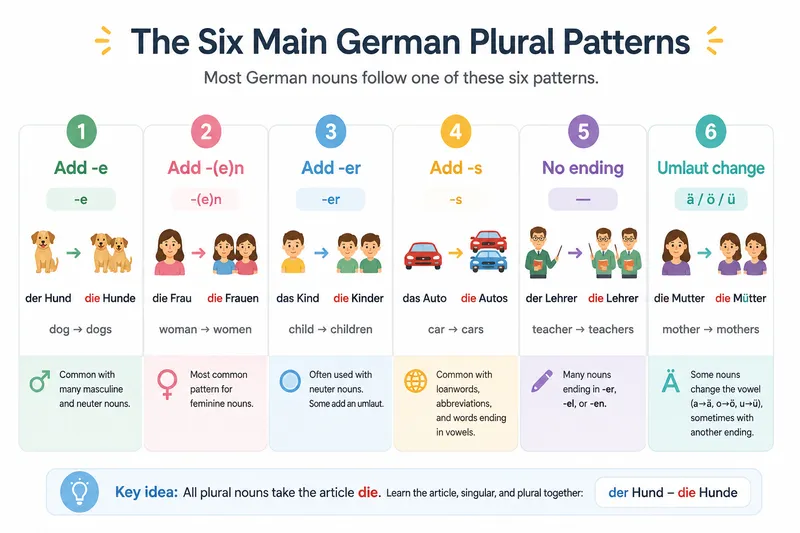
Learn these six patterns as a practical overview, but remember that a noun may combine an ending with an umlaut. As your vocabulary grows, you’ll begin recognizing these combinations naturally. As your vocabulary grows, you’ll begin to recognize them naturally.
| Pattern | Example | Common with |
|---|---|---|
| -e | Hund → Hunde | Many masculine nouns and some neuter nouns |
| -(e)n | Frau → Frauen | Most feminine nouns |
| -er | Kind → Kinder | A limited group of neuter nouns |
| -s | Auto → Autos | Loanwords, abbreviations, and some nouns ending in a vowel |
| No ending | Lehrer → Lehrer | Many nouns ending in -er, -el, or -en |
| Umlaut change | Mutter → Mütter | May appear alone or together with -e or -er |
Don’t worry if this table feels unfamiliar right now. We’ll go through each pattern one by one with examples, pronunciation, and tips for remembering them.
1. The -e plural
Adding -e is one of the most common ways to form plural nouns in German.
You’ll often see this pattern with masculine nouns, while some neuter nouns also use it.
Here are some common examples.
| Singular | Plural | English |
|---|---|---|
| dog → dogs | ||
| day → days | ||
| table → tables | ||
| chair → chairs |
Notice that Stuhl not only adds -e, but also changes u to ü.
This combination—adding -e together with an umlaut—is another common German plural pattern.
Tips for remembering the -e pattern
- It commonly appears with masculine nouns.
- Some neuter nouns also use -e.
- Some nouns add an umlaut as well as -e.
A good habit is to learn the singular and plural together:
2. The -(e)n plural
The -(e)n ending is the most common plural pattern for feminine nouns.
If you’re unsure how to pluralize a feminine noun, -(e)n is often your best first guess.
Here are some examples.
| Singular | Plural | English |
|---|---|---|
| woman → women | ||
| flower → flowers | ||
| cat → cats | ||
| language → languages |
Tips for remembering the -(e)n pattern
- Most feminine nouns follow this pattern.
- Nouns ending in -e usually become -en.
- This is the safest plural pattern to guess for unfamiliar feminine nouns.
For example:
In the next section, we’ll look at another common pattern: nouns that form their plural by adding -er, often together with an umlaut.
3. The -er plural
Some German nouns form their plural by adding -er.
This pattern occurs mainly with a limited group of neuter nouns, although some masculine nouns also use it.
Here are some common examples.
| Singular | Plural | English |
|---|---|---|
| child → children | ||
| picture → pictures | ||
| egg → eggs |
Some -er plurals also change their vowel with an umlaut.
| Singular | Plural | English |
|---|---|---|
| book → books | ||
| house → houses | ||
| word → words |
Tips for remembering the -er pattern
- The -er pattern is especially associated with a group of neuter nouns.
- Some nouns also add an umlaut.
- Learn the singular and plural together instead of trying to predict every ending.
For example:
4. The -s plural
The -s ending is probably the easiest plural pattern for English speakers because it works similarly to English.
Fortunately, it is also one of the least complicated German plural rules.
You’ll commonly see -s used with:
- Loanwords from other languages
- Abbreviations
- Some nouns ending in vowels
Here are some examples.
| Singular | Plural | English |
|---|---|---|
| car → cars | ||
| hotel → hotels | ||
| taxi → taxis | ||
| café → cafés |
Tips for remembering the -s pattern
- Common with international words.
- Frequently used for modern loanwords.
- Usually one of the easiest plural forms to recognize.
5. No plural ending
Some German nouns look exactly the same in both the singular and plural forms.
Don’t let this confuse you—the article or the surrounding sentence usually tells you whether the noun is singular or plural.
Here are some common examples.
| Singular | Plural | English |
|---|---|---|
| teacher → teachers | ||
| computer → computers | ||
| window → windows |
Many nouns ending in -er, -el, or -en follow this pattern.
For example:
Understanding umlaut changes in German plurals
One of the trickiest parts of German plurals is the umlaut.
In this beginner guide, we treat the umlaut change as one of six practical plural patterns. However, an umlaut does not always work by itself. It may be the only visible change, or it may appear together with another plural ending.
The three common vowel changes are:
| Singular vowel | Umlaut |
|---|---|
| a | ä |
| o | ö |
| u | ü |
Here are the main ways an umlaut can appear in a German plural:
| Singular | Plural | English | Pattern |
|---|---|---|---|
| mother → mothers | Umlaut only | ||
| book → books | Umlaut + -er | ||
| house → houses | Umlaut + -er | ||
| chair → chairs | Umlaut + -e |
This means the umlaut pattern can overlap with other plural patterns:
- Mutter → Mütter uses an umlaut without an added ending.
- Stuhl → Stühle combines an umlaut with -e.
- Buch → Bücher and Haus → Häuser combine an umlaut with -er.
Unfortunately, there isn’t one simple rule that tells you exactly when an umlaut will appear. Not every noun containing a, o, or u changes its vowel in the plural.
The best approach is to learn the singular and plural together:
As your vocabulary grows, you’ll begin recognizing the most common umlaut combinations naturally.
How to guess the plural of a German noun
Although there are exceptions, you can often make an educated guess.
Use these guidelines as a starting point.
| If the noun… | Your best guess |
|---|---|
| is feminine | usually -(e)n |
| is feminine and ends in -e | usually adds -n |
| is a loanword (Hotel, Taxi, Auto) | often -s |
| ends in -chen or -lein | usually no change |
| ends in -er, -el, or -en | often no ending |
These are not absolute rules, but they work surprisingly well for many everyday nouns.
As your vocabulary grows, you’ll rely less on guessing and more on recognizing familiar plural patterns.
German plural cheat sheet
Here’s a quick summary you can bookmark for future reference.
| Pattern | Example | Common with |
|---|---|---|
| -e | Hund → Hunde | many masculine nouns and some neuter nouns |
| -(e)n | Frau → Frauen | most feminine nouns |
| -er | Kind → Kinder | a limited group of neuter nouns |
| -s | Auto → Autos | loanwords, abbreviations, and some nouns ending in a vowel |
| No ending | Lehrer → Lehrer | many nouns ending in -er, -el, or -en |
| Umlaut change | Mutter → Mütter | may appear alone or together with -e or -er |
The most important thing to remember is this:
Always learn German nouns together with:
- the article
- the singular form
- the plural form
For example:
This habit will improve your German much faster than memorizing plural endings on their own.
Frequently asked questions about German plural rules
How do you make nouns plural in German?
Unlike English, German doesn’t have a single plural ending. Most nouns follow one of six common plural patterns:
- -e
- -(e)n
- -er
- -s
- No ending
- Umlaut changes
Learning these patterns makes it much easier to recognize and remember German plurals.
Do all German plural nouns use an umlaut?
No.
Some plural nouns add an umlaut, while many others do not.
For example:
- Hund → Hunde — no umlaut
- Buch → Bücher — umlaut plus -er
- Mutter → Mütter — umlaut without an added ending
Because there isn’t one simple rule for umlauts, it’s best to learn each singular noun together with its plural form.
Is there an easy rule for German plurals?
Not one single rule.
However, many nouns follow predictable patterns. For example:
- Most feminine nouns use -(e)n.
- Many masculine nouns use -e.
- The -er pattern is especially associated with a group of neuter nouns.
- Many loanwords use -s.
Learning these patterns is much easier than trying to memorize every plural individually.
Why are German plurals so difficult?
German developed over many centuries, so plural forms come from different historical patterns rather than one universal ending.
The good news is that most everyday nouns fit into a small number of common plural groups, making them much easier to learn than they first appear.
Do all German plural nouns use an umlaut?
No.
Many German plural nouns do not use an umlaut. An umlaut is a vowel change, not a plural ending, and it only appears with certain nouns.
For example:
- Hund → Hunde — no umlaut
- Buch → Bücher — adds -er and an umlaut
- Mutter → Mütter — changes the vowel with an umlaut
There isn’t a single rule that tells you exactly when an umlaut will appear. Instead of trying to memorize umlaut rules by themselves, learn each noun together with its article, singular form, and plural form.
Over time, you’ll naturally recognize which nouns commonly take an umlaut, making German plurals much easier to remember.
What’s the best way to memorize German plurals?
Instead of memorizing only the singular noun, always learn three pieces of information together:
- the article
- the singular noun
- the plural noun
For example:
This approach helps you remember both grammatical gender and plural forms at the same time.
Final thoughts
German plural rules can seem overwhelming at first, but most nouns follow a relatively small number of common patterns. Once you recognize these patterns, you’ll spend less time memorizing individual words and more time understanding how German vocabulary works.
Don’t worry if you occasionally choose the wrong plural. Even advanced learners continue discovering exceptions as they expand their vocabulary. Consistent exposure, reading, and listening are far more effective than trying to memorize long lists of rules.
Whenever you learn a new German noun, make it a habit to learn:
- the article
- the singular form
- the plural form
This simple habit will improve your accuracy and confidence much faster than studying plural endings in isolation.
To strengthen your pronunciation while learning new vocabulary, try our German Pronunciation Tool. It lets you listen to native-quality audio for German vowels, consonants, and example words, helping you connect spelling with natural pronunciation.
As your vocabulary grows, you’ll begin recognizing plural patterns automatically, making German reading, listening, and speaking feel much more natural.