TL;DR
German sentence structure can feel confusing because the verb doesn’t always stay in the same place.
The good news is that German word order isn’t random. It follows a small number of consistent patterns. Once you understand where the conjugated verb belongs, building and understanding German sentences becomes much easier.
In this guide, you’ll learn:
- The most important German word order rule
- How statements and questions are formed
- Why the verb sometimes moves to the end
- Common beginner mistakes to avoid
- Practical examples you can start using today
Table of Contents
Open Table of Contents
- Why does German sentence structure seem so difficult?
- The one rule every beginner should remember
- Rule 1: Basic German sentence structure
- Rule 2: The verb stays second—even when the sentence begins differently
- Rule 3: How to ask questions in German
- Rule 4: Modal verbs create a “verb pair”
- Rule 5: Separable verbs split into two parts
- Rule 6: Where do nicht and kein go?
- Rule 7: Why does the verb suddenly move to the end?
- Rule 8: Time–Manner–Place
- A simple way to remember German word order
- Common beginner mistakes
- Practice: Can you build the correct sentence?
- How to practise German sentence structure
- Frequently Asked Questions
- Final thoughts
Why does German sentence structure seem so difficult?
Many English speakers feel confident when they learn their first German sentence.
For example:
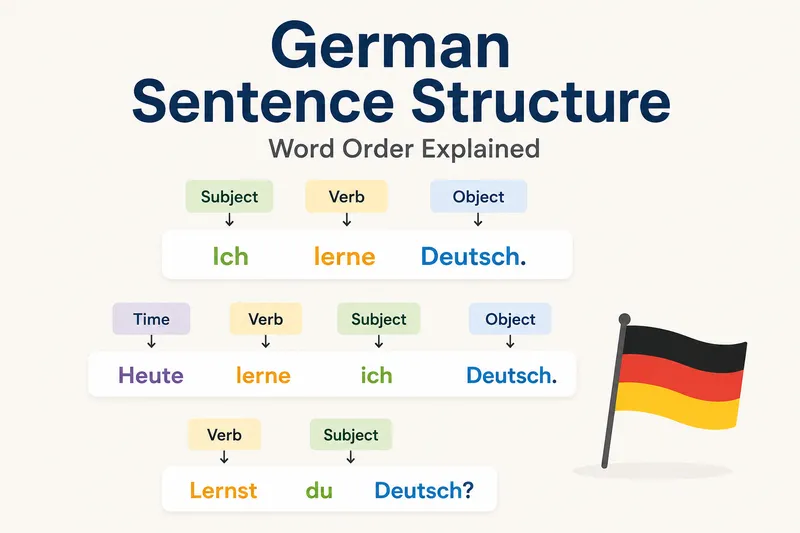
Ich lerne Deutsch.
I am learning German.
That seems simple enough.
Then a lesson introduces this sentence:
Heute lerne ich Deutsch.
Today I am learning German.
The verb suddenly moved.
A little later you see:
Lernst du Deutsch?
Do you learn German?
Now the verb comes first.
Then someone writes:
…, weil ich Deutsch lerne.
…because I am learning German.
Now the verb has moved to the end.
At this point, many learners start wondering whether German word order has any logic at all.
Fortunately, it does.
German doesn’t move words around randomly.
Instead, German uses word order to show what information is most important and to indicate how different parts of a sentence fit together.
Once you recognize the patterns, German sentence structure becomes much more predictable than it first appears.
Instead of memorizing dozens of grammar rules, you’ll only need to recognize a few common sentence patterns.
Let’s begin with the one rule that explains almost everything else.
The one rule every beginner should remember
If you remember only one idea from this article, make it this:
In most German main clauses, the conjugated verb stays in the second position.
Notice we say second position, not second word.
That’s one of the most important ideas in German grammar.
Here’s the basic pattern:
| Position 1 | Position 2 | Rest of the sentence |
|---|---|---|
| Ich | lerne | Deutsch. |
| Heute | lerne | ich Deutsch. |
| Nach der Arbeit | treffe | ich Freunde. |
Notice something interesting.
Nach der Arbeit contains three words, but together they count as one position.
That’s why the verb still comes immediately afterward.
Think of the conjugated verb as the anchor of the sentence.
Whatever occupies the first position, the conjugated verb normally comes next.
Once you start looking for the verb first, German sentences become much easier to understand.
Rule 1: Basic German sentence structure
The simplest German sentence follows a pattern that’s familiar to English speakers:
Subject + Verb + Object
For example:
| German | English |
|---|---|
| Ich lerne Deutsch. | I learn German. |
| Er spricht Englisch. | He speaks English. |
| Wir trinken Kaffee. | We drink coffee. |
| Anna liest ein Buch. | Anna is reading a book. |
If you’re still learning German subject pronouns, our German Pronouns Chart is a helpful companion to this guide.
Notice another important feature.
The verb changes depending on the subject.
| Subject | Verb |
|---|---|
| ich | lerne |
| du | lernst |
| er | lernt |
| wir | lernen |
This is called verb conjugation.
Every complete German sentence needs one conjugated verb.
As you practise reading German, try finding the conjugated verb before anything else.
It often tells you how the entire sentence is organized.
Rule 2: The verb stays second—even when the sentence begins differently
Unlike English, German allows much more flexibility in what comes first.
Suppose you want to emphasize today.
You could say:
Ich lerne heute Deutsch.
Or:
Heute lerne ich Deutsch.
Both are correct.
The meaning stays almost the same.
The only difference is which piece of information receives slightly more emphasis.
German often places the most important or most relevant information first.
Whatever occupies the first position…
…the conjugated verb immediately follows.
Here are a few examples.
| German | English |
|---|---|
| Heute lerne ich Deutsch. | Today I’m studying German. |
| Im Sommer fahren wir nach Berlin. | In summer we’re going to Berlin. |
| Nach der Arbeit treffe ich Freunde. | After work I’m meeting friends. |
A common beginner mistake is writing:
❌ Heute ich lerne Deutsch.
Instead, remember:
✅ Heute lerne ich Deutsch.
The verb-second rule applies to main clauses.
Later in this guide you’ll learn that subordinate clauses, such as those introduced by weil, follow a different pattern.
If you’d like more practice building natural German sentences, our guide on German Speaking Practice: Fun Ways to Build Confidence includes simple exercises you can use to reinforce these word-order patterns.
Rule 3: How to ask questions in German
Questions are one of the first places where learners notice German word order changing.
Fortunately, the same idea still applies.
Start by finding the conjugated verb.
There are two common question patterns.
Yes/no questions
If the answer can be yes or no, the conjugated verb moves to the beginning of the sentence.
| German | English |
|---|---|
| Sprichst du Deutsch? | Do you speak German? |
| Hast du Zeit? | Do you have time? |
| Kommt er heute? | Is he coming today? |
| Kannst du mir helfen? | Can you help me? |
Notice that the subject now comes after the verb.
Unlike English, German doesn’t usually need an extra helping verb like do.
The conjugated verb simply moves into the first position.
W-questions
Questions beginning with:
- wer (who)
- was (what)
- wann (when)
- wo (where)
- warum (why)
- wie (how)
follow another predictable pattern.
| Position 1 | Position 2 | Rest |
|---|---|---|
| Wo | wohnst | du? |
| Wann | beginnt | der Kurs? |
| Warum | lernst | du Deutsch? |
| Wie | heißt | du? |
The question word occupies the first position.
The conjugated verb immediately follows.
Once again, finding the verb first makes the sentence much easier to understand.
Rule 4: Modal verbs create a “verb pair”
Sooner or later you’ll start using modal verbs such as:
- können (can)
- müssen (must)
- wollen (want)
- dürfen (may)
- sollen (should)
- mögen (like)
Modal verbs introduce one of the most recognizable German sentence patterns.
Consider this sentence:
Ich kann Deutsch sprechen.
There are two verbs.
- kann → the conjugated modal verb
- sprechen → the infinitive
Instead of trying to memorize a complicated rule, imagine these two verbs forming a verb pair.
The conjugated verb stays near the beginning.
The infinitive waits patiently until the end.
Everything else fits between them.
| Position | Example |
|---|---|
| Beginning | Ich kann |
| Middle | Deutsch |
| End | sprechen |
The same pattern appears again and again.
| German | English |
|---|---|
| Ich kann Deutsch sprechen. | I can speak German. |
| Wir müssen jetzt gehen. | We have to go now. |
| Er möchte Kaffee trinken. | He would like to drink coffee. |
| Sie will heute arbeiten. | She wants to work today. |
If modal verbs are still new to you, our German Modal Verbs guide explains each one with practical examples and common everyday uses.
Rule 5: Separable verbs split into two parts
Another feature that surprises beginners is the idea of separable verbs.
Some German verbs have a prefix that separates in normal sentences.
For example:
- aufstehen (to get up)
- einkaufen (to shop)
- zurückkommen (to come back)
Look at these examples.
| German | English |
|---|---|
| Ich stehe um sieben Uhr auf. | I get up at seven o’clock. |
| Er kauft heute ein. | He is shopping today. |
| Sie kommt morgen zurück. | She is coming back tomorrow. |
Once again, the same pattern appears.
The conjugated verb stays in its usual position near the beginning.
The prefix moves to the end.
At first this may look unusual.
After reading enough German, though, you’ll start recognizing separable verbs almost automatically.
Rule 6: Where do nicht and kein go?
Negation is another topic that often worries beginners.
Fortunately, you don’t need to memorize every rule immediately.
A useful starting point is understanding the different jobs of kein and nicht.
Use kein with nouns
Kein usually replaces an article.
| German | English |
|---|---|
| Ich habe kein Auto. | I don’t have a car. |
| Wir trinken keinen Kaffee. | We aren’t drinking coffee. |
| Sie hat keine Zeit. | She doesn’t have any time. |
Think of kein as meaning:
no / not a / not any
Use nicht for everything else
Nicht usually negates:
- verbs,
- adjectives,
- adverbs,
- or an entire statement.
For example:
| German | English |
|---|---|
| Ich spreche nicht schnell. | I don’t speak quickly. |
| Das ist nicht schwer. | That isn’t difficult. |
| Er arbeitet heute nicht. | He isn’t working today. |
Don’t worry about mastering the exact placement of nicht on your first day.
Even intermediate learners continue refining this skill.
For now, focus on recognizing when German uses kein instead of nicht.
Rule 7: Why does the verb suddenly move to the end?
This is the point where many beginners think German has stopped making sense.
You learn:
Ich lerne Deutsch.
Then suddenly you see:
Ich lerne Deutsch, weil ich in Deutschland arbeiten möchte.
What happened?
The answer is actually quite simple.
The word weil (“because”) introduces a subordinate clause.
Inside subordinate clauses, the conjugated verb usually moves toward the end.
Compare these examples.
| Main clause | Subordinate clause |
|---|---|
| Ich lerne Deutsch. | …, weil ich Deutsch lerne. |
| Er arbeitet heute. | …, weil er heute arbeitet. |
| Wir haben keine Zeit. | …, weil wir keine Zeit haben. |
Earlier we learned that the verb-second rule applies to main clauses.
This is one of the most important exceptions.
Whenever you see words such as:
- weil (because)
- dass (that)
- obwohl (although)
- wenn (when / if)
prepare yourself to find the conjugated verb near the end.
It feels unusual at first.
With enough reading and listening, though, it gradually becomes one of the easiest German patterns to recognize.
Rule 8: Time–Manner–Place
As your German becomes more advanced, you’ll begin building longer sentences.
When a sentence includes information about time, manner, and place, German often follows this order:
Time → Manner → Place
For example:
Ich fahre morgen mit dem Zug nach Berlin.
Let’s break it down.
- morgen = time
- mit dem Zug = manner
- nach Berlin = place
This isn’t an absolute rule.
German speakers sometimes change the order for emphasis.
However, Time → Manner → Place is an excellent guideline for beginners and will usually produce natural-sounding sentences.
You’ll notice this pattern frequently in conversations, books, and news articles.
A simple way to remember German word order
By now, you’ve probably noticed something.
German sentence structure isn’t about memorizing dozens of unrelated grammar rules.
Instead, it’s about recognizing a few consistent patterns.
Here’s a quick summary.
| Sentence type | Basic pattern |
|---|---|
| Statement | Subject + Verb + … |
| Statement beginning with time or place | Time/Place + Verb + Subject + … |
| Yes/no question | Verb + Subject + … |
| W-question | Question word + Verb + Subject + … |
| Modal verb sentence | Subject + Modal verb + … + Infinitive |
| Subordinate clause | … + Subject + … + Verb |
If you ever feel lost while reading German, don’t try to analyze every word immediately.
Instead, ask yourself one question:
Where is the conjugated verb?
Once you’ve found it, you’ll usually understand how the rest of the sentence fits together.
That’s the habit experienced learners develop automatically.
Common beginner mistakes
Everyone makes mistakes while learning German.
The good news is that most beginner mistakes follow a few predictable patterns.
Mistake 1: Keeping the subject first all the time
Many English speakers naturally write:
❌
Heute ich lerne Deutsch.
because English usually keeps the subject before the verb.
German doesn’t.
✅
Heute lerne ich Deutsch.
Whenever another element comes first, the conjugated verb usually follows immediately.
Mistake 2: Forgetting the infinitive at the end
Modal verbs create a verb pair.
That means the infinitive normally moves to the end.
❌
Ich kann spreche Deutsch.
✅
Ich kann Deutsch sprechen.
If you’re unsure, look for the second verb.
It probably belongs near the end of the sentence.
Mistake 3: Forgetting verb-final word order after weil
This mistake is extremely common.
❌
Weil ich bin müde.
✅
Weil ich müde bin.
Remember:
The verb-second rule belongs to main clauses.
Subordinate clauses follow different rules.
Mistake 4: Translating English word order directly
English and German share many similar words.
That doesn’t mean their sentences are built the same way.
Instead of translating word for word, try learning complete German sentence patterns.
Doing so will make your German sound much more natural.
Mistake 5: Studying grammar without using it
Reading grammar explanations is useful.
But grammar becomes much easier to remember when you repeatedly encounter it in real German.
Read short articles.
Listen to podcasts.
Watch videos.
Write your own sentences.
Most importantly, use German regularly.
If you’re looking for an effective long-term study routine, our guide on How to Learn German Fast explains how to combine grammar with reading, listening, speaking, and review.
Practice: Can you build the correct sentence?
Understanding the rules is one thing.
Using them is another.
Try answering these before checking the solutions.
1.
Arrange these words:
heute / ich / lerne / Deutsch
✅ Answer:
Heute lerne ich Deutsch.
2.
Choose the correct sentence.
A.
Ich kann Deutsch sprechen.
B.
Ich kann sprechen Deutsch.
✅ Correct answer:
A.
The infinitive sprechen belongs at the end.
3.
Choose the correct sentence.
A.
Weil ich müde bin.
B.
Weil ich bin müde.
✅ Correct answer:
A.
Subordinate clauses usually move the conjugated verb to the end.
4.
Which question sounds natural?
A.
Sprichst du Deutsch?
B.
Du sprichst Deutsch?
Both are possible.
However:
- Sprichst du Deutsch? is the normal way to ask a question.
- Du sprichst Deutsch? usually expresses surprise or asks for confirmation.
How to practise German sentence structure
The fastest way to improve isn’t memorizing more rules.
It’s seeing the same patterns repeatedly.
A simple daily routine might look like this:
- Read five to ten German sentences.
- Find the conjugated verb in each one.
- Read the sentences aloud.
- Rewrite one sentence by changing what comes first.
- Create one similar sentence yourself.
For example:
Ich lerne heute Deutsch.
↓
Heute lerne ich Deutsch.
Notice that the meaning hardly changes.
Only the emphasis changes.
Exercises like this train you to recognize German word order naturally.
If you’d like more conversation practice, our guide on German Chat Online explains how AI can help you practise sentence structure in realistic dialogues whenever it’s convenient.
Frequently Asked Questions
Is German sentence structure the same as English?
Not exactly.
Simple German statements often look similar to English.
However, German has much more flexible word order, especially in questions, sentences with modal verbs, and subordinate clauses.
Is German SVO or SOV?
Both.
Main clauses usually follow a Subject–Verb–Object (SVO) pattern.
Subordinate clauses often move the conjugated verb toward the end, which is why German is sometimes described as having both SVO and SOV characteristics.
Understanding this difference helps explain why German sentences sometimes look similar to English and sometimes look completely different.
Why is the verb sometimes at the end?
This usually happens in subordinate clauses introduced by words such as weil, dass, or obwohl.
Although it feels unusual at first, it’s one of the defining features of German grammar.
Is German sentence structure difficult?
It often seems difficult at the beginning because the verb changes position.
Once you recognize the common patterns, however, German becomes much more predictable than many learners expect.
Do Germans always follow these rules?
In standard written and spoken German, yes.
In everyday conversation, you’ll sometimes hear shortened sentences, regional expressions, or informal variations.
Learning the standard patterns first gives you a solid foundation before exploring those differences.
What’s the fastest way to improve German word order?
Read and listen to German every day.
Rather than memorizing grammar rules in isolation, pay attention to where the conjugated verb appears in real sentences.
Over time, correct word order becomes something you recognize automatically instead of something you have to calculate consciously.
Final thoughts
German sentence structure often looks intimidating because the verb doesn’t always stay in the same place.
But once you understand the patterns behind German word order, you’ll realize that the language is far more consistent than it first appears.
If you remember only one idea from this guide, let it be this:
Find the conjugated verb first.
Whether you’re reading a book, listening to a podcast, or having your first conversation, the position of the conjugated verb tells you how the rest of the sentence is organized.
Don’t worry about mastering every grammar rule immediately.
Instead, keep reading, listening, speaking, and writing a little German every day.
With enough meaningful exposure, these sentence patterns will gradually become automatic—and that’s when German starts to feel much more natural.