TL;DR
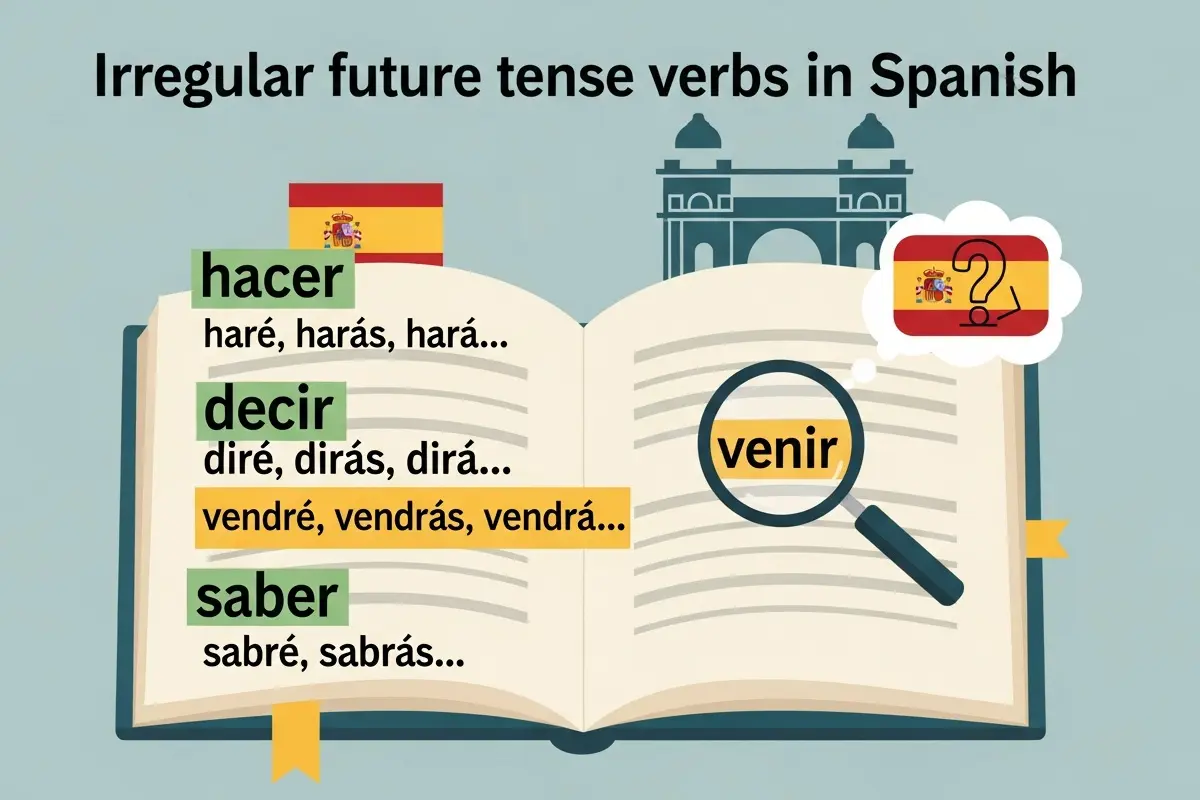
- There are 12 key irregular future tense verbs in Spanish.
- Instead of adding endings to the original verb, their stem changes before conjugation.
- These verbs fall into three predictable pattern groups.
- You only need to remember the pattern — not memorize 12 unrelated forms.
Table of Contents
Open Table of Contents
- What Are Irregular Future Tense Verbs in Spanish?
- How Many Irregular Future Tense Verbs Are There?
- The 12 Irregular Future Tense Verbs in Spanish
- Why Do These Verbs Become Irregular?
- The Three Patterns You Should Learn
- How to Practice These Verbs
- Quick Comparison: Regular vs Irregular
- Common Mistakes to Avoid
- Internal Learning Connections
- FAQ
- ❓ Are all irregular future tense verbs also irregular in the conditional?
- ❓ Is the future tense common in spoken Spanish?
- ❓ Which irregular future tense verb is the most used?
- ❓ When should I use ir + a + infinitive instead of the simple future?
- ❓ Why do irregular future tense verbs exist?
- ❓ Are any -ar verbs irregular in the simple future?
- ❓ Do irregular future tense verbs change accent placement?
- ❓ What’s the fastest way to memorize irregular future tense verbs?
- ❓ Are irregular future tense verbs required for DELE or AP Spanish exams?
- ❓ Can the future tense be used to express probability?
- Final Takeaway
What Are Irregular Future Tense Verbs in Spanish?
Irregular future tense verbs in Spanish are verbs whose stems change before adding the regular future endings (-é, -ás, -á, -emos, -éis, -án).
All future tense verbs — regular or irregular — use the same endings:
| Subject | Ending |
|---|---|
| yo | -é |
| tú | -ás |
| él/ella/usted | -á |
| nosotros | -emos |
| vosotros | -éis |
| ellos/ustedes | -án |
Reference grammars and overviews of Spanish verbs agree that the simple future is formed by adding these endings directly to the infinitive, and that irregular verbs change only the stem while keeping the endings the same. See the future tense explanation on Wikipedia:
Spanish verbs – Future (futuro simple)
These irregular stems are historical: they preserve older, shorter forms that survived through frequent use, while the regular pattern developed around them.
How Many Irregular Future Tense Verbs Are There?
There are twelve commonly taught irregular future tense verbs in Spanish — and all belong to -er or -ir groups.
✔ No -ar verbs are irregular in the future tense.
Standard grammar references and educational tables consistently list these same twelve verbs with irregular future stems.
Spanish irregular verbs – Future and conditional
The 12 Irregular Future Tense Verbs in Spanish
| Verb (Infinitive) | Meaning | Irregular Stem | Example (Yo) |
|---|---|---|---|
| decir | to say/tell | dir- | diré |
| hacer | to do/make | har- | haré |
| poder | to be able to | podr- | podré |
| querer | to want/love | querr- | querré |
| saber | to know | sabr- | sabré |
| haber | auxiliary “will have” | habr- | habrá (impersonal) |
| poner | to put/place | pondr- | pondré |
| salir | to go out/leave | saldr- | saldré |
| tener | to have | tendr- | tendré |
| venir | to come | vendr- | vendré |
| valer | to be worth | valdr- | valdré |
| caber | to fit | cabr- | cabré |
These are the verbs you truly need to master for irregular future tense in Spanish.
Why Do These Verbs Become Irregular?
Linguists explain that verbs used most often tend to evolve differently over time.
According to research summarized by language historian Joan Bybee, high-frequency verbs resist regularization and often preserve older, shorter forms, while less frequent verbs follow newer, “regular” patterns more closely.
Frequency of Use and the Organization of Language (Oxford University Press, 2007)
That’s why so many core verbs — tener, venir, poder, hacer, decir — look irregular in the future tense: they’re common, old, and deeply rooted in spoken Spanish.
The Three Patterns You Should Learn
Instead of memorizing 12 verbs individually, you can learn three stem-change patterns.
1️⃣ Verbs That Drop the -e in the Infinitive
These verbs shorten their infinitive before adding future endings.
Examples:
| Verb | Stem | Example Sentence |
|---|---|---|
| poder | podr- | Podré ayudarte mañana. (“I will be able to help you tomorrow.”) |
| saber | sabr- | Sabrás la respuesta pronto. (“You will know the answer soon.”) |
| querer | querr- | ¿Querrás venir conmigo? (“Will you want to come with me?”) |
| caber | cabr- | No cabrá en la maleta. (“It won’t fit in the suitcase.”) |
| haber | habr- | Habrá una fiesta esta noche. (“There will be a party tonight.”) |
Takeaway: Drop the -e, then add the usual future endings.
2️⃣ Verbs That Replace -e / -i With -d
These are rhythmic simplifications to make pronunciation smoother.
| Verb | Stem | Example Sentence |
|---|---|---|
| tener | tendr- | Tendré tiempo mañana. — “I will have time tomorrow.” |
| venir | vendr- | Vendrán más tarde. — “They will come later.” |
| salir | saldr- | Saldremos temprano. — “We will leave early.” |
| poner | pondr- | ¿Pondrás la mesa? — “Will you set the table?” |
| valer | valdr- | Valdrá la pena. — “It will be worth it.” |
Takeaway: Change the middle vowel to -d- and then add endings.
3️⃣ Verbs That Drop -ec / -ce
Only two verbs follow this pattern:
| Verb | Stem | Example Sentence |
|---|---|---|
| decir | dir- | Te diré la verdad. — “I will tell you the truth.” |
| hacer | har- | Haré mi tarea luego. — “I will do my homework later.” |
Takeaway: Cut out the -ec/-ac part and attach the future endings to the shortened stem.
How to Practice These Verbs
Here’s a quick exercise:
Fill in the correct irregular future tense form:
- Yo ______ (salir) temprano.
- ¿Qué ______ (hacer) mañana?
- Ellos ______ (venir) contigo.
- Tú ______ (saber) la verdad pronto.
A good way to check yourself is to say each form out loud and listen for the stem change + regular ending pattern.
Quick Comparison: Regular vs Irregular
| Type | Example Verb | Future Form | Pattern |
|---|---|---|---|
| Regular | hablar → hablaré | infinitive + future ending | no stem change |
| Irregular | tener → tendré | modified stem + ending | tendr- + é |
Key idea: Irregular future verbs in Spanish are only irregular in the stem, not in the endings.
Common Mistakes to Avoid
❌ Using the present tense when expressing distant plans.
✔ Use the future tense properly:
- Voy mañana → immediate or very near future (correct)
- Iré el próximo año → future plan (correct)
❌ Forgetting to change the stem.
✔ Think: stem first, endings second (e.g., tendr- + é → tendré).
Internal Learning Connections
If you’re learning irregular future tense verbs in Spanish, the next logical step is to connect them with other essential grammar topics. These posts build the foundation you need for fluency and help reinforce patterns across all verb tenses:
- 📌 Conjugation for Future Tense in Spanish
- 🔤 Spanish Verb Conjugation Chart: Complete Beginner Guide
- 👥 Spanish Pronoun Chart: A Complete Guide
- 🧠 Master Present Tense Spanish Easily with Charts & Tips
- ⏳ Past Tense Conjugation Spanish: Complete Guide
- 🧩 Tenses in Spanish Chart: Full Guide with Examples
- 🧪 Mastering the Present Perfect Tense in Spanish
- 🧱 Spanish Sentence Structure: A Simple Beginner Guide
- 🎨 Spanish Adjectives: Complete Guide with Rules & Examples
Together, these resources help you build a strong mental map of Spanish grammar—from sentence structure to verb tenses—so using the future tense feels intuitive rather than memorized.
FAQ
❓ Are all irregular future tense verbs also irregular in the conditional?
✔ Yes — the same stems are used for both tenses.
Example:
futuro: tendré → condicional: tendría
Once you learn the stems, you unlock two tenses at once.
❓ Is the future tense common in spoken Spanish?
In many regions, especially across Latin America, the “ir + a + infinitive” form is more common in everyday conversation.
Example:
Voy a comer. (I’m going to eat.)
However, the simple future appears frequently in written Spanish, news headlines, and formal speech, so it’s still essential to master.
❓ Which irregular future tense verb is the most used?
“Haber” (habrá) is extremely frequent because it’s used to say there will be:
- Habrá lluvia mañana. (There will be rain tomorrow.)
- Habrá más oportunidades. (There will be more opportunities.)
❓ When should I use ir + a + infinitive instead of the simple future?
A simple rule helps: • Use ir + a + infinitive for planned or near events. → Voy a viajar mañana. (I’m going to travel tomorrow.) • Use the simple future for predictions, promises, or uncertain future events. → Viajaré algún día a España. (I will travel to Spain someday.)
❓ Why do irregular future tense verbs exist?
Linguists explain that the most common verbs tend to evolve differently over time.
High-frequency verbs undergo phonetic simplification, leading to shorter stems like har-, dir-, or podr- because they are faster to pronounce.
❓ Are any -ar verbs irregular in the simple future?
❌ No — only verbs from the -er and -ir groups become irregular.
All -ar verbs follow the regular future tense structure.
❓ Do irregular future tense verbs change accent placement?
No — the accent marks stay consistent across all regular and irregular future tense conjugations: • yo → -é • tú → -ás • él/ella/usted → -á • nosotros → -emos • vosotros → -éis • ellos/ustedes → -án
Only the stem changes — the endings remain regular.
❓ What’s the fastest way to memorize irregular future tense verbs?
Learners find success with: • Pattern grouping (learn the 3 stem patterns) • Flashcards with audio • Color-coding stems and endings • Repeating complete sentences instead of isolated forms
Example drill: Tendré → tendrás → tendrá → tendremos → tendrán
❓ Are irregular future tense verbs required for DELE or AP Spanish exams?
✔ Yes.
These verbs appear in grammar tasks, short essays, fill-in-the-blank questions, and reading comprehension sections.
Mastering the stems helps with: • simple future • conditional • formal writing • academic Spanish
❓ Can the future tense be used to express probability?
✔ Yes — Spanish uses the future tense to express speculation or uncertainty in the present.
Example: ¿Dónde estará Juan? → Where might Juan be?
Even though it looks like a future tense form, the meaning expresses a guess about now.
Final Takeaway
Irregular future tense verbs in Spanish look intimidating at first, but they follow three clear stem-change patterns. If you focus on those stems — instead of memorizing every form as if it were random — speaking about the future becomes much easier and more natural.