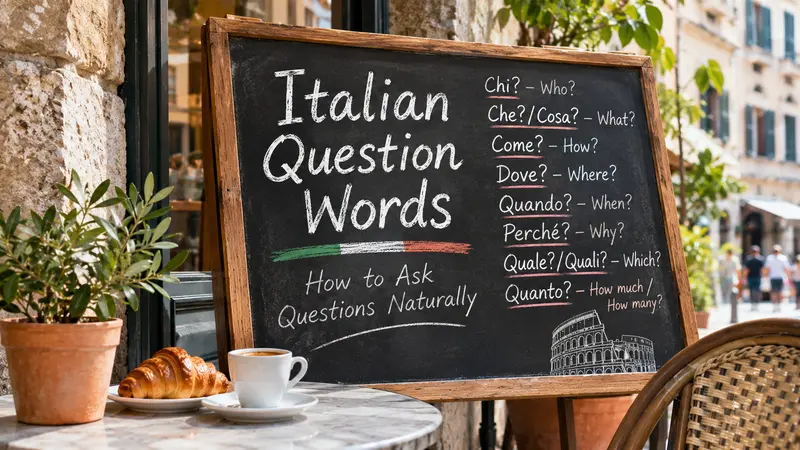
Learning Italian question words is one of the quickest ways to move from memorizing phrases to having real conversations.
Once you know how to ask who, what, where, when, why, and how, you can do much more than introduce yourself. You can ask for directions, order food, make plans, and understand what someone wants to know.
The good news is that Italian questions are often simpler to build than English questions. You usually do not need extra helping verbs such as do or does.
This guide explains the most useful Italian question words, how they work in natural sentences, and the small grammar differences that beginners should learn early.
TL;DR: Italian question words at a glance
| Italian | English | Example |
|---|---|---|
| Chi | Who | Chi sei? |
| Che cosa / Cosa | What | Cosa fai? |
| Che | What / Which | Che libro leggi? |
| Come | How | Come stai? |
| Dove | Where | Dove abiti? |
| Quando | When | Quando parti? |
| Perché | Why | Perché studi italiano? |
| Quale / Quali | Which / What | Quale preferisci? |
| Quanto / Quanta | How much | Quanto costa? |
| Quanti / Quante | How many | Quante persone vengono? |
The most important distinction is between asking about a person, a thing, a place, a time, a reason, or a quantity.
Start with that distinction rather than trying to memorize every possible sentence.
Table of Contents
Open Table of Contents
- How do you form questions in Italian?
- 1. Chi: Who
- 2. Che cosa, cosa, and che: What
- 3. Come: How
- 4. Dove: Where
- 5. Quando: When
- 6. Perché: Why
- 7. Quale and quali: Which or what
- 8. Quanto, quanta, quanti, and quante
- 9. Asking questions with prepositions
- 10. Real-life Italian questions you can use immediately
- Common mistakes with Italian question words
- Practice: Choose the correct Italian question word
- How to practice Italian questions naturally
- FAQ: Italian question words
- What are the main question words in Italian?
- What is the difference between cosa and che cosa?
- What is the difference between che and quale?
- How do you ask where someone is from in Italian?
- Why does perché have an accent?
- Is it qual è or qual’è?
- How do you ask someone’s age in Italian?
- Do Italian questions need different word order?
- Final thoughts
How do you form questions in Italian?
Italian generally does not use an English-style do/does construction.
Compare:
English: Where do you live?
Italian: Dove abiti?
The Italian sentence uses the question word followed by the verb. There is no separate equivalent of do.
Another example:
English: What do you want?
Italian: Che cosa vuoi?
You can also ask yes-or-no questions without a question word:
- Parli italiano? — Do you speak Italian?
- Hai fame? — Are you hungry?
- Sei pronto? — Are you ready?
In speech, intonation helps signal the question. In writing, use a question mark.
Italian also frequently omits subject pronouns because the verb form already identifies the subject.
For example, Dove lavori? is a complete question without adding tu.
If you are still learning the difference between important verbs such as essere and avere, see our essere vs avere guide.
1. Chi: Who
Use chi when asking about a person or people.
| Italian question | English |
|---|---|
| Chi sei? | Who are you? |
| Chi è? | Who is it? |
| Chi viene con noi? | Who is coming with us? |
| Chi ha chiamato? | Who called? |
| Con chi vai? | Who are you going with? |
Chi does not change for masculine, feminine, singular, or plural.
For example:
- Chi è quella donna? — Who is that woman?
- Chi sono quelle persone? — Who are those people?
Notice that the verb changes according to the sentence, but chi remains the same.
Asking who someone is
A natural conversation might be:
A: Chi è Marco?
Who is Marco?
B: È un mio amico.
He’s a friend of mine.
When you need a preposition, it usually comes before chi:
- Con chi? — With whom?
- Per chi? — For whom?
- Di chi? — Whose? / Of whom?
For a broader explanation of these relationships, see Italian prepositions.
2. Che cosa, cosa, and che: What
Italian has several ways to ask what.
The most useful are:
- Che cosa
- Cosa
- Che
All three can be used to ask about things or actions, but they are not interchangeable in every sentence.
Che cosa vs cosa
Consider:
- Che cosa fai? — What are you doing?
- Cosa fai? — What are you doing?
Both are natural Italian.
Che cosa is a complete, widely accepted form. Cosa is especially common in everyday conversation.
You do not need to avoid either one.
More examples:
| Italian | English |
|---|---|
| Che cosa vuoi? | What do you want? |
| Cosa mangi? | What are you eating? |
| Che cosa significa? | What does it mean? |
| Cosa cerchi? | What are you looking for? |
When to use che
Che is particularly useful before a noun.
- Che libro leggi? — What book are you reading?
- Che musica ascolti? — What music do you listen to?
- Che lavoro fai? — What do you do for work?
- Che ora è? — What time is it?
You may also hear Che fai? instead of Che cosa fai?
However, a beginner-friendly rule is:
Use che before a noun, and cosa or che cosa when asking generally about an action or thing.
This is a useful starting pattern, not an absolute grammatical restriction.
3. Come: How
Come asks about a manner, condition, or method.
It appears in some of the most common Italian expressions.
| Italian | English |
|---|---|
| Come stai? | How are you? |
| Come ti chiami? | What’s your name? |
| Come va? | How’s it going? |
| Come funziona? | How does it work? |
| Come si dice in italiano? | How do you say it in Italian? |
Come stai vs come va
Both are useful, but they are not identical.
Come stai? asks how someone is feeling or doing.
Come va? is a broader, casual way to ask how things are going.
A short conversation:
A: Ciao, come va?
Hi, how’s it going?
B: Bene, grazie. E tu?
Good, thanks. And you?
If you want more ways to open conversations, see Greetings in Italy.
Com’è: What is it like?
When come comes before è, the usual written form is com’è.
- Com’è il tempo? — What’s the weather like?
- Com’è il tuo insegnante? — What’s your teacher like?
- Com’è la pizza? — What’s the pizza like?
Do not confuse com’è with come in expressions such as Come stai?
4. Dove: Where
Use dove to ask about locations or destinations.
| Italian | English |
|---|---|
| Dove abiti? | Where do you live? |
| Dove lavori? | Where do you work? |
| Dove vai? | Where are you going? |
| Dove si trova la stazione? | Where is the station? |
| Dove posso comprare un biglietto? | Where can I buy a ticket? |
Dove vs dov’è
Before è, you will commonly see dov’è.
- Dov’è il bagno? — Where is the bathroom?
- Dov’è la farmacia? — Where is the pharmacy?
- Dov’è il mio telefono? — Where is my phone?
These are especially useful when traveling.
Asking for directions
A: Scusi, dov’è la stazione?
Excuse me, where is the station?
B: È vicino alla piazza.
It’s near the square.
Scusi is a polite way to get someone’s attention in a formal or unfamiliar situation.
Notice how dove helps you ask for information immediately, even with a limited vocabulary.
5. Quando: When
Quando asks about time.
You can use it for appointments, travel, plans, and everyday routines.
| Italian | English |
|---|---|
| Quando parti? | When are you leaving? |
| Quando torni? | When are you coming back? |
| Quando inizia il film? | When does the movie start? |
| Quando ci vediamo? | When shall we meet? |
| Quando hai tempo? | When do you have time? |
Quando vs a che ora
These expressions are related, but they ask for different levels of precision.
Quando? asks when something happens generally.
A che ora? specifically asks for the clock time.
Compare:
- Quando parti? — When are you leaving?
- A che ora parti? — What time are you leaving?
Someone might answer the first question with domani (tomorrow) and the second with alle otto (at eight).
To learn how to express clock times correctly, read How to Tell Time in Italian.
6. Perché: Why
Perché asks for a reason.
It is also used to introduce an explanation meaning because.
| Italian | English |
|---|---|
| Perché studi italiano? | Why are you studying Italian? |
| Perché sei qui? | Why are you here? |
| Perché ridi? | Why are you laughing? |
| Perché non vieni? | Why aren’t you coming? |
Perché can mean why or because
This is one of the most useful Italian patterns to learn.
A: Perché studi italiano?
Why are you studying Italian?
B: Perché voglio viaggiare in Italia.
Because I want to travel to Italy.
The same word introduces the question and the explanation.
Perché vs come mai
Come mai is another way to ask why.
Compare:
- Perché sei in ritardo? — Why are you late?
- Come mai sei in ritardo? — How come you’re late?
Come mai can sound more conversational or express curiosity or surprise, depending on the situation and tone.
Both are common.
Remember that perché has an accent on the final é.
7. Quale and quali: Which or what
Use quale when asking someone to identify or choose something.
Its plural form is quali.
| Italian | English |
|---|---|
| Quale preferisci? | Which one do you prefer? |
| Quale libro vuoi? | Which book do you want? |
| Quale lingua studi? | Which language are you studying? |
| Quali film ti piacciono? | Which movies do you like? |
| Quali sono i tuoi preferiti? | Which ones are your favorites? |
Quale does not change for gender
Unlike many Italian adjectives, quale has the same singular form with masculine and feminine nouns.
- Quale libro? — Which book?
- Quale città? — Which city?
For plural nouns, use quali:
- Quali libri? — Which books?
- Quali città? — Which cities?
If adjective agreement is still unfamiliar, our Italian articles guide introduces related gender and number patterns.
Qual è or qual’è?
The standard spelling is:
Qual è?
Not:
Qual’è?
This is because qual is a shortened form of quale, rather than a form created by dropping a vowel through elision.
Examples:
- Qual è il tuo nome? — What’s your name?
- Qual è il problema? — What’s the problem?
- Qual è la tua città preferita? — What’s your favorite city?
This is a small spelling detail worth remembering because the incorrect form appears frequently in beginner writing.
Che vs quale
Both can appear before nouns.
- Che libro leggi? — What book are you reading?
- Quale libro leggi? — Which book are you reading?
Che often asks more generally about the kind or identity of something.
Quale often makes the choice or identification more specific.
The difference is not always strict, and both can be correct in many contexts.
8. Quanto, quanta, quanti, and quante
Use these forms to ask about quantities, amounts, and numbers.
Unlike quale, quanto can change for both gender and number when used with nouns.
| Form | Gender and number | Example |
|---|---|---|
| Quanto | Masculine singular | Quanto tempo hai? |
| Quanta | Feminine singular | Quanta acqua vuoi? |
| Quanti | Masculine plural | Quanti libri hai? |
| Quante | Feminine plural | Quante persone vengono? |
Quanto costa?
One of the most practical questions in Italian is:
Quanto costa? — How much does it cost?
Use it when asking the price of one item.
For multiple items:
Quanto costano? — How much do they cost?
Notice that the verb changes from costa to costano.
Asking how many
Use quanti or quante with plural nouns.
- Quanti anni hai? — How old are you?
- Quanti fratelli hai? — How many brothers do you have?
- Quante sorelle hai? — How many sisters do you have?
- Quante persone ci sono? — How many people are there?
A frequent beginner mistake is using quanto with every noun.
Instead, check the noun’s gender and number when quanto directly modifies it.
When quanto is used as an adverb, as in Quanto costa?, it does not follow that adjective agreement pattern.
9. Asking questions with prepositions
Some Italian questions need a preposition before the question word.
English often places a preposition at the end of a question, but standard Italian commonly places it before the interrogative expression.
Compare:
English: Who are you going with?
Italian: Con chi vai?
Other useful examples:
| Italian | English |
|---|---|
| Di dove sei? | Where are you from? |
| Con chi parli? | Who are you speaking with? |
| Per chi è questo regalo? | Who is this gift for? |
| A che ora partiamo? | What time are we leaving? |
| Da quanto tempo studi italiano? | How long have you been studying Italian? |
| In quale città vivi? | Which city do you live in? |
Do not translate English word order mechanically.
For example, Con chi parli? is the natural structure to learn, rather than trying to place con at the end.
For a more detailed explanation, see Prepositions in Italian.
10. Real-life Italian questions you can use immediately
Knowing a question word is useful. Knowing a complete question is even better.
Here are common situations where beginners can put these expressions to work.
At a café
Customer: Quanto costa un cappuccino?
How much does a cappuccino cost?
Barista: Due euro.
Two euros.
Customer: Dove posso pagare?
Where can I pay?
Barista: Alla cassa.
At the register.
Meeting someone new
A: Come ti chiami?
What’s your name?
B: Mi chiamo Sofia.
My name is Sofia.
A: Di dove sei?
Where are you from?
B: Sono di Firenze.
I’m from Florence.
Making plans
A: Quando ci vediamo?
When shall we meet?
B: Sabato.
Saturday.
A: A che ora?
At what time?
B: Alle sei.
At six.
Asking for help
A: Scusi, dov’è la farmacia?
Excuse me, where is the pharmacy?
B: È vicino alla stazione.
It’s near the station.
A: Come ci arrivo?
How do I get there?
B: Vai sempre dritto.
Go straight ahead.
These short exchanges are more useful for beginners than memorizing question words without context.
Common mistakes with Italian question words
Mistake 1: Adding English-style helping verbs
Incorrect approach:
Trying to translate the English do in Where do you live? as a separate Italian word.
Correct:
Dove abiti?
Italian does not normally need a separate do/does auxiliary for this question.
Mistake 2: Writing qual’è
Incorrect:
Qual’è il tuo nome?
Correct:
Qual è il tuo nome?
Remember that qual è does not take an apostrophe.
Mistake 3: Using quanto with every noun
Incorrect:
Quanto persone ci sono?
Correct:
Quante persone ci sono?
Persone is feminine plural, so quante is required.
Mistake 4: Confusing quando and quanto
These words look similar but mean different things.
- Quando? — When?
- Quanto? — How much?
Compare:
Quando parti? — When are you leaving?
Quanto costa? — How much does it cost?
Mistake 5: Forgetting the accent in perché
Incorrect:
Perche studi italiano?
Correct:
Perché studi italiano?
The written accent is part of the correct spelling.
For help with Italian sound patterns and written accents, see Italian Pronunciation.
Practice: Choose the correct Italian question word
Complete each question using the most suitable word.
- ______ ti chiami?
- ______ abiti?
- ______ studi italiano?
- ______ costa questo libro?
- ______ anni hai?
- ______ è quella persona?
- ______ parti per Roma?
- ______ persone vengono alla festa?
- ______ è il tuo colore preferito?
- ______ fai domani?
Answers
| Number | Answer | Complete question |
|---|---|---|
| 1 | Come | Come ti chiami? |
| 2 | Dove | Dove abiti? |
| 3 | Perché | Perché studi italiano? |
| 4 | Quanto | Quanto costa questo libro? |
| 5 | Quanti | Quanti anni hai? |
| 6 | Chi | Chi è quella persona? |
| 7 | Quando | Quando parti per Roma? |
| 8 | Quante | Quante persone vengono alla festa? |
| 9 | Qual | Qual è il tuo colore preferito? |
| 10 | Cosa | Cosa fai domani? |
For number 10, Che cosa fai domani? is also correct.
How to practice Italian questions naturally
Instead of learning each question word as an isolated translation, try a short daily routine.
First: Choose three question words
For example:
- Dove
- Quando
- Come
Second: Build one question with each
- Dove lavori?
- Quando torni?
- Come stai?
Third: Answer your own questions
- Lavoro a Milano.
- Torno domani.
- Sto bene.
Fourth: Change one detail
Turn Dove lavori? into Dove studi?
Turn Quando torni? into Quando parti?
This helps you recognize how the question structure works instead of memorizing each sentence as an unrelated phrase.
Fifth: Practice aloud
Read the question, pause, and answer without looking at the translation.
For pronunciation practice, use short, natural Italian sentences. Listening and repeating complete questions helps you connect the written words to real spoken Italian.
FAQ: Italian question words
What are the main question words in Italian?
The main Italian question words are chi, che, che cosa, cosa, come, dove, quando, perché, quale, and quanto, along with their relevant plural or gender forms.
What is the difference between cosa and che cosa?
Both can mean what. Cosa is especially common in everyday speech, while che cosa is a complete and widely accepted alternative. In many questions, both are natural.
What is the difference between che and quale?
Both can modify nouns. Che is common in general questions, while quale often emphasizes identifying or choosing a particular item. Their meanings overlap in many contexts.
How do you ask where someone is from in Italian?
A common question is Di dove sei?, meaning Where are you from?
You can answer with Sono di Roma, meaning I’m from Rome.
Why does perché have an accent?
Perché is written with an accented final vowel. The accent marks the stressed ending and is required in standard spelling.
Is it qual è or qual’è?
The correct standard spelling is qual è, without an apostrophe.
How do you ask someone’s age in Italian?
Say Quanti anni hai?
The literal structure refers to how many years someone has, using the verb avere.
Do Italian questions need different word order?
Not always. Italian often forms questions without the auxiliary verbs used in English. Question words commonly appear near the beginning, while intonation and context help identify the sentence as a question.
Final thoughts
Italian question words are small, but they open the door to real communication.
With chi, you can ask about people. With dove, you can find places. With quando, you can make plans. And with come and perché, you can move beyond simple answers into more meaningful conversations.
You do not need to memorize every possible Italian question immediately.
Start with the expressions you are most likely to use, practice them in short exchanges, and pay attention to the differences between che, quale, and quanto.
The goal is not simply to recognize Italian question words on a page. It is to feel comfortable using them when you actually need an answer.