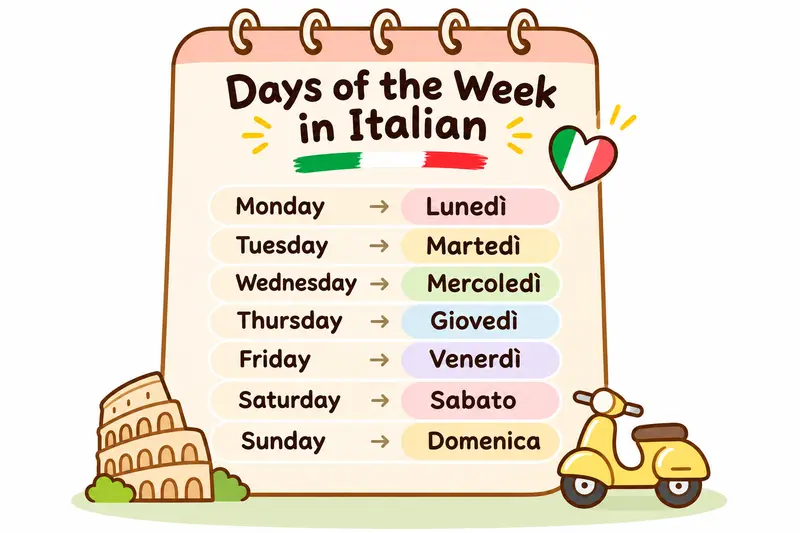
Learning the days of the week in Italian is a small but essential step toward everyday conversation. Whether you’re arranging a meeting, booking a restaurant, or talking about your weekly routine, you’ll use these seven words constantly.
The names are easy to memorize, but using them naturally takes a little more practice. For example, lunedì can mean Monday, while il lunedì usually means on Mondays when describing a recurring habit.
In this guide, you’ll learn all seven Italian weekdays, how to pronounce them, when to use articles and prepositions, and how to talk about your schedule without translating directly from English.
Days of the week in Italian: Quick reference
| English | Italian | Pronunciation (IPA) |
|---|---|---|
| Monday | lunedì | /luneˈdi/ |
| Tuesday | martedì | /marteˈdi/ |
| Wednesday | mercoledì | /merkoleˈdi/ |
| Thursday | giovedì | /dʒoveˈdi/ |
| Friday | venerdì | /venerˈdi/ |
| Saturday | sabato | /ˈsabato/ |
| Sunday | domenica | /doˈmenika/ |
The Italian week conventionally starts on lunedì (Monday) and ends on domenica (Sunday).
Notice two useful patterns:
- The first five weekday names end in -dì, a form historically connected to the Latin word for day.
- Saturday and Sunday have different endings: sabato and domenica.
The first five names carry stress on the final syllable, while sabato and domenica have stress earlier in the word.
Table of Contents
Open Table of Contents
- How to pronounce the Italian weekdays
- Are Italian weekdays capitalized?
- How to say today, tomorrow, and yesterday in Italian
- Lunedì vs il lunedì: The most important grammar rule
- How to say next Monday and last Friday
- Do you need a preposition before Italian weekdays?
- How to ask what day it is in Italian
- Useful weekday expressions in Italian
- Italian weekdays in real conversations
- Common mistakes with Italian weekdays
- Practice: Italian days of the week
- A simple way to memorize the Italian weekdays
- FAQ: Days of the week in Italian
- What are the seven days of the week in Italian?
- Does the Italian week start on Monday or Sunday?
- Are days of the week masculine or feminine in Italian?
- Do Italian weekdays need capital letters?
- Why do Italian weekdays end in dì?
- How do you say on Mondays in Italian?
- How do you say next Friday in Italian?
- How do you say weekend in Italian?
- How do you ask what day it is today?
- Final thoughts
How to pronounce the Italian weekdays
Italian pronunciation is relatively consistent once you learn its spelling patterns. Listen to each weekday below and repeat it aloud, paying attention to the stressed syllable.
1. Lunedì — Monday
Pronunciation: lu-ne-DÌ
Stress the final syllable.
2. Martedì — Tuesday
Pronunciation: mar-te-DÌ
Stress the final syllable.
3. Mercoledì — Wednesday
Pronunciation: mer-co-le-DÌ
This word has four syllables, with stress on the last one.
4. Giovedì — Thursday
Pronunciation: gio-ve-DÌ
The initial gi has a soft sound, similar to the English j in jump. Stress the final syllable.
5. Venerdì — Friday
Pronunciation: ve-ner-DÌ
Stress the final syllable.
6. Sabato — Saturday
Pronunciation: SÀ-ba-to
Unlike the first five weekdays, sabato is stressed on the first syllable.
7. Domenica — Sunday
Pronunciation: do-MÈ-ni-ca
Stress the second syllable.
Quick pronunciation tip
The first five Italian weekdays end in -dì, with stress on the final syllable. Sabato and domenica follow different stress patterns.
Try listening to all seven words in order, then repeat them without looking at the pronunciation guides. This will help you remember both the weekday names and their natural Italian rhythm.
Why do five weekdays have an accent?
In Italian, words stressed on their final vowel generally require a written accent.
That’s why we write:
- lunedì
- martedì
- mercoledì
- giovedì
- venerdì
The accent is not optional in standard spelling.
Sabato and domenica don’t need a written accent because their stress falls earlier.
If you want to understand Italian stress and letter sounds in more detail, see our Italian pronunciation guide.
Are Italian weekdays capitalized?
Unlike English, Italian normally uses lowercase letters for weekday names.
Correct:
- lunedì
- martedì
- mercoledì
- giovedì
- venerdì
- sabato
- domenica
Incorrect in ordinary sentence context:
- Lunedì
- Martedì
- Mercoledì
Capitalization is appropriate when a weekday begins a sentence or appears in a title that requires it.
Examples:
Oggi è lunedì.
Today is Monday.
Lunedì lavoro da casa.
On Monday, I work from home.
The second example begins with a capital letter because Lunedì is the first word of the sentence.
How to say today, tomorrow, and yesterday in Italian
Before using weekdays in conversation, it’s useful to know a few basic time expressions.
| Italian | English |
|---|---|
| oggi | today |
| domani | tomorrow |
| ieri | yesterday |
| dopodomani | the day after tomorrow |
| l’altro ieri | the day before yesterday |
| questa settimana | this week |
| la prossima settimana | next week |
| la settimana scorsa | last week |
| il fine settimana | the weekend |
Examples:
Oggi è martedì.
Today is Tuesday.
Domani è mercoledì.
Tomorrow is Wednesday.
Ieri era lunedì.
Yesterday was Monday.
Ci vediamo la prossima settimana.
See you next week.
These expressions are useful because they let you discuss time without always naming a specific weekday.
Lunedì vs il lunedì: The most important grammar rule
One of the most common beginner questions is whether Italian weekdays need an article.
The basic distinction is between a particular day and a recurring habit.
Without an article: A particular Monday
When referring to a specific day, Italian commonly uses the weekday without an article.
Lunedì vado a Roma.
I’m going to Rome on Monday.
Martedì ho un appuntamento.
I have an appointment on Tuesday.
Venerdì ci vediamo.
We’ll see each other on Friday.
The exact week is usually understood from context.
With il: Every Monday or on Mondays
When describing something that happens regularly, Italian commonly uses il before a weekday.
Il lunedì lavoro da casa.
I work from home on Mondays.
Il martedì studio italiano.
I study Italian on Tuesdays.
Il venerdì vado in palestra.
I go to the gym on Fridays.
Compare:
| Italian | Meaning |
|---|---|
| Lunedì lavoro. | I’m working on Monday. |
| Il lunedì lavoro. | I work on Mondays. |
| Sabato vado al cinema. | I’m going to the cinema on Saturday. |
| Il sabato vado al cinema. | I go to the cinema on Saturdays. |
This distinction is especially useful when discussing work schedules, classes, and weekly routines.
What about Sunday?
Domenica is feminine, so recurring Sundays normally use la, not il.
La domenica riposo.
I rest on Sundays.
La domenica pranzo con la famiglia.
I have lunch with my family on Sundays.
For recurring activities, remember:
- il lunedì through il sabato
- la domenica
To learn more about grammatical gender and definite articles, read our Italian articles guide.
How to say next Monday and last Friday
English speakers often want to translate expressions such as next Monday or last Friday.
Italian has several natural ways to express these ideas.
Next Monday
Lunedì prossimo
Next Monday
Example:
Ci vediamo lunedì prossimo.
See you next Monday.
Last Friday
Venerdì scorso
Last Friday
Example:
Ho lavorato venerdì scorso.
I worked last Friday.
Next Sunday
Domenica prossima
Next Sunday
Last Sunday
Domenica scorsa
Last Sunday
Notice that prossimo and scorso agree with the weekday’s gender.
| Italian | English |
|---|---|
| lunedì prossimo | next Monday |
| martedì scorso | last Tuesday |
| sabato prossimo | next Saturday |
| domenica prossima | next Sunday |
| domenica scorsa | last Sunday |
A helpful pattern is:
Weekday + prossimo/prossima
or
Weekday + scorso/scorsa
Be aware that expressions like next Monday can be ambiguous in both languages, depending on the day you’re speaking. If the exact date matters, add a calendar date.
Do you need a preposition before Italian weekdays?
English usually says on Monday, but Italian often doesn’t need a preposition.
Correct:
Ci vediamo giovedì.
See you on Thursday.
You don’t need to translate the English word on directly.
When can you use di?
You may encounter di in expressions such as:
Di lunedì lavoro.
On Mondays, I work.
This can describe a habitual schedule, although il lunedì is generally the more straightforward pattern for beginners.
Other useful expressions include:
- di mattina — in the morning
- di sera — in the evening
- di domenica — on Sundays
When can you use a?
The preposition a commonly appears when giving a specific clock time.
Ci vediamo lunedì alle nove.
See you Monday at nine.
Here, alle nove means at nine o’clock.
For a detailed explanation of Italian clock-time expressions, see How to Tell Time in Italian.
How to ask what day it is in Italian
Two particularly useful questions are:
Che giorno è oggi?
What day is it today?
Che giorno è domani?
What day is it tomorrow?
Possible answers:
Oggi è mercoledì.
Today is Wednesday.
Domani è giovedì.
Tomorrow is Thursday.
Asking about a particular event
Che giorno è la riunione?
What day is the meeting?
Quando è il tuo appuntamento?
When is your appointment?
In che giorno cade Natale quest’anno?
What day does Christmas fall on this year?
These questions combine weekday vocabulary with Italian question structures.
You can learn more in our Italian question words guide.
Useful weekday expressions in Italian
Knowing the weekday names is only the beginning.
Here are practical expressions you’ll encounter in conversations, opening hours, and schedules.
| Italian | English |
|---|---|
| dal lunedì al venerdì | from Monday to Friday |
| da lunedì a venerdì | from Monday to Friday |
| tutti i giorni | every day |
| ogni lunedì | every Monday |
| ogni domenica | every Sunday |
| nei giorni feriali | on weekdays / working days |
| nel fine settimana | on the weekend |
| durante la settimana | during the week |
| all’inizio della settimana | at the beginning of the week |
| alla fine della settimana | at the end of the week |
Ogni lunedì vs il lunedì
Both expressions can describe a recurring activity.
Ogni lunedì studio italiano.
Every Monday I study Italian.
Il lunedì studio italiano.
I study Italian on Mondays.
Both are natural.
However, ogni is followed directly by the singular weekday without an article.
Correct:
Ogni venerdì
Not:
Ogni il venerdì
Italian weekdays in real conversations
Let’s look at how these words appear in situations that travelers and beginners actually encounter.
Conversation 1: Making plans with a friend
A: Quando sei libero?
When are you free?
B: Sono libero venerdì.
I’m free on Friday.
A: Ci vediamo venerdì sera?
Shall we meet Friday evening?
B: Va bene. A che ora?
Sounds good. At what time?
A: Alle otto.
At eight.
Conversation 2: Asking about opening hours
A: Siete aperti la domenica?
Are you open on Sundays?
B: No, siamo chiusi la domenica.
No, we’re closed on Sundays.
A: E il sabato?
And Saturdays?
B: Il sabato siamo aperti fino alle sei.
On Saturdays, we’re open until six.
Notice the recurring use of la domenica and il sabato.
Conversation 3: Booking an appointment
A: Vorrei prenotare un appuntamento.
I’d like to book an appointment.
B: Per quale giorno?
For which day?
A: Per martedì prossimo, se possibile.
For next Tuesday, if possible.
B: Va bene. Alle dieci?
All right. At ten?
A: Perfetto, grazie.
Perfect, thank you.
Conversation 4: Talking about a weekly routine
A: Quando studi italiano?
When do you study Italian?
B: Studio italiano il lunedì e il mercoledì.
I study Italian on Mondays and Wednesdays.
A: E nel fine settimana?
And on weekends?
B: La domenica ripasso quello che ho imparato.
On Sundays, I review what I’ve learned.
These conversations show how weekday vocabulary becomes useful when combined with question words, verbs, and time expressions.
Common mistakes with Italian weekdays
Mistake 1: Capitalizing every weekday
Incorrect:
Oggi è Lunedì.
Correct:
Oggi è lunedì.
Italian normally uses lowercase weekday names.
Mistake 2: Forgetting the accent
Incorrect:
martedi
Correct:
martedì
The accent is required for the first five weekday names.
Mistake 3: Using il with domenica
Incorrect:
Il domenica riposo.
Correct:
La domenica riposo.
Domenica is feminine.
Mistake 4: Adding a preposition unnecessarily
Unnatural for the intended meaning:
Ci vediamo a lunedì.
Natural:
Ci vediamo lunedì.
See you Monday.
Mistake 5: Confusing a single day with a recurring routine
Sabato lavoro.
I’m working on Saturday.
Il sabato lavoro.
I work on Saturdays.
The article can change the meaning of the sentence.
Mistake 6: Using prossimo without agreement
Incorrect:
Domenica prossimo
Correct:
Domenica prossima
Because domenica is feminine, the adjective must agree.
Practice: Italian days of the week
Test your understanding before checking the answers.
Exercise 1: Translate the weekdays
Translate these words into Italian.
- Monday
- Thursday
- Sunday
- Wednesday
- Saturday
- Friday
- Tuesday
Exercise 2: Choose the correct form
Complete each sentence.
- Oggi è ______. (Monday)
- ______ domenica vado a trovare i nonni. (Every Sunday)
- Ci vediamo martedì ______. (next)
- Il negozio è chiuso ______ domenica. (on Sundays)
- ______ lunedì lavoro da casa. (on Mondays)
- Ho un appuntamento venerdì ______. (last)
Exercise 3: Understand the difference
What is the difference between these sentences?
A: Lunedì studio italiano.
B: Il lunedì studio italiano.
Think about whether the speaker means one specific Monday or a recurring habit.
Answers
Exercise 1
- lunedì
- giovedì
- domenica
- mercoledì
- sabato
- venerdì
- martedì
Exercise 2
- lunedì
- Ogni
- prossimo
- la
- Il
- scorso
Exercise 3
Sentence A generally refers to studying Italian on a particular Monday.
Sentence B describes a recurring Monday routine.
A simple way to memorize the Italian weekdays
Try this five-minute routine.
Minute 1: Read all seven weekday names aloud.
Minute 2: Say them in order without looking.
Minute 3: Practice the five words ending in -dì, paying attention to final stress.
Minute 4: Create three sentences about your own schedule.
For example:
- Lunedì lavoro.
- Mercoledì studio italiano.
- La domenica riposo.
Minute 5: Ask and answer two questions.
- Che giorno è oggi?
- Quando sei libero?
Repeating the names is helpful, but using them in meaningful sentences makes them easier to remember.
FAQ: Days of the week in Italian
What are the seven days of the week in Italian?
They are lunedì, martedì, mercoledì, giovedì, venerdì, sabato, and domenica.
Does the Italian week start on Monday or Sunday?
In standard Italian calendars and everyday scheduling, the week generally starts on Monday (lunedì).
Are days of the week masculine or feminine in Italian?
Lunedì, martedì, mercoledì, giovedì, venerdì, and sabato are masculine. Domenica is feminine.
This matters when using articles and adjectives.
Do Italian weekdays need capital letters?
Normally, no. Italian weekday names are lowercase unless they begin a sentence or appear in a context that requires capitalization.
Why do Italian weekdays end in dì?
The first five weekday names contain dì, a historical word meaning day, derived from Latin dies.
How do you say on Mondays in Italian?
Say il lunedì.
For Sundays, use la domenica.
You can also say ogni lunedì for every Monday.
How do you say next Friday in Italian?
Say venerdì prossimo.
For next Sunday, say domenica prossima.
How do you say weekend in Italian?
The traditional Italian expression is fine settimana.
The English loanword weekend is also widely used in contemporary Italian.
How do you ask what day it is today?
Say Che giorno è oggi?
A possible answer is Oggi è venerdì.
Final thoughts
The seven Italian weekdays are simple vocabulary, but they introduce several important grammar patterns.
Remember that the first five names end in -dì and carry final stress. Most weekdays are masculine, while domenica is feminine. And when you add il or la, you can turn a reference to a particular day into a recurring weekly routine.
The most useful next step is to talk about your actual schedule.
Practice saying when you work, study, travel, or meet friends. That way, the days of the week become part of your everyday Italian rather than just another list to memorize.