TL;DR
- Katakana is mainly used for foreign language loanwords
- Foreign words are reshaped into Japanese pronunciation patterns
- Watch for long vowels (ー), small ッ, and small ャュョ
- Practice real katakana words to read menus, brands, and technology terms fast
Learn Katakana in 7 Days
Follow the structured daily plan with reading drills, pronunciation practice, and writing exercises.
Go to the main guide →Foreign Words in Katakana: The Simple Pattern You’ll See Everywhere
If you have learned hiragana, katakana will feel familiar—but foreign words add a twist.
スマートフォン
コンピューター
ホテル
インターネット
These are English words written in katakana, reshaped to match Japanese pronunciation rules.
Once you understand the patterns, katakana words stop feeling random.
1) Why foreign words are written in katakana
Katakana is used for:
- Foreign loanwords (外来語)
- Modern technology terms
- Brand names
- Scientific vocabulary
- Onomatopoeia and emphasis
The Japanese language prefers simple syllables like:
- ア イ ウ エ オ
- カ キ ク ケ コ
Japanese does not allow complex consonant clusters like str or bl.
So foreign words are broken into katakana characters that fit Japanese rhythm.
2) The core logic: Japanese reshapes foreign sounds
Japanese pronunciation follows a consonant + vowel structure.
Example:
| English | Katakana | Japanese sound rhythm |
|---|---|---|
| coffee | コーヒー | ko-o-hi-i |
| computer | コンピューター | kon-pyu-u-ta-a |
| taxi | タクシー | ta-ku-shi-i |
👉 Japanese copies sound rhythm, not English spelling.
3) The 4 spelling patterns you’ll see everywhere
These explain 90% of foreign words written in katakana.
✅ Pattern 1: Break English into Japanese syllables
Japanese inserts vowels to avoid consonant clusters.
| English | Katakana | Breakdown |
|---|---|---|
| hotel | ホテル | ho-te-ru |
| glass | グラス | gu-ra-su |
| strike | ストライク | su-to-ra-i-ku |
Rule: If English is hard to pronounce, Japanese adds vowels.
✅ Pattern 2: Long vowels (ー) for stretched sounds
The long vowel mark ー extends the previous vowel sound.
| English | Katakana | Sound |
|---|---|---|
| table | テーブル | tē-bu-ru |
| coffee | コーヒー | kō-hī |
| taxi | タクシー | ta-ku-shī |
Tip: Hold the vowel one extra beat.
This is critical for japanese pronunciation accuracy.
✅ Pattern 3: Small ッ for double consonants (the stop)
Small ッ means a pause before the next consonant.
| English | Katakana |
|---|---|
| bed | ベッド |
| match | マッチ |
| good | グッド |
Say it like: gu → stop → do.
✅ Pattern 4: Small ャュョ and foreign sound kana
Japanese uses special combinations to mimic foreign sounds.
| Sound | Katakana |
|---|---|
| fa | ファ |
| fi | フィ |
| fo | フォ |
| ti | ティ |
| di | ディ |
| wi | ウィ |
| we | ウェ |
| リュ | リュ (ryu glide sound) |
Examples:
- file → ファイル
- team → チーム
- web → ウェブ
👉 These are one beat, not separate sounds.
4) Practice list: high-frequency katakana foreign words
Use this list to train reading and writing.
🌍 Everyday foreign words
- ホテル (hotel)
- レストラン (restaurant)
- インターネット (internet)
- スマートフォン (smartphone)
- コンピューター (computer)
☕ Food and lifestyle
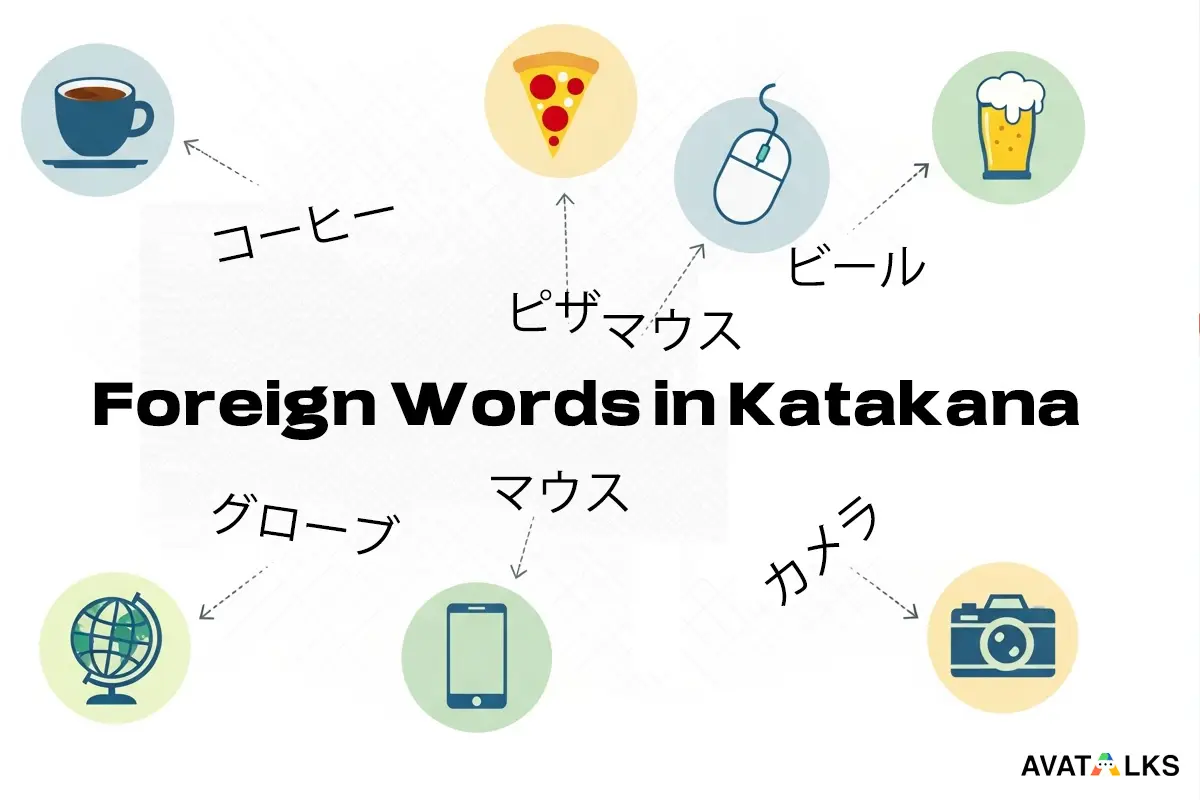
- コーヒー (coffee)
- ケーキ (cake)
- チーズ (cheese)
- ハンバーガー (hamburger)
- ピザ (pizza)
💻 Tech and modern life
- メール (email)
- アプリ (app)
- サイト (site)
- ダウンロード (download)
- パスワード (password)
🎯 Pattern drills for pronunciation
Long vowels
- コーラ
- ケーキ
- スポーツ
- ターゲット
Small ッ
- ベッド
- マッチ
- グッド
Small ャュョ
- キャッチ
- シャツ
- チョコ
5) How to practice katakana foreign words fast
Step 1: Split into kana beats
Example:
コンピューター
→ コン / ピュー / ター
Step 2: Listen → shadow → repeat
- Listen without reading
- Shadow audio
- Repeat 10 times
Step 3: Write while speaking
Write each word 5 times and say it aloud.
This connects sound, writing, and memory.
How English Sounds Change in Katakana (What Japanese Really Hears)
Many learners think katakana is just English written with Japanese letters.
In reality, katakana words are filtered through Japanese pronunciation rules.
This is why Japanese words can sound very different from the original foreign language.
English consonants become Japanese consonant–vowel sounds
The Japanese language does not allow most consonants to stand alone.
So foreign words are reshaped using katakana characters with vowels added.
For example:
| English sound | Katakana | Why |
|---|---|---|
| b | ブ (bu) | Japanese needs a vowel |
| d | ド (do) | No standalone “d” |
| t | ト (to) | Consonants must attach to vowels |
| l / r | ラ リ ル レ ロ | Japanese merges L and R sounds |
So “glass” becomes:
- glass → グラス (gu-ra-su)
English stress becomes Japanese rhythm
English uses stress accents (strong vs weak syllables).
Japanese uses timing-based rhythm, where each kana has equal length.
Example:
- English: COM-pu-ter
- Japanese: コン・ピュー・ター (even timing)
This is why katakana words sound robotic or evenly spaced.
👉 Katakana pronunciation focuses on timing, not stress.
Vowel sounds are simplified
English has many vowel sounds.
Japanese has only five core vowels:
- ア (a)
- イ (i)
- ウ (u)
- エ (e)
- オ (o)
So foreign vowel sounds get mapped to the closest Japanese vowel sound.
| English vowel | Japanese vowel |
|---|---|
| æ (cat) | ア |
| ɪ (bit) | イ |
| ʌ (cut) | ア |
| ʊ (book) | ウ |
This is why “bus” becomes バス (ba-su).
Common Mistakes When Reading Foreign Words in Katakana
Even advanced learners make these mistakes.
❌ Mistake 1: Ignoring vowel length (ー)
Many learners read:
- コーラ as kora instead of kōra
In Japanese pronunciation, long vowel length changes meaning.
Example:
- ビル (biru) = building
- ビール (bīru) = beer
One dash changes the word.
❌ Mistake 2: Skipping the small ッ pause
Small ッ is not optional.
- ベッド (beddo) must have a stop
- マッチ (macchi) must have a pause
If you skip it, Japanese listeners hear a different word.
❌ Mistake 3: Reading katakana too literally from English
Katakana is Japanese phonetics, not English spelling.
Example:
- “McDonald’s” → マクドナルド
- “YouTube” → ユーチューブ
You must follow Japanese sound rules, not English spelling.
How to Predict Katakana Spelling (Even for New Words)
Once you learn the patterns, you can guess katakana words you’ve never seen before.
Step 1: Break the English word into sounds
Example: Bluetooth
→ blue + tooth
Step 2: Convert sounds into Japanese syllables
blue → ブルー
tooth → トゥース
Final: ブルートゥース
Step 3: Apply katakana patterns automatically
- Long vowel → add ー
- Double consonant → small ッ
- Foreign consonant combos → small ャュョ or small vowels
This is how native speakers mentally process foreign words written in katakana.
Why Learning Katakana Foreign Words Feels Easy After Hiragana
If you already learned hiragana, katakana feels easier because:
- Sounds are the same
- Only the writing system changes
- Japanese pronunciation rules stay identical
The main difference is katakana is used for modern and foreign words.
So once you know katakana characters, you can read:
- menus
- technology terms
- brand names
- scientific vocabulary
This gives you instant reading power in Japanese.
Mini Drill: Practice Japanese Pronunciation with Loanwords
Try reading these out loud:
- アメリカ (America)
- ロンドン (London)
- パリ (Paris)
- ニューヨーク (New York)
- オーストラリア (Australia)
Focus on:
- vowel sound length
- rhythm
- small ュ sounds (like ニュ)
Pro Tip: Katakana Is Your Fastest Vocabulary Hack
More than 30% of modern Japanese vocabulary comes from foreign language sources.
Many katakana words are almost identical to English.
Once you master the patterns, you can guess meanings instantly.
Katakana is not just writing practice—it’s vocabulary acceleration.
CTA: Practice katakana foreign words now
👉 Open the katakana practice tool
Break each word into kana and drill pronunciation + writing.
Want the full roadmap?
👉 Learn Katakana in 7 Days →
FAQ: Katakana foreign words
Why do foreign words sound different in Japanese?
Japanese phonetics only allows certain syllables, so sounds are adapted.
Is katakana pronunciation the same as English?
No. Katakana approximates English using Japanese sound rules.
Do I need to memorize all loanwords?
No. Learn the patterns, and you can read thousands automatically.
Final Tip
Foreign words written in katakana follow predictable rules.
Once you recognize:
- syllable splitting
- long vowels (ー)
- small ッ stops
- small ャュョ glides
👉 Katakana words become readable instantly.
Keep practicing real words—not isolated characters—and your Japanese language reading speed will explode.