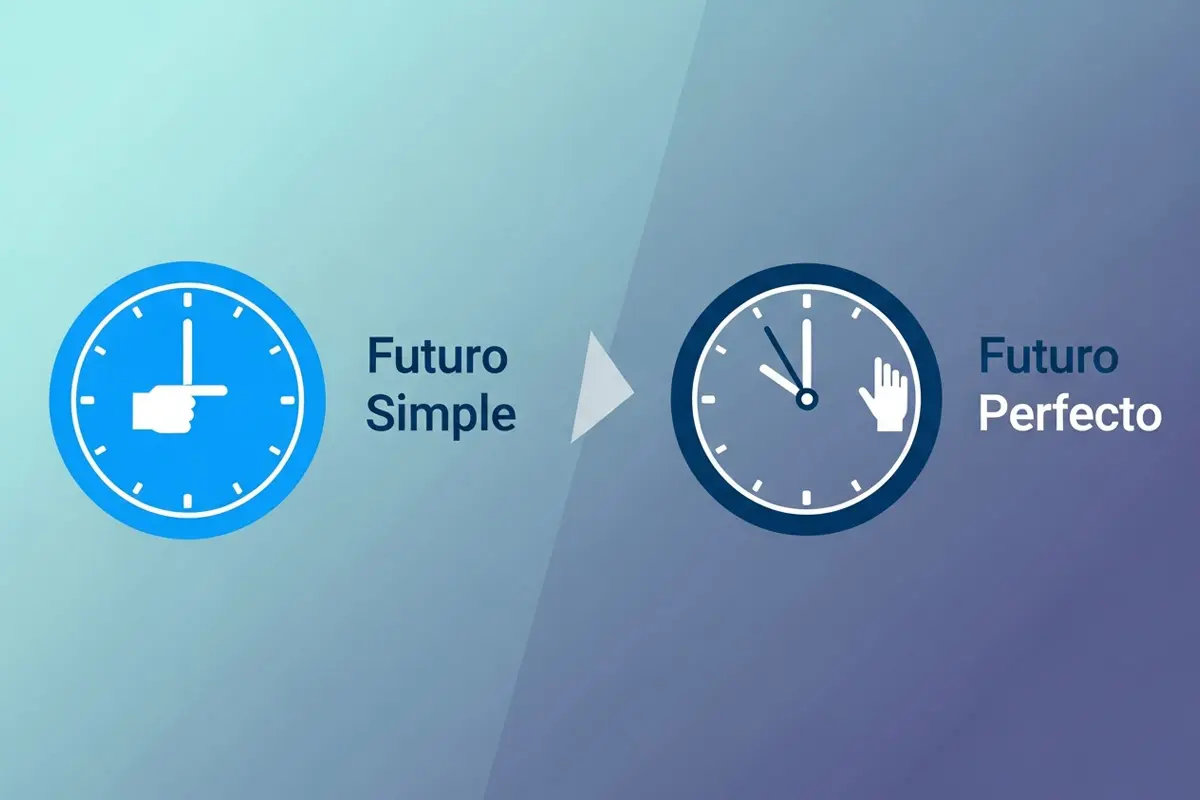
If the difference between the Spanish simple future and the future perfect still feels blurry, the real problem usually is not conjugation.
It is perspective.
Both tenses talk about the future, but they do not look at the future in the same way.
One answers:
- What will happen?
The other answers:
- What will already be finished by then?
That is why these two sentences are close, but not the same:
- Terminaré el informe.
- Habré terminado el informe.
Both refer to the future.
But the first one simply says the action will happen.
The second one looks ahead to a future point and then looks backward from there.
That is the key idea this guide will help you master.
TL;DR
Use the simple future when you want to say:
- what will happen
- what you will do
- what you predict
- what you promise
Use the future perfect when you want to say:
- what will already be finished by a future time
- what will have happened before something else
- what has probably already happened by now or by then
Short version:
- simple future = future action
- future perfect = future completion
The quick difference
The difference between the Spanish simple future and the future perfect is not really difficulty.
It is viewpoint.
Simple future
The speaker is looking forward.
- Viajaré mañana.
- I will travel tomorrow.
Future perfect
The speaker imagines a future moment and looks back from it.
- Para mañana, habré viajado.
- By tomorrow, I will have traveled.
So the future perfect always adds one extra layer: a later reference point.
What is the Spanish simple future?
The simple future talks about actions, events, or states that will happen later.
It answers the question:
What will happen?
Examples
-
Viajaré mañana.
I will travel tomorrow. -
Te llamaré luego.
I will call you later. -
Habrá una reunión.
There will be a meeting. -
Estudiaremos esta noche.
We will study tonight.
This tense is useful for:
- plans
- promises
- predictions
- formal statements
- and probability about the present
If you want the bigger future-tense overview, Future Tense Spanish is a good companion topic.
What is the Spanish future perfect?
The future perfect talks about something that will already be completed before a certain future moment.
It answers the question:
What will have happened by then?
Examples
-
Para mañana, habré terminado el informe.
By tomorrow, I will have finished the report. -
Para las ocho, habrán salido.
By eight o’clock, they will have left. -
Dentro de un año, me habré graduado.
In a year, I will have graduated.
This tense is very useful when the sentence includes:
- deadlines
- future milestones
- expected completion
- or future retrospection
That last idea matters.
The future perfect is not just “more future.” It is the future seen from a later point.
How to form the simple future
The simple future is formed with:
infinitive + future endings
Example with hablar
| Subject | Form |
|---|---|
| yo | hablaré |
| tú | hablarás |
| él / ella / usted | hablará |
| nosotros | hablaremos |
| vosotros | hablaréis |
| ellos / ustedes | hablarán |
This structure is the same across regular -ar, -er, and -ir verbs.
More examples
- comeré
- vivirás
- estudiaremos
For a fuller breakdown, Conjugation for Future Tense in Spanish is the direct follow-up.
How to form the future perfect
The future perfect is formed with:
haber in the future + past participle
Example with hablar
| Subject | Form |
|---|---|
| yo | habré hablado |
| tú | habrás hablado |
| él / ella / usted | habrá hablado |
| nosotros | habremos hablado |
| vosotros | habréis hablado |
| ellos / ustedes | habrán hablado |
More examples
- habré comido
- habrás vivido
- habremos terminado
So the future perfect has two parts:
- future haber
- plus the participle
That is why it feels like a “completed future.”
When should you use the simple future?
Use the simple future when the focus is the action itself, not its completion before another moment.
Common uses
1. Predictions
- Lloverá mañana.
- Habrá mucho tráfico.
2. Promises
- Te ayudaré.
- No lo olvidaré.
3. Decisions or intentions
- Lo haré mañana.
- Iremos después.
4. Formal or written future statements
- El evento comenzará a las ocho.
- La reunión terminará a las cinco.
5. Probability about the present
- Estará en casa.
- Serán las diez.
That last one is important because the simple future is not always literal future time.
Sometimes it expresses deduction or uncertainty.
This connects directly to When to Use the Future Tense in Spanish for Probability.
When should you use the future perfect?
Use the future perfect when completion matters more than the action itself.
Common uses
1. Something will be done by a future time
- Para mañana, habré terminado.
- Para el viernes, habremos decidido.
2. Something will have happened before another event
- Cuando llegues, ya habré salido.
- Antes de junio, habrán terminado el proyecto.
3. Probability about the past
- Habrá llegado ya.
- Habrán salido temprano.
This is one of the most interesting uses of the tense.
Just as the simple future can express probability about the present, the future perfect can express probability about something that has already happened.
The most useful contrast
Here is the core contrast learners need to feel.
| Tense | Main idea |
|---|---|
| Simple future | what will happen |
| Future perfect | what will already be finished by then |
Compare
-
Terminaré el trabajo.
I will finish the work. -
Habré terminado el trabajo.
I will have finished the work.
The difference is not grammar for grammar’s sake.
It is a difference in time framing.
Same situation, different perspective
These pairs help make the contrast clearer.
Example 1
-
Viajaré en julio.
I will travel in July. -
Para julio, habré viajado.
By July, I will have traveled.
The first one tells you what will happen.
The second tells you the trip will already be complete before July or by that point.
Example 2
-
Escribiré el informe esta noche.
I will write the report tonight. -
Para mañana, habré escrito el informe.
By tomorrow, I will have written the report.
The second one emphasizes deadline and completion.
Example 3
-
Llegarán pronto.
They will arrive soon. -
Ya habrán llegado.
They have probably already arrived.
This last pair also shows the probability use.
Time markers that often point to the future perfect
Certain expressions strongly suggest the future perfect because they create a future reference point.
Common signals
- para
- para entonces
- para mañana
- para el viernes
- ya
- dentro de
- antes de
Examples
- Para las ocho, habré cocinado.
- Dentro de un mes, habremos terminado.
- Antes de junio, habrá cambiado todo.
When you see this kind of structure, completion is often the real focus.
Can both tenses express probability?
Yes, but not in the same time frame.
Simple future
Used for probability about the present
-
Estará en casa.
He is probably at home. -
Serán las diez.
It is probably ten o’clock.
Future perfect
Used for probability about the past or something already completed
-
Habrá llegado ya.
He has probably arrived already. -
Habrán salido temprano.
They probably left early.
This difference is one of the best reasons to study the two tenses together.
Common learner mistakes
1. Using the future perfect without a reference point
Learners sometimes use it just because it sounds more advanced.
But the future perfect usually needs a reason:
- a deadline
- a completion idea
- or a probable completed action
2. Using the simple future when completion is the real meaning
If the real point is “done by then,” the future perfect is usually better.
3. Forgetting that future perfect needs haber
Wrong:
- terminado mañana
Correct:
- habré terminado mañana
- or more naturally:
- para mañana, habré terminado
4. Treating them as interchangeable
They are related, but they are not the same.
A simple decision rule
If you are unsure which tense to use, ask this:
Are you talking about an action in the future?
Use the simple future.
Are you talking about something that will already be completed by a future point?
Use the future perfect.
That one question solves most confusion.
Quick practice
Choose the most natural tense.
1. By tomorrow, I will have finished the project.
- Para mañana, habré terminado el proyecto.
2. I will finish the project tomorrow.
- Terminaré el proyecto mañana.
3. He is probably already home.
- Habrá llegado a casa ya.
or, depending on the exact meaning, - Ya habrá llegado a casa.
4. There will be a meeting tomorrow.
- Habrá una reunión mañana.
How this connects to the larger tense system
These two tenses make more sense when you stop seeing them as isolated grammar topics.
They are part of a bigger system where Spanish separates:
- present action
- future action
- completed action
- and completed action viewed from another point in time
That is why tense comparison matters so much in Spanish.
If you want the broader future system, Future Tense Spanish is the main cluster page.
And if your main confusion is whether to use the future or the present for future meaning, Future Tense vs Present Tense in Spanish is the best next read.
FAQ
Is the future perfect common in Spanish?
Yes, but less common than the simple future. It appears especially when completion, deadlines, or probability about the past matter.
Can the future perfect replace the simple future?
No. The future perfect always adds the idea of completion before a future point or probable completion in the past.
Is the future perfect similar to English?
Yes. It often matches English patterns like will have finished, which can make the concept easier for English speakers.
Do both tenses use irregular future forms?
Yes. The simple future uses irregular stems with certain verbs, and the future perfect uses future forms of haber.
Which tense should beginners learn first?
The simple future first. Then the future perfect once the idea of future action is already stable.
Final takeaway
The difference between Spanish simple future and future perfect is not about choosing the more advanced tense.
It is about choosing the right time perspective.
Use the simple future when you want to say:
- what will happen
Use the future perfect when you want to say:
- what will already be done by then
Once you can feel that difference, these two tenses stop competing with each other and start working as a clear pair.