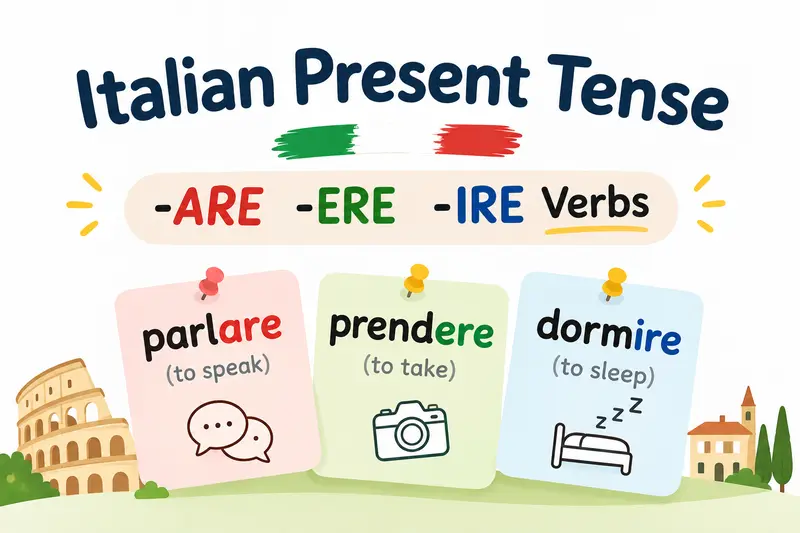
The Italian present tense is one of the most useful grammar skills you can learn as a beginner. With it, you can say what you do every day, describe what is happening now, and talk about plans that are already arranged.
The tricky part is that Italian verbs change their endings depending on who performs the action. English usually says I speak and we speak. Italian says parlo and parliamo.
Fortunately, most regular verbs follow three patterns: -are, -ere, and -ire. Once you recognize those patterns, you can build useful sentences without memorizing every verb from scratch.
Italian present tense: Quick answer
The Italian present tense is called the presente indicativo. For regular verbs, remove the infinitive ending (-are, -ere, or -ire) and add an ending that matches the subject.
| Subject | parlare (to speak) | prendere (to take) | dormire (to sleep) |
|---|---|---|---|
| io | parlo | prendo | dormo |
| tu | parli | prendi | dormi |
| lui / lei | parla | prende | dorme |
| noi | parliamo | prendiamo | dormiamo |
| voi | parlate | prendete | dormite |
| loro | parlano | prendono | dormono |
Three examples:
- Parlo italiano. — I speak Italian.
- Prendiamo un caffè. — We have a coffee.
- Dormono otto ore. — They sleep eight hours.
These are regular patterns, not rules for every verb. Common verbs such as essere, avere, andare, and fare have irregular forms, which we’ll cover below.
Table of Contents
Open Table of Contents
- What does the Italian present tense mean?
- Italian subject pronouns: Io, tu, lui, lei, noi, voi, loro
- 1. Regular -ARE verbs: Parlare, lavorare and mangiare
- 2. Regular -ERE verbs: Prendere, vendere and leggere
- 3. Regular -IRE verbs: Dormire, partire and aprire
- 4. -IRE verbs with -isc-: Capire, finire and preferire
- 5. Five essential irregular verbs in the present tense
- 6. How to make negative sentences
- 7. How to ask questions in the present tense
- 8. Italian present tense in everyday conversations
- 9. Common mistakes beginners make
- Mistake 1: Using the infinitive instead of a conjugated verb
- Mistake 2: Mixing endings from different verb groups
- Mistake 3: Forgetting -isc- where it is needed
- Mistake 4: Applying regular endings to an irregular verb
- Mistake 5: Adding a separate word for English do or does
- Mistake 6: Assuming English -ing always needs a special Italian tense
- 10. Practice: Conjugate Italian present-tense verbs
- A simple five-minute practice routine
- FAQ: Italian present tense
- What are the three regular Italian verb groups?
- How do you conjugate a regular Italian verb?
- What is the difference between dormire and capire?
- Do Italians always say io, tu and noi?
- Can the Italian present tense refer to the future?
- Is the Italian present tense the same as the English present continuous?
- What irregular present-tense verbs should beginners learn first?
- Final thoughts
What does the Italian present tense mean?
Italian uses the present tense in several everyday situations.
Habits and routines
Studio italiano ogni giorno. — I study Italian every day.
Il lunedì lavoro da casa. — I work from home on Mondays.
For more on recurring days, see our days of the week in Italian guide.
Actions happening now
Adesso scrivo un messaggio. — I’m writing a message now.
Italian can use the simple present for something happening right now. The construction stare + gerundio (sto scrivendo) can emphasize an action in progress, but it is not required every time English uses -ing.
General facts and states
Roma è in Italia. — Rome is in Italy.
Ho fame. — I’m hungry.
Near-future plans
Domani parto per Milano. — I’m leaving for Milan tomorrow.
A time expression such as domani makes the future meaning clear. The present tense does not replace the future tense in every context, but it is common for planned events.
Italian subject pronouns: Io, tu, lui, lei, noi, voi, loro
Before learning endings, identify the subject of the sentence.
| Italian | English |
|---|---|
| io | I |
| tu | you (singular, informal) |
| lui | he |
| lei | she |
| noi | we |
| voi | you (plural) |
| loro | they |
Italian also uses Lei as a formal singular you. It takes third-person singular verb forms: Lei parla italiano? — Do you speak Italian?
Why Italians often omit pronouns
The verb ending usually tells you who is speaking or acting.
- Io parlo italiano. — I speak Italian.
- Parlo italiano. — I speak Italian.
Both are correct. The second is often more natural when the subject is already clear. Use a pronoun when you want emphasis or contrast: Io lavoro, ma lui studia. — I work, but he studies.
1. Regular -ARE verbs: Parlare, lavorare and mangiare
Many common Italian verbs end in -are. To conjugate parlare, remove -are to get parl-, then add the appropriate ending.
| Subject | Ending | parlare |
|---|---|---|
| io | -o | parlo |
| tu | -i | parli |
| lui / lei | -a | parla |
| noi | -iamo | parliamo |
| voi | -ate | parlate |
| loro | -ano | parlano |
Useful -ARE examples
Lavoro in un ufficio. — I work in an office.
Mangi spesso la pasta? — Do you often eat pasta?
Parliamo italiano a casa. — We speak Italian at home.
I bambini giocano in giardino. — The children play in the garden.
A spelling detail: Mangiare and cercare
Some -are verbs adjust their spelling to preserve the intended sound.
Mangiare (to eat):
- io mangio
- tu mangi
- lui / lei mangia
- noi mangiamo
- voi mangiate
- loro mangiano
Cercare (to look for) keeps the hard c sound before i by adding h:
- io cerco
- tu cerchi
- lui / lei cerca
- noi cerchiamo
- voi cercate
- loro cercano
The endings still follow the -are pattern; the spelling protects the pronunciation.
2. Regular -ERE verbs: Prendere, vendere and leggere
For a regular -ere verb such as prendere, remove -ere and add these endings:
| Subject | Ending | prendere |
|---|---|---|
| io | -o | prendo |
| tu | -i | prendi |
| lui / lei | -e | prende |
| noi | -iamo | prendiamo |
| voi | -ete | prendete |
| loro | -ono | prendono |
Useful -ERE examples
Prendo il treno alle otto. — I take the train at eight.
Vendete libri italiani? — Do you sell Italian books?
Leggiamo un articolo. — We’re reading an article.
Leggere follows the regular present-tense endings, although its spelling can look less transparent: leggo, leggi, legge, leggiamo, leggete, leggono.
Not every -ere verb is regular. For example, bere (to drink) has the forms bevo, bevi, beve, beviamo, bevete, bevono.
3. Regular -IRE verbs: Dormire, partire and aprire
One group of -ire verbs uses the following endings:
| Subject | Ending | dormire |
|---|---|---|
| io | -o | dormo |
| tu | -i | dormi |
| lui / lei | -e | dorme |
| noi | -iamo | dormiamo |
| voi | -ite | dormite |
| loro | -ono | dormono |
Useful -IRE examples
Dormo bene. — I sleep well.
Partiamo domani mattina. — We’re leaving tomorrow morning.
Apri la finestra? — Can you open the window? / Are you opening the window?
Compare the three regular patterns for voi:
- parlate (-are)
- prendete (-ere)
- dormite (-ire)
This contrast makes the endings easier to remember.
4. -IRE verbs with -isc-: Capire, finire and preferire
Some common -ire verbs add -isc- in four present-tense forms: io, tu, lui/lei, and loro. They do not add it in noi or voi.
| Subject | capire (to understand) | finire (to finish) |
|---|---|---|
| io | capisco | finisco |
| tu | capisci | finisci |
| lui / lei | capisce | finisce |
| noi | capiamo | finiamo |
| voi | capite | finite |
| loro | capiscono | finiscono |
Non capisco. — I don’t understand.
Finisci alle cinque? — Do you finish at five?
Preferisco il tè. — I prefer tea.
How do you know which -IRE verbs use -isc-?
You generally need to learn the pattern with each new verb. Capire, finire, and preferire use -isc-, while dormire, partire, and aprire do not.
A useful vocabulary habit is to record a new -ire verb with its io form: capire → capisco or dormire → dormo. That tells you which pattern to follow.
5. Five essential irregular verbs in the present tense
Some of the most frequent Italian verbs do not follow the three regular patterns. Learn these forms early because they appear constantly in conversation.
| Subject | essere (to be) | avere (to have) | andare (to go) | fare (to do/make) | stare (to stay/be) |
|---|---|---|---|---|---|
| io | sono | ho | vado | faccio | sto |
| tu | sei | hai | vai | fai | stai |
| lui / lei | è | ha | va | fa | sta |
| noi | siamo | abbiamo | andiamo | facciamo | stiamo |
| voi | siete | avete | andate | fate | state |
| loro | sono | hanno | vanno | fanno | stanno |
Irregular verbs in natural sentences
Sono stanco. — I’m tired. (A female speaker says Sono stanca.)
Hai tempo oggi? — Do you have time today?
Andiamo al cinema. — We’re going to the cinema.
Che cosa fai? — What are you doing?
Come stai? — How are you?
Essere and avere deserve special attention because they also serve as auxiliary verbs in compound tenses. We explain their uses in more detail in Essere vs Avere.
6. How to make negative sentences
For a basic negative sentence, put non immediately before the conjugated verb.
| Positive | Negative |
|---|---|
| Parlo italiano. | Non parlo italiano. |
| Capisco. | Non capisco. |
| Abbiamo tempo. | Non abbiamo tempo. |
| Lei lavora oggi. | Lei non lavora oggi. |
Non stays the same regardless of the subject or verb ending.
Non mangiamo carne. — We don’t eat meat.
Non vanno a scuola oggi. — They’re not going to school today.
7. How to ask questions in the present tense
Italian does not normally add an English-style do or does to form questions. A statement can become a yes-or-no question through intonation and punctuation.
Parli italiano. — You speak Italian.
Parli italiano? — Do you speak Italian?
You can also begin with a question word:
- Dove lavori? — Where do you work?
- Quando partite? — When are you leaving?
- Perché studi italiano? — Why do you study Italian?
- Che cosa mangiano? — What are they eating?
See Italian question words for more examples with chi, come, dove, quando, and perché.
8. Italian present tense in everyday conversations
At a café
A: Che cosa prendi?
What are you having?
B: Prendo un cappuccino. E tu?
I’m having a cappuccino. And you?
A: Preferisco un espresso.
I prefer an espresso.
Talking about work
A: Dove lavori?
Where do you work?
B: Lavoro a Milano, ma abito a Como.
I work in Milan, but I live in Como.
A: Prendi il treno ogni giorno?
Do you take the train every day?
B: Sì, parto alle sette.
Yes, I leave at seven.
Making weekend plans
A: Che cosa fate sabato?
What are you doing on Saturday?
B: Andiamo a Roma.
We’re going to Rome.
A: A che ora partite?
What time are you leaving?
B: Partiamo alle nove.
We’re leaving at nine.
Notice how the same present-tense forms describe routines, preferences, and planned activities. You can also combine them with Italian time expressions.
9. Common mistakes beginners make
Mistake 1: Using the infinitive instead of a conjugated verb
Incorrect: Io parlare italiano.
Correct: Io parlo italiano.
Parlare means to speak. Parlo means I speak.
Mistake 2: Mixing endings from different verb groups
Incorrect: Noi prendamo il treno.
Correct: Noi prendiamo il treno.
All three regular groups use -iamo for noi in the present tense.
Mistake 3: Forgetting -isc- where it is needed
Incorrect: Io capo. (when you mean I understand)
Correct: Io capisco.
But remember: noi capiamo, not noi capisciamo.
Mistake 4: Applying regular endings to an irregular verb
Incorrect: Io ando a casa.
Correct: Io vado a casa.
Learn high-frequency irregular verbs as complete patterns.
Mistake 5: Adding a separate word for English do or does
Incorrect approach: Translating Do you speak Italian? word by word.
Correct: Parli italiano?
The verb and intonation already form a natural question.
Mistake 6: Assuming English -ing always needs a special Italian tense
Adesso mangio. can mean I’m eating now.
Sto mangiando. also means I’m eating, with emphasis on the action in progress. Both are possible, depending on context.
10. Practice: Conjugate Italian present-tense verbs
Try these exercises before checking the answers.
Exercise A: Complete the regular verb
- Io ______ italiano. (parlare)
- Tu ______ il treno. (prendere)
- Noi ______ presto. (dormire)
- Voi ______ a Roma. (lavorare)
- Loro ______ domani. (partire)
- Lei ______ la porta. (aprire)
Exercise B: Choose the correct -IRE pattern
- Io non ______. (capire)
- Noi ______ alle sei. (finire)
- Loro ______ la pizza. (preferire)
- Voi ______ tutto? (capire)
Exercise C: Use an irregular verb
- Io ______ italiano. (essere)
- Tu ______ fame? (avere)
- Noi ______ al mercato. (andare)
- Loro ______ sport. (fare)
- Come ______? (stare, tu)
Answers
| Number | Answer | Complete sentence |
|---|---|---|
| 1 | parlo | Io parlo italiano. |
| 2 | prendi | Tu prendi il treno. |
| 3 | dormiamo | Noi dormiamo presto. |
| 4 | lavorate | Voi lavorate a Roma. |
| 5 | partono | Loro partono domani. |
| 6 | apre | Lei apre la porta. |
| 7 | capisco | Io non capisco. |
| 8 | finiamo | Noi finiamo alle sei. |
| 9 | preferiscono | Loro preferiscono la pizza. |
| 10 | capite | Voi capite tutto? |
| 11 | sono | Io sono italiano. |
| 12 | hai | Tu hai fame? |
| 13 | andiamo | Noi andiamo al mercato. |
| 14 | fanno | Loro fanno sport. |
| 15 | stai | Come stai? |
A simple five-minute practice routine
Minute 1: Say the six subject forms of parlare aloud.
Minute 2: Repeat with prendere and dormire. Notice which endings are shared.
Minute 3: Practice capire and remember where -isc- appears.
Minute 4: Make three sentences about your own day, such as Lavoro, Studio italiano, and Prendo un caffè.
Minute 5: Turn two statements into questions and one into a negative sentence.
Short daily practice helps the endings become familiar without requiring you to memorize long lists in a single sitting.
FAQ: Italian present tense
What are the three regular Italian verb groups?
They are -are, -ere, and -ire, named after their infinitive endings. Each group has its own set of present-tense endings.
How do you conjugate a regular Italian verb?
Remove the infinitive ending and add the ending for the subject. For example, parlare → parl- → parlo for io.
What is the difference between dormire and capire?
Both end in -ire, but capire adds -isc- in the io, tu, lui/lei, and loro forms: capisco, capisci, capisce, capiscono. Dormire does not.
Do Italians always say io, tu and noi?
No. Subject pronouns are often omitted because the verb ending identifies the subject. Parliamo italiano already means We speak Italian.
Can the Italian present tense refer to the future?
Yes, especially for plans understood from context: Domani parto means I’m leaving tomorrow. Other future situations may call for the future tense.
Is the Italian present tense the same as the English present continuous?
Not exactly. Italian often uses the simple present where English uses am/is/are + -ing. Italian also has stare + gerundio to highlight an ongoing action.
What irregular present-tense verbs should beginners learn first?
Start with essere, avere, andare, fare, and stare. They are extremely common in everyday speech.
Final thoughts
The Italian present tense becomes easier when you stop treating every conjugated form as a separate word. Learn the three regular patterns, practice the two types of -ire verbs, and gradually add the irregular verbs you use most often.
Start with sentences about your own life: where you live, what you eat, when you work, and what you do on weekends. Those small, familiar sentences will give you a practical foundation for speaking and understanding Italian.