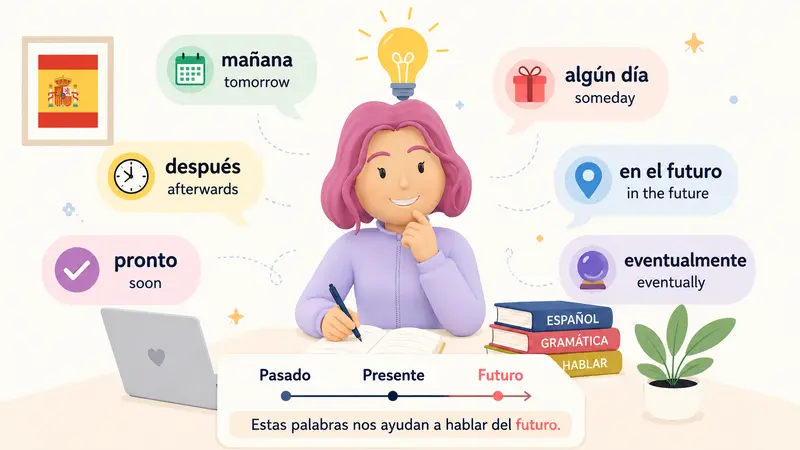
Some Spanish words and phrases make future time very easy to spot:
- mañana
- pasado mañana
- la semana que viene
- el próximo mes
- algún día
If you want a clear list of the most common future trigger words in Spanish, with English meanings and example sentences, you will find it below.
TL;DR
Spanish future trigger words are usually time expressions that point to something happening later.
Some of the most common are:
- mañana
- pasado mañana
- la semana que viene
- el próximo mes
- dentro de…
- pronto
- algún día
- en el futuro
- para mañana
The table below is the main part of this guide, so you can scan quickly and find the expression you need.
Full list of future trigger words in Spanish
| Trigger word or phrase | English meaning | Example sentence |
|---|---|---|
| mañana | tomorrow | Mañana estudio en casa. |
| pasado mañana | the day after tomorrow | Pasado mañana vamos a viajar. |
| esta noche | tonight | Esta noche cenamos fuera. |
| esta tarde | this afternoon | Esta tarde voy a llamar a mi abuela. |
| más tarde | later | Más tarde terminaremos el trabajo. |
| luego | later / afterwards | Luego hablaremos del problema. |
| pronto | soon | Pronto volveré a España. |
| dentro de poco | soon / before long | Dentro de poco empieza la película. |
| en un momento | in a moment | En un momento voy a salir. |
| dentro de una hora | in an hour | Dentro de una hora salimos. |
| dentro de dos días | in two days | Dentro de dos días empieza el curso. |
| dentro de una semana | in a week | Dentro de una semana te escribiré. |
| la semana que viene | next week | La semana que viene empiezo clases. |
| el mes que viene | next month | El mes que viene visitamos a mis primos. |
| el año que viene | next year | El año que viene viviré en Madrid. |
| el próximo lunes | next Monday | El próximo lunes tengo una entrevista. |
| la próxima semana | next week | La próxima semana vamos a estudiar más. |
| el próximo mes | next month | El próximo mes viajarán a Chile. |
| el próximo año | next year | El próximo año buscaré otro trabajo. |
| mañana por la mañana | tomorrow morning | Mañana por la mañana salgo temprano. |
| mañana por la tarde | tomorrow afternoon | Mañana por la tarde vamos al médico. |
| mañana por la noche | tomorrow night | Mañana por la noche cenaré con mi familia. |
| algún día | someday | Algún día viviré cerca del mar. |
| en el futuro | in the future | En el futuro trabajaremos menos horas. |
| más adelante | later on | Más adelante entenderás esta decisión. |
| de aquí a unos años | a few years from now | De aquí a unos años todo cambiará. |
| dentro de unos años | in a few years | Dentro de unos años comprarán una casa. |
| de ahora en adelante | from now on | De ahora en adelante estudiaré todos los días. |
| para mañana | by tomorrow | Para mañana habré terminado el informe. |
| para entonces | by then | Para entonces ya habremos llegado. |
| a esa hora | by that time / at that time | A esa hora ya habrá salido el tren. |
A quick note that matters
These expressions are often called future trigger words, but in Spanish they do not always trigger the same verb form.
For example, Spanish often uses the present tense with a future time expression:
- Mañana voy al cine.
- La semana que viene empiezo clases.
The Cervantes curriculum explicitly includes this kind of future meaning with the present, such as Mañana voy al cine, under beginner grammar. That is why these expressions are better understood as future time markers than as words that force only one tense.
Centro Virtual Cervantes A1–A2 grammar inventory
The most common groups of future trigger words
If you do not want to memorize one long list, this is a simpler way to organize them.
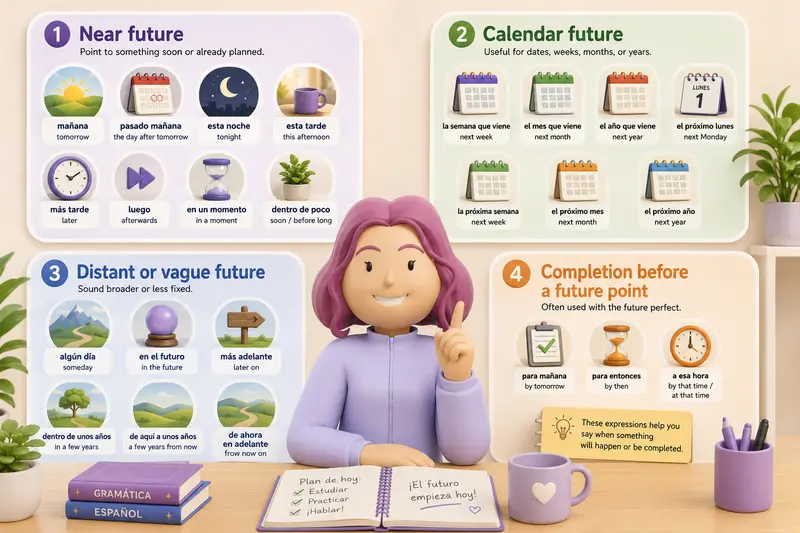
Near future
These often point to something soon or already planned.
- mañana
- pasado mañana
- esta noche
- esta tarde
- más tarde
- pronto
- en un momento
- dentro de poco
Calendar future
These are useful when talking about dates, weeks, months, or years.
- la semana que viene
- el mes que viene
- el año que viene
- el próximo lunes
- la próxima semana
- el próximo mes
- el próximo año
Distant or vague future
These often sound broader or less fixed.
- algún día
- en el futuro
- más adelante
- dentro de unos años
- de aquí a unos años
Completion before a future point
These are especially useful with the future perfect.
- para mañana
- para entonces
- a esa hora
If you want a bigger explanation of why mañana can work with the present tense while expressions like para mañana often point toward the future perfect, see our guides to future tense vs present tense in Spanish and Spanish simple future vs future perfect tense.
Two patterns learners often confuse
1. próximo / próxima
This usually means next.
Examples:
- el próximo lunes
- la próxima semana
- el próximo año
2. que viene
This also often means next.
Examples:
- la semana que viene
- el mes que viene
- el año que viene
Both are common. In many everyday cases, learners can understand them as two natural ways to express “next” with time words.
Do these trigger words always require the simple future?
No.
That is the main thing many learners misunderstand.
Spanish can use future time expressions with:
- the present tense
- ir a + infinitive
- the simple future
- sometimes the future perfect
Present tense
- Mañana estudio en casa.
Ir a + infinitive
- Esta tarde voy a llamar a mi madre.
Simple future
- Algún día viajaré por América Latina.
Future perfect
- Para mañana habré terminado.
The RAE also recognizes future meaning expressed through the present in clear contexts, so this is standard Spanish usage, not just casual speech.
RAE on present tense with future meaning
If you want a full beginner refresher on the future tense itself, our article on future tense Spanish is the best next step.
FAQ
What are future tense trigger words in Spanish?
They are usually words or phrases that show future time, such as mañana, pasado mañana, la semana que viene, and algún día.
Does mañana always use the future tense in Spanish?
No. Spanish often uses mañana with the present tense, especially when the action feels planned or clear.
What does que viene mean in Spanish time expressions?
In phrases like la semana que viene or el mes que viene, it means coming or next.
Is dentro de a future trigger phrase?
Yes. Expressions like dentro de una hora or dentro de dos semanas clearly point to future time.
Which future trigger words often go with the future perfect?
Expressions like para mañana, para entonces, and sometimes a esa hora often work well with the future perfect.
Final thoughts
A lot of these future expressions start to feel easy once you have seen them a few times in real sentences.
The important part is not memorizing a giant rule. It is getting used to the phrases themselves and noticing how Spanish uses them in context.
Start with the most common ones like mañana, la semana que viene, el próximo mes, and algún día. Once those feel familiar, the rest of the list becomes much easier to follow.
Little by little, these trigger words stop feeling like grammar terms and start feeling like normal Spanish.